Wynn Resorts, Limited
Q3 FY2026 · Earnings Call TranscriptNovember 5, 2026
Operator
[unclear] you may disconnect at this time. I will now turn the line over to Craig Fullalove, Chief Financial Officer.
Please go ahead.
Craig Fullalove
Thank you, everybody, and welcome to the Wynn Resorts Q3 earnings call. On the line with us today are Craig Billings and Brian Gullbrants in Las Vegas.
Also on the line are Jenny Holaday, Linda Chen, and Frederic Luvisutto. Please note that we published a presentation to provide more color on the company and recent performance ahead of this call.
You can find the presentation on our Investor Relations website. I want to remind you that we may make forward-looking statements under Safe Harbor federal securities laws, and those statements may or may not come true.
I will now turn the call over to Craig Billings.
Craig Billings
Thanks, Craig. Good afternoon, and as always, thank you for joining us.
This was a complicated quarter with more headwinds than tailwinds. Through all of it, our teams at each property executed very well given what each of them can control.
Here's what we delivered and how we see things going forward. I'm going to start here in Las Vegas.
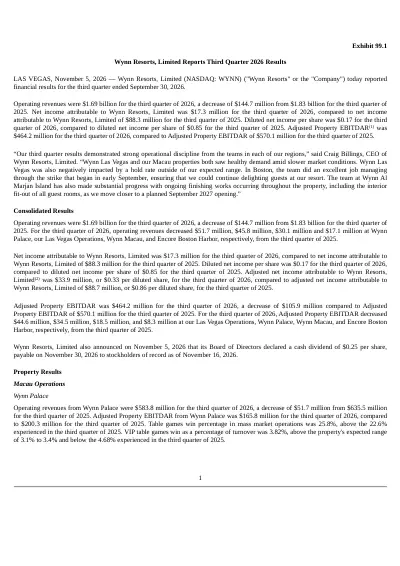
Wynn Las Vegas generated $158.8 million of adjusted property EBITDAR. Unfavorable hold cost us just under $24 million, and the summer market was a headwind.
Against that, the team delivered a 3% increase in both RevPAR and ADR, and retail lease revenues were up 8%. Those are all indicators that the high-end consumer remains healthy.
I'm proud of how the team executed. More recently, October was actually quite strong, with casino drop, ADR, RevPAR, and retail tenant sales all up year-over-year.
In October, we opened the Cliffside Grill, the clubhouse and restaurant on the 18th green of the Wynn Golf Club. XS Nightclub has completed its renovation and reopened.
The Encore tower remodel remains on track for completion in the first half of 2027. As we have mentioned several times now, we expect CapEx in Las Vegas to decline relative to the past several years, with select investments in food and beverage and nightlife in 2027.
Looking ahead, the remainder of the fourth quarter looks quite healthy. As is now often the case, we do particularly well when multiple market drivers overlap, and this quarter has F1, a robust convention calendar, and the NFL season.
F1 weekend is pacing ahead of last year in rate and occupancy, with demand for tickets and rooms still very high. Beyond the fourth quarter, our group and convention business for 2027 has both room nights and rate pacing ahead of where 2026 and 2025 stood at this point.
Turning to Boston, Encore Boston Harbor generated $50.1 million of adjusted property EBITDAR. In Boston, the strike, which kept 1,300 team members out through the whole of September, proved to be a modest headwind.
I'm grateful to our team for keeping the property running to our exacting standards throughout the strike, and I'm pleased to announce that we were recently able to reach a framework for resolution with union leadership that is both fair and economically feasible over the long term. Union leadership has recommended that agreement to its members, and a ratification vote will begin later today.
Moving to Macau, Wynn Macau generated $255.3 million of adjusted property EBITDAR, with VIP hold adding just over $12 million. The quarter was mixed in Macau with a soft September.
While the equity markets often take a more binary view of China and Macau, we don't really focus on whether the market is up 2% or down 2% in a given month. We instead focus on the long-term fundamentals.
China is a large, complex economy that has been doubted many times before and keeps adapting. We're not betting on a straight line; we're betting on that adaptation.
In October, Golden Week drop, handle, and retail sales were in line with last year, and the holiday period then ran longer than usual, though consistent with reported October GGR figures for the market, volumes declined into the end of the month. In the third quarter, we began construction on three previously announced projects in Macau: The Enclave, the theater, and event center.
The theater and event center remain on track to open in 2028, and The Enclave in early 2029, adding 432 suites to Wynn Palace, which already runs occupancy in the high 90s. Finally, Wynn Al Marjan Island.
Construction continues to move quickly, with finishing work underway throughout the property, including the fit-out of all guest rooms. Pre-opening hiring and operations planning are advancing well, and we remain on schedule for a September 2027 opening.
We acknowledge the uncertainty in the region, but as I've said before, we are firm believers in the resilience and adaptability of the UAE. I believe Wynn Al Marjan Island will be the most exciting integrated resort opening globally in over a decade.
Our future remains bright. I'll now hand it over to Craig Fullalove to run through some additional details on the quarter.
Craig?
Craig Fullalove
Thank you, Craig, and good afternoon, everyone. Let me walk you through the financials for the quarter, starting in Las Vegas.
Wynn Las Vegas generated $158.8 million of adjusted property EBITDAR on $575.2 million of operating revenue, for a 27.6% margin. Unfavorable hold was a significant headwind, costing us just under $24 million in the quarter.
On the cost side, OpEx, excluding gaming tax, ran $4.3 million per day, up 0.4% year-on-year. That slight increase is reflective of our continued discipline in managing costs, including FTEs, despite the inclusion of Zero Bond and Sadelle's, which continue to ramp on full staffing levels.
Over to Boston, Encore Boston Harbor delivered $50.1 million of adjusted property EBITDAR on $194.7 million of revenue, for a 25.8% margin. OpEx per day came in at $1.11 million, down 4.4% versus the third quarter of last year, partially reflective of near-term cost reductions related to the ongoing labor strike in that region.
In Macau, the team delivered $255.3 million of adjusted property EBITDAR on $919.2 million of operating revenue, for a 27.8% margin. VIP hold ran above our theoretical expectations this quarter, representing a positive impact of just under $12.3 million.
On costs, OpEx, excluding gaming tax, was approximately $2.9 million per day, up 5% year-on-year and down 60 basis points quarter-over-quarter. Similar to Las Vegas, that year-on-year increase is driven partially by deliberate investments in the premium customer experience with the opening of our Chairman's Club expansion earlier this year, plus normal course cost-of-living adjustments.
On Macau CapEx, as Craig mentioned, we recently began construction on the theater and event center along with The Enclave tower at Wynn Palace. Spend on these projects in 2026 will be limited to some piling and early development works, with funding for these projects coming from free cash flow generation out of Macau.
We continue to expect full-year 2026 expansionary CapEx for Macau to land in the $350 to $400 million range, as shown on page 23 of our investor deck. Turning to the balance sheet, our liquidity position remains excellent: $4 billion of global cash and revolver availability as of September 30th, split roughly $2.5 billion in Macau and $1.5 billion in the U.S.
That strong cash generation gives us the flexibility to keep returning meaningful capital to shareholders on both sides of the Pacific. On the Macau side, the Wynn Macau board approved a 2026 interim dividend of $150 million, up from $125 million in the prior year, which was paid in the third quarter.
We strive to maintain our current practice of capital return via an industry-leading dividend as a means of showing our confidence in the Macau market and will continue to reinvest that dividend level with the board as appropriate. At the Wynn Resorts level, we bought back $58.1 million worth of stock in the quarter.
Additionally, our board has approved a cash dividend of 25 cents per share, payable on November 30th to stockholders of record as of November 16th. In terms of total CapEx for the quarter, we spent approximately $201.6 million, primarily related to the Encore tower and spa remodels, Tower Suites Bar, XS renovations, and construction of the Cliffside Grill in Las Vegas, as well as on some early piling work for the theater, event center, and Enclave projects at Wynn Palace.
This is in addition to normal course maintenance across the business. Separately, we contributed $62.2 million of equity to the Wynn Al Marjan Island project during the quarter, bringing our cumulative contribution to just over $1.12 billion.
We've also continued drawing on the Marjan construction loan, with $1.76 billion drawn to date. On our 2Q call, we increased the expected budget for Wynn Al Marjan Island by $600 million, of which our 40% share equates to approximately $240 million, and now estimate our remaining share of required equity, including the Janu project, at approximately $465 to $590 million.
With that, we'll open the call up to Q&A.
Operator
Thank you. To ask a question, please press star one on your touchtone phone.
Unmute your phone and record your name clearly when prompted. Please limit yourself to one question and one follow-up question.
To withdraw your question, press star two. Our first question will come from Dan Politzer with J.P.
Morgan. Your line is open.
Dan Politzer
Good afternoon, everyone, and thank you for the question. Craig, I think it was helpful that you gave some forward-looking commentary on Las Vegas, especially as we think about 2027.
Do you think that you have the makings and the kind of backdrop for the market is supportive enough to kind of get back to a growth algorithm in Las Vegas, or do you need to see, incremental recovery or kind of strength start to pick up on the leisure side from some of your competitors?
Craig Billings
Thank you for the question. First, I think it's important to kind of talk about, from a high level, what's happening in Vegas.
If you think about it, over the last decade, the city has added pretty significant new demand drivers: the Raiders, the Sphere, F1, expanded and renovated convention center. In a quarter with several of those demand drivers, like the fourth quarter that we're in now, pricing power is very strong, and you can really top-tick EBITDA.
Summer has the fewest drivers of any period of the year. Corporate business is light, there's fewer events, the NFL season hasn't started.
Some quarters have many drivers, and some have few. Even in those quarters with few, we're still well above where we were from an EBITDA perspective five, six years ago.
Our own numbers kind of don't show a consumer issue. RevPAR and ADR are both up, retail lease revenue up, October was strong, which is what you'd expect as those drivers return.
From our perspective, Las Vegas is doing really well, and our pricing power remains very strong. Second, the group and convention business, our longest leading indicator as also looks strong in 2027.
2027 is pacing ahead of where 2026 and 2025 stood at this point. Third, look, we've performed so strongly for so long that we have tough comps.
That's not a comment on demand; it's just a mathematical fact. I don't really think about it as the leisure customer needing to return or come back.
We sit in a very unique position, and I feel great about where we are today, and I feel good about 2027.
Dan Politzer
Got it. Thanks.
Then on Macau, just the high-end play, I guess, look, that's the majority of your business anyway, but are you seeing any differences between the high end and the super high end? Just given what you've seen in terms of the tax policy from the government lately, has there been any change in terms of people kind of starting to come back to Macau just within the last few weeks?
Craig Billings
Sure. Look, there's a lot of moving parts in China and Macau at the moment.
Much like you can't pin kind of singular narratives on the U.S. economy, it's hard to pin singular narratives on China and on Macau.
The economy is complex. It's in the midst of change, with regional and industrial variation, just like the U.S.
There were well-understood effects from the World Cup and seasonality in the quarter that we just reported. There are tax policies that you mentioned, but really I wouldn't try to reduce a very complex economy to a single narrative.
I will say, if capital controls were the issue, I don't think we would have seen a Golden Week that looked a lot like 2025.
Dan Politzer
Got it. Thank you so much.
Craig Billings
Sure.
Operator
Thank you. Our next question comes from Shaun Kelley with Bank of America.
Your line is open.
Shaun Kelley
Hi, good afternoon, everybody. Thanks for taking my question.
Just wanted to see if we could touch again on Las Vegas. Craig, the performance there, I think especially on the RevPAR side of the house is, quite notable, with RevPAR up, relative to market.
Just wondering if you could talk a little bit about initiatives or pricing strategy to put in place, because you clearly held serve, really well in what was pretty difficult market conditions. Just looking for a little bit more color on what drove that outperformance.
Craig Billings
Sure. Brian, you want to talk a little bit about rate versus occupancy strategy, how we think about filling the place, etc.?
Brian Gullbrants
Sure. We've gone at length to really model the optimum EBITDA with the balance of rate and occupancy.
This market is always drove occupancy and tanked rate to fill that occupancy in need periods like the summer. We saw, based on what we put together, that that really wasn't the right model for us, especially where we operate in the market in the segment within the market.
We drove the right level of occupancy and ADR to maximize EBITDA for us. That was really also based on the group business that we laid as a base, and that the team continues to close business for our future in the base business so that we can yield correctly.
We manage segment by segment to make sure that we fill the right guests, the right place, the right time.
Craig Billings
I think you could look at our rates over F1 and get a pretty good sense for where we're pricing relative to others in the market. We continue to invest in the joint.
We continue to focus on service excellence every single day. We manage the place very, very nimbly and very, very aggressively, and were able to pick that up in rate.
We're proud of that.
Brian Gullbrants
F1's right now pacing ahead of '24 and '25 in both rate and occupancy revenue as well as on the casino side, the team is doing a great job getting ahead of it and looking good as we look forward.
Shaun Kelley
Glad to hear it. Then maybe just as a quick follow-up on Macau.
Any color you could provide more on sort of the financial or accounting implications of the subscription agreement? I know it was sort of something that was followed along in there and it applies to every operator in the market, but if we could just get a little bit more color on how it works for Wynn, that'd be helpful.
Craig Billings
Sure. Let me start, and then I'm going to hand it to Craig Fullalove to talk through the accounting.
To put this subscription agreement in context, we have $2.6 billion in commitments, concession-related commitments. You can put them kind of three buckets: CapEx, OpEx, and this fund.
Now we'll always have a preference for CapEx. It's additive to the amenities of the property.
It drives foot traffic for all the obvious reasons. We have a pretty locked and loaded CapEx plan, a substantial locked and loaded CapEx plan that satisfies a giant chunk of that $2.6 billion.
OpEx and the subscription agreement commitment that you reference, they're more fungible. Craig will talk about the accounting, but those commitments that we're making go on the balance sheet as opposed to OpEx, which is obviously better for EBITDA.
From our perspective, we kind of don't mind it, maybe the way to say it. Craig, do you want to talk a little bit about the accounting?
Craig Fullalove
From an accounting standpoint, to Craig's earlier point, the benefit of the fund is that it ultimately will sit on balance sheet as opposed to with an OpEx, so that's obviously better from an EBITDA standpoint. We're working through the accounting of it at the moment, but at the end of the day, we're comfortable that it'll sit on balance sheet, and ultimately, for us, we think that's better than it funding through operating expenses.
Shaun Kelley
Thank you.
Craig Billings
Got it.
Operator
Thank you. Our next question comes from Lizzie Dove with Goldman Sachs.
Your line is open.
Lizzie Dove
Hey, thanks for taking the question. You gave some really reassuring commentary about October kind of across the board, and particularly on Vegas, really.
I was hoping you could kind of pull out the kind of leisure from those statements, to the extent that you have seen that recovery as you've got kind of more into the event-driven cycle, as you mentioned, and if you feel like that leisure demand has found a bottom over the summer.
Craig Billings
Lizzie, thank you for the question. I guess what I would say, and then I'll ask Brian to provide his thoughts, is it doesn't really make sense for us to pull out the leisure demand, because the whole point of us being able to top-tick rate is to drive the group base and then drive leisure pricing on the back of that.
I think my point on the fourth quarter was that when you have the combination of group, you have the combination of these market events, when you have the combination of all of these things, you obviously have the opportunity to really push rate, really push occupancy if you so choose, and really take advantage of every lever. For us, we're not really going to pull kind of leisure out specifically and say are we getting the right leisure rate.
We're getting the right leisure rate because it's clearing the market, if you know what I mean.
Lizzie Dove
Yep.
Craig Billings
Brian, would you add anything?
Brian Gullbrants
I'd say the demand drivers actually apply to every segment of our base. Not just on the group side, F1's a good example where group rate is extremely strong, leisure and transient are doing very, very well, top of the market, and we're getting more than our fair share, at least our fair share, I believe, of casino from what it looks like right now.
I'd also add that one of the indicators we look at to look at the leisure transient segments are really retail sales or luxury retail sales that we have here, and not only did we pick up in Q3, but in October, for us, we had another high-end increase, which we thought was relatively healthy for this high end of the market. It continues to roll.
We feel good about it, and the indicators are still positive for us.
Lizzie Dove
Got it. Great.
Then just as one follow-up, so, as you mentioned, and Shaun asked about, you've seen some of the best hotel performance that we've seen across the board, and really strong RevPAR. I guess I'm wondering how do we kind of reconcile that versus kind of table drop being down year-on-year?
Is it a different type of customer that you kind of saw coming to Vegas, or I don't know if there was something with the renovations in the base that impacted occupancy or RevPAR at all, but just curious of the kind of dichotomy there.
Craig Billings
Sure. It's a good question.
Look, there's really two two components to my response here. One is pretty technical.
The first is one or two players can swing your drop pretty significantly in our business. That's just the nature of what we do.
I don't kind of look at month-to-month drop numbers and sweat it all that much. You're looking for broad, longer-term trends, and are we winning overall?
I would also point you to market share when Nevada releases their numbers, and our market share remains very, very healthy, particularly relative to pre-COVID. The second thing is there is a relationship between low hold and drop.
Again, it's a little bit technical, but the way that a player plays, a player will take a marker, they'll hit the table, they'll draw on that marker, and if they're winning, they have the ability to repay that marker, and that never goes into drop. Again, it's more accounting nuance than it is anything else, but all of those things can affect the drop numbers.
In a quarter where one or two players that love us that didn't show up in this quarter and we had unusual winners where they're repaying markers at the rim, we call it, and therefore that doesn't end up in drop, you can see swings in drop.
Operator
Does that conclude your question, Lizzie?
Lizzie Dove
Yes, I was on mute. Thanks.
Operator
Thank you. Our next question comes from John DeCree with CBRE.
Your line is open.
John DeCree
Hi, everyone. Thank you.
Maybe to shift gears to the Middle East. I know, Craig, you gave us a little bit of commentary in your prepared remarks about Marjan, but as we think about maybe towards opening next year, I was wondering if you could give us a little bit more detail on some kind of milestones over the next kind of nine or 10 months as you kind of approach target opening date, some things we should be watching for from your end as things get completed.
Craig Billings
Sure. We're handing over the building to operations in zones, and we'll actually start handing over the initial zones in the building just after the new year.
That means they've been fit out. They're ready for occupancy by the operations team.
They can start putting in their FF&E, etc., etc. We'll start that early in the new year.
Fit-out is, as I mentioned in my prepared remarks, well underway. Hiring of the team is well underway.
That handover will continue through July. The ops team will have full control in late July.
That provides more than ample time for training and readiness for opening. Then we'll open in September '27.
The vast majority of hiring will occur in kind of the three-month period. I shouldn't say hiring.
We will hire before that, but onboarding of employees will happen in the three-month period leading up to opening. You obviously want to balance between training and minimizing pre-opening expense and cash out the door, so that'll happen in the three months leading up to opening.
We'll open the doors, and we're excited to do so. Not all of that is super evident to outsiders, because it's all happening there within the building and in and around the building.
Of course, we're happy to update you on each of our calls over the course of the next several quarters.
John DeCree
Oh, that's great, Craig. Thank you.
Maybe to stick with the development theme, but thinking further out, obviously, big project to complete in the UAE, but what's your latest thinking on other potential opportunities internationally, or even in the U.S., I guess post elections on Tuesday, and there's some talk that maybe something like Texas might come up as an opportunity in the future? I guess international, U.S.
development for Wynn, is there anything that would kind of meet your parameters or you'd look for over the next couple of years strategically?
Craig Billings
Wait, there was an election? No, I'm just kidding.
Look, the whole landscape changed. It is pretty fascinating.
The way I would say it is this: If the UAE opens as we believe it will open, and, of course, the election had an impact on the likely trajectory of the conflict in the region as well, which is great. If it opens the way that we believe it'll open, then we have a land bank there, and we should think about how we're going to use that land bank because there's significant returns to be earned there.
Across the street, we have started to doodle and think about across the street here in Vegas and what relationship that property might have to our existing assets, and how we might be able to build, probably at a lower all-in dollar cost than a freestanding integrated resort, by leveraging its relationship to Wynn and Encore. We've started to think about that.
Elsewhere in the U.S., look, Texas is an outlier. Texas is a fascinating market that is very large today.
As we've talked about I think on prior calls, much of that business makes its way across the border into Oklahoma and ends up in nothing that gets publicly reported, really. It's kind of a stealth market that is giant, and so of course we would consider opportunities there.
I think our brand has resonance there. We have a great database from Texas here in Las Vegas.
Beyond that, regional gaming in the U.S., it's tough. The number of kind of high-growth markets, the risk of online gaming and potential cannibalization from online gaming, we're very thoughtful about how we would deploy capital elsewhere in the U.S.
John DeCree
Understood. That's helpful, Craig.
Thank you for all that color.
Craig Billings
Sure.
Operator
Thank you. Our next question comes from Robin Farley with UBS.
Your line is open.
Robin Farley
Great. Thanks.
Just circling back to Al Marjan for a moment. If we were kind of looking at different milestones, when would rooms go on sale for the September opening if things were sort of ideally, when would we look for that?
Then also on Al Marjan, can you remind us, are all of the costs locked in at this point in terms of the property build? Thanks.
Craig Billings
Sure. On the second question, the costs are substantially locked in.
Look, there's still a conflict going on, so that's real, and we have to pay attention to that, but a giant chunk of the costs have been bought out. In terms of when rooms will go on sale, actually quite soon.
Stay tuned.
Robin Farley
Okay. Great.
Thank you.
Craig Billings
Sure.
Operator
Thank you. Our next question comes from Brandt Montour with Barclays.
Your line is open.
Brandt Montour
Hi, everyone. Two quick ones for Las Vegas.
Can you remind us what portion of casino revenue or drop or whatever metric you want to give is from Far East play at this point? Are you seeing any spillover from the dynamics that we're seeing over in Macau and greater mainland China?
Then the second question is, if you could give us a little bit of a sense on how December's group calendar is shaping up. That part of the quarter is always a little bit different based on sort of leisure mix.
Any color on that would be helpful, too. Thank you.
Craig Billings
Sure. I'll cover the first one, and I'll ask Brian to talk a little bit about group mix throughout the quarter.
On the Far East side, we don't disclose relative splits. What I would say is that the quote-unquote Far East customer here in Las Vegas tends to be a little bit different than in Asia, and that's definitely been the case over the course of say the past five or six years.
They tend to be folks that have established positions either here in the U.S., Canada, in some cases Taiwan. It's slightly different, I wouldn't expect dynamics to be quite the same between here and Asia.
Brian, any views on anything you want to comment on group in December?
Brian Gullbrants
Yeah. The group mix really varies quarter to quarter, month to month, and we range anywhere from 20% to 30% of our business, so that's kind of the norm.
The
Craig Billings
history in December is such that you have some group business in the first
Brian Gullbrants
Solid in the first two weeks.
Craig Billings
Yes.
Brian Gullbrants
Then prior to Christmas and the holidays and post, it's usually pretty quiet.
Craig Billings
Same as every year.
Brian Gullbrants
Yep.
Brandt Montour
Okay. A little bit too early to read into the end of December based on sort of the booking lead time?
Brian Gullbrants
For group, the booking lead time finished months ago. Typically you see group book a year to 18 months out.
You do have some short-term
Craig Billings
He's referring to leisure.
Brian Gullbrants
You do have short-term stuff in group, and leisure, it's a 30-day window.
Craig Billings
December's every year, same story. Multiple levers first two weeks, then very quiet leading into Christmas, and then you make a ton of dough at New Year's.
This year will be no different.
Brandt Montour
Understood. Thanks, everyone.
Craig Billings
Sure.
Operator
Thank you. Our next question comes from David Katz with Jefferies.
Your line is open. David, your line is open.
You may need to unmute yourself. Yep.
David Katz
Just getting myself unmuted. Thanks for taking my question.
I wanted to get your latest thoughts, and I know there's been so much water under the bridge since our visit to Al Marjan Island. If we were to get to some lower-intensity version of the conflict, right, I guess what I'm asking is, how do you feel about your underwriting and the details that we talked through, what that property can do?
Craig Billings
Sure. Just as a quick anecdote before I answer, Brian, you were in the UAE two weeks ago,
Brian Gullbrants
yeah,
Craig Billings
right? Two weeks.
You stayed at one of the hotels near our place. It was packed with
Brian Gullbrants
It was full of Russians and Russian families.
Craig Billings
If you think about the market, there's so many different levers. You'll recall when we were there at the analyst day, we talked about kind of multiple zones of customers, right?
The customer that exists in Dubai, the customer that exists in the region, and the customer that exists internationally. All of those are levers, and in each case, I would expect, because we have 1,500 keys, demand exceeds supply.
In one version of a conflict, you are over-indexing to people that are already there. In a more moderate version of a conflict, you're over-indexing to people that are already there plus people that are in the region.
In a conflict resolution scenario, I think you have our original hypotheses that underpinned demand for that building. None of those are inherently worse than the other.
They're just different. Right?
Your midweek trends are different, your weekend trends are different, your pricing on weekends versus your pricing midweek is different, the composition of people in the casino is different. We are opening the only joint for thousands and thousands and thousands of miles.
You have an extremely wealthy local population, many of whom are expats, many of whom are accustomed to gaming and casino visitation. You have certain demographics that have no problem traveling there today.
That was why I opened with the anecdote that Brian answered. We remain pretty, pretty bullish on the opportunity.
It just is different. That's okay.
There's no kind of right or wrong; there's just different.
David Katz
Understood. If I may just pivot back to Vegas, as an issue I've been asking about seemingly incessantly about some of the property around there, is my takeaway, should it be that you're making some progress, and within say a year's time, we could have something more substantive where people like us could put pen to paper on what you're doing?
Craig Billings
Could be a year, could be three years. Did you think I'd take the bait there, David?
I don't know timing. Look, we have a giant capital project that we're trying to get open that is a seriously exciting, we believe high-return project.
That's where we're focused right now. We are in the privileged position of continuing to do all of our own design and development.
It's one of the core assets of this company, and that attention is focused on Wynn Al Marjan right now. As that eases, which is very soon, then we'll figure out what we're going to do next.
David Katz
Okie doke. Thank you.
Craig Billings
Thank you.
Operator
Thank you. Our next question comes from Steve Wieczynski with Stifel.
Your line is open.
Steve Wieczynski
Hey, guys. Good afternoon.
Craig, staying with Vegas and actually trying to get a little more specific into the fourth quarter. Look, you noted there's some positive events happening there in the market, but obviously Encore still under renovation in the fourth quarter.
I think last year you guys held pretty well in the fourth quarter as well, if I remember correctly. I guess what I'm trying to get at is here, I assume it's going to be tough to grow EBITDA in Vegas in the fourth quarter, but am I missing anything or any kind of color in terms of way to help us think about how the fourth quarter could shape up would be super appreciated.
Craig Billings
As we don't guide, I'm not going to comment on fourth quarter expectations specifically. Frankly, the goal of my prepared remarks and the goal of the commentary that we've made thus far on Q4 is actually not to get people all bowled up; it's to tell you exactly kind of what we're seeing.
What we're seeing is good, and it's a quarter that has a whole bunch of different demand drivers. That's when we shine.
I'm not going to compare it to last year. I did make a comment earlier that we have performed so strongly for so long that the comps have gotten very, very tough, and that is an absolute fact.
If you look at absolute performance, we're doing pretty well. That's really all I'll say.
Steve Wieczynski
Okay. I thought I'd take a shot at it, but it didn't work.
Then second question for Boston, and look, obviously positive news coming out about the labor side of things and the union side of things, but it doesn't even sound like that's finalized at this point. Wondering, I don't know if you can answer this or you can't or this not answer it, but any way to think about what OpEx might look like for that property moving forward?
Craig Billings
Here's what I would say. The ratification vote is tonight.
The history of ratification votes by unions is such that agreements are generally ratified because they're socialized ahead of time with key members of key membership. We will have a read for you on the next call.
What I would say is that we are very happy with where we landed.
Steve Wieczynski
Okay. Thanks, Craig.
Craig Billings
We'll turn that into numbers on the next call.
Steve Wieczynski
Okay. Understood.
Appreciate it.
Craig Billings
Sure.
Operator
Thank you. Our next question comes from Barry Jonas with Truist Securities.
Your line is open.
Barry Jonas
Hey, guys. Thanks for taking my questions.
Just following up on Boston, Craig, your Globe op-ed laid out some of the pressures facing the property. Just in that context, maybe help us think about the longer-term earnings power, or if you think we're looking at something diminished on a go-forward basis.
Craig Billings
Thank you for the question. I don't think diminished.
Look, Encore Boston Harbor is one of the largest private investments in the history of the state. Okay?
We invested $2.6 billion and turned a contaminated site where people used to hang their laundry outside across the street and end up with holes in it from all the chemicals flying around, and we turned that into over 3,000 jobs, more than $1.1 billion in tax revenue right since we opened. Yet, we are dealing, as are many of the regional gaming markets in the U.S., we're dealing with this persistent threat of iGaming, and in the case of Massachusetts, historical horse racing, and, frankly, with direct competition even from the lottery there.
It's ridiculous. That isn't sustainable.
Now I do think there's recognition, when you look at state houses, certain state houses around the country, I think there is recognition about the impact of that potential incremental legalization primarily on employment, by the way. Because no responsible operator is essentially just going to eat it all in margin.
I think there is recognition among the savvier legislators about what this means to their constituents, frankly, longer term. I don't see it as a diminished asset by any means.
It's a beautiful asset that churns out a meaningful amount of EBITDA. I think it's just important that we speak up, and we speak up loudly, so that paper cuts don't become night wounds.
That was the genesis of the op-ed.
Barry Jonas
Got it. We're looking forward to hosting our conference there next month.
Maybe just a quick follow-up on John's question on the midterms and new development. I believe in the past Wynn has mentioned Georgia as a market of interest.
Does that interest still hold now that I believe the governor-elect maybe more supportive of gaming? Thank you.
Craig Billings
It does. There's very select markets in the U.S.
that we actually take a look at. Texas is an obvious one, and I would put Georgia in that bucket as well.
Barry Jonas
Thank you.
Operator
Thank you. Our next question comes from James Hardiman with Citi.
Your line is open.
James Hardiman
Hey, good afternoon. Thanks for taking my question.
Going back to Vegas, if we sort of take that $24 million fold adjustment and add that back to the third quarter EBITDA, I get to about a 10% EBITDA decline versus last year. Obviously, that was short of our expectations coming into the quarter.
Maybe how did that land versus your expectations internally? Obviously, you don't give guidance, but curious what, if anything, surprised you.
Obviously, we've been talking a lot about this increased seasonality. I guess I'm trying to figure out if that is now behind us, right, this sort of post-COVID return to whatever seasonal pattern is the end point.
Obviously, it's a little bit of a crystal ball question, but as we're starting to put together our models for next year, regardless of what the full-year EBITDA number is, should we continue to expect sort of this make hay while the sun is shining situation where the periods where you have events, if there's going to be growth, it's going to be there, and we just have to sort of hold on during the summer months and potentially see declines? Just think it would help to get that sort of in models as soon as possible given the sky is falling sort of perspective that the Street has taken to your stock as of late.
Craig Billings
Yes, thank you. Thank you for the question.
I think if we're being intellectually honest, the way that I would answer that is there's the market, and there's our place in it. It's my opinion, look, we don't operate the other businesses on the Strip, I can only work off the market observations that I have.
I think the comments that I made in my prepared remarks hold true. I think it's intuitive.
When you have a bunch of demand drivers, the opportunity to drive rate, the opportunity to drive occupancy, the opportunity to drive gaming revenue are there. I think inherently, and again this is just my opinion, okay, inherently those quarters are going to perform better than quarters that don't.
The summer has the lowest number of demand drivers. It kind of is what it is.
Now our position in the market is, I think it's evidenced in the RevPAR that we turned in this quarter, is a little bit different. We turned in hotel numbers that were up.
We also had rooms out of service, which contributed to forgone EBITDA, you have to realize that as well, with the Encore tower renovation. If you asked me, "Hey, do you think summers now are going to be the lowest quarter of the year?"
I would say yes. The intellectually honest answer, it's happened for two years, and frankly, it always happened in Vegas for eons.
I think that just is what it is. I think mixed up in this narrative about post-COVID new normal is all of the different demand drivers that have been added to the market.
I think to ignore those is a giant mistake. I don't think it's as simple as summer comes along, and that's seasonality, and it is what it is.
You've had a lot of demand drivers added to this market. It's impressive, actually, what this market has been able to do.
We, because of the customer that we serve, tend to benefit from the best customers associated with every single one of those demand drivers. Look, maybe too cerebral of an answer to your question, but that's the way I would think about it.
James Hardiman
That's really good color. Thank you.
Then as we think about Al Marjan, I don't think you've touched on this yet, but going back to the analyst day a year ago, two variables that were certainly really important in terms of your ability to have success there. One was third-party hotel development, and then two was you being the only game in town.
Any sort of update on either of those fronts as we sit here today?
Craig Billings
As far as we are aware, and we keep our ear very, very close to the ground, we will be the only game in town for a substantial period of time. In terms of ancillary hotel development, the conflict certainly has slowed some of the ancillary hotel development.
It's important to remember that when at that analyst day, our perspective was that that was a long-term, mid- to long-term growth driver, and that remains true today. I don't think about that with respect to any given published EBITDA number in years one, two, three, etc.
I think about that over a five- to eight-year arc. All of that development continues to happen.
Some of it was subject to the same supply chain issues that we had, and I can tell you, life on the ground there is totally normal, and investment continues to be made, frankly, all over the Emirates. There is admittedly a delay in some of that development.
It doesn't keep me up at night because, really, I think about this as a 100-year building.
James Hardiman
Very helpful. Thanks, Craig.
Craig Billings
Sure.
Operator
Thank you. Our next question comes from Trey Bowers with Wells Fargo.
Your line is open.
Trey Bowers
Hey, guys. Thanks for the questions.
I guess the first one would be we discussed earlier in the call how some of the election results might result in governments that are state-level governments that are more amenable to casino expansion. I guess the flip side of that is also blue states generally are a little more amenable to tax increases and maybe a little less friendly on the corporate side.
Just curious your thoughts around Nevada, specifically if you see any risk of any kind of state-level gaming tax increase.
Craig Billings
No. Look, for those of you that I've known for some time, I am a student of this industry, right?
I covered this industry all over the world. There are markets where gaming is the tail and everything else is the dog, and those markets tend to abuse the industry and kind of move taxes willy-nilly.
The UK is a prime example of that. Then there are markets where the industry is an really important economic driver and is understood, and government is empathetic to the industry.
I didn't say they cater to the industry; I said empathetic, and that's an important distinction. Nevada is a model for how the state and the industry work together.
I will not be up nights worrying about gaming tax increases here, and, in fact, the outgoing governor, from our perspective, was tremendous. The incoming governor is someone we know well and have great respect for, and I feel very, very comfortable that governance in Nevada remains as sane as it has for 70 years.
Trey Bowers
Great color. Then as a follow-up, just swapping over to Macau, these are a few years away, but wondering if any thoughts around when the event center and the theater are done.
Macau's kind of the inverse of Vegas, that gaming revenues now the minority of your revenue in the market versus it's almost all the revenue in Macau. Do you think that shifts over time, like five years from now could we see a market that there's a much heavier amount of non-gaming revenue?
Thanks so much.
Craig Billings
Sure. I think I have extensive thoughts on this, but I'll try to just turn it into a little capsule.
How do markets adapt and develop? They adapt and develop through capital deployment.
People like us deploy capital, some of it works, some of it doesn't, what works gets replicated, and more people deploy capital in similar fashion. You are absolutely seeing that in Macau.
Right? Capital is getting deployed, some of it's going to work, some of it won't, some of it'll drive non-gaming revenue, some of it won't drive non-gaming revenue.
That's normal, and that's okay. The challenge that Macau has is that they don't have enough hotel rooms.
Right? You have a market that does five times the gaming revenue of the Las Vegas Strip, but has, oh, 30% of the hotel rooms.
How do you sell a room for cash? That's tough.
Long term, Hengqin is a component of that, additional room development is a component of that, perhaps one day the government will actually incentivize room development, which they did not do as part of the last concession renewal. That's really the challenge for the market and diversification of the market.
The demand is absolutely there. You go there, look at the strollers running around the place.
It's there. It's just a question of how you can utilize your rooms.
It's also why The Enclave is such a no-brainer. Right?
We run 99% occupancy. We tack on 432 suites.
That's obvious EBITDA. Anyway, if you ever want to sit down over a beer and get the hour-long version of that diatribe, I'm happy to do that.
Trey Bowers
Sounds great. Thank you.
Operator
Thank you. Our next question comes from Ben Chaiken with Mizuho.
Your line is open.
Ben Chaiken
Hey, thanks. Maybe a two-parter on Al Marjan.
I guess as you begin to prepare for the opening, maybe could you shed some light on the early guest communications to the extent that's occurring, and their reception? Then, as a reference to a prior question, have you pivoted at all in terms of the source markets, and if not, when do you need to make that call?
Thanks.
Craig Billings
Sure. Look, you can think about potential guest communication in three buckets.
Hosts, where we started building our gaming hosting team long ago, and so there's plenty of communication with the players that matter globally, and, in fact, the volume of inbounds that we get in other markets is quite healthy. The second is mass marketing, where we will begin to do mass marketing really leading into the opening, which is designed to create consumer awareness.
The third is database build, which we actually started quite early in the market with advertising, call-to-action advertising, gathering people's contact details, things like that. All of that's underway.
In terms of source market mix, it kind of goes back to a prior question. One of the beauties of this project is we have multiple source markets from which to draw, a lot of them actually.
The receptivity to the UAE ranges from people that live up the street in Dubai who are there already, all the way through to people who might be apprehensive about traveling to the region, probably Western European. We have a lot of options and a lot of levers to pull.
It does impact how we open, to your point, and we will make a decision about the format in which we open, and we'll probably make that decision around February, but we have the playbooks for every single iteration of that today.
Ben Chaiken
Understood. Maybe just a clarification or a follow-up.
You made the comment before that the demand outstrips supply, and I think many of us would agree with that. I guess part of the question I was getting at is understanding you have different source markets, and the whole entirety of the demand does outstrip supply, I didn't know if there was a timing dynamic of how quickly you can tap into each of those different source markets in terms of a lead time, given that this is a moving target.
Craig Billings
I see your question. Look, think about the addressable population of the UAE and the wealth of that population.
If you're looking for the bottom line answer, think about the addressable population there in the UAE, and think about the wealth embedded in a giant chunk of that population, and compare that to the most successful regional casino MSAs in the U.S. From that, you can get the base business that is probably easiest to address.
Then you can move from there to the fly-to markets that are quite easy to activate. Emirates is running what, guys?
85%? 85% of their schedule now anyway.
There will certainly be markets that will take longer to activate, but none of them tragically so, and a giant chunk of the market is immediately actionable. Craig,
Brian Gullbrants
if I can add one. Craig and I were over there.
Everybody knew about the project in Dubai, and they all asked when it was opening.
Craig Billings
The awareness is very, very high.
Brian Gullbrants
It was great.
Ben Chaiken
That's helpful. Thank you.
Operator
Thank you. Our next question comes from Steve Pizzella with Deutsche Bank.
Your line is open.
Steve Pizzella
Hey, good afternoon, and thank you for taking our questions. Craig, I believe you repurchased approximately $60 million of stock in the quarter.
Based on the price-based grid you've discussed in the past, it would seem the shares remain attractive to you at these levels. How are you thinking about the opportunity to be more aggressive with repurchases from here?
Craig Billings
You're right. We do buy on a price-based grid, and we think the stock is undervalued.
We're really kind of going through the highest constriction point in terms of our various other capital commitments. I'm not talking about Macau; Macau is self-funding.
I'm talking primarily about Marjan, Vegas, etc. We're constantly balancing the repurchases and CapEx.
I think you've seen us be a consistent buyer, not a programmatic buyer, but a consistent buyer over the course of the past several years, and we will continue to take advantage when we think the stock is dislocated. Anything you would add, Craig?
Craig Fullalove
No, I think that's right. We've bought back since 2022 over 14% of our shares, and we'll continue to do that when we think the underlying shares are undervalued.
Steve Pizzella
Thank you. Then pivoting back to Las Vegas, OpEx per day came in below or towards the low end of the range talked about last quarter.
Can you talk about what drove the performance, and how we should think about that run rate going forward?
Craig Billings
Nimble management. It's that simple.
Craig, do you have any forward-looking
Craig Fullalove
Going forward, we continue to expect OpEx per day to be in the range of $4.4 to $4.7 million. That depends on volumes and event calendar cadence.
To Craig's earlier point, the team here is doing a phenomenal job in controlling FTEs and managing our OpEx, despite the inclusion of additional amenities earlier in the year like Zero Bond and Sadelle's, which continue to ramp on full staffing levels.
Steve Pizzella
Thank you.
Operator
Thank you. Our last question comes from David Bain with Texas Capital Bank.
Your line is open.
David Bain
Great. Thank you.
I guess, first, I'm hoping to get any thoughts on international to Las Vegas as we move into '27. It looked like there was some July to September capacity in airline passenger positives.
In general, if you could remind us how international margins compare to kind of the domestic database, given length of stay and maybe different gaming velocities.
Craig Billings
Sure. I guess international for us comes in two flavors, right?
International, very high-end gaming play, where things are fine, and then international leisure. The international leisure business for us is relatively small, Brian, in percentage terms?
Brian Gullbrants
What really drove the growth of international visitation to Vegas was World Cup.
Craig Billings
Yeah. In percentage terms, if you think about our business,
Brian Gullbrants
Under 20%, 12%, 15%.
Craig Billings
Right. For us, it's just not that large, and because we're only 4,700 keys and much smaller than some of our competitors, we can backfill those rooms all day.
As the international visitation has been suppressed, look at our RevPAR numbers, and that kind of says it all.
Brian Gullbrants
Europe and Mexico were the big drivers for the summer, and no surprise, with World Cup.
David Bain
That's helpful Western Europe. What?
The rest of my questions have been asked, and I'm not going to reword one. Thank you, guys.
Craig Billings
Got it.
Craig Fullalove
All right, everybody,
Operator
thank you. You are in that
Craig Fullalove
Thank you for joining the Wynn Resorts Q3 earnings call. We appreciate your interest in the company, and the team looks forward to talking to you next quarter.
Craig Billings
Thanks, everybody.
Operator
Thank you. That concludes today's conference.
Thank you for participating. You may now disconnect.