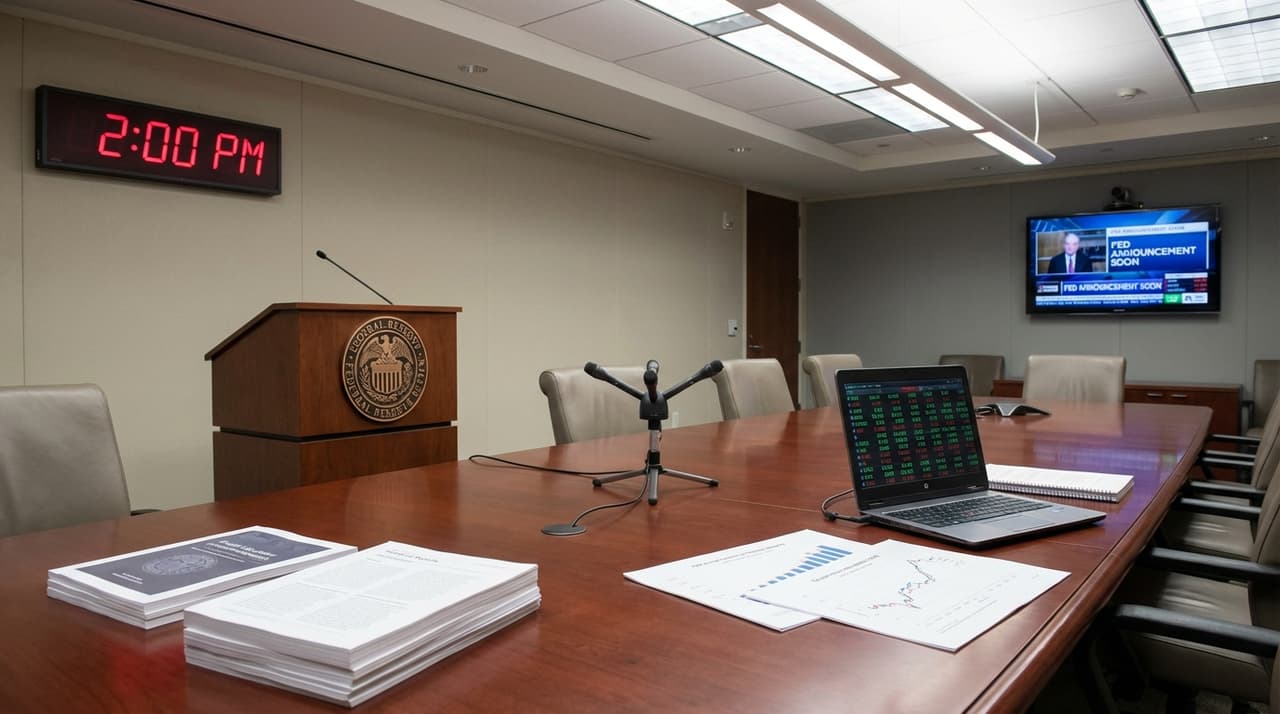
- The Federal Reserve is expected to hold interest rates steady at 3.5%-3.75% at its January meeting, with focus on whether Chair Jerome Powell signals a dovish stance.
- Dovish language could weaken the US dollar through mechanisms like rate cut expectations and policy statement wording, while political pressure from the Trump administration adds to vulnerability.
- Market implications include potential equity gains, renewed selling pressure on the dollar, and lower Treasury yields if dovish guidance emerges, with rate cuts likely delayed until later in 2026.
The dollar has stabilized in recent sessions but remains on shaky ground as investors brace for the Federal Reserve's upcoming policy decision. All 100 economists surveyed by Reuters anticipate unchanged rates at the January 27-28 meeting, with the benchmark holding at 3.5%-3.75%. Yet, the real drama lies in the subtleties of Powell's press conference and the policy statement's tone—whether it tilts hawkish or dovish could set the currency's course.
According to people familiar with the matter, the Fed's internal dynamics are shifting, with a new voting roster that includes four neutral voters, six dovish voters, and only two hawkish policymakers. This composition suggests the central bank is leaning more accommodative going forward, a shift that could amplify dovish signals. One Fed insider, speaking on condition of anonymity, theorized that Powell might stay on as a "backstop" against more aggressive rate cuts aligned with the administration's preferences, highlighting the unprecedented political pressure.
Trump's stated comfort with a weaker currency has created headwinds, while his appointee Stephen Miran is expected to advocate for a 50-basis-point rate cut, threatening Fed independence. If Powell expresses concern about labor market weakness or retains language like "considering the range and timing for further adjustments," investors may interpret this as dovish positioning, further pressuring the greenback. Conversely, emphasis on persistent inflation risks could bolster the dollar, but that scenario seems less likely given the current political climate.
Market expectations are finely tuned, with no cuts priced in until March and only a 15% probability then. Economists and analysts, however, forecast 2-3 rate cuts later in 2026, according to Wells Fargo (WFC) analysis. The timing is complicated by fiscal stimulus from the One Big Beautiful Bill Act of 2025, which could inject $100 billion into the economy, raising both GDP growth and inflation. This dynamic shortens the window for near-term cuts, suggesting the Fed will likely hold rates into at least June, as noted in recent briefings.
In real-time, the dollar index hovered near recent lows ahead of the announcement, with traders describing it as "vulnerable" but largely priced-in for a hold. Any dovish surprise from Powell could renew selling pressure, pushing the currency lower. Stocks, meanwhile, are poised for volatility: a dovish hold might send equities higher, while hawkish guidance could trigger a 1-2% dip, especially with major tech earnings from Microsoft (MSFT), Tesla (TSLA), and Meta (META) landing after Powell's remarks.
Gold has shown resilience amid the uncertainty, and Treasury yields are likely to move lower alongside any dollar weakness. Efforts to reach the Fed for additional comment were unsuccessful, but market participants are closely watching for clues in Powell's wording. As one analyst put it, "It's all about the tone now—the numbers are set, but the message will drive the moves."