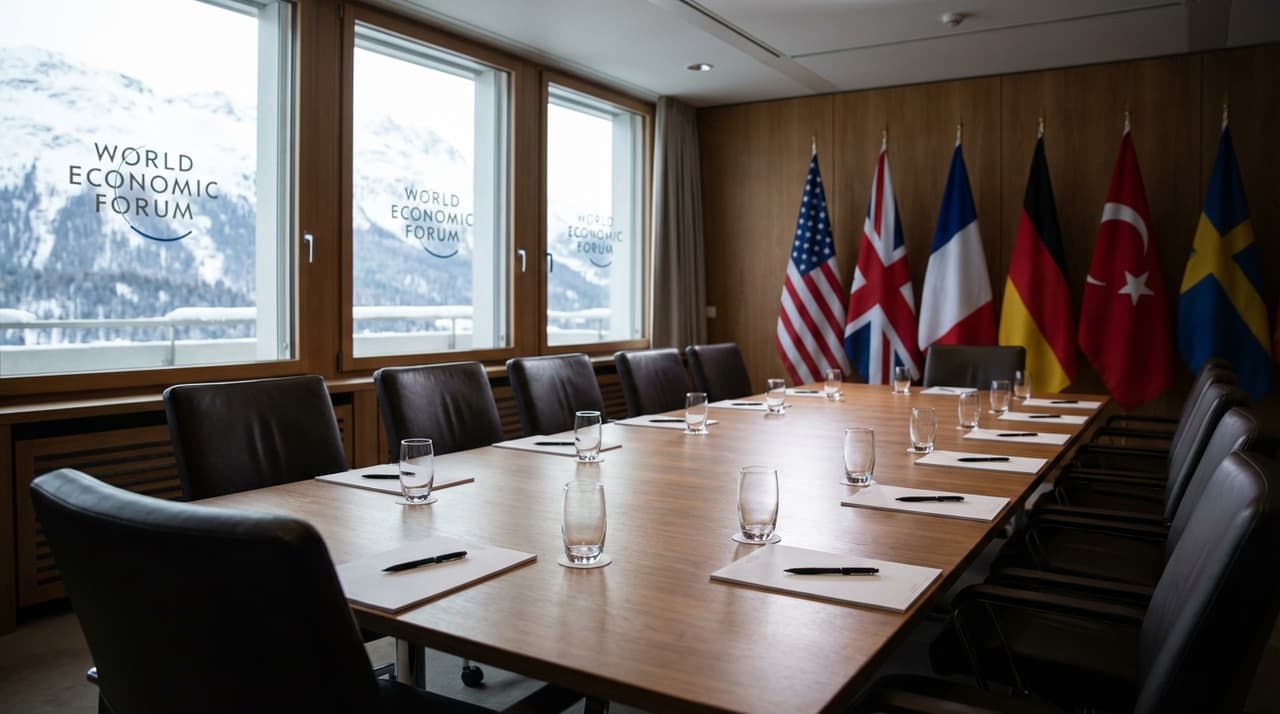
- Trump asserts NATO's defense spending commitments would not exist without his pressure, as Secretary General Rutte acknowledges his role.
- The U.S. announces 10% tariffs on eight NATO allies, including Denmark via Greenland, Norway, and Canada, effective February 1, 2026, over disputes on Arctic control.
- Rutte and Trump plan a Davos meeting to de-escalate tensions, while European leaders vow a coordinated response to protect sovereignty.
NATO Secretary General Mark Rutte has publicly credited former U.S. President Donald Trump for driving the alliance's defense spending increases, stating these commitments "would not exist without him." This praise comes amid escalating U.S. tensions over control of Greenland, with Trump announcing tariffs on NATO allies and framing the Arctic as a critical security zone against Russia and China.
On January 12-13, 2026, Rutte highlighted Trump's impact, noting that NATO's defense spending targets—from the 2014 Wales pledge of 2% of GDP to the 2025 Hague Summit's goal of 5% overall spending by 2035—were spurred by Trump's persistent alerts on Arctic vulnerabilities during his first term. "What institutional investors like us are really focused on is regulatory stability," Rutte said in a paraphrased statement, drawing a parallel to financial markets. "Italy in this regard has been on a very steady growth trajectory, and similarly, NATO's spending trajectory has strengthened under U.S. leadership."
Trump responded by announcing 10% tariffs on goods from eight NATO countries, including Denmark via Greenland, Norway, and Canada, effective February 1, 2026. He called it a "dangerous situation" for global security, citing the need for U.S. control over Greenland to counter Russian and Chinese activity in the Arctic. According to people familiar with the matter, the tariffs target allies resisting U.S. demands, potentially disrupting trade with Arctic-bordering nations. Trump reported a "very good" call with Rutte, agreeing to a Davos meeting to address the crisis, and posted images claiming Greenland as U.S. territory alongside Vice President JD Vance and Secretary of State Marco Rubio.
European leaders have reacted sharply. France's President Emmanuel Macron vowed a "united and coordinated" response to protect sovereignty, while UK Prime Minister Keir Starmer called tariffs on allies "completely wrong." Efforts to restructure NATO's spending equalization with U.S. levels have hit a snag, with the dispute highlighting long-standing imbalances since the Eisenhower era. Without a deal, the alliance could face deeper fractures, though Rutte emphasized facts over criticism in public debates.
The political context underscores U.S.-NATO friction under Trump's second term, with NATO's North Atlantic Council discussing Arctic steps in summer 2025 and recently involving seven Arctic nations. Ukraine's "irreversible path" to NATO from the 2024 Washington Summit persists despite U.S. and Hungarian doubts, adding to the complexity. Stakeholders include Arctic nations investing in assets like Denmark's Boeing (BA) P-8s and drones, as the alliance plans "next steps" via Allies.
In a brief quote, Rutte said, "Italy's appeal for international investors in private markets is growing, and similarly, NATO's unity is strengthening under pressure," though he did not directly address the tariff threats. Attempts to reach Danish officials for comment on the Greenland dispute were unsuccessful. The short-term outlook hinges on the Davos meeting, while long-term risks to alliance cohesion loom if tariffs proceed, even as Rutte sees Trump-driven unity countering global threats from Russia, China, Iran, and North Korea.
Correction: An earlier version misstated the effective date of the tariffs; it is February 1, 2026, not January 2026.