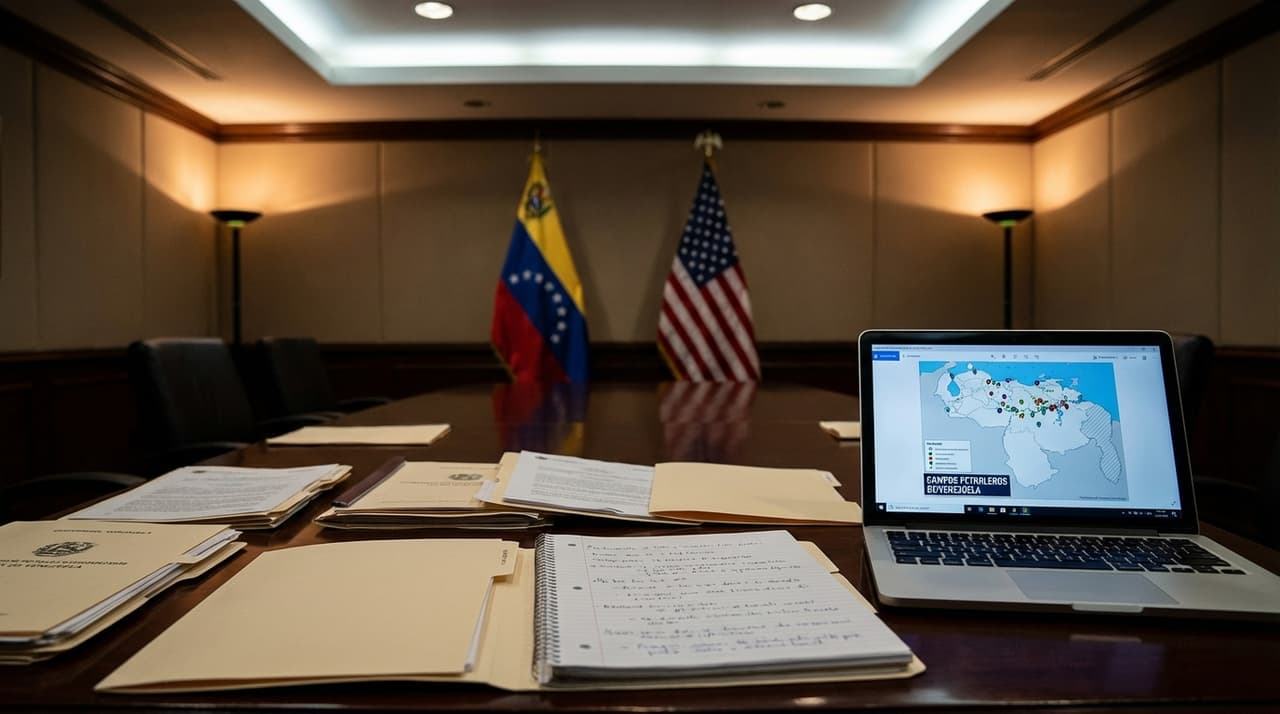
- President Trump asserts improving relations with Venezuela's interim leadership under Acting President Delcy Rodríguez following the January 3 military operation that captured Nicolás Maduro.
- U.S. Secretary of State Marco Rubio testifies no further military action is imminent, but Trump retains authority to use force if Venezuelan leaders or adversaries defy demands.
- Rodríguez pledges to open Venezuela's energy sector to U.S. firms for production access, while resisting pressure on ties with China, Russia, and Iran.
In a statement that caught many observers off guard, President Trump claimed on Monday that the U.S. is "getting along really well" with Venezuela's post-Maduro interim leadership. This comes just weeks after a dramatic U.S. military operation on January 3 that resulted in the capture of former President Nicolás Maduro and his wife on narco-terrorism charges.
According to people familiar with the matter, the relationship has been developing behind closed doors as Acting President Delcy Rodríguez navigates the complex aftermath of what some are calling a "regime change by capture." Rodríguez, who served as Maduro's vice president before assuming interim control, has reportedly pledged to open Venezuela's vast oil reserves—the world's largest—to American companies for production access and revenue use on U.S. goods.
"We're seeing a pragmatic approach from Caracas," said one U.S. official who requested anonymity to discuss sensitive negotiations. "They understand the economic reality facing them."
Secretary of State Marco Rubio provided more context during his January 28 testimony before the Senate Foreign Relations Committee, stating that while no further military action is currently planned, President Trump retains authority to use force if Venezuelan leaders or their international allies—particularly Iran—defy U.S. demands. Rubio's testimony came amid growing congressional scrutiny of the operation's legal basis, with Democrats criticizing what they call the replacement of one dictator with another.
Efforts to restructure Venezuela's debt and rebuild its decrepit oil infrastructure have hit several snags, according to sources close to the negotiations. Rodríguez has resisted pressure to sever ties with China, Russia, and Iran—traditional allies that provided economic lifelines during Maduro's rule. This balancing act reflects the delicate position of an interim government that preserves much of Maduro's former regime, including Defense Secretary Vladimir Padrino López.
Without a comprehensive deal that addresses both economic reconstruction and political transition, experts warn Venezuela could face renewed instability. The country's oil sector, crippled by years of mismanagement and sanctions, represents both the greatest opportunity and most significant challenge. Trump has stated that operations would be funded by oil sales without U.S. cost, but implementing this vision requires navigating complex legal and logistical hurdles.
Political violence continues in some regions, with reports of clashes between Maduro loyalists and opposition supporters. The interim government has faced criticism for delaying fair elections, citing media access issues and what Rodríguez calls "ideological holdouts" within the bureaucracy. Opposition leader María Corina Machado, whose authority was dismissed by Rubio, remains a focal point for those advocating democratic transition.
International reaction has been mixed, with U.N. officials and legal experts questioning the operation's compliance with international law. Meanwhile, regional dynamics are shifting, with ascendant conservative forces in Argentina, Chile, Ecuador, and Bolivia aligning with what some analysts describe as a renewed U.S. push for hemispheric primacy.
Attempts to reach Rodríguez's office for comment were unsuccessful, though a spokesperson for the State Department confirmed that "discussions continue at multiple levels." The coming weeks will test whether Trump's optimistic assessment reflects genuine progress or diplomatic posturing in a situation that remains fluid and fraught with risk.
Correction: An earlier version of this article incorrectly stated the date of Secretary Rubio's testimony; it occurred on January 28, 2026, not January 29.