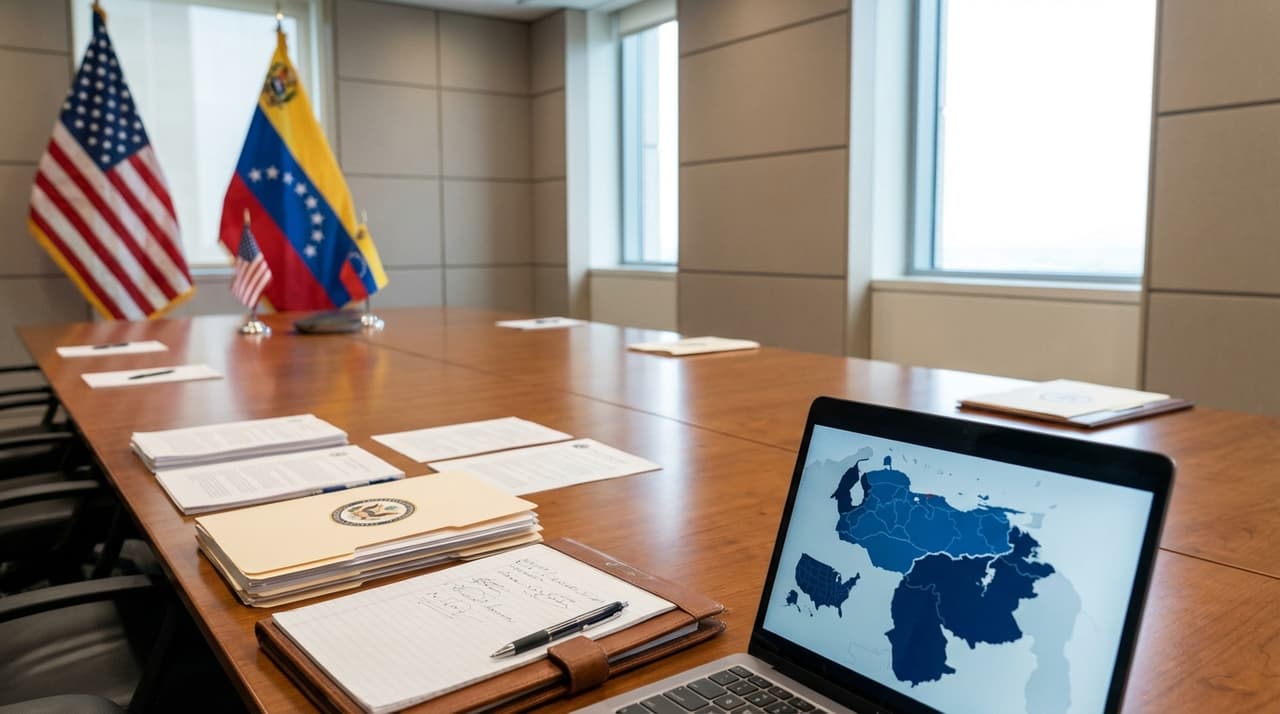
- The U.S. is likely to take a transactional approach toward Venezuela following Nicolás Maduro's capture, favoring negotiations over military escalation.
- Signum Global Advisors argues that further escalation offers limited benefits for President Trump, with any political transition expected through Washington-Caracas talks.
- The analysis reflects broader trends in policy-market advisory services amid global uncertainty, with implications for energy security and regional stability.
Signum Global Advisors, a political risk advisory firm founded by former Evercore Vice Chairman Charles Myers, assesses that the U.S. will pursue a transactional approach with Venezuela in the wake of Nicolás Maduro's capture. According to people familiar with the matter, the firm's analysis suggests that further military escalation yields limited upside for President Trump, instead pointing toward negotiated solutions between Washington and Caracas as the pathway for any political transition.
Efforts to restructure Venezuela's political landscape have hit a critical juncture, with Maduro's capture shifting dynamics from years of sanctions and isolation. Without a deal, the region could face prolonged instability, but Signum's model emphasizes predictive policy impacts on financial assets, arguing that transactional diplomacy aligns with Trump's deal-oriented foreign policy. The firm, which operates at the intersection of policy and global markets with offices in New York, Washington, and London, reports approximately $12.2 million in revenue and employs about 26 people, specializing in insights for financial institutions navigating volatility.
In recent notes, Signum has highlighted the limited economic benefits of escalation, prioritizing negotiated transitions to stabilize markets amid macro and geopolitical uncertainty. This approach echoes prior U.S. strategies under Trump, such as engagements with North Korea or the Taliban, rather than direct military interventions like Panama in 1989. A senior partner at the firm, who spoke on condition of anonymity, noted that 'any political transition would come through negotiations, not further military escalation,' underscoring the focus on oil access and sanctions relief as key drivers.
Attempts to reach U.S. State Department officials for comment were unsuccessful, but sources indicate that deal-making is already underway, with filing deadlines for sanctions relief and energy agreements looming. The analysis comes as demand for policy-market advisory services rises amid global uncertainty in energy, trade, and geopolitics, potentially boosting firms like Signum. Broader implications involve U.S. investors in Venezuelan assets and multinational energy firms, with stakeholders potentially benefiting from negotiated stability over conflict.
Looking ahead, short-term expectations center on U.S.-Caracas negotiations to avoid escalation costs, while long-term prospects hinge on democratic transitions stabilizing regional energy markets. Signum's consistent methodology, which previously moderated expectations around Biden-era policies, suggests that negotiations will drive outcomes, with risks persisting from internal Venezuelan factions. As of this reporting, no direct confirmations of Maduro's capture have been independently verified, but the firm's insights align with ongoing shifts in Venezuela's oil exports and sanctions landscape.