Aebi Schmidt Holding AG
NNASDAQ:AEBIQ3 FY2025 · Earnings Call TranscriptNovember 13, 2025
Operator
Good day, and thank you for standing by. Welcome to the Aebi Schmidt Group Third Quarter 2025 Earnings Call.
At this time, all participants are in a listen-only mode. After the speakers' presentation, there will be a question-and-answer session.
To ask a question during the session, you will need to press *11 on your telephone. You will then hear an automated message advising your hand is raised.
To withdraw your question, please press *11 again. Please be advised that today's conference is being recorded.
I would now like to hand the conference over to your first speaker today, Jay Goldbaum, General Counsel. Please go ahead.
Jay Goldbaum
All right. Thank you, Sharon.
We'll start on slide 2 with our safe harbor statement. Today's conference call contains forward-looking statements, which are subject to risks that could cause actual results to be materially different from those expressed or implied.
Primary risks that management believes could materially affect our results are identified in our forms S-4 and 10-Q filed with the SEC. We will be discussing non-GAAP information and performance measures, which we believe are useful in evaluating the company's operating performance.
Reconciliations for these non-GAAP measures can be found in the conference call materials. Please also note that historic financials presented herein for the purposes of comparing our third quarter 2025 performance are presented on a combined basis and do not reflect any pro forma adjustments or adjustments for costs related to integration activities, cost savings, or synergies that have occurred or may have been achieved if the acquisition of the former Shyft Group had occurred on January 1, 2024.
Turning to slide 3, I'd like to introduce the speakers for today's earnings call and the agenda for our presentation. Barend Fruithof, Group CEO, will provide the third quarter highlights, outlook, and concluding remarks.
Stefan Schwerter, CEO North America, will detail the performance and developments in North America. Marco Portmann, Group CFO, will provide a financial overview.
With that, I'll hand the call over to Barend. Thank you, and good morning, everyone.
I would like to welcome you to Aebi Schmidt Group's earnings call for the third quarter, our first quarter after our takeover of the Shyft Group on July 1st. We have made considerable progress in integrating the two businesses, leveraging the expertise and knowledge of our employees of both of the combined business.
We see very tangible improvements. We have created a new, stronger group with significant step-up in profitability.
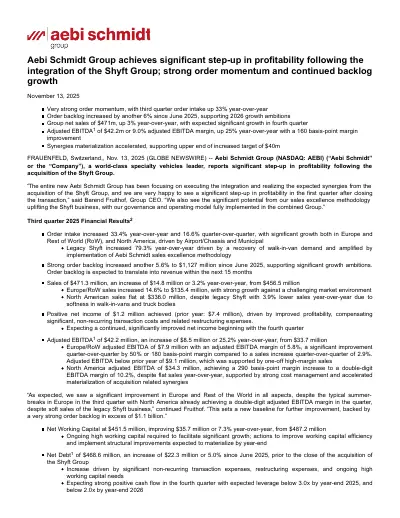
Looking at our highlights on slide 5: despite a continued challenging economic environment with many uncertainties, we show an ongoing very strong order momentum, with our third quarter intake up 33% year over year. This growth is supported by the sales excellence we have implemented at the legacy Shyft business.
Stefan will speak about this in more detail. We achieved $471 million sales, a 3% increase year over year, driven by significant organic growth in Europe.
North America sales are flat due to soft sales in walk-in vans and truck bodies at our legacy Shyft operation. To address this soft demand, we have implemented substantial countermeasures, reorganized the business, and already see a recovery in the walk-in van orders in the third quarter.
Driven by this order momentum, we expect a significant increase in our fourth quarter sales. Our profitability improved significantly, with an adjusted EBITDA of $42.2 million, a 25% increase year over year, driven by North America, with a double-digit adjusted EBITDA margin of 2.2— of 10.2%.
Europe and the rest of the world is also recovering fast, making substantial progress compared to the recent quarters. We continue to carry an elevated working capital to support our strong growth.
We have dedicated actions in implementation that will improve our working capital efficiency by year-end, contributing to expected strong positive cash flow in the fourth quarter. A highlight of our operation is our new supercenter in Chicago, which went live in early October, providing excellent customer service as a one-stop shop, broadening our service portfolio.
With our second earnings release post-acquisition, we can provide our second increase of expected synergies. Let's have a look at slide 6.
Prior to the acquisition, we identified synergies of $25 to $30 million. With our Q2 earnings release, we increased this target by $10 million to $35 to $40 million.
Today, we can confidently say that we will reach the upper end of the increased target of $40 million. We are also confident that we can deliver those synergies on an accelerated timeline versus our initial target.
We expect half of the synergies by mid-2026 and the full realization by mid-2027. In addition, we have implemented operational cost savings to support our profitability until the sustainable realization of the synergies materializes.
We see first positive impacts on our third quarter results, with significantly improved EBITDA margins. Let's have a closer look at Europe and the rest of the world on slide 7.
Airport and municipal both continue to show very strong order momentum and organic growth with improved margins. Our investments in the next-generation sweepers, including electrified sweepers, and our updated product offering in agriculture are expected to provide further momentum in 2026.
Despite the summer holidays in Europe, we achieved sales of $135 million, an increase of 2.9% from the second quarter. Europe and the rest of the world's profitability significantly recovered, with an adjusted EBITDA of 7— $7.9 million, 50% above the second quarter.
I now hand it over to Stefan for North America.
Stefan Schwerter
Thank you, Barend, and good morning, everybody. Thanks for giving me the opportunity to speak to you today.
Let's talk about our market environment on slide 9. Currently, we see a very good market momentum.
Our airport business is going very strong. We have a solid backlog moving into 2026, and we are working on adding capacity to bring lead times further down.
This should enable us to capture additional opportunities. In the goods transport, we see improvements in order entry for walk-in vans.
This will give us a good tailwind until year-end and into the next year. We also believe that we are currently able to gain market share.
On the commercial truck side, we see strong performance in the fleet sector. Dealer inventories are still elevated, but also here we see good developments for Aebi Schmidt.
Finally, on the municipal side, we see very strong quoting activity and order entry. This provides a very good backlog for 2026, and in addition, we are expanding our geographical footprint to support additional market share growth.
Let's go to slide 10. As you can see, backlog, order entry, and sales have improved quarter over quarter.
On the profitability side, we are on the right track with delivering a double-digit EBITDA margin this quarter. For additional context, the 10.2% EBITDA margin in Q3 this year is 290 basis points higher than in Q3 2024.
Finally, on slide 11, you can see the strong development in the order entry of the former Shyft business. We certainly see some market recovery on the walk-in van side, but in addition to that, everybody in North America is now working with the same sales tools.
This allows us to fully capitalize new opportunities which emerge across all segments. We are going into 2026 with a very healthy backlog, and with a traditionally strong production setup from the legacy Shyft side, we have a good level of confidence to also succeed in 2026.
Thanks, everybody, for listening, and with that being said, I'll hand it over to Marco.
Marco Portmann
Thanks very much, Stefan, and good morning, everyone. We continue on slide 13 with a more detailed look of our third quarter results.
As already mentioned by my colleagues, we see substantial order momentum further growing our backlog. Our order intake increased 33% year over year and 17% versus the second quarter, with significant growth both in Europe/rest of world and North America, driven by airport and municipal and a recovery in walk-in vans.
Our order backlog increased another 6% since June 2025 to $1.13 billion, which will translate into sales within the next 15 months, supporting our 2026 outlook with expected significant organic growth. Moving on to slide 14.
Our third quarter sales reached $471 million, 3% increase year over year and, notably, a 4% increase versus the second quarter, despite the usual summer breaks in Europe. However, I also have to point out a disappointing fact: the sales of the acquired Shyft business.
We see a shortfall of $200 million versus their announced $969 million sales for full year 2025. While the strong order momentum will allow us to improve significantly going forward, it will take its time to recover to previously planned sales levels.
Despite this weakness, in the month of September alone, we achieved sales of over $180 million and expect a continuation on that level, ending the year with a substantial sales growth in the fourth quarter, our seasonally strongest quarter. Looking at our profitability on slide 15, you can see that we translated that 3% increase in sales year over year into a 25% increase in adjusted EBITDA, delivering $42.2 million versus $33.7 million the year prior.
North America achieved a double-digit adjusted EBITDA margin of 10.2% in the third quarter, substantially outperforming prior performance. Again, this profitability uplift was achieved despite lagging sales at legacy Shyft.
Europe and the rest of the world delivered $7.9 million adjusted EBITDA, a significant improvement from prior quarters, but only a first stepping stone with an adjusted EBITDA margin of 5.8% for the third quarter. This was achieved despite the third quarter typically being the weakest in Europe.
For the group, this is a substantial 160-basis-point improvement year over year, with the entire group, not just our North American segment, achieving a double-digit margin in the month of September. Moving on to slide 16 to take a look at our balance sheet.
Our net working capital stood at $451 million at the end of September, an improvement of $36 million versus prior year. Our expected significant sales growth requires us to carry an ongoing high working capital.
We are implementing actions to improve our working capital efficiency and expect a significant contribution by year-end, with additional structural actions materializing in 2026. Our target is to largely compensate the growth-induced working capital needs with efficiency gains.
Our net debt amounted to $469 million, increasing $22 million since the end of June, just prior to the closing of the acquisition of the former Shyft Group. This increase is driven by the material transaction-related expenses and the expenses related to the restructuring and integration of the acquired Shyft business.
Our leverage is consequently elevated for the time being, but we expect the first improvements, driven also by a strong positive cash flow in the fourth quarter, to below leverage of 3.0 by year-end 2025 and below 2.0 by year-end 2026. As we mentioned in our last earnings call, deleveraging remains a key pillar of our strategy as we continue an opportunistic approach for strategic tuck-in acquisitions and are watching the market closely.
With that, I hand it back to Barend for the outlook and conclusion.
Barend Fruithof
Thank you, Marco. Let me summarize on slide 18.
Aebi Schmidt Group's strategic vision is to establish itself as a premier leader in the specialty vehicle market, targeting revenues of $3 billion and achieving a mid-teens adjusted EBITDA margin. With our third quarter results, we have already taken big steps in that direction.
Our integration is progressing exceptionally well, allowing us to confirm the upper end of the increased synergy target of $40 million. Our order momentum is very strong, particularly against a challenging market, with an order backlog that supports ambitious growth targets.
Our profitability has taken a big step upwards, with 160 basis points margin improvement year over year. Our net debt will significantly improve, supported by an expected strong positive cash flow in the fourth quarter and our commitment to substantially deleveraging by year-end 2026.
We confirm our market guidance for full year 2025. We expect sales at the midpoint of our guidance range of $1.85 billion to $2 billion, and we expect an adjusted EBITDA at the upper half of our guidance range of $145 to $165 million.
We are very proud of our teams and what we have delivered in such a short time. We will continue to execute the integration, delivering our synergies and grow our market shares.
That concludes our presentation. I will now turn it over to our operator to open up the line for questions.
Operator.
Operator
Thank you. To ask a question, you will need to press *11 on your telephone and wait for your name to be announced.
Please limit yourself to one question and one follow-up only. To withdraw your question, please press *11 again.
We will now go to our first question. Your first question today comes from the line of Ben Summers from BTIG.
Please go ahead.
Ben Summers
Hey, good morning, and thank you for taking my questions. It's nice to hear that you noted that you're starting to see a pickup in the walk-in van business.
Just kind of curious what you think is driving this pickup, and I guess what your near-term outlook is here.
Stefan Schwerter
Hey, Ben. Good morning.
This is Stefan. We believe that there is a recovery going on in the market.
The demand was fairly low over the last years, and with talking to customers, there is a general increase here in the sentiment. Basically, the demand is picking up from here.
It is a market recovery in the walk-in van business. How far this takes, how long it goes, I cannot tell you, but at the moment, there's a very healthy and good order entry.
Ben Summers
Awesome. Thank you.
Then just a little bit on the M&A opportunities that you guys mentioned. Curious what you guys are seeing in the market there, and then just kind of any potential timeline on when you think we could maybe start to see us really pursuing this kind of opportunistic strategy of these tuck-in acquisitions.
Barend Fruithof
Good question. Thanks a lot, Ben.
We're constantly being approached from kind of smaller let's call it competitors, also in Canada, more on the snow and ice side at the moment. Honestly, we just looked at it.
At the moment, we're really focusing on the integration, making sure that we can further improve our profitability and making sure that we also have our new organization under control.
Ben Summers
Awesome. Thank you guys for taking my questions, and thanks for the update.
Operator
Thank you. Your next question comes from the line of Michael Shlisky from D.A.
Davidson. Please go ahead.
Michael Shlisky
Good morning, and thank you. You had some discussion on sales excellence initiatives at the Shyft Group business.
Can you maybe provide a little more color on what you've done there and you have more to implement there? Have the results really been shown in the recent walk-in van orders, or is it being shown across Weld, DuraMag, across all businesses?
Barend Fruithof
Thanks, Mike, for the question. We have done a few things.
We aligned the organization. Secondly, we already have now one common IT platform, we migrated all to Salesforce by 1st of November so that everyone works with the same IT platform.
That is already a big step forward, I think, and that will help especially to steer also the sales and to measure our people in a different way. Then we have also implemented some concrete measures, and I would like to give the word to Stefan to answer this a bit more in detail.
Stefan Schwerter
Mike, this is Stefan. Thanks for the question.
It's not only on the walk-in van side. I think it is across the entire organization.
Since November 1st, we're all on salesforce.com. Every salesperson is required to put in call reports.
We get the KPIs, a common set of KPIs across the entire organization out of Salesforce with a weekly performance management. Basically, what we discussed earlier, we executed on that, and we are in operational mode here.
On top of that, we did many executive meetings with customers. Barend, Jay, and myself, we were out with customers talking to them, and we require from our people in every unit clear strategies for a strategic client management.
This is now spreading all over the organization, and we see good results here. We will continue this path.
We're at the beginning of the integration when it comes to Salesforce and all the performance data, and I firmly believe that we will gain a lot of traction from here.
Michael Shlisky
Outstanding. Thanks.
As my follow-up, looking to 2026, I think, Marco, you suggested or said that you're looking for organic growth next year. You've got the backlog certainly to back up a lot of that statement.
Any thoughts there whether it's going to be more vocational growth or it's going to be more final mile, any comments you can make about airport, just a bit more of a breakdown as to where you feel best and where you feel you have to do a little extra work for 2026?
Marco Portmann
It's going to be a combination of growth in a variety of our markets. As we do have a very strong backlog, particularly in airport and municipal, and that concerns also both segments.
That's the case in Europe as well as in the US. That, of course, will be, let's say the starting point for continued growth, and that is also what we really see already in our books.
We're also quite confident that we have further opportunities in our segments in Europe and expect to beat the basic GDP growth by quite a bit. We have quite some ambitions for Europe 2026.
In the US, it is, yes, as we talked about and as Stefan also mentioned, we do see some very good momentum at the moment in walk-in vans. We'll have to see how that continues, how long that continues.
Of course, it's still a bit of a question mark. At the moment, what we can see and what we're booking, we're very confident about that.
What is maybe a little bit more difficult remains truck bodies. That's a bit more of a question mark.
We'll have to see how we can develop there in '26.
Michael Shlisky
Thank you.
Operator
Thank you. Your next question comes from the line of Matt Koranda from ROTH Capital Partners.
Please go ahead. Hi, guys.
This is Joseph on for Matt. Just want to see if you guys can unpack here the margin improvement drivers both at your United States segment as well as Europe.
Anything you can give us there for details?
Marco Portmann
Sure. Marco here.
Look, in the US, it is really what we can see now with that significant margin improvement that we are the new combined company. We see the margin improvement on a gross margin level where we can push for a better pricing policy from our side, and then especially, and that's the big one here in the third quarter, on the cost side, which is in parts the accelerated realization of synergies, but also just a lot of good cost management, operational cost management, because we have seen, of course, the combined overhead, and that provides ample opportunities here to really push for that increase.
That's what uplifted us in North America very significantly and also very immediately. In Europe, it's really a recovery, I would say a first step, as we commented on, in terms of recovery to where we want to be.
Not yet, of course, at the margin level that is acceptable long term, but we have made a significant step forward with the recovery in our after-sales business, in our margin that we generate there, and with a better pricing as well. That is really supporting Europe.
If we see a further growth there, as we expect, as we commented on, in 2026, we will have a nice scaling up there on the generated profitability at the end of the day. As we said, we are in a comfortable place at the moment.
The market, of course, has some uncertainties, but for us, what we can see in order momentum and in our internal activities, we're well on track with what we expected.
Barend Fruithof
May I add one point, Matt? We have also two things on our radar screen, and that's what will be the future footprint of our operations.
That is something for sure we need to look at. Then the second point, we also think that we have some potential on the COGS side, which we already have dug into, but that takes a bit of time.
After the first clean-up, now we need to do a bit more our strategic work, and that will be also part then of our upcoming budget discussion. Got it.
Thanks for the detail there, Barend. Then as we look at the synergies, you're coming off well ahead of the pre-acquisition range that you guys gave back in December in your presentation.
As we look into Shyft order intake growth growing 100% sequentially, can you remind us of just other levers as we kind of move toward this goal of the $40 million in synergies?
Stefan Schwerter
Let me reiterate what we're looking at here, right? Pre-merger, we were talking about $25 to $30 million.
Apologies. The large part of that was already cost-related.
Basically, we identified what we said is roughly $5 million revenue synergies, about $5 million in procurement synergies with some vertical integration that we have between the two businesses, and then the rest was cost synergies. The big part was always cost synergies.
What we now can see and what uplifts us at the moment with our second increase here to now saying we will reach the full $40 million of the increased target that we have given last quarter, that is predominantly coming as well from additional cost synergies. Really on the overhead cost, the overhead spend, that's where we rather immediately have identified further opportunities.
As Barend just alluded, in terms of the procurement synergies, we're talking here the internal replacement of bodies, that will also likely achieve that $5 million plus that we were talking about initially, but it takes a bit of time. We are working on that, progressing very well, but it is a topic that will only kick in in the second half year of 2026.
Then on top, we have the revenue synergies, which, of course, are the ones that take the longest to fully implement. We do have good feedback.
We do have good identification of customers where we can sell more products from our product range now. That is going on very nicely.
To really have that fully materialized, that's then what you can expect to see not just in the second half of '26, but also what drags us into 2027. In terms of the majority, of course, of synergies, they are and will remain to be cost-related, and that's also why we're confident in realizing them also a little bit on an accelerated time frame versus what we initially talked about.
Got it. Thank you for taking my questions.
I'll go ahead and leave it there. Thanks very much, Joseph.
Operator
Thank you. This concludes the Q&A for today, and I will now hand back to Jay Goldbaum for closing remarks.
Jay Goldbaum
Thank you, Sharon. I would like to thank everyone for joining today's call and your interest in the Aebi Schmidt Group.
As always, please feel free to reach out to [email protected] if you have any follow-up questions. With that, Sharon, please disconnect the call.
Operator
Thank you. This concludes today's conference call.
Thank you for participating. You may now disconnect.