Aebi Schmidt Holding AG
NNASDAQ:AEBIQ2 FY2026 · Earnings Call TranscriptAugust 13, 2026
Operator
Good day, and thank you for standing by. Welcome to the Aebi Schmidt Group second quarter 2026 earnings call.
At this time, all participants are in a listen-only mode. After the speakers' presentation, there will be a question-and-answer session.
To ask a question during the session, you will need to press star one and one on your telephone. You will then hear an automated message advising your hand is raised.
To withdraw your question, please press star one and one again. Please be advised that today's conference is being recorded.
I would now like to hand the conference over to your first speaker today, Simone Grancini, Investor Relations Director. Please go ahead.
Simone Grancini
Thank you, Sharon. Good morning, and welcome to the Aebi Schmidt second quarter 2026 earnings call.
Joining me on the call today are Barend Fruithof, Chairman and Group CEO, who will provide the highlights of the second quarter, an outlook, and concluding remarks; Steffen Schewerda, CEO North America, and Henning Schröder, CEO Europe and Rest of World, who will detail the performance in the respective segments; and Marco Portmann, Group CFO, who will provide a financial overview. Today's comments include forward-looking statements, subject to the Safe Harbor language contained in this morning's press release and in Aebi Schmidt's filings with the SEC.
As a reminder, all 2025 comparative figures referenced in today's material, like all figures prior to the July 1st, 2025 acquisition, are presented on a combined basis for Aebi Schmidt and the acquired SHIFT Group. Accordingly, all year-over-year comparisons are based on combined 2025 financial information of both companies, rather than standalone historical results.
With that, I hand the call over to Barend.
Barend Fruithof
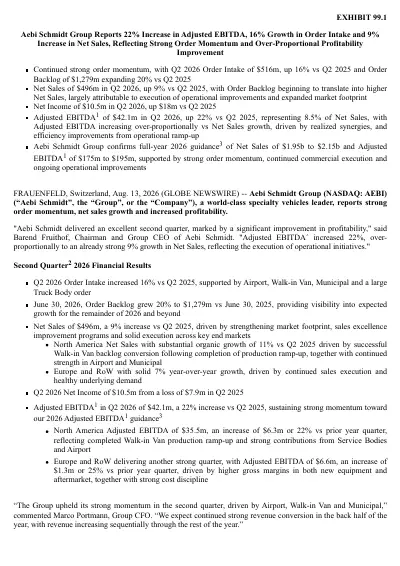
Good morning, everyone. Our second quarter 2026 results are another substantial step forward with significantly improved profitability.
As shown on slide 5, order intake increased by 16%, order backlog grew 20%, and net sales rose by 9% compared with the second quarter of 2025. Most importantly, we delivered a substantial improvement in profitability.
Adjusted EBITDA grew by 22%, and net income increased by $18 million year-over-year. In other words, profitability increased overproportionally compared to sales, reflecting production ramp-ups and other operational efficiency, the accelerated realization of acquisition synergies, and strict cost control.
On slide 6, I would like to briefly summarize some of our key achievements. We have now passed the first anniversary of the SHIFT acquisition, and we are very proud of what we have accomplished over those last 12 months.
In connection with the anniversary, we released our updated Group Strategy 2030, setting out a clear roadmap towards our ambition of becoming the global leader in specialty vehicles. On the topline, we continued to build momentum across all major business lines in the second quarter, including securing important orders.
In North America, we secured a landmark $96 million walk-in van frame contract, achieved a record quarter at Royal with our service bodies, and continued to benefit from strong momentum in airport and municipal. In Europe, we secured a major German motorway contract, expanded our cross-selling success with leading airport customers, and successfully launched the new Aebi Terratrac in our agricultural business.
Turning to slide 7. One year after the acquisition of the SHIFT Group, I'm very happy with our progress.
Comparing the 12 months before and after the acquisition, order intake has increased by 26%, adjusted EBITDA has grown by 22%, and our EBITDA margin has improved by approximately 120 basis points. We have successfully integrated our operations, expanded our American footprint, simplified our brand architecture, and increased our synergy target to more than $40 million on an annual run rate.
At the same time, we continued to invest in innovation to strengthen our competitive position across all business lines. This progress reinforces our confidence in the long-term value creation potential for the combined company.
Slide 8 highlights our continued innovation across the group. We recently introduced multiple new products and technologies, including the Cleango 550 compact sweeper, our next-generation Terratrac, expanded electric vehicle offerings, and, importantly, new airport equipment solutions.
At the same time, in partnership with YetiMove, we continue to develop autonomous airport operation solutions for our customers. Together, these initiatives strengthen our market leadership and support our organic growth.
Now, I turn the call over to Steffen.
Steffen Schewerda
Thank you, Barend, and good morning, everyone. We are on slide 10.
North America delivered a strong quarter characterized by three elements: topline execution, backlog conversion, and overproportional profitability improvement. In airport and chassis, order momentum remained robust.
This was supported by major project awards. We also continued the expansion of the AtlasCare service network through our partnership with Love's Travel Stops.
Within goods transport, we secured a significant seven-year $96 million frame contract with a strategic US customer. This customer has been a partner for more than two decades.
For the first time, the agreement includes cargo vans in addition to walk-in vans. We view this expansion as a clear sign of trust and the validation of the broader capabilities of the combined portfolio.
Our commercial business continues to benefit from healthy backlog levels. Royal had a record quarter.
Here, service body production increased by more than 20% compared to historical averages. In municipal, we secured multiple Swenson awards.
In addition, we successfully completed the Joliet production ramp-up, with customer deliveries progressing as planned. Overall, demand remains healthy, and our execution continues to improve across all major product categories.
Turning to slide 11. Order intake remains strong, and you can see the backlog increased around 27% year-over-year.
Sales increased 11% year-over-year. This was driven primarily by successful walk-in van backlog conversion.
In addition, we continued to see strong airport and improved municipal output. Adjusted EBITDA increased by approximately 22%, substantially outperforming sales growth.
This reflects improved operating efficiency, completed ramp-ups, and strong contributions from both airport and also Royal. Overall, we are pleased with the quarter and remain confident in the growth outlook for North America.
With that being said, I hand the call over to my colleague Henning Schröder. Henning?
Henning Schröder
Thank you, Steffen, and good morning. Europe and Rest of World delivered another strong quarter driven by exceptional order intake momentum and continued profitability improvement.
Our result reflects the strength of our market position and commercial execution. In airport, a major UK airport group selected Aebi Schmidt as its preferred supplier for winter maintenance and airfield sweeping equipment.
In addition, we successfully cross-sold Ladog vehicles into the airport segment. This underlines the potential to penetrate new customer segments, expand the addressable market, and unlock additional growth opportunities.
Within municipal, we secured a significant $11 million German motorway contract, strengthening our position with one of Europe's key clients. At the same time, we continue to benefit from increasing demand for electrified municipal vehicles.
In agriculture, the launch of the new Aebi Terratrac generated strong customer interest and highlighted our continued innovation leadership. Across the region, we continue to see healthy demand levels and strong customer engagement.
Turning to slide 14. Order intake increased approximately 20% compared with last year, supported by strong demand across Southern and Central Europe, as well as several significant contract wins.
Net sales increased by approximately 7%, reflecting continued operational discipline and strong production performance. Adjusted EBITDA increased by 25% for the quarter and marked another step forward in our profitability improvement journey.
The key drivers remain higher gross margins, strong aftermarket performance, and disciplined cost management. I'm proud of the progress our teams continue to deliver.
That concludes my comments, and I now turn the call over to Marco.
Marco Portmann
Thank you, Henning, and good morning, everyone. Turning to slide 16.
Order intake increased 16% compared with the second quarter of 2025 and reached $516 million. This performance was supported by growth in both our segments, particularly in airport and chassis, municipal, and the continued recovery of walk-in vans.
Order backlog increased nearly 20% year-over-year to approximately $1.3 billion and provides good visibility for the remainder of 2026 and beyond. Moving to slide 17.
Group net sales reached $496 million, representing an impressive organic growth of 9.4% compared with the second quarter of 2025. North America was the main driver, with sales up 11% versus last year, with walk-in vans as a major driver alongside strong growth nearly throughout.
Europe and Rest of World delivered a strong 7% organic growth through continued sales execution, further expanding its already strong market share. Overall, the second quarter demonstrates our ability to convert our substantial backlog into profitable revenue growth.
Looking at profitability on slide 18. Adjusted EBITDA in the second quarter reached $42 million, representing a growth of 22% year-over-year.
Group adjusted EBITDA margin increased to 8.5%, reflecting an improvement of around 90 basis points. Now, given the ongoing geopolitical uncertainties and continued discussions on trade tariffs, which are triggering supply chain disruptions and material cost inflation, we continued to be very cautious in our spending.
This tight cost management allowed us to mitigate temporary pressure on our gross margin and supported our realized adjusted EBITDA in this quarter. Looking ahead, we also expect our recent sales price increases to improve gross margins, which were executed swiftly, but are realized with some delay due to the substantial order backlog we carry.
Looking at our reporting segments, North America benefited from improving operating efficiency, completed ramp-ups, and stronger backlog conversion. Europe and Rest of World continued its profitability trajectory on its strategic path to expand realized margins.
This demonstrates the earnings potential of our platform as net sales continue to grow. Finally, having a look at our balance sheet on slide 19.
Net working capital improved year-over-year to $449 million despite continued strong sales growth, reflecting ongoing efficiency improvements and disciplined working capital management. Net debt stood relatively flat at $450 million at quarter-end, down $5 million from March, with a leverage of 2.7 times, down more than half a turn compared to the end of June 2025.
With our profitability and working capital improvements, we are well on track towards our leverage target of 2 times by year-end 2026. However, temporary investments in securing our supply chain and protecting our margins, including avoiding outsized material cost increases, will slightly impact us through year-end and into the first quarter 2027.
Accordingly, we are slightly updating our leverage target for year-end 2026 from previously 2 times or slightly below to 2 times or slightly above at year-end '26. These temporary investments allow us to continue to support our strong and profitable growth, while retaining our path to deleverage the balance sheet consistent with our capital allocation strategy.
That concludes my comments, and I hand back to Barend for the closing remarks.
Barend Fruithof
Thank you, Marco. Turning to slide 21.
We are pleased with our second quarter's performance and the continued progress across all areas of our business. Order momentum remains strong, further supporting an already strong order backlog.
Net sales continued to increase with an impressive organic growth. Adjusted EBITDA is growing significantly faster than revenue, demonstrating the benefits of operational improvements, realized synergies, and disciplined execution.
Based on this performance, we confirm our full-year 2026 guidance for net sales and adjusted EBITDA. We remain confident in our ability to deliver profitable growth while advancing our long-term ambition of becoming a $3 billion revenue company with a mid-teen adjusted EBITDA margin.
At the same time, our working capital management continues to improve, supporting cash flow and deleveraging, with more than a half a turn reduction in leverage year-over-year. We expect at least another half a turn improvement by the end of 2026.
That being said, our guidance assumes that geopolitical turmoil, tariff discussions, and inflation continues to normalize. As Marco mentioned, we face temporary pressure on our gross margins due to unexpected supply chain challenges and material cost pressure.
With our resilient business model and cautious approach, we are able to compensate for these impacts with strict cost management. Additionally, executed price increases will mostly come through by year-end and early 2027.
Now, beyond the second quarter updates, let me also take a moment to summarize why we believe Aebi Schmidt is uniquely positioned for long-term value creation, as shown on page 22. Our investment case rests on four key pillars.
First, we are a global leader in specialty vehicles. We have built long-standing customer relationships across our two home markets, supported by a portfolio of leading brands and a continuous focus on strengthening our product offering.
Second, we see a compelling growth opportunity. Today, we have a backlog of almost $1.3 billion, giving us strong visibility.
At the same time, we continue to benefit from exposure to attractive end markets, the expansion of our aftersales business, and additional opportunities to grow through M&A. Third, we have multiple levers to drive profitability.
We expect to further optimize our manufacturing footprint and improve operational efficiency across the group. These initiatives support sustainable margin expansion over time.
Finally, we have a resilient business model. Our local-for-local operating model, geographically diversified platform, and strong balance sheet helps us to navigate challenging market environments.
These strengths support our 2030 ambitions to delivering over $3 billion in annual sales through organic growth, a market recovery, and disciplined M&A, while increasing our adjusted EBITDA margin to above 13% through synergies, pricing and mix, and continued operational improvements. That concludes our presentation.
I now turn it over to our operator to open up the line for questions. Operator?
Operator
Thank you. To ask a question, you will need to press star one and one on your telephone and wait for your name to be announced.
Please limit yourself to one question and one follow-up only. To withdraw your question, please press star one and one again.
Thank you. We will now go to our first question.
Our first question today comes from the line of Michael Shlisky from D.A. Davidson.
Please go ahead.
Michael Shlisky
Yes, hello. Good morning and good afternoon, as the case may be.
The large order that you mentioned in the quarter, I think you said it was a seven-year order, or $96 million order, maybe that was, was that all in the backlog as of the end of the quarter? Is that entirely for shipment in 2026?
How common is a $90 million plus order? Is that something that would happen every quarter or this is just a very, very unusual, one-time thing?
Marco Portmann
Hey Michael, this is Marco just quickly repeating the question. We had a bit of an interruption in the line.
The question is, the $96 million framework order, whether that's on backlog by the end of the quarter, how much of that is realized in '26, and whether it's a normal size order or not, if I got that correctly.
Michael Shlisky
That. Please.
Steffen Schewerda
Michael, this is Steffen, good morning. This is, yes, this is a seven-year order, $96 million.
We will see the first revenue realization in 2027. Okay?
What is a little bit unusual is that it is not from the big parcel delivery companies, we are broadening our portfolio here. We see improved order entry from other segments as well.
On top of that, this is more than just walk-in vans, there were cargo vans added, we are broadening the portfolio here when we are offering to the customers.
Barend Fruithof
To add one point here, you asked also if that is booked into our backlog, which is not the case, we have here a very cautious model. Normally, we don't book any frame contracts in our backlog.
We just book it once we have received the PO.
Michael Shlisky
Thanks, Barend,
Steffen Schewerda
yeah. It's a general rule in our company.
Michael Shlisky
Got it. That's a very important detail.
I really appreciate that. Then maybe my follow-up will also be on the walk-in van chassis area.
I'm sure you've heard this, there was an announcement last week about Ford transitioning a good portion of their walk-in van chassis business. It'll still be a Ford powertrain, but most of the design, sales, assembly will be handled by Blue Bird going forward.
Can you maybe share on this call what are your impressions of that deal? Can you tell me what, if anything, might change at Aebi Schmidt in respect to how you outfit in the step van market?
From what you've heard about their transition plan throughout 2027 and into 2028, do you look to see any temporary disruption on your step van business as they change over?
Barend Fruithof
Thank you very much for this question. Chassis supply remains a critical topic for our industry and for us.
We see the announced move to the Ford chassis production Blue Bird as positive. It stabilizes chassis supply and removes risk of a bigger supply gap linked to necessary EPA 27 certification.
We have been in close contact with Blue Bird and we deepen our relationship and we see that as a support also going forward. What we have seen so far that some of our clients moved from the Ford chassis to the FCCC chassis.
We have to aggressively watch the situation how that will develop, because they have quite an aggressive plan to launch that new chassis in 2028. Overall, we see that as a positive development also that we still have then two providers in the chassis market.
That is it from our perspective, and as we have quite a good momentum in the walk-in van business, and as I said, we see big movements towards the FCCC chassis.
Michael Shlisky
Great. Thanks for that color.
I'll pass it along.
Operator
Thank you. Your next question today comes from the line of Ben Sommers from BTIG.
Please go ahead.
Ben Sommers
Hey yeah, good morning, good afternoon, and thank you for taking my questions. Wanted to ask a little bit on the 2030 strategic target that you guys gave.
Seems like there's some M&A baked in there. Just curious kind of what you're seeing in that market and just if you could talk a little about what's baked into that assumption.
Barend Fruithof
Okay. Thanks a lot for this question.
It's clearly our goal to first deleverage the company, as we have also outlined in our presentation. Then we see a few areas where we can further grow our company through an M&A.
In Europe, there we're still being a bit winter-dependent, there we see opportunities more, as we call it, into the summer business. Secondly, the commercial business is still very much in transformation and consolidation.
There we see some opportunities. The third point is, we still believe that we should have a similar business model in the US, and there we see some opportunities also in the sweeper area.
Ben Sommers
Super helpful. Just kind of wanted to ask a little bit about production or manufacturing capacity.
I know we mentioned the new outfit center in Iowa and Joliet, Chicago, that now fully operational, and we've had some strong backlog growth here. Just kind of how do you think about manufacturing capacity moving forward and is there any specific markets that maybe you're targeting moving forward in North America?
Steffen Schewerda
Ben, this is Steffen. The Joliet outfit center is operational and did ramp up very successfully.
We are on track with our customer deliveries. The one in Iowa you were referring to, we started the commercial outfitting there that is operational.
Municipal will follow, we start to utilize our outfit centers more and more for commercial and municipal on a combined base. Despite the geographical white spots, and we elaborated that in previous calls, we are pretty well set with our operational footprint, but I want to say that there is future potential for more rationalization and cost reductions when it comes to the footprint.
Does that answer your question?
Ben Sommers
Yep, super helpful. Thank you, guys, for taking my questions.
Steffen Schewerda
Thanks.
Operator
Thank you. Your next question today comes from the line of Matt Koranda from ROTH Capital.
Please go ahead.
Matt Koranda
Hey guys, thanks. Maybe just could you first unpack some of the temporary impacts that you're investing in, I guess, in the supply chain that are driving the slight shift in the leverage target at the end of the year?
Marco Portmann
Sure. This is Marco speaking, Matt.
Look, we have seen that supply chain has been a bit distorted, not in the sense that you would see let's say like with pandemic times where things are not available, so that's not the case. We have seen that there's a high risk.
There's alongside the high risk, also quite a material cost inflation pressure, which was to some degree also a little bit unexpected, right? Because we talk about previously steel, alu lock-ins, how we have essentially also surcharges in certain areas to cover that.
There's suppliers of suppliers that now come through with some price increases, and you see that also in the gross margin reflected. To secure that position there, we have slightly increased our safety stocks.
We have some elements where we buy a little bit in bigger batches than we would usually do just to get better discounts and things like that. That's a bit of a combination of measures that's just making sure that this pressure is countered and mitigated.
It will, however, lead to some temporary investments, as mentioned, for the next three quarter-ish, basically until early 2027 is what we can see so far. Despite progressing very nicely with the working capital efficiency, I should point out, right, if you look at working capital ratio to net sales, a year ago, we were at 25.0% in that ratio, in that perspective.
Now we are at 23.0%, we made two full percentage points in progress in just a year. The mid-term target, I should add as well, which we have given out in the equity story here is to get to 20-ish percent within another two, two and a half years.
We feel we're well on track to that, but this is a temporary hiccup that we're going to take just to make sure the profitability stays where we need it to be.
Matt Koranda
Very helpful. Thanks, Marco.
Then for my follow-up, just looking at the long-term outlook and the margin target in 2030, it looks like about 400 basis points of EBITDA margin expansion basically over the next four years if we're using the midpoint of your guidance this year. How should we think about the step-up through 2030?
Is that a linear sort of step-up and progression that you envision, or is there something a little bit lumpier that we should be taking into account? Maybe synergies realized earlier in the period or anything else that we should be thinking about as we look at the track toward the 2030 margin target?
Marco Portmann
Very good question. Look, the thing is, in single measures, there are partially some step-ups, yes, but overall, because it's such a combination of measures, right?
It's the operational footprint, it's the extension of the aftersales market, it is the continuation of the final synergies to come in. I should add on synergies, as we spoke about also today, we have accelerated that further to some degree, we're now nearly done.
We expect to be at $37 million by year-end 2026, with roughly five to come still in 2027. The gist of it all, if you put it all together, is that no, there's no big step-up through that next couple of quarters and years because the combination of the measures basically means that it's pretty much linearly going to develop until that 13 plus percent that we are giving as a mid-term guidance by 2030.
Matt Koranda
Understood. Thanks, guys.
Operator
Thank you. Your next question today comes from the line of Dave Storms from Stonegate.
Please go ahead.
Dave Storms
Morning and afternoon. Appreciate you taking my questions.
Marco, I wanted to hold on that last energy comment for a second there. Saw that you did increase that target to over $40 million.
Could you maybe just help us understand where that's coming from, what that should look like on the ground, and maybe any timing around that increase?
Marco Portmann
Sure. Look, we spoke about it before, right?
The initial target was $25 to $30 million. We rather quickly were able to increase that in 2025.
That was mostly driven from additional opex, we essentially had additional potential identified in the organization, but also just with the base opex spending that was executed fairly quickly. Again, that's also part of what helps us now to mitigate a little bit that gross margin pressure we see.
As just mentioned, right, we now expect to see $37 million realized by year-end. The piece that's still to come that's now ramping up in the third quarter is the XP service body pro.
That's the service body that we now produce in-house. That was a key consideration of our merger.
Then we also heard examples as well today in the call from Steffen. We see that the cross-selling is now also coming in, right?
That's the piece we expected last, the revenue synergies, the cross-selling synergies, that takes its time getting those new customers, now a nationwide player. It is coming in exactly as expected, and that's then the part that we expect to see really not just with the momentum and the orders coming, but really with revenue and profitability in 2027 as the last piece of it.
That's then the roughly $5 million or a big part of the $5 million for the 2027 final upside out of that merger synergies.
Dave Storms
Understood. Very helpful.
Maybe switching over to the guidance, I think it was pretty well laid out. What could put you on the lower end of the guidance between the geopolitical uncertainty, tariffs, inflationary pressures.
Just thinking about what you can control in-house, where do you see the greatest leverage points to maybe put you on the higher end of that guidance going into the last two quarters of the year?
Barend Fruithof
Thank you very much for the question. The tariffs at the end of the day you cannot control, but with our resilient business model, which is based on a local-for-local model, we're not heavily impacted, we're just indirectly impacted, and our competitors as well.
There we have some challenges because of our big backlog, and that leads then also a bit to a lower gross margin at the moment. We are more impacted, to be very honest, by the Iran war because energy prices went up and that impacted some of our material costs.
At the same time, we started to increase our prices, and as I mentioned in my presentation, that will kick in by the end of 2026 and then also beginning 2027. We will see definitely then also an improvement on the gross margin longer term.
Dave Storms
Appreciate the color. Thank you.
Operator
Thank you. This concludes the Q&A for today, and I will now hand the call back to Simone Grancini for closing remarks.
Simone Grancini
Thank you, Sharon. I thank everyone for joining today's call and your interest in the Aebi Schmidt Group.
As always, please reach out to [email protected] if you have any follow-up questions. With that, Sharon, please disconnect the call.
Operator
Thank you. This concludes today's conference call.
Thank you for participating. You may now disconnect.