Alliance Laundry Holdings Inc.
NNYSE:ALHQ3 FY2026 · Earnings Call TranscriptNovember 10, 2026
Operator
Hello, and welcome everyone joining today's Alliance Laundry third quarter 2026 earnings conference call. At this time, all participants are in a listen-only mode.
Later, you will have the opportunity to ask questions during the question-and-answer session. To register to ask a question at any time, please press *1 on your telephone keypad.
Please note this call is being recorded, and we are standing by if you should need any assistance. It is now my pleasure to turn the meeting over to Tom Gelston, Vice President of Investor Relations.
Please go ahead.
Tom Gelston
Thank you, and good morning, everyone. Along with today's call, you can find our earnings press release and presentation on our Investor Relations website at ir.alliancelaundry.com.
A replay will also be available on our website following the call. As a reminder, today's earnings release, presentation, and statements made during this call include forward-looking statements under the federal securities laws.
These statements are subject to risks and uncertainties that could cause actual results to differ materially from our expectations and projections. Such risks and uncertainties include factors set forth in the earnings release and in our filings with the SEC, including the Risk Factors section of our 10-K filing and subsequent 10-Q filings.
We assume no obligation to update or revise any forward-looking statements except as required by law. Additionally, during today's call, we will discuss certain non-GAAP financial measures outlined in our earnings presentation.
We believe these measures are important indicators of our operations as they exclude items that may not be indicative of ongoing business performance. Reconciliations to the most directly comparable GAAP measure can be found in our earnings release and presentation appendix.
With that, I'd like to now turn the call over to Mike Schoeb, our Chief Executive Officer. Mike?
Mike Schoeb
Hey, thanks, Tom, and thank you all for joining our earnings call. Our third quarter results reflect our deep commitment to customers and the strength, resilience, and non-discretionary nature of our business.
We continue to invest in expanding our connected equipment platform, deepening our distributor partnerships, and supporting the businesses, operators, and people who count on our products every day. North America delivered another strong quarter, led by commercial and home and on-premise laundry.
Cost pressure persisted, led by steel and freight, but tariff refund and the pricing actions we took late last year helped to offset it. Internationally, we grew profitability despite varied results across regions.
Latin America was solid. Asia Pacific was lower on project timing.
The rest of our markets were steady, including the Middle East, though at slightly lower levels. Dean will walk you through both segments in more detail in a few minutes.
I'll highlight again that this performance was achieved in a varied and uncertain macro environment. In a news cycle focused on inflation and interest rates, it's worth remembering that every day truly is laundry day.
Our demand is essential and replacement-driven, our business is positioned to perform in any environment. Commercial laundry is a vibrant, growing, and essential part of modern life.
Our diversified geographies and end markets, serving non-discretionary needs where laundry is not optional—hospitals and elder care, hospitality, industrial, emergency responders, laundromats, and many other verticals—have performed across all economic cycles, giving us a level of growth, consistency, and downside protection that is hard to find. This quarter, revenue grew and profitability expanded despite an inflationary environment.
Digital continues to gain traction, and our strategy hasn't changed: the more connected our equipment, the more value we deliver—better uptime, smarter servicing, lower costs, and higher revenue. The end consumer experience gets better, which strengthens our customer relationships and affinity for our brands.
We also continued to strengthen our balance sheet through debt paydown and executed on an accretive share repurchase of $75 million in the quarter. Taken together, the strengths we demonstrated this quarter—pricing discipline, our local-for-local manufacturing, and a strengthened balance sheet—are what we expect to carry us through the balance of 2026 and into 2027.
Before I hand the call over to Dean to cover the third quarter in more detail, I want to share how I feel coming out of this quarter. I have confidence in our business, our outlook, and our industry.
That comes from what I've seen and heard first-hand, from taking part in two well-attended, energetic commercial laundry trade shows in Milan, Italy and Shanghai, China, to numerous in-person meetings with customers and distributors around the world, to the encouraging forward view that our equipment financing business and its investor pipeline give us. With that, I'll turn it over to Dean to take you through the details of our third quarter performance and updated guidance.
Dean Nolden
Thanks, Mike. Starting on slide 4, I'll walk through our third quarter financial results.
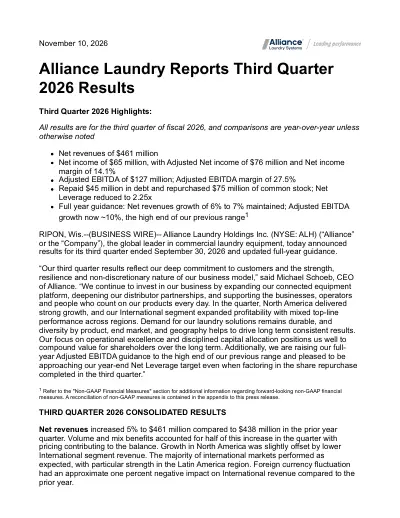
Third quarter net revenue grew 5% versus the prior year to $461 million. Volume and mix accounted for half of the increase, with pricing contributing the balance.
Gross profit grew 12% to $182 million, representing a gross margin of 39.4%, up approximately 240 basis points from the prior year. Volume and mix provided a meaningful benefit in the quarter, helping to offset ongoing inflationary pressures alongside pricing actions already in place, as well as a $5 million tariff refund received in the quarter.
Excluding this refund, gross margin increased by 130 basis points. Our local-for-local manufacturing footprint continues to provide a structural advantage through competitive labor costs, shorter freight routes, access to local supply base, and insulation from tariffs.
Adjusted EBITDA grew 14% to $127 million, with margin of 27.5%, up 217 basis points. This expansion was driven by volume leverage, operational excellence, and supply chain efficiency, which allowed us to continue to invest at scale relative to our competition in people, to support international sales growth, and digital and engineering, to develop new products and enhance existing ones.
The tariff refund received in the quarter also helped absorb higher current year inflationary costs. Excluding that item, adjusted EBITDA grew approximately 10% versus the prior year quarter.
Adjusted net income was up 57% year-over-year to $76 million, and adjusted earnings per share was up 36% to 38 cents. This result reflects both strong operating performance and the benefit of lower interest expense, down roughly $20 million from the prior year quarter.
On a GAAP basis, net income was $65 million, up 98%. Moving to the cash flow and balance sheet, operating cash flow was $84 million in the quarter, up from $66 million in the prior year quarter, reflecting strong earnings conversion and continued working capital efficiency.
We paid down $45 million of debt in the quarter, bringing our year-to-date paydown to $160 million, and we also repurchased $75 million of our common stock. As of September 30, total debt was $1.21 billion and net debt was $1.07 billion, resulting in net leverage of 2.25 times, down from approximately 2.4 times in the second quarter and down more than a half a turn from prior year-end.
Removing the effect of the share repurchase, we would have been levered at approximately 2.1 times at the end of the third quarter and ahead of our expectations for deleveraging year-to-date. Turning into the segments on slide 5, North America delivered a strong quarter, with revenue up 8% to $356 million, adjusted EBITDA was $115 million, up 21%, and adjusted EBITDA margin was 32.4%, an increase of more than 300 basis points versus the prior year.
Growth was led by commercial and home and on-premise laundry, both driven by higher volume and mix. Commercial and home results reflect the continuing trend of consumers choosing the reliability, longevity, and durability that our commercial product delivers, and on-premise laundry had a strong quarter, reflecting our commercial focus and its steady, replacement-driven demand.
In vended, which includes laundromat and multi-housing customers, results reflected the timing of new store projects, including longer lead times for permitting and construction, while customers continue the trend of retooling with larger capacity machines. Significant cost pressures persisted during the quarter, led by steel and freight, but pricing actions taken late last year and the tariff refund helped offset that inflation.
Even without the refund, North America adjusted EBITDA grew 15%. International revenue decreased 1% to $105 million due to foreign currency translation, while adjusted EBITDA increased to $27 million, resulting in a margin of 25.3% versus 24% in the prior year quarter.
The international segment grew profitably despite varied top-line performance across regions. Europe was steady, with continued support from the ongoing replacement and upgrade cycle, plus vended growth across its end markets.
Latin America showed solid growth, as expected, while Asia Pacific results reflect the timing of projects following strength in prior quarters, with year-to-date APAC revenue up versus the prior year. Our Middle East and Africa region improved in the quarter, supported by the hospitality market and growth in areas not directly affected by the conflict in the Middle East.
Adjusted EBITDA and margin expansion in international reflected favorable product and end market mix and positive price versus cost, net of inflation and tariffs. Our local-for-local manufacturing strategy continues to help mitigate the impact of currency on profitability.
Underlying financial trends in international have been positive beyond a single quarter. Regional and product mix will continue to make international results variable from quarter to quarter, given the smaller base and swings in regional strength.
We continue to invest in people and products in both emerging and more mature markets to support future international growth, with the largest investment in headcount focused on new markets where we believe we can replicate the long-term growth we have historically achieved in countries like Thailand and Brazil. Now we'll turn to our updated full-year guidance on slide 6.
The strength of our year-to-date performance and our visibility into the balance of 2026 give us the confidence to raise our full-year adjusted EBITDA guidance today. We're maintaining our full-year revenue growth guidance of 6% to 7%.
We are raising our adjusted EBITDA growth guidance to approximately 10%, which is the high end of our prior range of 8% to 10%, as we realize the benefit of volume and mix, as well as pricing alongside continued cost-down initiatives and the tariff refunds, which have helped offset input cost inflation. We expect the fourth quarter to continue to see inflationary pressures, including steel, that will impact profitability relative to both the prior year and recent quarters, ahead of the early 2027 price increases we've already communicated.
We anticipate net leverage of approximately 2.1 times at the end of the year versus our prior guidance, as a result of the $75 million share repurchase completed in the third quarter. Of course, this is based on our current expectations of business operations and capital expenditures, and does not take into account potential impact of other capital deployment opportunities.
A few additional assumptions in our full-year outlook: we expect 2026 interest expense to total approximately $75 million, and we now expect our full-year diluted share count for 2026 to be approximately 203 million shares. Our capex and effective tax rate guidance are unchanged.
Now, I'll turn the call back over to Mike.
Mike Schoeb
Hey, thanks, Dean. With that, I want to close with our consistent four key messages.
First, commercial laundry is a vibrant, growing, and essential industry. Second, we hold a leading market position as the only scaled, pure-play operator, two times the size of the number two competitor.
Third, we have an experienced, hungry, and proven team that has long delivered results through every economic cycle, and that gives us the confidence in our full-year outlook, including raising the midpoint of our adjusted EBITDA guidance. Finally, there are systemic tailwinds of magnitude that we believe will continue to power this company for the next several years.
I'll close by thanking our employees, distribution partners, customers, suppliers, and shareholders for your continued support. We appreciate it, and look forward to continuing to create long-term value for all of Alliance's stakeholders.
Before we open the line for questions, I'll be joined this morning by Dean and Tom. With that, operator, let's open the line for questions.
Operator
Thank you. If you'd like to ask a question, press *1 on your keypad.
To leave the queue at any time, press *2. We do ask that you please limit yourself to one question and one follow-up.
Once again, that is *1 to ask a question. We'll go first to Andrew Obin with Bank of America.
Your line is now open.
Andrew Obin
Good morning, Mike, Dean, Tom. Maybe the question is, and you alluded to it, but how should we think about continued inflationary pressures, freight, fuel cost, impact in third quarter and fourth quarter outlook?
You sort of alluded to it. You would still have had over 100 bps of margin expansion excluding the tariff benefit, clearly you're executing well, but just trying to understand how fast inflation has been hitting the P&L, and how fast has it been relative to expectations?
Mike Schoeb
It's probably an answer Dean and I both answer. From my perspective, look, we've got a long history here, Andrew, and a lot of learning, which is you have to get way ahead of any inflationary impact.
I think you've seen us do that over the years. I don't think it's any different in terms of how we see it.
Pricing actions for 2027 have been communicated. They have been, generally speaking, well-accepted.
As I have said often times, it is a great promotional activity when you announce price increases. It's embedded.
There could be timing occasionally, but I think, generally speaking, we're on track, and we feel pretty good about it. Dean, anything further?
Dean Nolden
I would just add that as we look at the steel markets and we look at our availability of steel supply, there's quite high demand today, and so our ability to get our supply under current contract is an issue a little bit, and we may have to buy at spot rate in some cases in Q4, which creates a little bit of a headwind compared to our agreed prices under the contract. That's also in our minds as we look at Q4 and think about our outlook for the rest of the year.
Andrew Obin
Thank you. Maybe my follow-up, your competitors are dealing with the same cost inflation pressure, but they really don't have the benefit of local-for-local manufacturing.
What are you seeing in the market? How is your competition responding?
Mike Schoeb
What we see, Andrew, is finally, as we said, we thought it would come in the back half of 2026, we do see that pricing generally across the board as they are dealing with the tariffs. That's been very helpful in our North America market.
I think the industry has been generally rational for the 20 years that I've been here. People do, over time, offset any of those cost increases, and that's what helps it be an attractive place to play, and particularly to be in a leadership position.
Andrew Obin
Do you think there's good market momentum into '27 on pricing in North America from that perspective?
Mike Schoeb
I think they will, yes.
Andrew Obin
Thanks so much.
Mike Schoeb
You're welcome.
Operator
Thank you. Our next question comes from Susan Maklari with Goldman Sachs.
Your line is now open.
Susan Maklari
Thank you. Good morning, everyone.
My first question is on the strength that you've seen in the commercial and home segment. Can you talk about a little more about the demand trends that are coming through there and your ability to continue to outperform given the macro and the state of the consumer in the last couple months?
Mike Schoeb
Look, I think, Susan, consumers, more than anything, are just looking for value. As I've said on past calls, it's the same thing our professional operators look for.
They want that low total cost of ownership. Our product is highly differentiated.
It is a commercial-grade product. That demand is not slowing.
We do not see that anywhere. Again, it's a combination of a unique product that is highly differentiated, as well as a highly differentiated go-to-market strategy, where our proposition for those retailers is a profitable product for them to sell.
It is a product that stays sold. It helps them build their brand.
We do not see any slowdown in that at all.
Susan Maklari
That's encouraging. Then turning back to the margin, in addition to price, can you talk about productivity and efficiencies that you can also realize within there, maybe not only in North America, but in the international as well, and how we should think about just generally the path for margins in this kind of an environment?
Mike Schoeb
Dean, you can maybe answer a little more detail on the margin side. Susan, I think, again, we have always managed the business to ensure our financial profile and those margins are attractive.
I think we've got a pretty good record of doing that. I think the efficiency gains are pretty striking.
We see lots of opportunity in terms of additional tooling. Our factories around the world are using AI and other things.
We are getting fairly significant, and I always look back and I think the total headcount in our North American Ripon facility is down about 200 heads or so, and that's on incremental additional volume. They are getting it.
They're working with those teams, and we see continued opportunity. In addition to that, right, there is slow, steady, careful, methodical cost down as we sort of shake the trees with our suppliers and look at optimizing design, again, always careful to make sure that it has equal or better longevity, durability, and all the things that our professional operators demand, frankly.
I think it's a very robust opportunity, and I think that's one of the most exciting things about this company, is we're doing some good things, but there's a lot more that we continue to execute on, and it feels pretty good.
Susan Maklari
That's great color.
Dean Nolden
The only thing—
Susan Maklari
Oh, go ahead.
Dean Nolden
The only thing I would add to Mike's comment is that just to emphasize the productivity opportunities that still lie in our capex investments of automation, etc., that as we look at those investments for returns, productivity is number one, and safety and all those things go along with it. It's a multitude of things that we look at for determining prioritization of capex.
There's opportunity there. There's also opportunity in the leveraging of our volumes that you see continuing throughout the year with mid-40% incremental margins on additional volume on the gross margin line, and then leveraging SG&A.
We think we have the opportunity to leverage our infrastructure costs in SG&A to grow margins even further as the top line grows.
Susan Maklari
Okay. Thank you both for the color, and good luck with the quarter.
Mike Schoeb
Thank you.
Operator
Thank you. Our next question comes from Amit Mehrotra with UBS.
Your line is now open.
Zach Walljasper
Hi, thank you. This is Zach Walljasper on for Amit.
Just two quick questions for me. On the gross side, can we just dig a little deeper into on-premise?
I don't think it gets too much color on these calls. My other question is also growth-related, but can we get a little update on how the growth opportunities in Southeast Asia are progressing?
Thank you.
Mike Schoeb
Yeah. On-premise, remember that's our highly diverse, very specialized part of the market, where it is really about total cost of ownership in an extraordinary way, right?
These are mission-critical applications, and there are literally hundreds and hundreds of small sub-verticals. With that being said, it has a high percentage into hospitality.
For those of you who are traveling, as I do, the rates that these hotels are getting are pretty extraordinary. They are healthy.
Occupancy rates are high. They will not take risk on their laundry equipment because as you know and as you might imagine, without clean linens, they don't have a room to sell.
It is really, really important, and that applies across all of those verticals. It's healthy.
It is heavy, heavy replacement-driven, and we're seeing a lot of growth that is happening there. Part of it, as I have said candidly on other calls, is a refocusing for us to really get at that on-premise opportunity.
We have incredible brands. We've got a great team on the ground, and a very, very strong product for our distribution partners to sell into market.
Steady, we've seen that throughout the year, and again, a rebalancing. The second part of your question on Southeast Asia, we talk very much about our VIP countries, Vietnam, Indonesia, the Philippines.
Again, I would say that the markets for most of our international, and particularly on the emerging side, they can be lumpy at times, but that overall demand is very strong. There is a lot of opportunity.
Those teams are continuing to open hundreds of stores a month. Again, these stores, and principally that growth is coming from laundromat in that market.
Again, it's a new market, it's emerging, it's nascent, and we've been at this for well over a decade, so that flywheel is active, that is continuing to grow, and we feel pretty good about it. Notwithstanding, again, occasionally you get this lumpiness, and that's just part of the emerging market backdrop, okay?
Zach Walljasper
Got it. Thank you so much.
Mike Schoeb
You're welcome.
Operator
Thank you. Our next question comes from Tomo Sano with JP Morgan.
Your line is now open.
Tomo Sano
Hi, good morning, everyone.
Mike Schoeb
Good morning.
Dean Nolden
Good morning.
Tomo Sano
Thank you. Maybe just on vended, which was actually affected by permitting and construction delays for new store projects.
Is this primarily a timing issues, or are you seeing any changes in customer investment appetites or underlying store demand into 2027?
Mike Schoeb
Tomo, what we see right now is demand is still at record highs. We see that principally through our financing facility, where we will sponsor these stores.
That is up in the 20% kind of plus range, I would say it's timing, it is permitting, and a lot of this is just locations, right, where the underlying demand is unchanged. Lots of people looking to get in, a lot of replacement.
I'll remind everyone that this is a replacement-driven market. Some of the product innovation that we have launched that is active in the field is very compelling.
I would characterize this timing. We don't see anything at this time.
There can be some weakness in certain parts of the market, particularly with the ICE raids that has had some impact, but it tends to go away once those raids are over. Overall, no change, and this is very consistent in terms of the underlying demand being unchanged.
Tomo Sano
Thank you. Just follow up on digitalization and initiatives, you said connected equipment can improve uptime and service and the customer experiences.
Could you give us more color about your sense of the adoptions and the modernizations of offerings, such as scan-to-pay, wash, and LaundryIQ, and so on? Thank you.
Mike Schoeb
Scan-pay-wash in the quarter, I think it was several hundred thousand transactions, right, so that is continuing to grow. It's that frictionless transaction that end users want.
As I've said, they want to get in and they want to get out of these laundromats as fast as they can on that side, and that allows them to do that. Continuing to go there, and again, the product mix, particularly towards the digital with these touch screen products that, again, based on our data, right, increases revenue in sort of the mid-teens versus the non-digital products.
It's pretty compelling. It is all part of, I think, the attraction, the returns that investors are looking for because they understand what their end customers want.
Often times, that is increasing, right, the what we call cycle modifier, as Tomo, as you saw at the trade show. People want value at the end.
They want speed, they want convenience, and I think that digital product gives them all of that for the end user, also for the investor who's looking for connectivity because it is very difficult, very expensive to scale without connected machines, and I think that's the underlying thing that we see and have been seeing for a period of time, is you have people looking for multiple stores in that space, not a single one, and obviously, for common laundry rooms with our customers who have tens of thousands, or in some cases, hundreds of thousands of units, that connectivity is really critical to give them visibility and to give them insights into their product.
Tomo Sano
Great. Thank you, Mike.
Congrats on the quarter.
Mike Schoeb
Thank you.
Operator
Thank you. Once again, if you'd like to ask a question, please press * and 1 on your keypad now.
We'll move next to Ketan Mamtora with BMO Capital Markets. Your line is now open.
Ketan Mamtora
Good morning, Mike, Dean. Maybe just coming back to price/cost, can you give some sense on how you are thinking about price/costs for 2027?
You talked about price increases in place. If you can just quantify that for us, obviously assuming this cost stay where they are right now.
Mike Schoeb
I'm not sure we want to talk 2027, Dean, unless you feel differently. I would say that, look, it's no different than how we approach every year.
As I said, getting ahead of those inflationary impacts, communicating very effectively to our distribution partners, and knowing that the industry is generally, as I've said, rational. I think everybody's faced with the same inflation, and you'll see us and probably do the same thing we have always done.
Dean, I don't know if there's any further color you want to give on that.
Dean Nolden
In addition to that, or just to confirm and to repeat, the fourth quarter will be a quarter where we see the higher inflationary cost continuing without the benefits of tariff refund. We've received all of the tariff refunds we've applied for and are owed through the third quarter, there's a little bit of a lag there.
As we said in the remarks earlier that we have communicated our price increases to our customers for early 2027, we're ready. We've evaluated the cost versus price that Mike was talking about, and consistent with prior years, we're trying to get ahead of it with that early 2027 price increase announcement.
Ketan Mamtora
Understood. No, that's helpful.
Then just switching to the international side, can you just talk about kind of where you are seeing, sort of just relatively speaking, more challenging demand versus the areas where you're seeing an improvement in demand?
Mike Schoeb
I would say Europe continues to be strong. Again, you can have some volatility quarter by quarter.
Our direct offices, particularly in Spain, France, Italy, performing very well. We've had a lot of growth coming also from the vended side.
As we have a licensed store program with one of our Speed Queen brands. That is continuing to drive incremental growth.
Steady, consistent, incredible team. Asia can be a little lumpy, as our other emerging markets, as I talked about.
Latin America, I think, is on an upswing, and I think we'll see, as a matter of fact, September was one of the strongest months we've seen from them in a while. Middle East, Africa, as I have said on the call, sometimes, matter of fact, always with crisis, there is opportunity.
Sometimes you have to look for it a little bit harder. I will say that the growth that they expect to come, and what we're seeing away from the Middle East and those regions and countries impacted by the conflict has forced them, and I say that in a good way, to find other opportunities, which they have.
That's in India, that's in Egypt, countries like Morocco, Ghana, where they have had great success with laundromats. I think across the board, there's nothing that would be unusual about this year than any other year.
Ketan Mamtora
Got it. That's helpful.
Good luck.
Mike Schoeb
Thank you.
Operator
Thank you. We'll go next to Brandon Knutson with Morgan Stanley.
Your line is now open.
Brandon Knutson
Hi, good morning. Just one for me.
Of the $75 million of share repurchases was a positive in our view in the quarter. Should we look at that as a one-off and the focus still shifting to kind of debt paydown till you get to levels you want, or is this going to be a regular use of capital we can expect going forward?
Thank you.
Dean Nolden
Brandon, I would say, yeah, maybe I can start, Mike, and you can fill in, but I would say that we made that share buyback in conjunction with our sponsors' follow-on offering to sell down a portion of their ownership interest. You can expect that to be a continued opportunity for us going forward, although timing is uncertain and not under our control.
I would say that deleveraging is still a number one priority to get down to that 2.1 times by the end of the year, and we'll very quickly get below 2 times, as you can imagine, based on historical trends and performance, into the 1 times range in 2027. We'll have the fortunate opportunity to evaluate multiple levers around capital allocation to include continuing investment in the business, deleveraging as an opportunity, but share buybacks could be an option as well in 2027 or late 2026 as things progress.
The good news is we have a lot of options. There is no plan out there that's been approved by our board, for example, for share repurchases on the open market, so that's really not in the cards at this point, but continuing going forward with multiple opportunities around buybacks in connection with follow-on offerings, potentially continued deleveraging and investment in the business.
Our strong free cash flow both allows us to do multiple things at the same time.
Operator
Thank you. At this time, there are no further questions in queue.
I will now turn the meeting back to Mike Schoeb for closing remarks.
Mike Schoeb
Thank you very much, operator, and thank you all for joining the call. We really appreciate, again, your continued engagement.
Thank you for the questions, and have no further comments. Thanks again.
Operator
Thank you. This brings us to the end of today's meeting.
We appreciate your time and participation. You may now disconnect.