Alliance Laundry Holdings Inc.
NNYSE:ALHQ2 FY2026 · Earnings Call TranscriptAugust 13, 2026
Operator
Good morning, and welcome to Alliance Laundry's second quarter 2026 earnings conference call. After the speakers' prepared remarks, there will be a question-and-answer session.
If you would like to ask a question during this time, simply press * then the number 1 on your telephone keypad. If you would like to withdraw your question, press *2.
We ask that you please limit yourself to one question and one follow-up, then return to the queue if needed. With that, it is my pleasure to turn the program over to Tom Gelston, Vice President of Investor Relations.
Tom, please go ahead.
Tom Gelston
Thank you, and good morning, everyone. Along with today's call, you can find our earnings press release and presentation on our Investor Relations website at ir.alliancelaundry.com.
A replay will also be available on our website following the call. As a reminder, today's earnings release, presentation, and statements made during this call include forward-looking statements under federal securities laws.
These statements are subject to risks and uncertainties that could cause actual results to differ materially from our expectations and projections. Such risks and uncertainties include factors set forth in the earnings release and in our filings with the SEC, including the Risk Factors section of our 10-K filing and subsequent 10-Q filings.
We assume no obligation to update or revise any forward-looking statements except as required by law. Additionally, during today's call, we will discuss certain non-GAAP financial measures outlined in our earnings presentation.
We believe these measures are important indicators of our operations as they exclude items that may not be indicative of ongoing business performance. Reconciliations to the most directly comparable GAAP measures can be found in our earnings release and presentation appendix.
With that, I'd like to now turn the call over to Mike Shade, our Chief Executive Officer. Mike?
Mike Schoeb
Hey, thanks, Tom, and thank you for joining our earnings call. Our second quarter results reinforce the message we have carried since becoming a public company, that a resilient, replacement-driven, essential industry, a market-leading position, and disciplined operational excellence combine to deliver strong, sustainable outcomes through any environment.
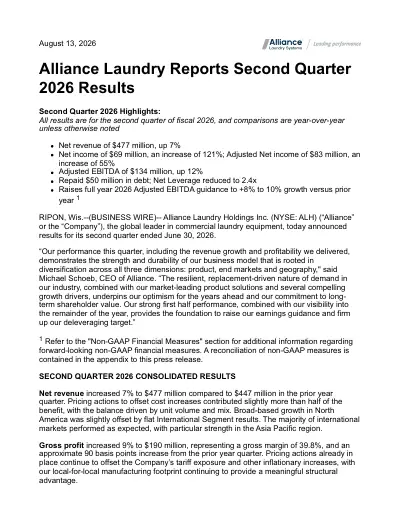
In the second quarter, revenue grew 7% year-over-year with adjusted EBITDA growth of 12% and adjusted net income up 54%. This performance was broad-based, and it reflects the diversification that defines our business across products and markets and geography.
The strength of our first half, combined with our growing visibility into the balance of the year, gives us the confidence to raise our guidance today, and Dean will take you through that detail shortly. I'd like to highlight again that this performance was achieved in a macro environment that's still volatile in many parts of the world, but remember, every day really is laundry day.
Commercial laundry is a vibrant, growing, and essential part of modern life. Our diversified geographies and end markets, serving non-discretionary needs, hospitals and elder care, hospitality, industrial, emergency responders, and many other verticals, have performed across all economic cycles, giving us a level of growth, consistency, and downside protection that is hard to find.
This quarter was no different. Revenue met our expectations with strong adjusted EBITDA and net income conversion.
Digital innovation also continues to see strong adoption, and our strategy here is unchanged: the more connected our equipment is, the more value we can deliver through better uptime, smarter servicing, lower costs, and higher revenue, and ultimately, a better end-user or end-consumer experience that further strengthens our customer relationships. Turning to the regions, North America delivered another strong, broad-based quarter with growth across every vertical and pricing that helped offset inflation and tariff impacts.
Internationally, we saw strength in Asia-Pacific, especially in vended markets, and Europe was steady. As we noted previously, the Middle East Africa region represents less than 2% of our global revenue, the direct impact of the ongoing conflict is small.
While we are seeing some knock-on effects in other regions, mainly due to higher energy costs, we expect normal growth dynamics to return when the conflict subsides. We're also continued to strengthen our balance sheet, repaying $50 million of debt in the quarter, bringing year-to-date paydown to $115 million and over $800 million over the past 12 months, which has resulted in a reduction in net leverage from 4.6 to 2.4 times.
Taken together, the strength we demonstrated this quarter, broad-based demand, pricing discipline, our local-for-local manufacturing footprint, and a strengthened balance sheet, are what we expect to carry us through the balance of 2026. Before Dean walks you through the financials, I want to share a recent event that brings a key aspect of our long-term growth story to life.
In late June, I attended our annual event in Bangkok, where we bring current and prospective laundromat operators together with our distribution partners. Southeast Asia has long been a strategic growth engine for us, and laundromats are leading the way.
The demand for new stores continues to impress me in a market that barely existed a decade ago, and one we're proud to have helped create. This demand is structural, not cyclical: urbanization, a growing middle class, and the shift toward modern out-of-home laundry.
It's durable, essential demand, the kind that has carried this company through every economic cycle. Here, our advantages are unmistakable: our technology, our distribution network, our highly trained team, and unmatched product reliability.
Operators choose Alliance because our connected, durable equipment delivers a lower total cost of ownership and a better experience for their customers. There's a second tailwind building underneath the growth.
This equipment runs hard, all day, every day in high-throughput stores, and that intensity of use sets up a durable replacement cycle in the years ahead. Even as new stores drive the top line today, the installed base we're building now becomes a recurring source of demand tomorrow.
The event generated hundreds of qualified leads across Thailand with the opportunity extending across the region. Thailand isn't the exception; it's the template.
We see the same early innings dynamics taking shape in market after market: structural tailwinds, a growing installed base, and emerging market runway, all pointing to a business built to compound for years to come. On that note, I'll hand it over to Dean to provide details of our second quarter performance and increased guidance.
Dean Nolden
Thanks, Mike. Starting on slide 5, I'll walk through our financial results, including our strengthening balance sheet.
Second quarter net revenue grew 7% versus the prior year. Pricing contributed slightly more than half of the increase with the balance coming mainly from volume.
Gross profit grew 9%, representing a gross margin of 39.8%, up approximately 90 basis points from the prior year. Regarding the cost environment, pricing actions already in place helped to offset our tariff exposure and other current inflationary pressures.
Our domestic manufacturing footprint continues to provide a meaningful structural advantage relative to our peers. Adjusted EBITDA grew 12% versus the prior year with margin of 28.1%, up 135 basis points.
This expansion came from volume leverage, operational excellence, and supply chain efficiency, and also includes continued investment in people, digital, engineering, and commercial capabilities at scale versus the competition. In addition, during the quarter, we received tariff refunds and a business interruption insurance claim totaling approximately $3.8 million.
Excluding these two items, adjusted EBITDA grew 9% versus the prior year quarter, and EBITDA margin expanded 60 basis points. Adjusted net income was up 55% year-over-year, and adjusted earnings per share was up 32% to 41 cents.
This result reflects both strong operating performance and the meaningful benefit of significantly lower interest expense, down roughly $22 million from the prior year quarter. Moving to cash and the balance sheet, operating cash flow was $66 million in the quarter, reflecting strong conversion and continued working capital discipline.
We paid down $50 million of debt in the quarter, bringing our year-to-date paydown to $115 million. Net leverage at the end of the quarter was 2.4 times adjusted EBITDA, down 0.2 turns in the quarter and down 0.4 turns from year-end.
Stepping back, the progress over the past year is striking. Since June 30, 2025, we have paid down $825 million against our term loan, funded by strong organic cash generation and IPO proceeds, cutting our net leverage nearly in half over the last 12 months from 4.6 times to 2.4 times with one full turn of that deleveraging due to organic cash flow generation and EBITDA expansion.
In addition, we're quite pleased that both Moody's and S&P have upgraded our corporate and senior debt ratings, recognizing our ability to both grow and delever at the same time. This action also has the benefit of lowering our borrowing costs on our term loan by 25 basis points going forward.
Drilling into the segments on slide 6, North America delivered a strong quarter with revenue up 9%, adjusted EBITDA up 17%, and adjusted EBITDA margin of 31.6%. Adjusted EBITDA growth was over 12% if you exclude the impact from the insurance recovery and tariff refund mentioned previously.
Growth was broad-based across our end markets with mix providing a modest positive impact in the quarter. Internationally, revenue was approximately flat with adjusted EBITDA of $34 million and a margin of 28.9%.
Asia-Pacific saw strong growth, particularly in fast-developing vended markets, and Europe was steady across all end markets with operators actively investing in new stores, fleet upgrades, and energy efficiency. This flat result masks genuinely strong underlying momentum.
As we noted, our Middle East and Africa region, which makes up less than 2% of global revenue, saw a temporary pause in demand tied to the ongoing regional conflict as well as higher energy costs, which also weighed on certain other international markets in the quarter. The year-over-year international EBITDA and margin comparison reflects regional mix within the segment, as well as our ongoing investments in people and products to support future growth.
International EBITDA and profitability will be lumpier quarter-to-quarter than North America, given the smaller base and the swings in regional strength and mix. We look at progress over time, and the trajectory is toward improved profitability and continued parity with our North American margins.
Now we will turn to our updated full-year guidance on slide 7. The strength of our first half performance and our growing visibility into the balance of 2026 give us the confidence to raise our full-year guidance today.
We are maintaining our full-year revenue growth guidance of 6 to 7% with volume and price expected to contribute equally. We are raising our adjusted EBITDA growth guidance to a range of 8 to 10%.
We expect revenue to be fairly consistent between quarters across the second half with margin expansion weighted more toward the fourth quarter, given our geographical mix expectations and normal seasonal patterns. We now anticipate net leverage of 2.0 times at the end of the year, down from the prior forecast of the low two times range.
Of course, this is based on our current expectations of business operations and capital expenditures and does not take into account the potential impact of other capital deployment opportunities. A few additional adjustments to our full-year outlook: we now expect 2026 interest expense to total approximately $80 million, we anticipate a lower effective tax rate of 23%, our CapEx and share count guidance are unchanged.
Now, I'll turn the call back over to Mike.
Mike Schoeb
Thanks, Dean. With that, I want to close with our four consistent messages.
First, commercial laundry is a vibrant, growing, and essential industry. Second, we hold a leading market position as the only scaled pure-play operator, two times the size of our number two competitor.
Third, we have an experienced, hungry, and proven team that has long delivered results through every economic cycle, and that gives us the confidence to raise our outlook for the full year. Finally, there are systemic tailwinds of magnitude that we believe will continue to power this company for the next several years.
I'll close by thanking our employees, our distribution partners, our customers, and our shareholders for your continued support. We really appreciate it and look forward to continuing to create long-term value for Alliance's stakeholders.
Before we open the line for questions, I do want to note that Dean is unable to participate in the Q&A portion of today's call due to a personal matter. I'll be handling questions this morning alongside Tom and Bob Calver, our outgoing head of IR and future international COO.
With that, operator, let's open the line for questions.
Operator
Thank you, sir. We'll now begin the question-and-answer session, and that is *1 to enter the queue.
As a reminder, we ask that you please limit yourself to one question and one follow-up, then return to the queue if needed. Our first question will come from Amit Mehrotra with UBS.
Please go ahead.
Amit Mehrotra
Great. Thank you.
Good morning, gentlemen. Appreciate the question.
Maybe I can just start by asking about the Middle East conflict and sort of the direct and indirect impacts there. Be curious how much you think that impacted the international business both on revenue and earnings, and maybe just give us a sense of kind of, I know it's going to be lumpy prospectively, but as we think about third and fourth quarter, what are sort of the continuing impacts?
Thank you.
Mike Schoeb
Hi, Amit. This is Mike.
I would say, hey, remember it's 2% of revenue, the region itself de minimis in terms of impact. What you have there is honestly, it's more transit, some vessels being delayed, things of that nature.
The good news is it includes Africa also, which has been an area that candidly we've done okay in select countries, but there's a lot of opportunity. If you think about the demographics of that part of the world, right, large family sizes and other things, and so we've got a lot of opportunity in many ways.
Like any crisis, it's a gift if you look at it the right way, and that gift is forcing that team to refocus on the African market, which again is pretty stunning in terms of the long-term potential opportunity. Then as I said in the opening remarks, it's more about the knock-on effects where understandably, some people are pausing a little bit on the international side.
Energy costs are a little bit higher. The regions that matter there obviously are Asia and Europe in particular.
The thing that we see is, as Asia put in a great quarter. We're still very confident about that.
I think in Europe a little slower, but we've seen this before, and usually what happens is people are a little hesitant, they pause, and then all of a sudden, it sort of comes back because people realize laundry is every day and they got to get to work and the business comes back. I would say it's more probably seeing that same phenomenon where, to use your word, a little lumpy, a little bumpy, but long-term, they are and we believe will be fine.
Amit Mehrotra
That's helpful. Just maybe as a follow-up, obviously the North American margins were just spectacular, and what I found interesting is you only attributed mix to sort of a modest benefit in the quarter.
We have North America margin sort of approaching 32% here. I think that's sort of an all-time high tied to maybe something you did back in 2023.
Is there a ceiling here, because the incremental margins are so far in excess of the absolute margins and your growth is good? It implies that you can continue on this expansion trajectory, but I just want to make sure I'm thinking about it correctly.
Mike Schoeb
Look, I would sort of caution on that side, but as we've got some internal targets that we won't talk about. We think we can continue to grow, that is our plan on the margin side, but I would say sort of slow, steady upward trajectory, nothing radically different, but confident in our ability to again, be cost down to offset any tariffs and inflation to just get better every day through our operational excellence, right?
Then on the new product side, a lot of the design criteria that our engineering team is very, very capable of doing, in particularly given as we've talked about in some of the past calls, the expansion of our laboratory testing facilities, and also we have added additional folks to our engineering team and the technicians and other guys that are involved in that. Again, being a little long-winded here, but think up to the right and continual progress.
Operator
Thank you. Our next question will come from Susan Maklari with Goldman Sachs.
Please go ahead.
Susan Maklari
Thank you. Good morning, everyone.
My first question is on the strength and mix shift that you saw in vended. Can you talk a little more about what's driving that and how you're overcoming some of those underlying perhaps headwinds given the macro and some of the other constraints you mentioned last quarter relative to the initiatives that you're putting through and the innovations that you're launching?
Mike Schoeb
The mix we've talked about, Susan, in the past, and I think it's pretty consistent, and that is in their retail locations, right, it's all about revenue per square foot. The larger capacity product simply just drives better returns, right?
The footprint is smaller, the ability to charge more is higher, revenue per square foot is significantly higher, and again, you see people doing that. The other thing is the end consumer, most people don't like doing laundry, they particularly don't like doing laundry in public many times, what they really want to do is they want to get in and they want to get out and they want to get on with their life and go play baseball with the kids or do whatever their free time allows them to do.
It's really, really strong that way. Then it is the trifecta in terms of the third part, which is for us, right, the engineering content is higher in larger capacity product, there is less of a competitive set on that side, and those things allow us to make a little more margin for it.
It's really a win across the board for the consumer, for the store owner, and for us as a manufacturer.
Susan Maklari
That's helpful. Then maybe shifting to the margin on the cost side, can you talk a bit about price cost and what you're seeing there, especially just given the move in steel and how you're thinking about the potential for any further pricing as we look to the back half of the year?
Mike Schoeb
Steel we're locked through the first quarter of '27. We are watching it.
It does look like for '27, hey, the inflationary environment is a little more hot than we would like, but we're early days. Again, we're watching everything.
We're seeing lots of different things in terms of freight and other things that are sort of moving around. I think my message would be, hey, as we have done traditionally, we will get ahead of any of those cost increases and offset that with price and again, some of the cost down and other efforts that we have to continue to be really attractive in terms of our margin profile.
Right now, again just looks like it'd be a little hot, but too early to tell.
Operator
Thank you. Our next question will come from Mike Halloran with Baird.
Please go ahead.
Mike Halloran
Hey, good morning, everyone.
Mike Schoeb
Morning. Morning.
Mike Halloran
Can we start on just sort of the channels in North America, maybe talk a little more broad depth in on the commercial home, what you're seeing on that side, any broader macro headwinds impacting that demographic or that buying group, any change in trajectory, any kind of loose thoughts?
Mike Schoeb
Having just returned actually night before last from a buying group show, I can tell you the demand is extraordinary, the preference for the Speed Queen brand is extraordinary, and it is all signs green. There is no slowdown, and they're really asking for us to deliver more product.
That's probably the biggest opportunity is to really scale that up a little bit more.
Mike Halloran
You're going to be sub two times leverage exiting the year here. Maybe just give a little context to what your capital allocation or deployment plan looks like beyond that.
Does a dividend come into the cards? How are you thinking about the M&A market?
Buybacks seem maybe a little premature given the float, but maybe just add some context around the plan after you get down to two turns.
Bob Calver
Hi, Mike. It's Bob Calver.
Really no change from what Dean talked about the last three quarters. Primary use is to get that leverage down, and we're, as tracking really strongly against that.
Investing in the business, be that CapEx or M&A remains the next best use of capital. We've talked about it before, there's limited M&A out there that we see, and you've seen that over the last few years.
We think fairly successfully done those distributor roll-ups in the US, and that may continue, but they're fairly small dollar items. Then you're absolutely right, cash generation is really, really strong, and we do need to start thinking about what we do with it at that point.
I think it's a little bit premature right now to be talking about that in any detail, but I think long term that combination of dividends, buybacks is kind of where you land logically, but we don't have a firm plan to share with anyone at this point.
Operator
Thank you. Our next question will come from Kyle Mingus with Citigroup.
Please go ahead.
Kyle Mingus
Great. Thank you, guys.
I just wanted to understand maybe a little bit more what's embedded in the second-half expectations for international markets. It seems like in the second quarter, Middle East and Africa was down quite a bit year-over-year and in Europe flat.
Just trying to understand, are you basically assuming more of the same in the second half, and just any color you can provide on how you're thinking about some of these international markets in the second half and what's embedded in the guide?
Mike Schoeb
What I would say, Kyle, is we still feel pretty good about it. It is and can be lumpy at times.
What we see is Europe continuing to perform, nothing really systemic there in any way. As I've said on multiple calls, an incredible team, really, really strong manufacturing base where we can be very, very competitive from a cost side.
Our competitive set there very capable, but as we've continued to grow. We think we have a lot of tailwinds still, particularly on the vended side that is continuing to grow.
It's a new market, and that region has always been strong on the on-prem. Very diverse, lots of opportunity, still feel good about it.
Asia-Pacific, we should be okay. I don't expect anything negative.
Again, lots of opportunity to grow. Certainly challenges in the region for sure.
Probably a little more energy-conscious in that part of the world. Latin America, again, we feel like these emerging markets, it's sometimes lumpy, but long-term strong.
For us, that region is really about what's happening in Mexico and Brazil. That drives the majority of the business.
Middle East Africa, as I said, and actually as an example, they've had a pretty good start to Q3, but it is going to be dependent on what the team can do there. I would say it's more like we talked about, vessels that get delayed, transport, that kind of thing.
Saudi and the UAE are down, it's really up to that team to find other opportunities for growth. Again, very capable, and I would expect that to be down for sure.
I don't see recovery there for the year, but as I stated, it's about 2% of revenue. Love to have it up, but if there's a region that's going to be down, that's the one that would have my vote.
Kyle Mingus
That's helpful, Mike. Then just a quick follow-up.
Bob, I think you mentioned the potential for some M&A. It sounds like small dollars, just curious how the M&A pipeline is looking now that you'll be at about two times leverage exiting this year, if it's mostly small dollars or anything bigger in the pipeline.
Thank you.
Bob Calver
Kyle, I think we've talked about it before. There's a limited amount that we need.
We've got everything that we think we need to continue growing at historic rates well into the future. If anything did come up that was attractive in terms of filling product gaps, distribution gaps, those kind of things, we'd absolutely consider it.
We certainly don't believe that we need it. It's always a lever that's there, but I think we're very happy with what we've got and what the future looks for us like at the minute.
Operator
Thank you. Our next question will come from Tomo Sano with J.P.
Morgan. Please go ahead.
Tomo Sano
Hi, good morning, everyone.
Mike Schoeb
Morning.
Bob Calver
Morning.
Tomo Sano
Thank you. If you could talk about the international business, especially the primary drivers for margin pressures, geographic mix, and cost, and investment ramp, and staffing, and pricing, if you give us more color and what happened in 2Q and how should we think about the back half?
Thank you.
Mike Schoeb
There's some dynamics going on, but let's start with the manufacturing base that we have, right? In Europe, or in the Czech Republic, it is highly, highly cost competitive.
We feel really good both about that location, our sourcing team, and the product design. International markets, I think in general, what you see there is more large chassis, which is produced in each of those regions, or certainly in Europe.
In the case of Asia, just to touch on that a little bit, from the cost side, right, and our Thai factory, it is state of the art, it is our newest factory, it is highly efficient, and again, it is sourcing all materials locally, very competitive with local manufacturers. Outside of Australia, New Zealand, not a lot of product coming from outside of the region, right?
It is primarily high margin, although we use this term large chassis, as product where again, you've got more engineering content, a lesser competitive set, and we think opportunity to go. Sometimes you'll have some mix shifts where there'll be a country or two that all of a sudden takes a large order of lower-margin product that it would be the small chassis product.
Again, highly differentiated, but not an equal margin versus the large chassis product. Over time, what those regions use small chassis to sort of seed the market, particularly on the vended side, because it's a lower capital cost if you want to start up a store, as an example.
We can just stay on that for a minute. Then they get comfortable, and then they realize, hey, this is a really good business, it is everyday.
Then their next store, what they will do traditionally is they will upgrade then to a larger chassis product, which has longer life, got faster cycle times, and offers a better return on investment. They will dip their toes, and we use that to allow them to dip, get comfortable, and then that second and third and fourth store, hopefully if all goes well, right, you do not see them using small chassis in those subsequent stores.
Does that answer your question?
Tomo Sano
Yes, thank you, Mike. Follow-up on Bob, congratulations on the leadership transitions, and this is questions for Mike and Bob.
Under Bob's leadership, what will concretely change to improve speed and executions, and where will decision-making be different versus today in international business? Thank you.
Bob Calver
Tomo, first of all, thanks for the congratulations. I'm going to defer this one to Mike because I think this sounds like an objective conversation,
Mike Schoeb
so. Tomo, trust me, we have those ongoing dialogues.
I'm looking at him right now, and everything is going to change. No, no, but we feel really good.
As he's very capable, he's been in the business for a long period of time. One of the good things, Tomo, is we've had Tom join us, the transition and Tom's experience and tenure and professionalism honestly has allowed Bob to get a running start on the transition.
I can say, for example, we've been in almost every region of the world over the last two months and meeting customers, they know him already, he knows the sales team, and I think he is bringing in good perspective. You always win when you bring somebody in new, they look at things differently, they uncover opportunities, they challenge, and I feel really good about the trajectory, the opportunity, and I think Bob's leadership and knowledge, he's not starting from zero.
He's an experienced guy who's been around for a long time. As the numbers matter, and so actually his background on the finance and investor relations side is super helpful to help drive that into his regional teams, and I feel really good.
Operator
Thank you. Our next question will come from Andrew Obin with Bank of America.
Please go ahead.
David Ridley-Lane
Hi, good morning. This is David Ridley-Lane on for Andrew.
Just a question here. A competitor has instituted surcharges in response to, as you said, a little bit higher inflationary environment.
What has Alliance done historically, and what is your plans on pricing second half and maybe early thoughts on 2027? Thank you.
Mike Schoeb
David, actually, look, we've done all of the above a little bit. In a hyper-inflationary, we have used surcharges for shorter periods of time, sort of weighted, watched.
If I go back a year or so ago, it was on the freight side, and then as that looked to be a consistent cost increase, we did roll out a price increase. You'll see us do that.
At the moment, we're watching. We feel we can offset the majority of that with a lot of other different actions that we're taking here, but the one thing you should know about us is we have consistently sort of gotten ahead of any price increase to make sure our margin profile remains attractive.
We're not quite there yet. We're watching it.
As I said, I think '27 will be a little bit hotter than normal, nothing like what we've seen in the past, but it's likely to be a little bit hotter. Again, you'll see us announce, get ahead of it, and we don't chase it because you can never catch it is my experience anyways.
That's how I frame it.
David Ridley-Lane
Thank you. Then just a follow-up on there's been a number of tariff changes.
I know you're primarily local-for-local. Does the Section 301 tariffs, kind of the 10 or 12 and a half percent, have any benefit to you in the second half, neutral?
Any thoughts on that? Thank you.
Bob Calver
David, I'll just take that one. I think you should consider the second half very similar to the first half.
We don't see any changes, and it's fairly neutral for us right now.
Operator
Thank you. Our last question will come from Keyvan Memar-Zia with BMO Capital Markets.
Please go ahead.
Patrick Beairsto
Morning. This is Patrick Beairsto on for Keyvan.
I wanted to ask about the demand trends in Europe, both by sort of end market and region, and how did you see those trends sort of evolve through Q2?
Mike Schoeb
I'm sorry, I missed the first part of the question. Can you repeat that?
Patrick Beairsto
I just wanted to ask on the demand trends in Europe on a end market and region basis, and then how you saw those trends sort of evolve through Q2.
Mike Schoeb
Yeah. I don't think there's any material change.
Again, the vended piece continues to grow. Again, you've got a lot of new storefronts that are going in, no real change there.
The incremental growth of that part of the business has been quite strong. Then again, it is a more on-premise heavy as a percent of revenue.
There are a lot of opportunities in terms of same phenomenon you see here where Europeans are staying more often, they're staying in the region, a lot of the bed and breakfast. You do have a different sort of hospitality market there where you've got a lot of smaller properties versus what you have here of 300-, 400-room hotels.
You don't see that there, and you've got a lot of 50-, 60-room locations that have on-premise laundry, a lot of opportunity there and others. I would say tailwinds that are favorable.
The Eastern Europe is a little more hard-hit with the energy costs. There's concern across the region, right?
As everybody knows, sustainability is really, really critical in that part of the world. We've got the right product suite that allows them to get much, much higher efficiency and lower costs, but I would say the East is a little bit more stressed than Western Europe, and particularly where we are strong in France, Spain, and Italy, which has a high population base, we have a direct business there, that is performing very, very well, and has long been outperforming and growing faster than some of our independent distributor countries.
Patrick Beairsto
That's helpful. Then on the tariff refund side, are you expecting anything for the remainder of the year?
Bob Calver
Patrick, hey, it's Bob again. Look, we're not going to share anything specific.
Obviously, the benefit we got in Q2, the reality is that there's probably still something out there, but it's still subject to confirmation. Just to be clear on guidance, it's not included in our kind of full-year guidance, nothing over and above what we've seen in the second quarter is in there.
If there is any, it will be an additional benefit.
Operator
Thank you. This brings us to the end of the Q&A portion and also the conclusion of Alliance Laundry's second quarter 2026 earnings conference call.
You may now disconnect your lines and have a wonderful day.