Alliance Laundry Holdings Inc.
NNYSE:ALHQ1 FY2026 · Earnings Call TranscriptMay 12, 2026
Operator
Good morning, and welcome to Alliance Laundry's first quarter 2026 earnings conference call. With us today are Michael Schoeb, Chief Executive Officer; Dean Nolden, Chief Financial Officer; and Bob Calver, Vice President of Investor Relations.
After the speakers' prepared remarks, there will be a question-and-answer session. If you would like to ask a question during this time, simply press *, then the number 1 on your telephone keypad.
If you would like to withdraw your question, press *2. We ask that you please limit yourself to one question and one follow-up, then return to the queue if needed.
With that, it is my pleasure to turn the program over to the team. Bob, please go ahead.
Bob Calver
Thank you, Operator, and good morning, everyone. Along with today's call, you can find our earnings press release and presentation on our Investor Relations website at ir.alliancelaundry.com.
The replay will also be available on our website following the call. As a reminder, today's earning release, presentation, and statements made during the call include forward-looking statements under federal securities laws.
These statements are subject to risks and uncertainties that could cause actual results to differ materially from our expectations and projections. Such risks and uncertainties include factors set forth in the earnings release and in our filings with the SEC, including the Risk Factors section of our 10-K filing and subsequent 10-Q filings.
We assume no obligation to update or revise any forward-looking statements, except as required by law. Additionally, during today's call, we will discuss certain non-GAAP financial measures outlined in our earnings presentation.
We believe these measures are important indicators of our operations as they exclude items that may not be indicative of ongoing business performance. Reconciliations to the most directly comparable GAAP measures can be found in our earnings release and presentation appendix.
I'll now turn over to Mike.
Michael Schoeb
Thanks, Bob, and thank you all for joining our earnings call. Building on a strong 2025, Q1 demonstrated what we've been talking about since becoming a public company: that a resilient, replacement-driven, essential industry, a market-leading position, and disciplined operational excellence deliver strong, sustainable outcomes.
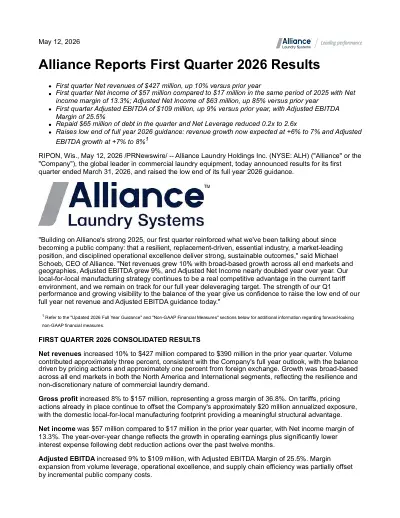
In Q1, revenue grew 10% year over year, with adjusted EBITDA growth of 9% and adjusted net income almost doubling. This growth was broad-based, driven by both volume and price.
The strength and breadth of this performance, combined with our growing visibility into the balance of the year, supports our confidence to raise the low end of our full-year revenue and adjusted EBITDA guidance today to 6% to 7% revenue growth and 7% to 8% adjusted EBITDA growth, and Dean will take you through the details shortly. I'd like to highlight that this strong performance was achieved in what we all know has been a very volatile macro environment.
Remember, every day is laundry day. Commercial laundry is a vibrant, growing, and essential part of modern life.
Our diversified geographies and end markets serving non-discretionary applications have performed across all economic cycles, providing a level of growth, consistency, and downside protection that is hard to find. We see this period as no different.
We saw solid performance from our commercial and home market, where replacement-driven demand means we are not exposed to new home construction trends, and consumers everywhere are searching for reliable and durable products in their homes. Europe also performed extremely well across all end markets.
On tariffs, which I know is top of mind for many, our local-for-local manufacturing strategy continues to be a real competitive advantage, not only in the US, but around the world. Our local-for-local manufacturing footprint puts us in a stronger position relative to competitors who have more import-dependent and complex supply chains.
Digital innovation also continues to see strong adoption, and I want to be clear about our strategy. Our priority is building an extensive, connected install base and driving adoption by delivering technology, innovation, and tools that our customers love.
The more connected our equipment is, the more value we can deliver through better uptime, smarter servicing, lower cost, and higher revenue. Ultimately, all of this delivers a better end-consumer experience, which further strengthens our relationships and stickiness with our customers.
Our connected equipment base continues to grow month on month, now standing at more than 250,000 connected machines. Also, ScanPayWash, our first-of-its-kind cashless payment solution requiring no app download, processed over 100,000 transactions in the month of March alone, with total transactions in Q1 double the entirety of Q4 2025.
We're still in the early innings of the value this technology can unlock, and we look forward to sharing more as this platform scales. Far, the adoption trends are encouraging, and we continue to see strong progress on our multi-year product pipeline.
As we touched in our last earnings update, we were excited to complete the distributor acquisition in New York during Q1, which marks our second acquisition in one of the most vibrant commercial laundry markets in the US. This tuck-in also brings the Speed Queen, UniMac, and Huebsch brands together under one highly talented team and provides us with the opportunity to realize its full potential.
We've also continued to strengthen our balance sheet, having made debt payments of $65 million in the quarter, and reduced net leverage 0.2 turns to 2.6 times adjusted EBITDA. We remain on track for our full-year deleveraging target.
Taken together, the strength we demonstrated in Q1, broad-based demand, pricing discipline, a local-for-local manufacturing footprint, and a strengthened balance sheet are what we expect to carry us through the balance of 2026. We remain confident in our ability to deliver on our raised guidance for the full year and equally confident in the long-term value we are creating for shareholders.
Finally, before Dean takes over, I want to thank all of the investors and analysts we have met over the past few months. The level of engagement has been fantastic, and I look forward to continuing the dialogue as we work hard to continue demonstrating our best-in-class industrial, financial, and operational profile.
On that note, I will hand it over to Dean to provide details on our Q1 performance and increased guidance.
Dean Nolden
Thank you, Mike. Starting on slide 4, I'll walk through our strong results and strengthening balance sheet.
First quarter net revenue grew 10% to $427 million versus the prior year. We saw real unit volume increases, contributing roughly 3%, consistent with our full-year outlook, with the balance coming from pricing and roughly 1% benefit from foreign currency.
This reinforces what Mike said earlier: Alliance is fundamentally a volume-led growth story, enhanced by rational pricing, and our results remain consistent with the balanced growth pattern that has long characterized us and our industry over time. Gross profit grew 8% to $157 million, representing a gross margin of 37%.
On the cost environment and tariffs specifically, pricing actions already in place continue to offset our approximately $20 million annualized exposure, and our domestic manufacturing footprint provides a meaningful, structural advantage relative to peers. We are monitoring the evolving trade landscape closely and believe we are well equipped to manage through new developments or changes in the tariff environment.
Operating expenses were $73 million or 17% of revenue, consistent with our expectations and reflecting the full-quarter impact of public company costs, as well as our continued investments in our digital, engineering, and commercial capabilities at scale versus the competition. Taken all together, these dynamics translated into adjusted EBITDA of $109 million, up 9% versus prior year, and an adjusted EBITDA margin of 25.5%.
Volume leverage, operational excellence, and supply chain efficiency would have driven margin expansion higher in the quarter, but were offset by the incremental costs of operating as a public company. Adjusted net income was up 85% year over year to $63 million, a result that reflects both our strong operating performance and the meaningful benefit of significantly lower interest expense as our debt reduction over the past 12 months continues to flow through the P&L.
Moving to cash and the balance sheet, operating cash flow in the quarter was $80 million, reflecting strong operating cash conversion and continued working capital discipline, consistent with what we've delivered historically. We paid down $65 million in debt in Q1, ending the quarter with total debt of $1.3 billion and net debt of $1.2 billion.
That puts net leverage at 2.6 times adjusted EBITDA, down 0.2 turns in the quarter and squarely on track for our full-year leverage guidance. Drilling into the segments, North America delivered a strong quarter, with revenue up 9% to $320 million and adjusted EBITDA up 8% to $87 million and an adjusted EBITDA margin of 27.2%.
Growth in the quarter was broad-based across our end markets, with some mix impacting margin modestly in the quarter. We saw strong growth in our vended markets, both retail laundromats and communal laundry in multi-housing locations, driven by new store development and existing operators continuing to modernize their fleets with higher-capacity, digitally connected equipment.
Alliance remains well positioned to capitalize on this continuing growth driver. On-premise delivered solid results driven by predictable replacement demand that defines that end market.
As Mike talked about earlier, commercial and home continued to outpace the industry. Internationally, revenue grew 10% to $107 million, with adjusted EBITDA up 13% to $33 million and margin of 30.4%.
Europe continues its strong momentum, with our total cost of ownership value proposition resonating with an operator base that is actively investing in fleet upgrades and energy efficiency. Across our other international markets, we continue to see strong growth in Asia Pacific, especially in the nascent vended markets.
Our Middle East and Africa region, which represents roughly 2% of total revenue, consistent with its historical size and split broadly between the Middle East and Africa, also grew in the quarter. Now we'll turn to our full-year guidance on slide 6.
While it's still early in the year, the strength of our Q1 performance and our growing visibility into the rest of 2026 gives us confidence in raising our full-year 2026 guidance today. We are increasing our full-year revenue guidance, with growth now expected to be in the range of 6% to 7%, an increase of 1 percentage point to the low end of our prior range, with equal contribution expected from volume and price.
We also continue to anticipate adjusted EBITDA margin expansion for the full year and are updating our adjusted EBITDA growth to be in the 7% to 8% range as we realize price and volume increases and the benefit of continued cost-down initiatives. In addition, subsequent to our first quarter deleveraging, we remain confident in our ability to continue to generate free cash flow and are reaffirming our expectation to reduce leverage by approximately 3/4 of a turn in 2026, bringing us to the low 2 times net debt leverage range by year-end.
Our other guidance items remain unchanged. Before I wrap up, I want to reaffirm our capital allocation framework to highlight the strong position this business is in today and the compelling opportunities we have ahead.
We are generating strong, consistent free cash flow and putting it to work strategically and deliberately. Deleveraging remains a priority and, as you've seen, we are executing against that commitment.
Each quarter of paydown strengthens our balance sheet and expands our financial flexibility. As we move through the year and leverage continues to decline, that flexibility grows and, with it, our ability to act on additional opportunities to drive shareholder value.
Organic investment in high-return growth remains a core use of our capital, and we also continue to monitor the landscape for potential tuck-in acquisitions that could support and enhance our long-term growth. At the same time, we expect to maintain the flexibility to return capital to shareholders when appropriate: potential buybacks in the nearer term and dividends as a longer-term consideration as the balance sheet continues to strengthen.
With that, let me turn it back to Mike.
Michael Schoeb
Thanks, Dean. Before we open it up for Q&A, I want to close with four key messages.
First, commercial laundry is a vibrant, growing, and essential industry. Second, we hold a leading market position as the only scaled, pure-play operator two times the size of the number two competitor.
Third, we have an experienced, hungry, and proven team that has long delivered results through every economic cycle, and that gives us confidence to raise our outlook for the year. Finally, there are systemic tailwinds of magnitude that we believe will continue to power this company over the long term.
I'll close by thanking our employees, our distribution partners, customers, and shareholders for your continued support. We appreciate it and look forward to continuing to create long-term value for Alliance's stakeholders.
With that, let's open the line for questions.
Operator
We will now begin the question-and-answer session. If you'd like to ask a question, press *1 on your keypad.
As a reminder, we ask that you please limit yourself to one question and one follow-up, then return to the queue if needed. Our first question today will come from Kyle Menges with Citigroup.
Your line is now open.
Kyle Menges
Great, thank you, guys. Maybe to start off, I'm curious just any notable changes in how you're thinking about the growth in any of the verticals in North America for the rest of the year.
Maybe piggybacking on that, I think you mentioned commercial and home outgrew the industry in the quarter. I'm curious if that growth was still positive and just how you're thinking about commercial and home for the rest of the year.
Michael Schoeb
Yeah. Hey, Kyle, it's Mike.
Look, I don't think anything's changed, we still feel very optimistic in terms of all verticals in the business having continued growth. Momentum is positive.
Sentiment is positive. Commercial and home, in particular, has been, as doing quite well for a number of years.
We see no change in demand, at the moment, everything is green.
Kyle Menges
That's helpful. I'd love to just hear more about the ScanPayWash technology that you've rolled out and just curious how unique this is to Alliance.
Then just how are you thinking about monetizing it? Is it more of a, I guess, market share gain play that you think you can get with this technology?
Michael Schoeb
Yeah. Remember, we're really the only player in the industry who has a truly integrated platform with software and hardware together.
Payment is a part of that. The ScanPayWash has been very, very popular just because people don't like to download apps.
I think it's just convenient, it's easy, it provides some benefits to the store owners, but ultimately, it's a convenience for the end user. In terms of monetization, as I said in the opening remarks, I think we're more focused today on, hey, let's just get adoption.
We believe again that that stickiness, the value that we can bring sort of by the digital platform in general is going to continue to be very strong, and we will monetize that as it goes through. We do clip a little bit of a fee on the ScanPayWash, but it is not really meaningful, Kyle.
That we think is the right strategy for now.
Kyle Menges
Makes sense. Thank you, guys.
Operator
Thank you. Our next question comes from Michael Halloran with Baird.
Your line is now open.
Michael Halloran
Hey, morning, gentlemen.
Michael Schoeb
Hi, Mike.
Michael Halloran
First just on the vended side of things, North America, maybe just talk about the dynamics you're seeing in the marketplace. Any sensitivity to the volatility right now when it comes to the refurbishment cycle or even build-out cycle?
What are the customers saying about the current dynamics?
Michael Schoeb
Mike, I will tell you at the store level, not really any major impact of note. At the investor level, those who are hoping to get new stores or retrofit their existing stores that they have, there is no change in demand.
The continual challenge has been more on the permitting, and then just finding labor in particular. To a lesser extent, still, when you're putting a store together, you've got a lot of different components and parts and pieces.
Some of that is subject to supply chain where you can't get a front door that closes, or a boiler, or whatever it happens to be. In general, it's really just permitting, labor, and then as we've talked about on past calls, site selection.
More the drag is it just takes more time and you're pushing through the funnel, but demand, the pipeline, is still very, very robust.
Michael Halloran
Thanks for that. Then on the price/cost side of things, maybe just talk through the inflationary backdrop, how you think the price/cost manages through the year, and do you foresee any incremental pricing actions on your side?
Dean Nolden
Hi, Mike. This is Dean.
Good morning. I think from the standpoint of price and cost, as we've disclosed in our release and talked about previously, we've really covered our cost increases from inflation as well as tariff with the price increases we took in middle to late 2025, and then some early in 2026 internationally.
We're well positioned to manage as pricing evolves, as tariff environment evolves to adjust accordingly, but we feel good with where we're at today and our guidance for covering our cost with price for the rest of the year.
Michael Halloran
Thank you. Appreciate it, guys.
Operator
Thank you. Our next question comes from Andrew Obin with Bank of America.
Your line is now open.
David Ridley-Lane
Morning, this is David Ridley-Lane on for Andrew Obin. Am I right in thinking that this is probably year-over-year basis the most meaningful one for tariff pressure just given the timing of all the things?
Then also on the topic, could you discuss there were changes to Section 232 tariff on steel and aluminum. Can you discuss whether that was a net benefit or a drag for you and also maybe your competitors?
Thank you.
Dean Nolden
I think from the standpoint of tariffs, yes, I think the first quarter is really the toughest comp quarter given the ramp-up and the activity in tariffs in 2025. We have about $4.5 to $5 million of headwind in the first quarter from tariffs that are consistent with prior year.
Again, consistent with the prior question, we've covered those costs with price. Also on the other side of some of our commodities, as we've locked in the most important commodities in terms of our cost of materials in terms of steel and stainless steel for the year, we feel good with where we're at.
We have good visibility on those costs as relates to our prices. Then
Michael Schoeb
I will say on the change in the Section 232, I would say it's slightly favorable, but pretty close to what it was before.
David Ridley-Lane
Got it, thank you. It sounds like you are in a good position from your own costs.
It would seem that broadly this concept that electricity prices are going higher is out there and in the public mainstream now. That would seem to me to be an impetus maybe for since utility costs are so meaningful for your customer base, that it seemed to be a maybe on the margin, maybe an impetus for refreshing.
Is your energy efficiency more of a selling point today than in the past, and how do you think about that? Thank you.
Michael Schoeb
Yeah. Oh, sorry, go ahead.
David Ridley-Lane
No, that was it. Thank you.
Michael Schoeb
Okay. Again, it depends on the age of the equipment you currently have.
On older generation, let's say, approaching the 7 to 10 year, again, these units, as get warm and ridden pretty hard. Everything kind of loosens up, efficiency generally degrades over time, particularly if it's not well maintained, which is the reality.
Very few people really maintain their product as well as they should, just like a car or anything else, nobody really does what the manufacturer's asking you to do. There is a value proposition there.
I think it would take probably several quarters of when you really see that show up and it materially impacts your results month after month. I think that gets people off of sort of dead center.
I think it helps. I think more important is sort of the innovation and the digital connectivity that allows people again to not only reduce energy, but gives you potentially an uplift in terms of the revenue side of the equation.
I think it'll come, but I don't think it's a quick one, and we need it to be pretty consistent out there for a number of quarters.
David Ridley-Lane
Thank you very much.
Michael Schoeb
Yep, thank you.
Operator
Thank you. Our next question comes from Tomohiko Sano with J.P.
Morgan. Your line is now open.
Tomohiko Sano
Hi, good morning, everyone.
Michael Schoeb
Morning.
Dean Nolden
Morning.
Tomohiko Sano
Europe and APAC were strong. Could you talk about where exactly is the growth coming from, countries, channels, and if you could talk about what are the key risks, including geopolitics and competition, please?
Yeah.
Michael Schoeb
For Europe, very strong across the board, all parts of the business. Vended was up pretty significantly, our on-premise business was up significantly.
The majority of that has come where we have direct offices, Italy, Spain in particular, and France. We see no change in that.
I will say, having just been in that region a week or two ago, sentiment is people are a little bit wouldn't say nervous, but they're thinking, they're pausing, and they're kind of waiting. I would expect that, given energy prices in particular, given, again, the uncertainty around the war, we'll see some pull back, I would suspect.
Nothing material at the moment, nothing that we can sort of point our fingers at, but general sentiment in that part of the world is slightly negative, I would characterize it that way. In APAC, it's been a continual story.
We are getting more growth from on-premise. It is one of the areas that we have, as I've talked about them in prior calls, sort of lost a little bit of focus on, they're getting more there.
Then in particular, Thailand has really had a very, very strong start to the year, and most of that has been on the vended side of the business.
Tomohiko Sano
Thank you, Mike. One follow-up: international margins are now 30.4% versus North America 27.2%.
What's structurally drives the gap, and how should we think about it going forward, please?
Dean Nolden
I would say, first, Tomo, as we've talked about in the past, as we grow internationally and as different regions of the international segment, and mix impacts those regions, especially Europe in particular that Mike talked about, we will see stronger EBITDA margins as a result. It is a little bit lumpy, but consistently growing, trending up and to the right, parity with North America will continue to increase or to get closer together.
One thing I would say is that about a third of the top line and a third of the bottom line is FX-related in the quarter. If you take away the FX impacts in internationally, we'd be up 7% in revenue and 9% in EBITDA.
Still margin expansion. We're benefiting from the natural hedge that we have on our local-for-local manufacturing strategy.
We feel really good about the margin trajectory internationally, but again, it's somewhat episodic or lumpy in terms of which regions and which end markets are the strongest in the quarter, again, up into the right over time.
Tomohiko Sano
Thank you, Dean, and congrats on the quarter.
Michael Schoeb
Thank you.
Operator
Thank you. Our next question comes from Susan Maklari with Goldman Sachs.
Your line is now open.
Susan Maklari
Thank you. Good morning, everyone.
Michael Schoeb
Morning.
Susan Maklari
My first question is on the adoption rates that you're seeing with ScanPayWash. It sounds like you're getting some really nice traction there.
As we think about the next several quarters and this continuing to gain some momentum, can you talk about how we should think about what that means in terms of the overall growth, and then how you're also thinking about investing in the next wave of innovation and other strategic initiatives that you have in the pipeline?
Michael Schoeb
Yeah. Just on ScanPayWash, again, it's part of our digital platform.
There are a lot of other sort of features that you would get with that. It's more just sort of an add-on.
Again, as I mentioned, it's not really material at the moment in terms of showing up in the financials in any way. I think in terms of our innovation, it is really across the board.
It's something that we have invested pretty significantly in, right? I talked about almost doubling our testing capacity that we have in the US, in Thailand, as well as in Czech Republic to really get that 24/7 turn.
The physical product, again, Susan, will be a little bit slower because what we don't want to do is launch a product before it's tried, tested, and true, those labs are very, very important. They're helping us accelerate the physical product, and simulating all kinds of things from brownouts, to dirty water, to vibration, to all kinds of things, and run life testing to make sure that that product is durable, reliable, and long-lasting.
Then the digital side, again, much, much quicker to innovate faster, to roll out. We see again that sort of 1-2 punch.
We've got a very significant development team. As I said, we believe we are the only fully integrated company in the space, and got some great team members in a development center, again, primarily in our Asian market.
It is going to be pretty healthy, I think, in terms of how we feel about it, how we look at it, and what you will continue to see from the company.
Susan Maklari
That's great color. Then you also mentioned that you completed your second acquisition of a distributor in New York.
Can you just talk a bit about the M&A pipeline, and have there been any changes given the recent uncertainty in the macro and moves in inflation?
Michael Schoeb
Yeah. Again, you should think of us as very capable of acquisitions.
We're always looking. That pipeline is not infinite.
It's a small number. We have largely accomplished what we said we would do setting out our strategy a number of years ago in terms of the acquisitions of distribution in the US market.
That's not to say we aren't engaging, continuing to dialogue with people, but it will be a part of our story. You should not think of us that way on the manufacturing side.
Again, we're always in active discussion, but I would say more than anything, we've got everything we need to continue to grow at a pace above market. We view all of these as complementary, nice to have, but none of it is a need to have, and that's kind of how we look at it.
Where we can find value and again, I would emphasize we're very disciplined in terms of any of these targets that we're looking at, but where we see it, you'll see us act. It is more on the margin is what I would say.
Susan Maklari
Yeah. I appreciate that.
Thank you for the color. Good luck with the quarter.
Michael Schoeb
Thank you.
Operator
Thank you. Once again, if you would like to ask a question, please press * and 1 on your keypad now.
Our next question will come from Amit Mehrotra with UBS. Your line is now open.
Zach Fadem
Thank you. This is Zach Walsh asking on for Amit.
For my first questions, could you just talk about the phase-in of the pricing actions? I was trying to understand the natural carryover pricing from last year versus the incremental pricing from tariffs.
Then just my second question is just around, the press release called out a negative impact for the North America margins, and just based on guidance, it seems like the negative mix should reverse for the balance of the year. Just any color there would be helpful.
Thank you.
Dean Nolden
Yeah. Thanks.
I'll start on the second question first. Yes, the impact on margins, gross margin in particular in the quarter, was pretty much mix-related, product and region, nothing fundamental to gross margins for the quarter.
We still expect gross margin expansion and EBITDA expansion built into our guidance for the full year. I think to your point is accurate that we will start to see that pick up as we comp our price increases year over year and our public company costs.
With regard to pricing, as we've said in the previous quarter and consistent with this quarter, is that pricing will be a bigger benefit to our top line in the first half of the year given the timing of price increases in 2025 due to tariffs and otherwise. We pulled forward our 2026 North America price increases into November, announced them in November of 2025, those could be started and realized at the beginning of 2026.
As the year progresses, you'll see less impact in the second half from price because of that timing, but we're also very confident that quarter over quarter, consistently for the year, you're going to see volume increases consistent each quarter on a comparable basis quarter over quarter, such that for the full year, we still expect to be about 50% price on average and 50% volume in terms of our guidance for the full year.
Zach Walljasper
Great, thank you so much.
Operator
Thank you. We'll go next to Ketan Mamtora with BMO Capital Markets.
Your line is now open.
Ketan Mamtora
Good morning, and congrats on a strong start to the year.
Dean Nolden
Thank you.
Ketan Mamtora
Maybe to start with, can you talk a little bit about and we discussed M&A, but I'm just curious, as you start to approach your target of two times leverage, can you talk about how you are thinking about sort of capital allocation, and if you can just rank order your priorities, please?
Dean Nolden
Thanks for the question. I think consistent is the theme, I think, here in terms of our communication on capital allocation strategy.
We're fortunate, given our business model and our strong free cash flow profile that's consistent throughout the year, to have multiple opportunities to pull multiple levers at the same time in order to return capital to shareholders and be balanced. Still, our number one priority currently is deleveraging.
Having said that, we are able to deleverage, at the same time we are going to continue to invest in our business in terms of capital and new product and innovation at scale compared to our competition. As Mike referred to earlier, M&A is really not a big portion of our story.
It's not something that's going to take a lot of capital as we foresee it today. Then we will still have the opportunity, as we said in our prepared remarks, to return cash to shareholders over the longer-term, medium-term in terms of when it's available, when it's opportunistic to buy back shares and/or over the long term consider a dividend.
The good news is we have a lot of opportunity at our discretion given our strong free cash flow profile, and deleveraging is our number one priority, but able to pull on multiple levers at the same time given our strong free cash flow profile.
Ketan Mamtora
Got it, that's helpful. Then just as a follow-on question, Mike, can you talk a little bit about sort of competitive dynamics both here in North America and in Europe?
Michael Schoeb
Yeah. Again, where we can find the information, as our number two competitor is publicly traded, you guys who follow them can find the information.
I think, in general, the competitive situation is unchanged. We do see at times again, these are great companies.
At times there are decisions they make that we don't fully follow, and we're not clear on. I would say, in general, it is the same and it has been.
Again, the international players struggling a little bit more here in the US, particularly given the tariff dynamic. We're starting to see some of those pricing actions begin to come in.
They are not anywhere close to what we know their costs are going up. They are beginning to pass those on, and as we've talked about, we felt that that would really begin to manifest itself in the back half of the year.
We still think that is the situation. The competitive dynamics from our position, we feel that we are in a stronger position.
Certainly, and again, I've been here almost two decades, I've really never seen the opportunities that we have at the moment in terms of our value proposition, our products, our team, what we have coming down the pike in terms of the innovation and value for end users is incredibly, incredibly strong. I'd probably just leave it at that.
I feel we're executing very, very well and in a tremendous position.
Ketan Mamtora
All right, no, that's helpful perspective. I'll turn it over.
Good luck.
Michael Schoeb
Thank you.
Operator
Thank you. This does conclude today's question-and-answer session, as well as Alliance Laundry's first quarter 2026 earnings conference call.
You may now disconnect your lines, and have a wonderful day.