Atlanticus Holdings Corporation
Q1 FY2026 · Earnings Call TranscriptMay 7, 2026
Operator
Hello, and welcome to Atlanticus' first quarter 2026 earnings conference call. At this time, all participants are in a listen-only mode.
After the speakers' presentation, there will be a question-and-answer session. To ask a question during the session, you will need to press *11 on your telephone.
You will then hear an automated message advising your hand is raised. To withdraw your question, please press *11 again.
I would now like to hand the conference over to Dan Mauch. Please go ahead.
Dan Mauch
Thank you, operator, and good afternoon, everyone. Atlanticus released results for the first quarter ended March 31st, 2026 this afternoon after market close.
If you did not receive a copy of our earnings press release, you may obtain it from the Investor Relations section of our website at investors.atlanticus.com. We have also posted an updated investor presentation.
With me on today's call are Jeff Howard, President and Chief Executive Officer, and Bill McCamey, Chief Financial Officer. This call is being webcast and will be archived on the Investor Relations section of our website.
Today's discussion may contain forward-looking statements that reflect the company's current views with respect to, among other things, earnings growth, returns on equity, portfolio performance, the benefits of the acquisition of Mercury, including expected synergies, and future financial and operating results. These statements are subject to certain risks and uncertainties that could cause actual results to differ materially from those included in the forward-looking statements.
Please review our earnings release and the risk factors discussed in our SEC filings. The forward-looking statements speak only as of the date on which they are made, and, except to the extent required by federal securities laws, the company disclaims any obligation to update any forward-looking statement.
In addition, during this call, we may refer to certain non-GAAP financial measures. Please refer to our earnings release for important disclosures regarding such measures, including reconciliations to the most comparable GAAP financial measures.
With that, I'll turn the call over to Jeff.
Jeff Howard
Thanks, Dan. Good afternoon, everyone, and thank you for joining us.
2026 is off to a very good start, combining strong legacy asset performance with continued momentum from our recent acquisition of Mercury Financial. We're now two full quarters into the Mercury acquisition, and the integration continues to progress well.
Last quarter, we noted that we were ahead of plan, and that pace continued throughout the first quarter. We're encouraged by the early results from our portfolio management actions, which are ahead of our acquisition model, as well as better than planned origination volumes and unit-level economics.
Most importantly, we're ahead of schedule on our operational integration and the creation of One Atlanticus. As I stated in our earnings release, we are a more scaled, better-resourced, more talented, and capable company than we were at this time last year.
I will further add, with the ability to serve an even broader customer base. We're excited about the opportunity to build on these enhancements in the periods ahead.
Aside from the Mercury acquisition, we also experienced growth in our legacy portfolios, which reinforces the underlying strength of the platform, with managed receivables growth, excluding Mercury, of 35%. This growth remains broad-based across both our private label and general purpose product lines, supported by increased customer acquisition on behalf of our bank partners and deeper customer engagement, as well as retail partners' organic growth and market share gains within those partnerships.
From an overall portfolio perspective, we continue to see favorable asset-level performance. Payment behavior remains consistent, purchase activity is steady, and newer customer cohorts are performing well as they season.
While macro uncertainty persists, we have not observed any material change in underlying trends. In fact, we continue to see stable and rational consumer behavior across the portfolio.
Through our deep data-driven insights, we're closely monitoring our book of managed receivables for any signs of stress, particularly given the market's concern regarding recent increases in gas prices. Utilization rates, payment rates, first pay default, early delinquency trends, percent of consumers making on-time payments, percent of consumers making more than the monthly minimum payment, all exhibit normal behaviors.
Yes, spending patterns have shown some changes. The percent being spent on gas did increase in March, but remains in line with 2023 and 2024 spending levels, and well below 2022 levels.
Conversely, we're actually seeing higher levels of discretionary spending and dining out expenditures. While we are mindful of the risk associated with inflation and, specifically, the continued rise in gas prices, we also note that the economy at large is in reasonably good shape.
Unemployment rates are steady, jobless claims are at a 50-year low, and according to published reports, deposits as a percent of disposable income and inflation-adjusted deposit levels for middle-income consumers remain substantially higher than pre-pandemic levels. As a result, we continue to feel confident in our portfolio performance and the continued achievement of our unit-level return targets.
From a competitive standpoint, as mentioned last quarter, the general purpose card environment remains active, with continued elevated solicitation levels across the markets we serve. As a result, we are seeing somewhat lower response rates.
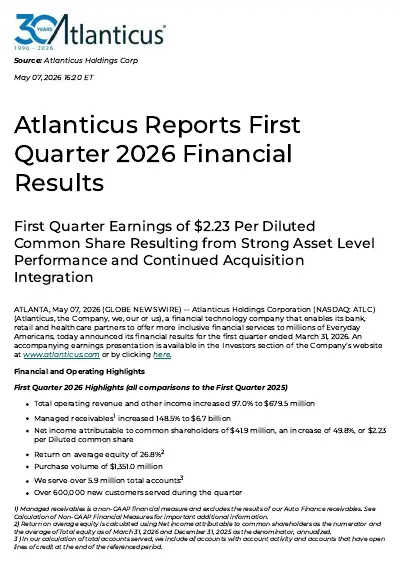
Despite this increased competition, we continue to see opportunities for prudent growth and attractive asset-level returns, which are supported by our differentiated analytics, multiple product offerings, and omnichannel origination capabilities. Turning to financial performance, we delivered another strong quarter of earnings, with net income attributable to common shareholders of $41.9 million, or $2.23 per diluted share, up 50% year-over-year and 27% sequentially.
We also achieved a return on average equity of 26.8%. As we look ahead, we believe the business is better positioned than we have ever been.
We remain focused on further optimizing the Mercury portfolio, leveraging our scale, driving disciplined growth, and maintaining stable credit performance as we continue to seek to serve the more than 100 million everyday Americans looking for a trusted financial partner. We're excited about the momentum we have coming out of Q1 and continue to expect to deliver earnings growth and returns on equity at or above our targets of 20%.
With that, I'll turn the call over to Bill.
Bill McCamey
Awesome. Thanks, Jeff.
Thank you, everyone, for joining us. I'll begin with revenue.
For the first quarter, total operating revenue and other income increased 97% year-over-year to $680 million, including $224 million from the Mercury portfolio, reflecting its continued contribution along with ongoing growth in our legacy receivables and customer base. Net margin increased over 60% year-over-year to $190 million, reflecting the earnings contribution from a larger receivable base, partially offset by higher funding costs and the higher fair value impacts associated with portfolio growth.
Changes in fair value of loans were negative $366 million, an increase of 105% year-over-year, reflecting the larger receivables base and the corresponding charge-offs, partially offset by favorable assumption changes and continued improvement in newer customer cohorts. First quarter seasonal dynamics, including tax-related paydowns and typical moderation in new receivable growth, along with continued portfolio seasoning, provided a modest benefit to fair value.
The quarter also included approximately $13 million of favorable impact related to reduction in contingent consideration associated with the Mercury acquisition. Delinquency and charge-off trends remained stable and consistent with our expectations.
As anticipated, we are seeing the benefit of tax season in the first quarter, with lower delinquency levels and corresponding improvement in charge-offs versus last year. Interest expense increased 158% year-over-year to $123 million, reflecting higher debt balances associated with receivables growth, higher borrowing costs, and financing associated with the Mercury portfolio.
Total operating expenses increased 69% year-over-year to $131 million, reflecting the scale of the combined platform, higher marketing and customer acquisition activity, and increased servicing costs as the portfolio continues to grow. As we continue to scale the platform, we are seeing the benefits of operating leverage begin to emerge.
Turning to the balance sheet, we ended the quarter with total assets of $7.5 billion and total equity of $644 million, along with $650 million of unrestricted cash, providing ample capital to support continued growth. The first quarter reflects continued revenue growth, stable credit performance, meaningful integration progress, and solid earnings expansion.
Looking ahead, we remain focused on disciplined, profitable growth to most effectively deploy our capital. With that, I'll turn the call back to the operator for questions.
Operator
Thank you. Ladies and gentlemen, as a reminder, to ask a question, please press *11 on your telephone and wait for your name to be announced.
To withdraw your question, please press *11 again. Please stand by while we compile the Q&A roster.
Our first question comes from the line of David Scharf with Citizens Capital Markets. Your line is open.
David Scharf
Hi, good afternoon. Thanks for taking my questions.
Congrats on a very strong start to the year. I guess one of the things I was, well, curious to get some color on, Jeff, is maybe how you define ahead of plan in so many of the aspects of the Mercury deal.
You obviously were looking at this target for quite a while. Can you provide a little more color, maybe first on why you think you're kind of performing ahead of pace on originations in that asset, whether it's something that is deliberate in terms of kind of a lean into marketing or if there was just something about the product that seems to be capturing share?
Then I guess secondly, on the integration front, does being ahead of plan refer to just timing or are there potentially greater cost synergies than you originally anticipated?
Jeff Howard
Thanks, David. I'll try to go through those sequentially as you ask them, but obviously a lot of good questions there.
Really getting behind the detail of why we're so excited about what we've been able to accomplish and look forward to accomplishing with the Mercury acquisition. You rightly point out that we had a lot of time to do due diligence and build models and come up with an operating and financial plan for the Mercury acquisition.
That included repricing and change in terms activities, that included operational integration, that included overhead reduction, a whole host of things that we had well laid out as our operating plan. I think that the biggest driver of it thus far has been the change in terms were able to be executed more quickly, and the adoption rate, and I'll call it stickiness, and response from consumers has been better than modeled.
We're getting better financial performance on that repricing than we had originally modeled. Additionally, we're seeing, I guess the more rapid realization of some of the operating synergies and therefore the leveraging of the combined infrastructure.
We're putting the companies together from a technology and infrastructure perspective ahead of our schedule. Across all of the metrics that you mentioned as the possibilities for areas that we quote-unquote say were ahead of plan, we're checking all of those boxes.
As it relates to new originations and being a bit ahead of tempo there as well, we were really conservative. I'd say we were conservative in terms of our acquisition model and the change in terms.
We were also very conservative in terms of what we thought we might be able to do from an origination perspective. I would say, having the capital to put behind the team and to lean into opportunities where we see at or above unit-level target return opportunities in the market, we've been able to put capital to work there.
That's supported the team to find those opportunities, bring those opportunities up, and increase the mail velocity, increase some of our online partnerships, and really expand at a rate that is a bit faster than we had anticipated in terms of new account origination.
David Scharf
Got it, and I appreciate that color. Maybe just as a follow-up, this is more in the weeds, the $13 million kind of contingency release, where would we see that in the P&L?
Jeff Howard
That's in our fair value mark, David, and it's going to be a reduction...
David Scharf
Oh, okay. Got it.
Jeff Howard
Yep.
David Scharf
Understood. Great, thank you.
Operator
Our next question comes from the line of Vincent Caintic with BTIG. Your line is open.
Vincent Caintic
Hey, thank you. Good afternoon.
Thanks for taking my questions, and congratulations on that great quarter. First, I wanted to talk about the relative competition comments.
I know you talked earlier about maybe competition increasing a little bit, but it's pretty amazing to see same-company managed receivables growth 35% year-over-year. I don't cover any of the companies that's growing that fast.
It seems like loan growth with other credit card and purchase finance providers are slowing down. Should we read that to mean that you're taking share as maybe some prime lenders and others are tightening?
Would you attribute it to Atlanticus' own sales efforts? I did note on the press release there was a paragraph about expanding with one of your retail partners.
If you could maybe describe that in more detail, is that retailer shifting away from another provider towards Atlanticus or is that a new kind of greenfield opportunity for expansion? Thank you.
Jeff Howard
Thanks, Vincent. Appreciate the questions.
On the general purpose side, I think that the competition has increased as people have realized that there's stability in the consumer segment that we market in, and I think that's indicative of not just our view, but what our competitors are seeing as well. We had a massive amount of what I would consider irrational competition during the quote-unquote fintech bubble to call that from kind of 2015 to 2021, 2022.
That competition has rationalized. I think it's consolidated amongst five or six players in this space that have a long history of serving this consumer, and they, like us, are seeing a good, stable consumer and are leaning into those market opportunities.
We're just seeing more mail volume in the direct mail channel than we've seen in a while. As a result, we've seen slightly lower response rates.
For the most part, it's rationally priced competition, where we're all trying to serve that 100 million consumers. It's a really, really, really big market at a time where we're seeing more rational pricing coming from fewer competitors.
I think that that's really the summation of it. I think a lot of concern and or headline-grabbing quotes have been made about the K-shaped economy, and I think a lot of that has more to do with the separation between the top half and the bottom half.
The bottom part of that K-shape is really doing fine. It's stable.
It's not decreasing. It's not showing any real signs of stress, and I think the market in total is just leaning into that and continue to serve that consumer more fully.
On the retail credit side, I think you hit the nail on the head. We are taking share.
You might recall that we bought a portfolio from another competitor in this space back in October. There's some consolidation of competition there as well.
The merchant partners that that competitor served, we've grown our share within, as well as continue to grow with existing merchants who are having some organic growth of their own. I'd say we're sort of checking the boxes across all of those variables.
We are taking share, we're continuing to grow and supporting some of the organic growth that exists at our merchant partners, and as a result, we're seeing good, attractive growth across the entire portfolio.
Vincent Caintic
That's great. Thank you.
Then wanted to kind of touch back on that Mercury acquisition update, and maybe just a follow-up on David's question. Sounds like things are better relative to the guidance.
Maybe if you could help us understand, because you've provided a multi-year guidance framework on the acquisition slide deck when Mercury was announced. Where are we in that path?
Has your view of guidance changed since in the terms of are we still in line with guidance or are things looking better than that guidance pathway? If you could also talk about what's left in terms of the integration pathway.
Thank you.
Jeff Howard
Good question. Thank you.
I think we feel very good about the guidance we provided. Obviously, we provided a range of guidance for both '26 and '27 and feel very good about our progression towards the achievement of those financial outcomes within that range.
As to what's left, there's ongoing opportunities in the portfolio to optimize it, to continue to undertake portfolio management activities that we think will result in long-term value creation, whether it be continue repricing, credit line increases, in some cases, APR reductions to help stimulate retention and growth with the existing lower-risk account holders. That's just an ongoing exercise that we now have a more scaled portfolio to undertake those portfolio management activities on.
That will be an ongoing process for us. As it relates to sort of the operational integration, there's some more technology work that needs to be done.
Obviously, we had two disparate infrastructures that we're trying to bring together. Those are going to happen over the course of, as we had outlined before, about an 18-month timeline.
We feel good about that timeline, feel like we'll probably come in before that 18-month period expires, but there's still some work to be done there. Multiple databases, decision engines, system of records, all of that needs to get consolidated, and it's work that's well underway.
We feel like we have a very thoughtful plan in place and a team that's extraordinarily adept at accomplishing those tasks.
Vincent Caintic
Great. Thank you.
Operator
Thank you. As a reminder, ladies and gentlemen, that's *11 to ask a question.
Please stand by for our next question. Our next question comes from the line of Randy Binner with Texas Capital.
Your line is open. Hey,
Randy Binner
thanks for taking the question. I have a couple if I could.
I guess the first one is just on the lower response rates and there's a lot of competition, but is it also kind of a read on your target market, maybe not reaching as much for credit? Is there another way to look at lower response rates in addition to just being a lot of competition?
Is that kind of a sign of stability that you're not getting really high responses?
Jeff Howard
I think there's two ways to look at it: one, do we have a supply issue, or two, do we have a demand issue? We are certainly seeing, based on third-party data, an increase of supply.
We're certainly seeing more mail. You're right to point out that if there are early signs of stress, you typically see demand from consumers, and therefore response rates go up.
We're not seeing that across any of our channels, per se. Like we said before, we're seeing good, stable performance across all of our early indicators, response rates or demand for credit being one of them.
I think it's just indicative of stability. I think we see a lot of people use the term resilience.
I like the term stable better, because we haven't seen anything in our data that suggests the customer is struggling against some headwind. We know that gas prices are going up.
We haven't really seen it affect credit yet. We've seen some changes in other payment behavior.
Like we've seen over our 30-year history, if our consumer is given time to adjust to whatever headwind they have, they have found a way to do that. That's why we like the space that we're in.
The utility they see in our product, they treat accordingly. Therefore we see better performance over time, as long as the consumer's had a chance to have time to adjust to that.
I think that's what we're seeing now. We're seeing some indications that consumers are driving less because gas prices are up.
We saw when food inflation was up, a shift from dining out to groceries. Our consumer is typically going to try to find ways to adjust their lifestyle, whether it be through changing expenditures or supplementing income, to continue to meet their credit obligations.
That's the sort of steady performance we're seeing and has not led, back to your original question, to what we've seen as an unusual demand for credit.
Randy Binner
All right, that's helpful. Then I guess and I came into the call late, apologies if I missed this, but just on tax refunds, it's been a big talking point I guess going into earnings, but it's broadly reported at this point that the refunds were maybe 9 to 12% higher than last year.
It depends on the source you look at. I think I'm wondering if you saw your experience with tax refunds because of the big, beautiful bill tax reforms.
Did you see that? Was most of it kind of front-loaded, meaning it was in these first quarter numbers or would we still see it in the second quarter?
Did that help organic growth at all? Or does it affect anything on the delinquency numbers?
Just kind of interested in how it came through the first quarter numbers and if it could be something to consider as we think about the second quarter.
Jeff Howard
Good question, and let me answer the growth part of that question first. That is, no, it did not affect our growth, our leaning into originations in any way, shape, or form.
Obviously, we've got now 30 years' worth of modeling to understand how seasonality works for our consumer space and don't tend to try to play the timing game as it relates to tax season. I will say that our portfolio now is obviously much larger than it was a year ago.
We have more data in the near-prime space than we did before. We're able to see the impact of tax season across a broader subsegment of the less-than-prime consumer space.
What we did see was a what I would consider a better tax season in the deeper subprime. We saw greater reduction in early delinquencies.
We saw a what I'd consider a longer tax season in the near-prime space. Importantly is, how do things look coming out of tax season?
I would say, as we look at it right now, coming out of tax season looks very much like it did last year.
Randy Binner
Okay. Cuz I feel like I've heard different accounts of this earnings season, do you feel like a lot of that impact was before March 31st or will that kind of continue into some of the second quarter numbers?
Jeff Howard
No, we see tax benefit that does lean into April. Like I said, particularly in the near-prime portfolio, that tax season was a little bit more extended.
It started a little later, ended a little later. Across our entire portfolio, we see the benefit of tax paydown through March 31st and into the early parts of first quarter.
Randy Binner
Okay. I see what you
Jeff Howard
mean.
Randy Binner
That's helpful. Second quarter.
Yeah. Understood.
All right, well, I'll leave it there. Thank you.
Jeff Howard
Thank you.
Operator
Thank you. Ladies and gentlemen, this concludes the question-and-answer session.
I would now like to turn the call back to Jeff Howard for closing remarks.
Jeff Howard
Thank you, and I want to thank everyone for their interest. We're obviously very pleased with Q1 and equally so in the positioning of our business on a go-forward basis.
We're excited about the opportunities that lie ahead for us, not just with the Mercury acquisition and the integration and obviously the leveraging of that platform and the ongoing profit growth for us, but the organic opportunities that exist across our entire platform, whether it be retail credit, general purpose, healthcare, all of our lines of business. We're excited about the positioning of our business, excited about what lies ahead for us, and we're certainly looking forward to sharing that results with you in the next quarter.
Thank you all.
Operator
That concludes today's conference call. Thank you for your participation.
You may now disconnect.