L.B. Foster Company
NNASDAQ:FSTRQ4 FY2025 · Earnings Call TranscriptMarch 3, 2026
Operator
Good day and thank you for standing by. Welcome to the fourth quarter 2025 L.B.
Foster earnings conference call. At this time, all participants are in a listen-only mode.
After the speakers' presentation, there will be a question-and-answer session. To ask a question during the session, you will need to press *11 on your telephone.
You will then hear an automated message advising your hand is raised. To withdraw your question, please press *11 again.
Please be advised that today's conference is being recorded. I would now like to hand the conference over to your speaker today, Lisa Durante.
Please go ahead, ma'am.
Lisa Durante
Thank you, operator. Good morning, everyone, and welcome to L.B.
Foster's fourth quarter of 2025 earnings call. My name is Lisa Durante, the company's Director of Financial Reporting and Investor Relations.
Our President and CEO, John Kasel, and our Chief Financial Officer, Bill Thalman, will be presenting our fourth quarter operating results, market outlook, and business developments this morning. We'll start the call with John providing his perspective on the company's fourth quarter and full year 2025 performance.
Bill will then review the company's fourth quarter financial results. John will discuss perspectives on market developments and company outlook in his closing comments.
We'll then open up the session for questions. Today's slide presentation, along with our earnings release and financial disclosures, were posted on our website this morning and can be accessed on our Investor Relations page at lbfoster.com.
Our comments this morning will follow the slides in the earnings presentation. Some statements we are making are forward-looking and represent our current view of our markets and business today.
These forward-looking statements reflect our opinions only as of the date of this presentation, and we undertake no obligation to revise or publicly release the results of any revisions to these statements in light of new information, except as required by securities laws. For more detailed risks, uncertainties, and assumptions relating to our forward-looking statements, please see the disclosures in our earnings release and presentation.
We will also discuss non-GAAP financial metrics and encourage you to carefully read our disclosures and reconciliation tables provided within today's earnings release and presentation as you consider these metrics. With that, let me turn the call over to John.
John Kasel
Thanks, Lisa, and hello, everybody. Thank you for joining us today for our fourth quarter earnings call.
I'll begin my comments on slide 5, covering the highlights of the quarter. During last year's quarters reporting cycle, we indicated that our increased backlog should deliver a strong fourth quarter.
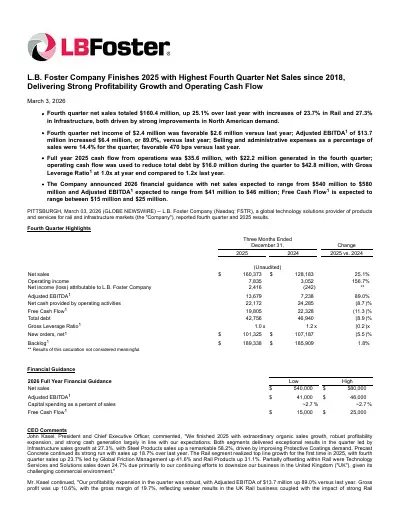
I'm pleased to report we wrapped up 2025 with exceptional sales growth, robust profitability expansion, and strong cash generation, truly a fantastic finish to the year. Net sales of $160.4 million were up 25.1% over last year.
This was the highest fourth quarter sales since 2018. Both segments delivered significant sales growth in Q4, with Rail up 23.7% and Infrastructure up 27.3%.
Gross profit was up 10.6%, while gross margins of 19.7% were down 260 basis points due to weaker rail margins primarily related to our TS&S business in the UK, coupled with greater volume of rail product sales. We delivered strong leverage of SG&A expenses, which were down $1.3 million or 5.2% from last year's quarter.
The Q4 SG&A percentage of sales improved 470 basis points to 14.4%. Adjusted EBITDA of $13.7 million was up a remarkable $6.4 million or 89%, with the increased gross profit and lower SG&A expenses delivering the improvement versus last year.
In line with our seasonal working capital cycle, we also delivered a strong quarter of cash generation, with operating cash totaling $22.2 million. Cash was deployed with capital expenditures at $2.4 million, stock repurchases came in at $3.3 million, and further reduction in net debt of $16.9 million to end the quarter's balance at $38.4 million.
As a result of lower debt levels and improved profitability, our gross leverage ratio improved to 1.0 times, down from 1.6 times at the start of the quarter and 1.2 times last year. I'll now turn to slide 6 to cover some of the key highlights of the 2025 full year results.
Sales of $540 million were up 1.7%, with the full year growth achieved as a result of strong fourth quarter. Infrastructure delivered a strong year with sales up 14.9%.
However, rail sales were down 6.5% due to DODGE-related US government funding impact at the start of 2025, and we continued our proactive scale-down measures with our business in the UK. Adjusted EBITDA of $39.1 million was up $5.5 million over last year, as substantially lower SG&A expenses partially offset by slightly lower adjusted margins.
Operating cash flow also improved in 2025, totaling $35.6 million and up $13 million over last year. We deployed this cash to fund $10.4 million in CapEx, reduce net debt $6.1 million, and fund $14.4 million in stock repurchases under our stock buyback program, which reduced our outstanding shares 5.4% in 2025.
New orders net of $540.9 million were up 6.8% year over year, and overall backlog increased 1.8% to $189.3 million, with substantial improvements realized across our rail business. I'm very proud of what our team has accomplished in 2025, especially the strong finish in the fourth quarter.
Their disciplined execution of strategic playbook continues to manifest in improving profitability and returns, and has positioned us well for expected growth in 2026 and beyond. I'll now turn it over to Bill to cover the financial details for the quarter and year.
I'll come back in the end with closing comments on our markets and outlook for 2026. Over to you, Bill.
Bill Thalman
Thanks, John, and good morning, everyone. I'll begin my comments covering the fourth quarter highlights on slide 8.
As always, the schedules in the appendix provide more information on our financial results, including the non-GAAP disclosure reconciliations. Fourth quarter net sales of $160.4 million increased 25.1%, with higher organic volumes realized in both Rail and Infrastructure.
While gross profit grew 10.6%, gross margins declined 260 basis points to 19.7% due to the weaker results in the UK, coupled with unfavorable sales mix in the Rail segment, partially offset by improvements realized in Infrastructure. More to come on segment sales and margins in a minute.
SG&A as a percentage of sales of 14.4% was down 470 basis points due to lower personnel and administrative costs, despite the substantially higher sales volume. I'll mention here that we completed a further restructuring of our UK rail business in the fourth quarter.
The total restructuring charge in Q4 was $2.2 million, with $1.0 million recorded in gross margin and $1.2 million recorded in SG&A. We expect this program, which included staff reductions and two facility closures, to deliver approximately $1.5 to $2.0 million in run rate savings in 2026.
Adjusted EBITDA for the quarter was $13.7 million, up 89% versus last year due to the higher sales volumes and the resulting improved gross profit, coupled with the lower SG&A expenses. I'll cover cash flow performance along with segment orders and backlog later in the presentation.
We like to remind everyone of the financial performance seasonality we typically see over the year reflected on slide 9. Our sales and profitability are typically strongest in the second and third quarters, with the first and fourth quarters a bit weaker.
This is due to the construction season for our customers in the spring and summer months. The phasing was skewed a bit in 2025 with the abnormally soft Q1 start for the rail business related to the DODGE government funding impacts, with both segments having an exceptionally strong fourth quarter.
As a result, combined Q2 and Q3 sales and profitability as a percentage of the full year are slightly lower than what we would typically see with the strong performance in Q4. As we've seen over the last three years, free cash flow is strongest in the second half of the year as working capital needs unwind in line with the end of the construction season.
I'll next cover segment details starting with Rail on slide 10. Rail fourth quarter revenues totaling $98 million were up 23.7% over last year.
The increase was driven by higher volumes in Friction Management and Rail Products, up 41.6% and 31.1%, respectively. I'll note that the Rail Products sales in Q4 was the highest fourth quarter on record, and Friction Management was strong all year, delivering 19% growth for 2025.
Partially offsetting were lower TS&S sales, down 24.7% due to our downsizing actions in the UK, coupled with softer demand in both the UK and North American markets. Rail margins of 17.8% were down 440 basis points due primarily to lower sales volumes, higher costs, unfavorable sales mix, and the $1.0 million restructuring costs associated with our downsizing efforts in the UK.
Rail margins were also adversely impacted by the dilutive impact of higher Rail Products sales volumes. While rail orders were softer in the quarter, rail backlog was up 55.3% year over year, with substantial gains realized across all three business units.
Turning to Infrastructure Solutions on slide 11, segment revenue increased $13.4 million, or 27.3%, with sales growth realized in both business units. Steel Products sales were up 58.2%, led by a 206.5% improvement in Protective Coatings.
Precast Concrete also continued its strong run with sales up 18.7% for the quarter and 19.9% for the year. Infrastructure gross margins were up 20 basis points to 22.8%, with gains in Steel Products offsetting lower precast margins.
Higher sales volumes and improved business mix drove Steel Products margins up, while Precast Concrete margins were weaker due to unfavorable sales mix, coupled with a $600,000 increase in start-up costs related to our new facility in Florida. Finally, the lower infrastructure backlog reflects the $19 million Summit order cancellation reported back in Q3, as well as lower open orders for bridge forms and precast concrete.
We started last year with an elevated backlog for infrastructure, especially for Precast Concrete. This year reflects a normal level that we expect will increase in the coming months as we enter the construction season.
I'll briefly cover that full year highlights on slide 12. As John mentioned, 2025 sales were up 1.7%, with the strong Q4 results delivering sales growth for the full year.
Infrastructure realized sales growth in every quarter in 2025, while Rail achieved growth in the fourth quarter only due to the weaker start to 2025. 2025 adjusted EBITDA was $39.1 million, up $5.5 million compared to last year, driven by substantially lower SG&A expenses, partially offset by lower margins resulting from the weakness in Rail.
It should be highlighted that the 2025 results included approximately $2.2 million in start-up costs related to our new precast facility in Florida. In addition, reported gross margins and SG&A reflect the costs and charges associated with the UK automated material handling product line exit announced in Q2, and the UK restructuring completed in Q4.
Such costs totaled $1.4 million and $2.2 million, respectively. Finally, I'll mention here that the year-over-year decline in net income was driven primarily by last year's federal valuation allowance release, coupled with a relatively higher effective tax rate this year due to higher UK pre-tax losses not being tax effected.
We expect our effective tax rate to be substantially lower in 2026, with an improved outlook for the UK, which John will touch on in his closing remarks. I'll now cover our liquidity and leverage on slide 13.
We've successfully managed our leverage and debt levels in line with our business profitability and capital allocation priorities. The chart on slide 13 reflects a consistent pattern of steady improvement over time.
In 2025, we generated $35.6 million in operating cash flow and $25.2 million in free cash flow. Over the last three years, our average free cash flow was approximately $28 million, excluding the Union Pacific settlement payments which were completed at the end of 2024.
As a result, we've maintained significant financial flexibility, while also executing our capital allocation priorities. Our capital-light business model, along with the modest cash tax requirements provided by our federal NOL, further enhances our cash generation and financial flexibility to fund our capital allocation priorities, which I'll now cover on slide 14.
Managing our debt and leverage levels remains our top capital allocation priority, and we maintain a disciplined, prudent approach to capital allocation with leverage in mind. At the end of 2025, the gross leverage ratio per our revolving credit facility was just under 1.0 times, a low point in recent years and at the low end of our target range of 1.0 to 1.5 times.
Seasonal working capital needs are expected to elevate our debt and leverage somewhat in early 2026, but we should stay around our target range and realize improvements in the second half of the year in line with our normal cash cycles. Capital spending in 2025 totaled $10.4 million or 1.9% of sales.
We have several targeted organic growth programs within our Precast Concrete business that we expect will increase the CapEx rate of sales to 2.7% in 2026. Share repurchases are an important capital allocation priority for us, and we have $28.7 million remaining to spend on our buybacks under the most recent authorization approved in February of 2025.
We repurchased approximately 121,000 shares for $3.3 million in Q4, and we repurchased just over 1 million shares or approximately 9% of the shares outstanding at an average price of just under $23 per share since restarting the program back 3 years ago. Finally, we also continue to evaluate tuck-in acquisitions to add breadth to our growth platforms, primarily in the Precast Concrete market space.
My closing comments will refer to slides 15 and 16, covering orders, revenues, and backlog trends by business. The trailing 12-month book-to-bill ratio at the end of Q4 was 1:1, improved from Q4 last year, but down from Q3 with the strong Q4 sales.
Rail order rates have begun to recover with the TTM ratio at 1.11:1, and I'll highlight that Friction Management orders were up 58.4% in Q4. Lower net orders in Infrastructure drove the lower trailing 12-month ratio to 0.87:1.
Summit order cancellation reported in Q3 was the primary driver of the decline. Lastly, the consolidated backlog reflected on slide 16 totaled $189.3 million, up $3.4 million over last year, with substantial improvements across all rail businesses, partially offset by lower infrastructure backlog.
The shifts in the backlog suggest a stronger start for our rail business in 2026 compared to last year, with infrastructure growth developing later in the year after the strong results achieved in 2025. John will cover some additional backlog details and developments in his closing remarks.
I'll wrap up by saying we're very pleased with our financial performance in 2025 and excited about the prospects for further progress in 2026. Thanks for your time this morning.
Back to you, John.
John Kasel
Thanks, Bill. I'll begin my closing remarks on slide 18, reviewing developments in our key end markets.
Starting with Rail segment, we're seeing favorable trends in bidding activity that give us optimism that we will return to growth in 2026. The federal government programs that fund our customers' repair and maintenance projects are active and flowing, and we expect that this will provide a tailwind for demand for rail products in US for the foreseeable future.
Of course, we'll monitor developments in Washington to respond to any changes in funding should they occur. Turning to rail technologies, Friction Management had a phenomenal year in 2025 with 19% sales growth, noting that this growth was all organic.
We continue to invest our commercial technology capabilities for this important growth platform, and expect continuing long-term growth aligned with our customers' focus on safety, fuel savings, and operating performance. The Total Track Monitoring product line was somewhat flat in 2025, but we're expecting improved demand in 2026 with the commercialization of some new technologies that improve rail safety and operating ratios.
The UK market environment remains extremely challenging. We've taken significant actions in the last 3 years to reposition this business and expect it will lead to improved results in 2026.
We also see some market trends worth mentioning for our Infrastructure segment. Starting with civil construction activity, remains robust, particularly in the southern part of US, which is bolstering demand for Precast Concrete products.
Demand for our Enviro-Keeper water management solution is increasing, with some large projects wins already in our backlog. These improvements are partially offsetting softer demand for CXT buildings in the short term.
This product line had a record year in 2025, and bidding activity is starting to pick back up. The softer residential real estate market has impacted demand for our Envirocast wall system product line in our new Florida facility.
We remain optimistic that a lower interest rate environment and favorable population trends will improve demand in the future. Within Steel, our Protective Coatings product line sales improved 42.7% in 2025 with the renewed interest in US oil and gas production, and we expect these favorable trends to continue to '26 as well.
A quick comment on tariffs. As in the case for most domestic markets, the impact of rising tariffs is being absorbed and managed by our supply chain and commercial teams.
I can confidently say that tariffs have had a minor impact on our business. In summary, we expect the start to 2026 to be stronger than last year, and we believe we are well-positioned to benefit from the infrastructure-based investment plans for years to come.
Turning to slide 19, I'll wrap up today's call with an overview of our 2026 financial guidance. I'll start by highlighting the significant progress we have made since we launched our strategic transformation back in 2021.
While last year's sales were up only 5% since 2021, adjusted EBITDA has more than doubled, and free cash flow is up $30 million. The capital deployed in the business is also much lower, significantly improving financial results.
Our 2026 guidance anticipates continuing sales growth, profitability expansion, and strong cash generation, while investing in our growth platforms. Bill mentioned earlier that our backlog was approximately $189 million at year-end, up 1.8% versus last year.
While the increase is modest, there are some important shifts in the backlog that should be highlighted and are support for our optimism in 2026. Starting with the rail backlog, which is up $34.5 million versus last year.
The increase is driven in part by stronger North American demand for both Rail Products and Friction Management. Rail Products backlog is up $10.6 million, while Friction Management is up $7.6 million.
The balance of the increase was realized within our TS&S, with the UK business securing a $20 million multiple-year order last year. The higher executable backlog for rail should translate into a better start for 2026 versus last year's weaker first half, when the pause in federal funding curtailed rail customer project work.
While infrastructure backlog is down $31.1 million, the majority of the decline is due to the Summit order cancellation. In addition, the Precast Concrete backlog is down $5.4 million, with slightly lower CXT building backlog to start 2026, after a record year in 2025 for this product line.
As a reminder, precast business grew 19.9% in 2025. This impressive growth was all organic.
I'm pleased to report that project pipelines are robust and bidding activities picking up in both segments. During the first 2 months of 2026, overall backlog is up above 15% from year-end, with solid gains realized in both segments.
Our 2026 guidance reflects 3.7% sales growth, with a 11. 11.3% growth in adjusted EBITDA, both at the midpoints of the range.
Free cash flow is expected to remain robust at the midpoint of $20 million, with a slightly higher CapEx rate of 2.7% of sales as we invest in organic programs, primarily in Precast Concrete. In summary, our 2026 guidance reflects our expectation of another solid year and improvement in financial performance, while investing for future growth along our strategic priorities.
I'll close today's call by thanking our team for a fantastic 2025. It was a challenging year in many ways, but our team was resilient, and we finished the year strong, in fact, one of the best quarters we've seen in recent years, and we're carrying that positive momentum into 2026.
I'm coming up on my fifth year anniversary as CEO in July, and I could not be more proud of what our team has achieved over those 5 years. I look forward to greater accomplishments in '26 and beyond.
Thank you for your time and continuing interest in L.B. Foster.
I'll turn it back to the operator for the Q&A session now.
Operator
Thank you. As a reminder, to ask a question, please press *11 on your telephone and wait for your name to be announced.
To withdraw your question, please press *11 again. One moment for our first question.
Our first question will come from the line of Liam Burke with B. Riley Securities.
Your line is open, please go ahead.
Liam Burke
Thank you. Good morning, John.
Good morning, Bill.
John Kasel
Morning, Liam.
Liam Burke
John, it looks like with the orders in both Friction Management, Rail Products that segment will look a little more normal than it did in 2025 based on the UK problems and DOGE opening the year. Only thing we're seeing is maybe Track Monitoring flat, but that's project-based.
Is there anything else that would keep you from having a more normal year in Rail Products this year?
John Kasel
No, well, thanks Liam for joining us today. I think you hit it on the head.
We finished the year down about $189 million, and the reason being we delivered. Our billings were fantastic.
The bookings really picked up here, as I mentioned, up 15% since the end of the year, with equal weighting, I would say, throughout Rail Products and the infrastructure precast business. As you mentioned, we're back to normal.
We feel, in fact, we're closer back to normal in the fourth quarter last year, bidding activity and the need is there today. Our team feels very good about the start to the year and our ability to see that guidance, the increase of revenue they're looking for profitability.
It's kind of refreshing to have that now compared to where we were just a year ago.
Liam Burke
Great. Thank you.
On concrete, you had the order cancellation. You have normal quarter-to-quarter variability anyway.
You touched on order activity being pretty solid in the first quarter. Do you anticipate a better cadence for concrete as we get into the third and fourth quarter this or second and third quarter this year?
John Kasel
Same. We're starting to pick up some nice backlog as well as on the total infrastructure side and steel as well, which ended very strong back end of the year.
We're starting to see the energy business, our specific facilities down in Texas, as well as Birmingham, starting to build up backlog. Then we were a little light coming into the year because of the building side, but we pretty much shored that up in the first two months already.
Again, our facilities are basically running at capacity right now for at least the first half of the year. We'll see definitely pick-ups in the second half here, especially as areas like Florida with our new facility really come online.
We'll be excited about that.
Liam Burke
Great. Thank you, John.
John Kasel
Thanks, Liam.
Operator
Thank you. As a reminder, to ask a question, please press *11 on your telephone.
Our next question comes from the line of Julio Romero with Sidoti & Company. Your line is open, please go ahead.
Julio Romero
Thanks. Hey, good morning, John, Bill, Lisa.
Maybe to start Good
John Kasel
morning, Julio.
Julio Romero
Hey, good morning. Hey, maybe to start on the 2026 guidance ranges that imply sales growth of about flatish to 7% on the sales line, and then EBITDA growth of 5% to 18%, I believe.
Just talk about what the puts and takes are that you think can get you to the high and the low end of those ranges.
John Kasel
I think Liam hit it right there. It's about work and backlog and less disruptions.
The need is, we're an infrastructure company in the right market right now with industrials. Our customers need our product.
We're feeling much different about the start of the year than we were last year. Order book is strong, and the bidding activity is as good as we've seen in recent years.
We feel good about bringing the revenue in. Now we got to really shore up some things.
We had, as we mentioned, some things in the UK, and we've done now 3 years of really right-sizing that business to protect the company and protect the margins. We feel good with what's going on specifically here on the rail side.
RFM business, as I mentioned, you look at our growth platforms here, Julio, you look at precast, as well as rail, both of them up respectively 20% in the fourth quarter. All the activity we talked about was all organic.
It really bodes well for the capital that we're bringing into the company. As I mentioned, we took up the capital as a percent of sales a little higher this year, 2.7%, because we feel very, very good about the opportunities we have in front of us.
The reality is we have to increase capital now to stay up with the need, specifically on the rail side and the precast side. Then we're back-filling some of the work that we need to do on the coating side as well.
Right now we're really focused on producing the backlog and executing well coming into the first quarter and first half of the year in much different position we were just 1 year ago today.
Julio Romero
Absolutely. Thank you for that answer.
I was just hoping to go a little bit deeper into the cadence of the quarter-to-quarter rail revenues expected in 2026. Obviously difficult to foresee any DOGE-like events kind of driving delays for your customers,
John Kasel
but absent
Julio Romero
an event like that, you mentioned you feel better about rail right now than maybe this time 1 year ago. Just speak about the confidence of the quarter-to-quarter cadence
John Kasel
of
Julio Romero
rail top line.
John Kasel
Yeah. Remember, we're a construction seasonal company, too, right?
As far as rail, they really don't get in and do much as far as refurbishments until the weather improves heading into second, third quarter, right? Right now it's about bringing us orders, and we're providing them the materials for them to get on track and do what they need to do to shore up things in the second, third quarter.
We're looking more of a typical bell curve, if you will, this year with the highest revenues coming in Q2 and Q3, Julio. Unlike what we had to do this year, make it all happen in the fourth quarter, we're going to see quite a bit more work and activity and sales happen in the first half of the year, specifically in Q2 and then continuing in Q3 compared to what we had just last year.
We're set up to do it. When the customers come and the need is there, we pivot, and we do very well executing.
I think it's going to look like a much more normal year this year on the rail side and including on the precast side. We feel very good about the performance we're having coming out of our concrete group.
We've done a good job of stabilizing our acquisition that we made back in 2023, and we're starting to really move product to the East Coast. Then we had a record year in our Hillsboro facility.
The plant manager there, Jason Busby, just done an outstanding job with record revenue coming out of that facility. We feel very, very good about what we see specifically with our growth platforms and their ability to perform and do it more consistently this year than getting in a hole like we had last year and having to come out of it in the fourth quarter like we did, and we communicated to the market.
I think the other thing that we're really focused on is our debt. For us to be down to 1.0 times to really manage the working capital that you see here today, as well as the cash generation, we're very pleased with the really focus on bringing the cash back to the shareholders and getting our debt to something, well, we finished the year 1.0 times.
We're very proud of all those activities.
Julio Romero
Absolutely. Fair point about the inherent seasonality of construction in your business.
I guess I'm just asking because you had such a funky, for lack of a better word, sales cadence in '25 on the revenue line. Thinking about the year-over-year growth rates for rail in '26, is it fair to expect year-over-year sales growth in the first half of '26, and would you expect the year-over-year growth rates to be more weighted?
Or I guess just help us think about that given the fact that the 2025 comps are so skewed.
John Kasel
Let me give you a little color, and then I'll let Bill give you a few specifics. Last year, remember DOGE, right?
At this time last year, the POs were curtailed because basically much of what we see, especially on the Rail Products side, 55% of what we have flows through the government. There were just a number of projects that we're looking for that didn't happen.
We were basically in a waiting game. The need was still there, but the funds, as well as the POs, weren't flowing.
It really put us behind the eight ball, if you will, for the first half of the year, and we were able to make it up for the most part in the second half of the year because we have very good supply chain partners and our ability to flex our workforce and get the product out to the customer. The good news is that demand and requirement has continued now from the fourth quarter into the first quarter of this year.
That's where things are completely different. We're getting the POs, the bidding activity's there, and most importantly, the need is there.
We're in the maintenance and refurbishment part on the rail side, the needs to the market are there, and the good news is we're there to deliver. Maybe Bill can give a little more color on the
Bill Thalman
phasing. Julio, I guess the way I would look at it is if you just take what you would layer out as a run rate in terms of your outlook for rail, if you convert that to a normal seasonality that we would typically see, you're probably going to find that there's going to be some growth in rail in Q1, and stronger growth in Q2 and Q3 just based on the normal seasonality.
Then with the extraordinarily strong Q4, the growth potentially not be as strong there or potentially not covering the extraordinarily strong Q4 that we had. On the infrastructure side, I'd say as John mentioned, the backlog's improving, but we started the year with a little lighter backlog.
I would say that it's still going to be a solid year of growth, but that's probably going to be more towards the second, third, and fourth quarters of the year, as opposed to getting off to a strong start like we did last year. I think John mentioned our backlog was elevated at the beginning of the year with a strong buildings backlog.
We executed against that in last year's Q1. Infrastructure may be a little lighter, but strong sales growth to start the year for rail.
Julio Romero
Super helpful. Thank you, Bill, and John, for that.
I guess just last one before I turn it over is just wanted to comment on, you really did have really extraordinarily strong free cash flow in the fourth quarter. If you could just speak to the drivers of that, and how much of a function of that is kind of the structural things you've done as an organization?
John Kasel
If you look at the last couple of years, we do that pretty frequently, how we manage the fourth quarter, right, because of our working cycle needs. We have a big lift in working cycle really to raw materials coming in Q2, Q3 because of the seasonality, and that's our largest sales.
We're bringing in materials, and then we do a good job of moving those materials out and then collecting on our bills in the fourth quarter. We got a really good team that makes those things come together and make those things happen.
We did the same thing last year, 1.2 times that we finished the year. We finished this year, that last year being the year of 2024, and then, of course, we finished this year at 1.0 times.
We're good at it. Now, we want to make sure that we keep that focus, but at the end of the day, it's also about making sure that we're delivering to our customer.
Behind all this is, it's good quality systems, on-time deliveries, and make sure that we don't have customers that have reasons not to pay us. There's also a very good performing part of this that makes sure that when we ship something, it doesn't come back and we have delighted customers.
Julio Romero
Great. Thank you for all the color.
I'll pass it on.
John Kasel
Thanks, Julio.
Operator
Thank you. One moment for our next question.
Our next question comes from the line of Justin Bergner with GAMCO Investors. Your line is open, please go ahead.
Justin Bergner
Good morning.
John Kasel
Morning, Justin.
Justin Bergner
Lots been covered, but I just want to delve into some areas that maybe would be great to get some more clarity on. The Total Track Monitoring, could you provide some discussion as to the puts and takes there on the fourth quarter and looking forward?
John Kasel
All right. We mentioned it was somewhat flat last year related to the activity.
That is true. We've been doing quite a bit of work behind the scenes and continue work on technology innovation, which I mentioned in today's call.
We have some things that are coming to the market that help shore up what that business is and keep bringing in next generation of product for condition monitoring to the marketplace. Our team was very active.
We had a significant job that we're working on abroad last year, too. It took away a little bit of our time and attention to the North American market, but we feel very good about where we're at today.
We've built up that team. We have spent our available SG&A to bring the technical resources here in the US moving from the UK.
We're really set up well to deliver our Mark IV application. Then as we've been talking about this rockfall installation that we're seeing pretty well, significant excitement in the marketplace today.
Last year was really getting ourselves shored up to make this happen, to make sure it was supported, make sure we had our operating centers ready to perform. We're looking for big things out of that group in '26 and beyond.
Justin Bergner
Got it. Then secondly, the Protective Coatings business, should we expect double-digit type growth there in 2026?
John Kasel
I think we're going to be right up to it. It's, and I think what's going around right now in the world related to energy and the need for more energy here in US is probably going to continue to put us in a better position as far as volume and activity for the balance of the year.
Again, we spent some money in those facilities. We brought in some new equipment to make us more efficient to be able to produce more product.
As those orders come in, we're going to be ready to deliver in a big way that we haven't done in years past.
Justin Bergner
Great. Then lastly, the headwinds to EBITDA in the quarter, you mentioned the UK rail business.
I guess your adjusted EBITDA adds back a lot of the restructuring expenses. In light of that,
John Kasel
That's right.
Justin Bergner
any clarity on sort of even after adding back those restructuring expenses, what caused the fourth quarter to be a little bit light versus your expectations?
John Kasel
Yeah. As far as the UK, this has been a three-year plan now, really getting ourselves aligned to the market needs over there because it's been changing.
It's been dynamic. It was a big part of our growth initially, and as that market has changed, we've been pivoting and adapting our business to those needs.
I think we've done a very good job of right-sizing the business. The materials handling part of that was the last step that we've done getting ourselves in position to end the year strong, much stronger over there than where we were just a year ago.
Bill, maybe you could give a little additional color you would like as far as Q4 other puts and takes?
Bill Thalman
Yeah. Justin, as John mentioned, it's been three years of a restructuring and downsizing effort there.
What we're seeing coming through in the in the fourth quarter is basically what I would call us wrapping up those final steps of us of of those downsizing efforts. The margin impacts were a result of the lower sales volume.
There was definitely manufacturing deleveraging that occurred as a result of that, some higher costs that came through. Then we also had some longer-term legacy commercial contracts that we resolved within the quarter.
That all and and resulted in a headwind for margins in the UK in the fourth quarter. I guess what I'd like to highlight is we're seeing improvement on a run rate basis moving into 2026 already, and we expect that to continue to improve as we go into the year.
Justin Bergner
Got it. That's very helpful.
If I could throw in one last one, just the infrastructure backlog, you mentioned it was up from the end of the year. Is it up modestly or is it up material?
If obviously you're only one month away from the end of the quarter, should we expect to see a nice uptick in the backlog for infrastructure?
John Kasel
We are up 15% since the end of the year.
Justin Bergner
Gotcha. All right, thanks so much for taking
John Kasel
Thanks, Justin. Thanks for joining us today.
Operator
Thank you. I'm showing no further questions, and I would like to hand the conference back over to John Kasel for closing remarks.
John Kasel
Thank you, Michelle, and thank you for joining us today. I'd like to leave you with one thing that we mentioned several times, but I think is really, really important to the culture and fabric of our company.
I mentioned that in July will be my fifth year as CEO of the company. One of the things that the leadership team here has really been focusing on is our culture.
L.B. Foster's, we're in our 124th year.
That really says something about the company. A lot of people have worked here for their entire career.
What really makes us tick is our value system. First and foremost is our focus on the people and safety, our safety results.
The last two years have been respectively the best years we have had in the 124 years as far as safety performance, which it's not just the number, it's all the activity and the focus and the attention to our people, the process, putting money back in the facilities, the yards, and letting people know that they're important. When you have all those things come together, you're a more profitable company, and you're really providing the value to shareholders.
I think that's something that's sustainable. I'd like to recognize Ben McClellan.
Ben started with the company just about 25 years ago, in October, he'll hit 25 years. Ben is the Director of Environmental Health and Safety.
He's basically been in that role since he joined the company. Let's just say 25 years ago, L.B.
Foster was not what it is today. We did not have great safety performance.
There was a lot of effort and a lot of activities to make that happen, but the reality is it took time. It took dedication, it took focus, it brought in new skill sets.
Ben was always there, and he was always pulling the levers, as well as keeping the pieces together. I'd just like to thank Ben for all your efforts, all your focus, all your drive, and really putting L.B.
Foster at the forefront of being world-class and how we do things, and to be an extension of not just the shareholders, but our customers as well. Thank you for your time today, and look forward to meeting or hooking up with you after we finish Q1 results.
Take care.
Operator
This concludes today's conference call. Thank you for participating, and you may now disconnect.