L.B. Foster Company
NNASDAQ:FSTRQ2 FY2026 · Earnings Call TranscriptAugust 10, 2026
Operator
Good day, and welcome to the L.B. Foster Second Quarter 2026 Earnings Conference Call.
At this time, all participants are in a listen-only mode. After the speaker presentation, there will be a question-and-answer session.
To ask a question during the session, you will need to press *11 on your telephone. You will then hear an automated message advising your hand is raised.
To withdraw your question, press *11 again. Please be advised that today's conference is being recorded.
I would now like to hand the conference over to your speaker, Lisa Durante, Director of Financial Reporting and Investor Relations. Please go ahead.
Lisa Durante
Thank you, operator. Good morning, everyone, and welcome to L.B.
Foster's second quarter of 2026 earnings call. My name is Lisa Durante, the company's Director of Financial Reporting and Investor Relations.
Our President and CEO, John Kasel, and our Chief Financial Officer, Sean Reilly, will be presenting our second quarter operating results, market outlook, and business developments this morning. We'll start the call with John providing his perspective on the company's second quarter performance.
Sean will then review the company's second quarter financial results. John will provide perspective on market developments and company outlook in his closing comments.
We will then open up the session for questions. Today's slide presentation, along with our earnings release and financial disclosures, were posted on our website this morning and can be accessed on our Investor Relations page at lbfoster.com.
Our comments this morning will follow the slides in the earnings presentation. Some statements we are making are forward-looking and represent our current view of our markets and business today.
These forward-looking statements reflect our opinions only as of the date of this presentation, and we undertake no obligation to revise or publicly release the results of any revisions to these statements in light of new information, except as required by securities laws. For more detailed risks, uncertainties, and assumptions relating to our forward-looking statements, please see the disclosures in our earnings release and presentation.
We will also discuss non-GAAP financial metrics and encourage you to carefully read our disclosures and reconciliation tables provided within today's earnings release and presentation as you consider these metrics. With that, let me turn the call over to John.
John Kasel
Thanks, Lisa, and hello, everybody. Thanks for joining us today for our second quarter earnings call.
Before I commence my remarks, I want to welcome Sean Reilly, who was promoted CFO effective June 1st. Also present with us on the call is Bill Thalman, who was appointed COO on that same date.
Congratulations to both Sean and Bill on your promotions. I'll begin on slide 5, covering the key drivers of our second quarter results.
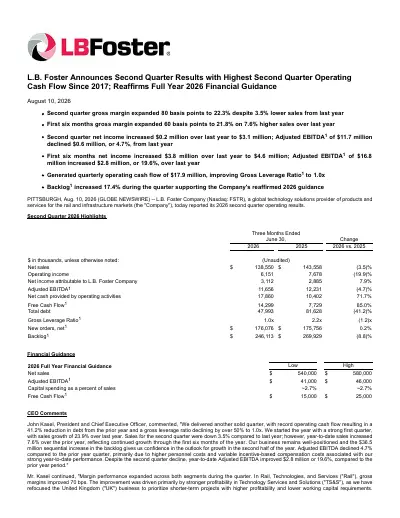
As you can see from the earnings release, we delivered another solid quarter with cash generation of $17.9 million, reaching the highest second quarter level since 2017. Net debt was reduced by $13.5 million or 24.2% during the quarter, and by $35.2 million or 45.5% compared to last year.
As a result of lower debt levels and improving profitability, our gross leverage was cut by over 50% from 2.2 times last year to 1.0 times at quarter-end. As expected, revenue in the second quarter declined by 3.5% as sales were pulled forward to the first quarter, which resulted in top-line growth in the quarter of 23.9%.
All in, sales for the six months increased by 7.6% over last year, reflecting the strong start to the year. During the quarter, we continued our strategic shift in the UK with the announcement of exit of certain non-core product lines within our two engineering business, incurring $2.6 million of exit-related costs.
Adjusted EBITDA in the second quarter was down 4.7% from last year, driven by higher personnel costs, including incentive-based compensation expense. This is due to the strong year-to-date performance, with adjusted EBITDA increasing by 19.6% compared to last year.
In summary, we're pleased with the second quarter and first half of the year. Along with our current robust backlog, we remain confident about the second half of the year.
I'll cover the market outlook and financial guidance for the year after Sean runs through the financial details for the quarter. Over to you, Sean.
Sean Reilly
Thanks, John. Good morning, everyone.
I'll begin my comments on slide 7, covering the consolidated results for the second quarter. Our business can experience variability from quarter to quarter, given the timing of customer orders and shipment.
On a year-to-date basis, our results continue to outperform last year, reflecting strong underlying demand across our business. Net sales for the quarter were $138.6 million, a 3.5% decline from last year due to the timing of customer orders within our Rail Products business.
Consolidated gross profit was flat in the quarter, with gross margins improving 80 basis points to 22.3%, driven by favorable business mix. Gross profit for the quarter included a $2.1 million charge related to the two product line exits.
Last year, gross profit included a $1.1 million charge associated with the exit of our Automation business in the UK. I'll provide more color on the segments later in the presentation.
SG&A expense totaled $24.1 million, increased by $1.7 million or 7.7% compared to last year. As John indicated, the primary driver of the increase was attributable to higher employment costs, including $1.1 million in variable incentive-based compensation associated with our strong year-to-date performance.
SG&A expense in the second quarter includes a $0.5 million charge related to the two product line exits and other non-recurring costs. Adjusted EBITDA was $11.7 million, down 4.7% versus last year, driven by SG&A expense.
The higher effective tax rate for the quarter was due to UK pre-tax losses where we do not recognize a tax benefit. As John highlighted, second quarter cash flow was $17.9 million, an improvement of $7.5 million over last year due to lower working capital.
Lastly, consolidated orders improved slightly compared to the prior year, while the backlog was lower by 8.8%, due in part to an order cancellation in the third quarter of last year. Sequentially, backlog improved 17.4% from the first quarter and illustrates the variability that can occur within the business on a quarterly basis.
The financial profile of our results on slide 8 highlight the seasonality in the business over the last three years, with sales and adjusted EBITDA concentrated in the second and third quarters in line with typical construction seasons. We anticipate 2026 having a similar pattern for sales.
However, our free cash flow has deviated from historical trends, with the strong cash generation in the second quarter due to lower working capital. I'll cover the segment performance on the next couple of slides, starting with Rail on slide 9.
Second quarter sales were $72 million, down 5.2% compared to last year, driven by order timing in Rail Products. Partially offsetting Rail Products was Global Friction Management, where sales increased 18.1% as this growth platform continued to perform well.
Technology Services and Solutions sales were also up 66.9% due to short-term project work in our UK business. Rail margins of 20.6% were up 70 basis points, driven primarily by favorable sales mix, despite incurring an additional $1 million of exit costs.
Turning to rail orders and backlog, Q2 orders were down 1.9% due to the timing of large orders in Rail Products. Global Friction Management and Technology Services and Solutions continued to perform well, with orders up 27.8% and 126.4%, respectively.
The growth in Technology Services and Solutions was due to UK short-term project work. Rail backlog was up 8.2% due to a large order received in our UK business late last year.
Turning to Infrastructure Solutions on slide 10, net sales decreased $1 million or 1.5% compared to last year. Steel Products sales declined $2 million, primarily due to lower volumes in our threaded water well product line.
This was partially offset by a $0.9 million improvement in precast concrete, reflecting continued demand across this key growth platform. Infrastructure gross profit increased $0.3 million with margins up 80 basis points to 24.1%.
This was due to favorable sales mix and manufacturing efficiency. Infrastructure orders increased $2.5 million or 4% due to improved order intake in the protective coatings businesses.
Partially offsetting was precast concrete orders that declined $7.4 million or 15.4% versus last year. Infrastructure backlog totaled $104.7 million at quarter-end, a decrease of $34.5 million from last year.
$19 million of this decline was associated with the Summit pipeline coating order that was canceled in Q3 last year. Precast concrete backlog was also lower by $16 million due to lower order activity and quicker turn projects.
As we have discussed, order activity can be lumpy. Our infrastructure backlog in July increased by approximately 10% from June, with increases in both Steel Products and precast concrete.
Next, I'll cover some of the key takeaways from our year-to-date results on slide 11. Sales in the first half increased 7.6% to $259.7 million, driven by growth in both segments.
Rail increased 12.9%, driven by strong sales growth in our Global Friction Management and Technology Services and Solutions businesses, delivering 27.4% and 46.7% growth, respectively. Infrastructure sales increased 1.4%, led by precast concrete, which increased 7.8% over last year.
Year-to-date gross profit increased $5.5 million due to higher volumes and favorable business mix, with gross profit margins expanding 60 basis points to 21.8%. SG&A costs increased $3.8 million over last year, attributable to higher employment costs, including $2.3 million in variable incentive-based compensation expense associated with our strong year-to-date performance.
Variable incentive expense includes $0.5 million for accelerated stock compensation associated with retirement-eligible employees. Adjusted EBITDA was $16.8 million, up 19.6% versus the prior year, driven by higher sales volumes and gross profit improvement.
Operating cash flow was $7.4 million, favorable $23.2 million compared to last year, due to higher profitability and lower working capital needs. Orders declined by 2%, reflecting modest decreases in both segments.
I'll next cover liquidity and leverage metrics on slide 12. The chart highlights the significant progress we have made in strengthening our balance sheet through debt reduction and profitability expansion.
Net debt of $42.2 million was down $35.2 million compared to last year, while our gross leverage ratio was reduced by more than half to 1 times. Our capital-light business model has enabled the company to generate substantial cash flow, enabling us to invest in the business while maintaining a strong financial position.
We have approximately $71 million in federal NOLs available, which should continue to minimize the cash taxes paid for the next several years. Turning to capital allocation on slide 13, managing our debt and leverage at reasonable levels remains our top priority.
At the end of the second quarter, our gross leverage ratio per our revolving credit agreement was 1 times, well within our targeted range of 1 to 1.5 times. While seasonal working capital requirements may increase debt during the second half of the year, we expect to stay within our targeted leverage range.
We remain committed to investing in our growth platforms, with capital spending targeting organic growth initiatives within our precast concrete business. We expect capital spending to be approximately 2.7% of sales in 2026.
Share repurchases remain an important component of our capital allocation strategy. Since early 2023, we have repurchased more than 1 million shares, representing 9.3% of shares outstanding.
While we did not make any open market repurchases in the second quarter, we have $28.7 million remaining to spend on buybacks over the next two years. Finally, with our strong balance sheet and available borrowing capacity, we will continue to evaluate acquisitions that complement our portfolio, with a primary focus on the precast concrete market.
I'll finish my remarks with some additional color on order rates and backlog on slide 14 and 15. As we have noted previously, order activity can be lumpy from quarter to quarter, given the project-based nature of many of the end markets we serve.
We believe trailing 12-month metrics provide a meaningful view of underlying demand trends. On a consolidated basis, the trailing 12-month book-to-bill ratio at the end of the second quarter was 0.96 to 1, which represents a modest improvement from the first quarter, but below the prior-year levels.
The year-over-year decline was driven by Infrastructure, with a trailing 12-month book-to-bill ratio of 0.85 to 1, primarily due to the Summit order cancellation impacting Steel Products, as well as softer precast orders. Rail order activity remained healthy with a ratio of 1.03 to 1.
Turning to slide 15, consolidated backlog was $246.1 million at the end of the quarter, down $23.8 million from last year. This was primarily driven by the $19 million Summit order cancellation, as well as lower precast concrete order levels.
Rail backlog improved 8.2% from the prior year due to a large order received in the UK. I'll close by saying we are very pleased with our 2026 results, including our cash flow generation, debt levels, and our strong year-to-date sales and EBITDA growth.
Thanks for the time this morning. I'll now hand it back to John for his closing remarks.
Back to you, John.
John Kasel
Thanks, Sean. Great job.
I'll begin my closing remarks on slide 17, reviewing developments in our key end markets. Starting with Rail, the federal programs that fund our customers' repair and maintenance projects remain active, with no significant disruptions evident today.
Importantly, a significant portion of available CRISI grants remains available, and we continue to expect those funds to support future growth project activity. For Infrastructure, end markets developments remain favorable as well.
Starting with Steel Products, market conditions remain favorable and are supported by continued strength in the domestic energy market, which has benefited our protective coating businesses. In precast, robust civil construction activity across key geographic markets continues to support demand for our products, providing a positive outlook for the business.
In summary, we are encouraged by the strength of demand across the entire business. While the broader geopolitical and macroeconomic environment remains dynamic, we have not experienced a material impact on demand for our offerings.
We will continue to monitor these conditions closely and remain focused on executing our strategy. Turning to slide 18, I'll begin by highlighting the significant progress we have made over the past several years and the strong execution our teams continue to deliver.
Following our 2025 accomplishments, we carry that momentum into 2026 and are very pleased with our performance through the first half of the year. Our year-to-date results reflect solid year-over-year growth and profitability improvements, and set the stage for a strong second half.
While order activity can fluctuate, as Sean talked about, our current backlogs of $246.1 million positions us well for a strong second half of the year and reaffirmation of the full-year financial guidance. Before we move to Q&A, I'd like to take a moment to recognize some important leadership transitions.
First off, Greg Lippard has announced plans to retire at the end of the year following an outstanding career at the company. We are grateful for his many contributions and leadership he has provided over the years, and wish him well in retirement.
At the same time, excited to announce several internal promotions, including Bill Thalman's move to Chief Operating Officer, and Sean Reilly's appointment to Chief Financial Officer, as I mentioned at the start of the call. Additionally, Jason Bowling has been appointed to succeed Greg Lippard as SVP of Rail, and will work closely alongside him to ensure a seamless handoff.
We're also promoted TJ Kerr to Controller and Principal Accounting Officer, Rich Burnside to Senior Vice President of Supply Chain, and Brandon Vernon to Senior Vice President of IT. I'd like to congratulate each of these leaders on their new roles, and once again thank Greg for his contributions to the company.
Thank you for your time and continued interest in L.B. Foster.
I'll turn it back to the operator for the Q&A session.
Operator
Thank you. As a reminder to ask a question, please press *11 on your telephone and wait for your name to be announced.
To withdraw your question, press *11 again. One moment while we compile the Q&A roster.
Our first question will come from the line of Laura Mayer with B. Riley Securities.
Your line is open.
Laura Mayer
Hi, good morning, John, Sean, and Bill. Thanks for taking the question.
John Kasel
Thanks, Laura. Good morning.
All right.
Laura Mayer
My first question, backlog grew pretty materially quarter-over-quarter, driven by Rail. You called out a large order in the UK.
Can you size that order and what's the revenue recognition timeline on that?
John Kasel
Sure. Thanks for recognizing.
Sequentially, our orders did improve significantly between Q1 and Q2. Bidding activities has been as strong as we've seen it in recent periods or recent times.
We're very encouraged with what's going on, and that continued in July as well as far as orders continuing for a strong start into Q3 as well. UK, we had a nice order there and I think Sean, if you want to give a little details on that?
Sean Reilly
Perfect. Thank you, John.
That order goes out quite a bit of time, a couple of years, and it is currently about £15 million.
Laura Mayer
Great. Thanks.
Then for my second question, how much of the backlog converts in second half of '26 versus 2027, given guidance implies roughly $280 to $320 million in second half sales, and how much visibility does current backlog give you towards the midpoint?
John Kasel
Our backlog is project-related, but many of those projects are third and fourth quarter type projects for us. I'd say at least 80% will execute this year.
Of course, we'll continue to get more orders to fill out the balance of Q3 and Q4, but we got at least 80% that will execute between now and the end of the year.
Laura Mayer
Great. Thanks.
I'll pass it on.
John Kasel
Thanks, Laura.
Operator
Thank you. As a reminder, if you would like to ask a question, please press *11.
Our next question will come from the line of Julio Romero with Sidoti. Your line is open.
Julio Romero
Thanks. Hey, good morning, everyone.
John Kasel
Hi, Julio.
Julio Romero
Hi. Very very nice operating cash flow here in the second quarter.
Can you discuss what's implied for the second half, both on an operating cash flow and a free cash flow basis?
John Kasel
Let me start and I can have Sean, he's anxious to add some colors to this, so. Thanks for recognizing the cash flow, which is not typical in a Q2 for us, because we usually are building up a lot of inventory, working capital, for a big Q3 push.
That wasn't the case. Our teams really delivered in the quarter, at $17.9 million.
I think I mentioned that we haven't seen results like that since 2017. That's absolutely fantastic.
With our debt down to 1.0 times, coming off the 2.2 times where we were just a year ago, we feel very strong about where we're at in the balance sheet. As far as the balance of the year, Sean, you want to give a little color on what the thinking is?
Sean Reilly
Perfect. Thank you, John, and good morning, Julio.
We are holding our guidance, we have free cash flow of low end $15, high end $25, midpoint $20 million. Year-to-date, we have just a little under a million dollars of free cash flow, the majority of that free cash flow will come in the second half.
We still are targeting capital spending at right around 2.7% of sales, at the midpoint, about $15 million of cap spend. That's kind of how it's developing.
Julio Romero
Perfect. Then my follow-up is, you talked a little bit about the backlog earlier.
Just how much of I guess your guidance range is implied here both on a sales and EBITDA basis is kind of based on the Rail Products order timing hitting? What's not baked in that?
Kind of what's the expectations for the Infrastructure Solutions segment based on the guidance ranges? Thank you.
John Kasel
We have strong bidding activity across the board right now, and then orders coming in are solid. Even on the precast side with the Great American Outdoors Act, which is towards the end of that program.
We're very encouraged with what we're seeing today as far as activity. Infrastructure is strong as well.
The piece that we're starting to really see pick up now is on the energy side, which is supporting our two business, coating business, the in-line and off-line coatings that we have businesses in Birmingham, as well as down in Texas. That looks very good, too.
I think it's really building up to a strong end of the year and a great start to 2027.
Julio Romero
Perfect. Then actually one more, if it's okay to squeeze it in, is the TS&S portion of the Rail segment looks like the sales were up year-over-year.
I know part of that is based on UK, but can you give us an update on the commercialization of the rockfall monitoring product line? I think that was supposed to be a driver on volume side this year.
John Kasel
We don't talk much about that. There's a lot of work happening behind the scenes, however.
We do have two sites up and running right now in the West, one in Canada, one in the West Coast United States. Both those installations are performing extremely well.
Our customers are looking to expand that some this year, as well as looks like the biggest tranche probably will come into '27 and beyond.
Julio Romero
Great. I'll pass it on.
Thank you.
John Kasel
Thanks, Julio.
Operator
Thank you. I'm showing no further questions in the queue at this time.
I would now like to turn the call back over to Mr. John Kasel for any closing remarks.
John Kasel
Thanks, Cherie. I'd like to finish the call with where I kind of left with my closing remarks, and that's these recent promotions.
I mentioned six promotions and what we really don't talk much about is the people. Our nation just celebrated 250 years and L.B.
Foster's been around for almost half of it. So 124 years.
We'll celebrate our 125th year next year. It's all about the people.
That's where we are able to make this operating cash. This is where we're able to make the profit and our shareholder returns is through our people.
We make a large investment in our people, and really as we promote, we always look internal. These six promotions are just a great testament to the people we have, their focus on not just a job, but a career, and they're willing to give what's required really separate our company from our competition.
I'd like to recognize the Foster employees today. Not just the ones that we talked about the promotions, but the ones that are continuing to do the work day in and day out, to manage through a really tough working environment, if you will, in many cases.
We have a lot of wind in our sails today, and our people are making it a very special place to be. Thanks to our L.B.
Foster employees and thanks to listeners today and your support in the L.B. Foster company.
Have a great day.
Operator
This concludes today's program. Thank you all for participating.
You may now disconnect.