Nutex Health Inc.
Q3 FY2025 · Earnings Call TranscriptDecember 2, 2025
Operator
Greetings, and welcome to the Nutex Health 2Q and 3Q 2025 financial results conference call. At this time, all participants are in a listen-only mode.
A question-and-answer session will follow the formal presentation. If anyone should require operator assistance, please press *0 on your telephone keypad.
As a reminder, this conference is being recorded. It is now my pleasure to introduce Jennifer Rodriguez of Investor Relations.
Please go ahead.
Jennifer Rodriguez
Good morning, everyone, and welcome to Nutex Health's combined second and third quarter 2025 earnings call. I'm Jennifer Rodriguez, and I'm pleased to moderate today's discussion.
Thank you for joining us as we review our performance and outline our plans for the future. This call is being recorded for future reference.
With me today are our key leaders, Dr. Tom Vo, Chairman and CEO; Jon Bates, Chief Financial Officer; Dr.
Warren Hosseinion, President; and we would like to formally welcome our new Chief Operating Officer, Wesley Bamberg. They will provide insights into our financial results, operational progress, and strategic direction, followed by a Q&A session.
Before we begin, a few reminders. Today's discussion may include forward-looking statements based on management's current expectations.
These are subject to risks and uncertainties that could cause actual results to differ. For details, please refer to our press release and Form 10-Q and our other SEC filings.
We'll also discuss non-GAAP measures like adjusted EBITDA, with reconciliations available in our press release and Form 10-Q. With that, I'm pleased to turn the call over to Dr.
Tom Vo, our founder and CEO. Dr.
Vo, the floor is yours.
Tom Vo
Thank you, Jen. Good morning, everyone.
I am pleased to report Nutex Health's second and third quarter 2025 results, which reflect continued momentum following a strong 2024 and first quarter of this year. Our commitment to accessible, high-quality, patient-centered care remains the foundation of our growth and operational stability.
We have completed the restatement of 2024 and first quarter of 2025, with only minor adjustments that did not materially impact revenue, adjusted EBITDA, or cash positions. John will further provide details.
However, with these amendments finalized, our financials now benefit from independent verification by two PCAOB audit firms. Having completed a full-year audit for 2024, we expect the 2025 audit process to be significantly more efficient.
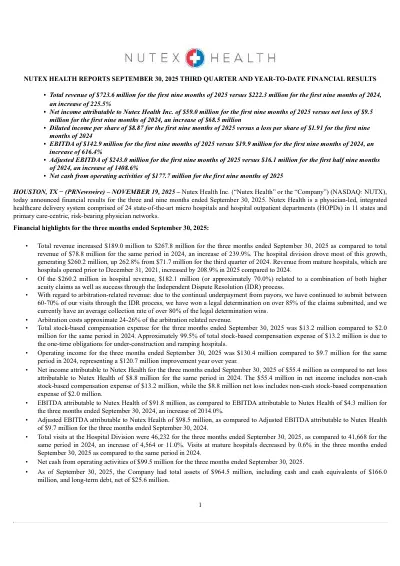
Operationally, Q3 2025 shows steady progress, with total patient visits reaching 46,232, an 11% increase from 41,668 in Q3 of 2024. Financially, revenue reached $267.8 million, up $240 million from Q3 2024.
Adjusted EBITDA grew to $98.5 million from $9.7 million, and net income was $55.4 million, compared to an $8.8 million loss of last year. Our balance sheet remains strong, with cash increasing to $166 million from $40.6 million at year-end 2024, and operating cash flow through the first three quarters totaling $177.8 million versus $23 million in the prior year.
Our long-term debt remains low at $25.6 million. These results reflect our focus on increasing patient volume, expanding inpatient services, optimizing costs, and improving revenue cycle management.
Looking ahead, we are well positioned for 2026 and beyond. We remain on track to open three new hospitals in 2025.
Red River opened last week, and Houston and St. Louis are both scheduled to be open by year-end.
Our 2026 pipeline includes three to four hospitals, with planning already underway for new hospital openings in 20 2027 and 2028. To provide a little bit more context for John's discussion on the share earnouts, I'd like to give a brief history of Nutex Health.
We have evolved through three distinct phases since 2011: the initial growth as a free-standing ER management company, where we were instrumental in the opening of 23 free-standing ERs, of which seven were later converted into micro-hospitals. Note that Nutex did not have any equity ownership in these early ERs.
The second phase began in 2017, when Nutex expanded into micro-hospitals, and where we opened 14 hospitals as a managed company, again, without any equity ownership in any of these hospitals. In 2022, we successfully consolidated 21 hospitals and hospital outpatient departments to transform into a publicly traded company through a share exchange program, where former hospital owners exchanged the hospital shares for Nutex shares.
In addition to the 21 facilities at merger, there were 17 additional hospitals that were under development as of 2022. These under-development hospitals were given the same considerations as the open hospital and had the right to roll their local shares up to Nutex shares at the conclusion of their second-year anniversary.
Note that all new future hospitals that began development after April 2022 will not and did not have the share exchange option. John will also explain this in more details later.
Today, Nutex Health owns and operates 25 locations across 11 states, with over 15 facilities in the pipeline under development. Building micro-hospitals requires significant capital, regulatory expertise, and operational discipline, creating a very high barrier to entry.
This is one reason why our model is very unique in the marketplace and why we have so much demands around the country to develop and operate these hospitals. Despite these challenges, we have maintained a strong track record of growth and profitability, with physician retention exceeding 95%.
Our facilities have improved the lives of hundreds of physicians, thousands of healthcare workers, and hundreds of thousands of patients. Integrity and resilience define us, and we will continue to adapt and thrive amid changing conditions.
I am extremely proud of everything that we have accomplished in the past 14 years, and we look forward to building on this success for years to come. I will now turn the call over to Jon Bates, our CFO.
John?
Jon Bates
Thank you, Tom, and good morning, everyone. I'm happy to present Nutex Health's financial performance for the periods including the full year of 2024 with the restated 10-K that we filed on Tuesday, November 18th; the first quarter of 2025 with the restated 10-Q/A filed on Tuesday, November 18th as well; the second quarter of 2025 with the 10-Q filed on Tuesday, November 18th; and then, finally, the third quarter of 2025 with the 10-Q that we filed on Wednesday, November 19th.
With the completion of these filings bringing us into full compliance with NASDAQ. First, we will discuss the full year of 2024.
The good news of this filing is that the changes from the original '24 10-K filed were non-cash in nature, with most of all the changes being just reclassifications within the balance sheet. To highlight those, the major balance sheet accounts that were affected by these non-cash adjustments were: number one, we corrected the reclassification of non-cash stock compensation obligations totaling $16.4 million related to under-construction and ramping hospitals from equity to liability; and we reclassified related-party accounts payable balances of $3.5 million from liabilities to equity; third, we reclassified $2.9 million of restricted balances out of cash and cash equivalents and into short-term investments; and, finally, number four, we increased accrued income taxes by $0.5 million.
When compared to the previously issued financial statements, the changes resulted in an overall increase to liabilities of $13.4 million, a decrease in equity of same amount, $13.4 million, and a very nominal increase in net income of $0.5 million. These adjustments, as noted before, were non-cash in nature, had no material effect on key metrics including revenue, liquidity, short- and long-term debt, operating cash flow, adjusted EBITDA, or number of patients as of and for the periods presented therein, and had an immaterial impact on net income.
As we mentioned when this restatement work began, we believed there was no fundamental impact to the operations of the business, and after completing the work, we confirmed that belief. You can see that the 2024 year was a record year for the company, with 93.8% revenue growth, adjusted EBITDA of $124.1 million, and a 464.4% increase in gross profit, which laid a really strong foundation for what we will discuss shortly for each of the first three quarters of 2025.
Next, we'll go through the first quarter of 2025 relatively briefly as well. Like discussed previously for the 2024 period, the changes from the original 10-Q that was filed were, again, non-cash in nature and had no fundamental impact to the operations of the business.
The major balance sheet accounts that were affected by these non-cash adjustments for the first quarter of '24 excuse me, first quarter of '25 were: number one is we corrected the classification of non-cash stock compensation obligations totaling $20.7 million related to under-construction and ramping hospitals from equity to liability, just like we did in 2024; similarly, number two, we reclassified related-party accounts payable of $3.5 million from liabilities to equity, which was the same exact line item in the '24 work above, we were just carrying it forward into this period; third item was the reclassification of $2.9 million of restricted balances out of cash and cash equivalents into short-term investments, again, same exact item in 2024, they were just carrying forward into this period; and then the last item was we increased the accrued income tax expense by $2.4 million. When compared to the previously issued financial statements, the changes resulted in an overall net increase to liabilities of $19.6 million, with a similar decrease to equity of $19.6 million, and an increase in net income of $6.6 million.
These adjustments were non-cash in nature, had no material effect on key metrics including revenue, liquidity, short- and long-term debt, operating cash flow, adjusted EBITDA, or number of patients as of and for the periods presented therein, and included a small positive impact on net income. As we mentioned when this restatement work began, just like in 2024, we believed there was no fundamental impact to the operations of the business, and after completing the work, we confirmed that belief.
Therefore, we aren't going to spend much more time discussing the first quarter of '25 as it was materially same as originally reported, with a solid net income attributable to Nutex of $21.2 million, a record-high gross profit of 55.9% in the quarter, a record-high $51 million in net cash from operating activities, and a record-high cash balance of $84.7 million at the end of the quarter. Now let's discuss the key financial metrics for the second quarter and year-to-date June '25 period versus the same period in '24, and then we'll follow that with a discussion of the third quarter and year-to-date December '25 period versus the same period in '24, highlighting percentage changes across revenue, adjusted EBITDA, net income, EPS, and other indicators, all that were detailed in our Form 10-Q for the quarter ended June '25 filed on November 18th and our 10-Q for the third quarter ended September 30th, 2025 filed on November 19th.
To start, we're going to start on the second quarter of June '25 and compare that to the second quarter period in 2024. For the second quarter of 2025, total revenue grew 217.5% or $167.9 million to $244 million versus $76.1 million for the same period in 2024.
Of the revenue increase, mature hospitals, which are hospitals that were opened prior to December 31, 2021, and therefore provided two full years of comparative results, increased their revenue by 203% for the second quarter of '25 versus similar period for '24. For the hospital division visits, we saw growth as well during the quarter as they increased by 10.6% or 4,365 visits to 45,573 visits in the second quarter of '25 versus 41,208 visits in the same period in 2024, with mature hospitals growing at 0.6% in the second quarter 2024 versus the second quarter 20 excuse me, in the second quarter '25 versus the second quarter '24.
Additionally, Population Health division had a revenue reduction of $0.8 million to $7.7 million in the second quarter of '25 from $8.5 million in the similar period in '24, due mostly to the divestiture of one small entity within the division in the third quarter of 2024. Now, we discussed the growth in hospital revenue and visits that we've seen in the second quarter of '25.
Now let's discuss the overall facility and [crosstalk] John? Yes.
What was that? Okay.
We discussed the growth in hospital revenue and visits we have seen in the second quarter of 2025. Now let's discuss the overall facility and cost structure and improvements in that area.
Total facility-level operating costs and expenses represented only 48.8% or $119 million of total revenue for the second quarter of '25 versus 70.3% or $53.5 million for the same period in '24. As a result of the revenue and facility cost improvement, our 2025 second quarter gross profit was $124.9 million or 51.2% of total revenue as compared to $22.6 million or 29.7% of revenue in the 2024 period.
So 454% improvement in the second quarter of 2025 versus the second quarter of '24. From a corporate and other cost perspective, the general and administrative expenses as a percentage of total revenue for the second quarter of 2025 decreased to 5.1% compared to 14% for the second quarter of 2024.
Now, additionally, on our second quarter 2025 income statement, you'll see a line item for stock-based compensation expense, the amount for the second quarter of '25 being $78.7 million. Most of that expense is explained in our second quarter 2025 10-Q within Note 11.
In that note, we explained the impact of hospitals subject to contribution agreements, this topic indicated in our earlier report. In connection with the merger on April 1st of 2022, Nutex Health Holdco LLC entered into certain contribution agreements with holders of equity interests of subsidiaries and affiliates.
These holders agree to contribute certain equity interests in such subsidiaries to Holdco in exchange for equity interests in Holdco. Included in these transactions was 17 subsidiaries [unclear] to be under construction at the time of merger.
Operator
Excuse me, John. [unclear] Excuse me, John.
Your line is breaking up. Okay.
Are you able to hear now or not? Yes.
Please continue. Okay.
As we were talking about those 17 subsidiaries considered to be under construction at the time of the merger, the under-construction hospitals are hospitals that, at the time of the merger, had not started accepting patients and did not have any operating results to serve as a basis for valuation. Once these hospitals have opened for two full years, which we denote as the measurement period, the equity holders of these hospitals are eligible to receive a one-time additional issuance of company common stock based upon the earnings of the hospital in the second year of their operations.
Of the 17 under-construction hospitals, six hospitals had measurement periods that ended on or before June 30th of 2025. Four of those hospitals had measurement periods that end after June of '25, and there were three hospitals with no defined measurement period as the three hospitals had not opened as of June 30th.
The remaining four hospitals have no measurement period as their hospital development plans have been abandoned. For the second quarter of 2025, the former equity holders of two hospitals are to receive an additional issuance of 602,798 common stock shares based on the trailing 12 months results of the hospitals at the end of their measurement periods.
With four of these hospitals in their measurement period currently, we are accruing for the stock issuance for each in current liabilities. In the second quarter of 2025, that accrual amounted to $24.2 million, that will be trued up each quarter until we get to the end of year two for each hospital, at which time a final calculation will be done, and payment will be made 100% in company stock and recorded as non-cash comp expense.
Let's talk about operating income real quick. Operating income including the negative impact of the $78.7 million in non-cash stock-based compensation for the second quarter of 2025 was $33.7 million, compared to $5.3 million in the second quarter of '24, representing a $28.4 million improvement quarter-over-quarter.
Net loss attributable to Nutex was $17.7 million for the second quarter of '25, which included the negative impact of the $78.7 million of non-cash stock comp expense noted previously. The comparative net loss attributable to Nutex was $0.4 million for the second quarter of 20 4, showing a $17.3 million decrease period-over-period.
From an earnings per share perspective, our diluted EPS for the second quarter of 2025 was a loss of $2.95, $2.95 a share, compared to a loss of 7 cents a share in the second quarter of 2024. Adjusted EBITDA attributable to Nutex, which increased $64 million from $6.8 million in the second quarter of 2024 to $71.6 million in the second quarter of 2025.
Now we finished the second quarter. For the second quarter of 2025, we'll do the 6 months ending June of '25 compared to the 6 months of '24.
Total revenue for the first 6 months of '25 grew by 218% or $312 million to $455 million versus $143.5 million for the first 6 months of 2024. Of the total revenue increase, mature hospitals increased their revenue by 195.2% for the first 6 months of '25 versus the same period in 2024.
Hospital division visits saw a similar growth as they increased by 15.5% or 12,566 visits to 93,842 visits in the first 6 months of '25 versus 81,276 visits in the same period in 2024, with mature hospital visits growing at 15.5% in the 6 months into June versus the same period in 2024. Additionally, the Population Health division had a revenue decrease by 2% to $15.5 million in the first 6 months of '25 from $15.9 million in the first 6 months of 2024.
From a facility and corporate cost perspective, it also showed improvement for this first 6 months of '25 relative to the same period in '24. Total facility-level operating costs and expenses represented 46.6% or $212.5 million of total revenue for the 6 months ended June of '25 versus 77.2% or $110.8 million for the same period in 2024, which was a decrease of 30.6%.
The gross profit for the 6 months ended June of '25 was $243 million or 53.4 million percent of total revenue, as compared to $32.7 million or 22.8% of total revenue in the same period in 2024, a $210 million increase for the 6 months ended June of '25 for the same 6 months of 2024. From a corporate and other cost perspective, the G&A expenses as a percentage of total revenue for the 6 months ended '25 decreased to 4.9% or $22.5 million from 13.5% or $19.3 million for the same period in 2024.
Operating income for the 6 months ended June of '25 was $114 million, compared to $6.7 million for the 6 months ended June of 2024, and net income attributable to Nutex, Inc. improved by $4.2 million from a loss of $0.7 million for the 6 months of 2024 to income of $3.5 million in the first 6 months of 2025.
Adjusted EBITDA attributable to Nutex increased $138 million or 2,144% from $6.4 million in the first 6 months of '24 up to $144.4 million in the first 6 months of 2025. Now lastly, let's go on to the results for the third quarter ended September 30th of '25 and compare those results to the third quarter of 2024.
For the third quarter 2025, our total revenue grew 240% or $189 million to $267 million versus $78.8 million for the third quarter of '24. The hospital division drove most of this growth, generating $260.2 million, up 262.8% from $71.1 million for the same quarter in 2024.
Now, of the total revenue increase, mature hospitals, which were hospitals that were open prior to December 31st of 2021, and therefore provided two full years of comparative results, increased their revenue by 208.9% for the third quarter of '25 for the same quarter in '24. Excuse me, John.
Sorry, John, your line is distorting again.
Jon Bates
Okay. Is that better or not right now?
Can you hear?
Operator
No, it's still breaking up.
Jon Bates
Okay. All right, let's see.
Tell me if that's any better at this point.
Operator
No.
Jon Bates
Okay. Would you like me to continue if you like, or do you like me to pull off?
You're not able to hear anything right now?
Operator
No, sorry, John, we still can't hear you.
Jon Bates
Okay. I can attempt to call back in if that's what needs to happen.
Let's see. Can you hear me any better now?
Operator
Yep, you're clear now.
Jon Bates
All right, is that better now?
Operator
Yes, it is.
Jon Bates
Can you hear me now? Okay.
I'll continue from here. Tell me if you can't hear me.
We were just talking about of the total revenue increase. This is in the third quarter of I'll start back over for the third quarter.
For the third quarter 2025, our total revenue grew 240% or $189 million to $267.8 million versus the $78.8 million for the third quarter of '24. The hospital division drove most of this growth, generating $260.2 million, up 262.8% from $71.7 million for the same quarter in '24.
Of the total revenue increase, mature hospitals, which were hospitals that were open prior to December of 20 31st of 2021, increased their revenue by 208.9% for the third quarter of '25 versus the third quarter of 2024. Of the $260.2 million in hospital revenue, $182.1 million or approximately 70% related to a combination of both higher acuity claims as well as success through the independent dispute resolution process.
With regard to arbitration-related revenue, due to the continued underpayment from payers, we have continued to submit between 60% to 70% of our business through the IDR process, and we have won legal determinations on over 85% of the claims submitted, and we [unclear]
Operator
Excuse me, John. Sorry, again, it happened again.
Should I just let Tom?
Jon Bates
Should I get back Tom? Why don't you hand it back to Tom at this point and we'll go from there.
Operator
Okay. Dr.
Vo?
Tom Vo
Apologize about technical difficulties. Can you hear me okay?
Operator
Yes.
Tom Vo
Perfect. I think John was talking about the let's see here.
Jon Bates
Tom, we were talking about the Can you hear me at all? The third quarter of '25.
Were you able to hear that at all or not?
Tom Vo
I don't think we could hear you at all, John, but I'm not sure what happened there. Go ahead, John.
Jon Bates
I'll try to call back in through my cell phone and see if maybe that works better. Okay?
Give me 1 second.
Tom Vo
We apologize, everyone. Again,
Operator
ladies and gentlemen, thank you for your patience as we work through these technical difficulties. We will resume again shortly.
While we wait for John... Okay.
John, are you there? Are you there?
Jon Bates
Yes. Can you hear me or not?
Mhm. We can hear you, John.
Can you hear me okay?
Operator
Yes.
Jon Bates
All right. I'm back.
I'm going to start back over again with this last piece? Okay.
Thank you. John, can you hear me?
Can you hear me okay, Tom? Is it able to be heard?
Yeah. Okay.
All right, I'm almost done, we'll go through.
Tom Vo
John, if you can go over the stock-based compensation expense, because didn't hear [unclear] that. Then for the second quarter, [unclear] shareholder.
Then, obviously, start with...
Jon Bates
Tom, you ready for me to continue?
Tom Vo
Yes.
Jon Bates
Can you hear me okay? Okay.
I'm going to continue right now, and you let me know if you can hear me okay. All right, I'm going to finish with the third quarter.
We were talking about just on the revenue side. Of the $260.2 million in hospital revenue, $182.1 million or 70% related to the combination of both higher acuity claims as well as success through the IDR process.
With regard to the arbitration-related revenue, due to the continue underpayment from payers, we have continued to submit between 60% to 70% of our business through the IDR process, and we have won a legal determination on over 85% of the claims submitted, and we currently have an average collection rate of over 80% of the legal determination wins. Arbitration costs approximate between 24% to 26% of the arbitration revenue.
Now for hospital division visits, we saw growth as well during the quarter as they increased 11% or 4,564 visits to 46,232 visits in the third quarter of '25 versus 41,668 visits in the same period in '24, while mature hospitals increased by 0.6% in the third quarter or decreased by 0.6% in the third quarter of 2025 versus the third quarter of '24. Additionally, the Population Health division had a revenue increase of $0.5 million to $7.6 million in the third quarter of '25 from $7.1 million in the similar period in '24.
We discussed the growth in the hospital revenue and visits that we've seen in the third quarter of '25. Now let's discuss the overall facility and costs structure and improvements in that area.
Total facility-level operating costs and expenses represented only 42.2% or $112.9 million of total revenue for the third quarter of '25 versus 72.2% or $56.9 million for the same period in '24. As a result of the revenue and facility cost improvement, our 2025 third quarter gross profit was $154.9 million or 57.8% of total revenue as compared to $21.9 million or 27.8% of total revenue in '24, which was a 606.7% improvement in the third quarter of '25 versus the third quarter of 2024.
From a corporate and other cost perspective, the G&A expenses as a percentage of total revenue for the third quarter of '25 decreased to 4.2% compared to 12.5% for the same period in 2024. Similar to what we talked about in the second quarter, on the third quarter income statement, you're going to see that same stock-based comp line item, with the amounts for the third quarter of 2025 being $13.2 million.
Most of that expense is explained in the third quarter of 2025 10-Q, again, within Note 11. I'm not going to read through all the specifics on it, but what I wanted to highlight was, remember, we talked about of the 17 under-construction hospitals that we started with currently, as of the end of September, seven hospitals had measurement periods that had ended on or before September 30th of '25, three hospitals had measurement periods that end after September 30th of '25, and there were three hospitals with no defined measurement periods as the three hospitals have not opened yet as of September 30th, and then the remaining four hospitals out of that 17 have no measurement period as their hospital development plans had been abandoned.
For the third quarter of '25, the former equity holders of one hospital are to receive an additional issuance of 307,700 shares based on the trailing 12 months results of the hospitals at the end of their measurement period. With three of these hospitals in their measurement period currently, we are accruing for the stock issuance for each in our current liabilities.
In the third quarter of 2025, that accrual amounted to $11.2 million, that will be trued up each quarter until we get to the end of the year two for each hospital, at which time a final calculation will be done, and payment will be made 100% in company stock and recorded as a non-cash stock comp expense. Now with related to operating income for the quarter, including the negative impact of $13.2 million of non-cash non-stock-based compensation expense for the third quarter was $130.4 million, compared to $9.7 million in the third quarter of '24, representing $120.7 million improvement quarter-over-quarter.
Net income attributable to Nutex Health was $55.4 million for the third quarter of '25, including the negative impact of the $13.2 million non-cash stock-based compensation expense noted previously. The comparative net loss attributable to Nutex, Inc.
was $8.8 million for the third quarter of '24, showing a $64.2 million increase period-over-period. From an earnings per share perspective, our diluted EPS for the third quarter was $7.7 $7.76 a share, compared to a loss of $1.72 per share in the third quarter of '24, which is a $9 $9.48 per share increase period-to-period.
Lastly, related to adjusted EBITDA attributed to Nutex, it increased $88.9 million from $9.7 million in the third quarter of '24 to $98.5 million in the third quarter of '25. Now as the last item to discuss is going to be the 9 months of September of 30th of 2025 compared to the same 9 months ended September 30th of 2024.
Total revenue for the 9 months of '25 grew by 225% or $501.2 million to $723.6 million versus $222.3 million for the first 9 months of 2024. The hospital division drove most of this growth, generating 70 $700.5 million, up 251.4% from $199.4 million for the same period in 2024.
Of the total revenue increase, mature hospitals increased their revenue by 200% for the first 9 months of '25 versus the same period in 2024. Of the $700 million in hospital revenue, $462.9 million or approximately 66.1% related to combination of both higher acuity as well as success through the independent dispute resolution process.
With regard to the arbitration-related costs, similar results that we discussed in the quarter, due to the continued underpayment from payers, we have continued to submit between 60% to 70% of our business through the IDR process. We have won legal determinations on over 85% of the claims, and we have an average collection rate of over 80% on those legal determination wins.
Again, arbitration costs approximate somewhere in the 24% to 26% of that revenue. When it comes to visits, hospital division visits saw a similar growth as they increased by 13.9% or 7 17,130 visits to 140,074 visits in the first 9 months of '25 versus 122,944 visits in the same period of '24, with mature hospital visits growing at 1.8% in the 9 months ended September 2025 versus the same period in 2024.
Population Health had revenue increase by 1% to $23.1 million in the first 9 months of '25 from $23 million in the first 9 months of 2024. The facility and corporate-level costs continue to show improvement in the first 9 months of '25 compared to the same period in '24.
You look at total facility-level operating costs represented about 45% or $325.4 million of total revenue for the 9 months ended September '25 versus 75.4% or $167.7 million for the same period in 2024, which was a decrease of 30.4%. The gross profit for the 9 months ended September '25 was $398.1 million or 55% of revenue, as compared to $54.6 million or 24.6% of revenue in the same period in 2024, which was a $343 million increase for the 9 months of '25 versus same period in 2024.
From a corporate and other cost perspective, the G&A expenses as a percentage of total revenue for the 9 months ended September of '25 decreased to 4.7% or $33.8 million from 13.1% or $29.2% for the same period in 2024. Operating income for the 9 months ended September 30th of '25 was $244.7 million, compared to $16.4 million the same in the 9 months of 2024, and net income attributable to Nutex improved by $68.5 million from a loss of $9.5 million for the first 9 months of '24 to income of $59 million in the first 9 months of 2025.
Adjusted EBITDA attributable to Nutex increased $226.9 million or over 1,400% from $16.1 million in the first 9 months of 2024 to $243 million in the first 9 months of 2025. Finally, our balance sheet remains very strong, with cash and cash equivalents at September 30th, 2025, at a record high of $166 million, up $125.4 million from $40.6 million as of the end of 2024.
Our continued success with the collection efforts related to independent dispute resolution process is allowing us to get paid more fairly for the services we provide and was a big part of this process. With regard to accounts receivable, our balance at September 30th was $387.4 million, an increase of $155 million from the $232.4 million at the end of December.
With regard to cash flow, net cash from operating activities was very strong at $177.7 million for the 9 months of 2025, which was an increase of $154.6 million from the same period in 2024. Then on the liability side of our balance sheet, total bank or equity-type debt increased by $7.7 million to $49.1 million as of September 30th from $41.4 million at December 31st of 2024, with the majority of this debt relating to items like equipment loans for our hospitals for MRIs, X-rays, ultrasounds, and CT machines.
Outside of this $40-plus million of bank-type debt, the only other items materially that look like debt on the balance sheet are the liabilities related to financing and operating lease liabilities, which are just future lease payments due to landlords at our hospital facilities. We've discussed these in the past, I'm not going to belabor this now, but I will say that most investors and analysts don't view these right-of-use liabilities as real operating debt, I wanted to clarify that for you.
With all of this said, our balance sheet remains very solid, and we continue to strengthen it with our positive operating performance. Our current financial position has put us in a very great spot to be able to execute on all of our initiatives in our 2025 operating plan, including the opening of the three new hospitals later this year as Tom mentioned earlier.
With that said, I apologize for any of the technical difficulties today. I'm now going to turn it over to Warren Hosseinion, our President.
Warren Hosseinion
Thank you, John, and good morning, everyone. Thank you for joining us today.
I'm pleased to provide an update on Nutex Health's Population Health division, which supports our commitment to value-based care. As a reminder, our overarching strategy at Nutex Health is to build an integrated healthcare delivery system combining hospitals and medical groups, also referred to as IPAs.
Our IPAs are comprised of networks of primary care physicians and specialists located around our facilities. The IPAs enroll patients from different health plans and are responsible for the total care of these patients.
By combining hospitals and IPAs, we believe we will be able to deliver care that is coordinated, cost-effective, and with better outcomes for our patients. Our IPAs would send patients to our hospitals, and our hospitals would deliver more efficient and cost-effective care, reducing the medical loss ratios in our IPAs.
This is a long-term strategy that will take several years to bear fruit, but we are in this for the long run at Nutex Health. One thing we would like to note is that the physicians in our IPAs can refer their non-IPA patients to our emergency rooms as well, and we are already starting to see this in Phoenix.
We currently have over 40,000 patients enrolled in our IPAs in various risk-based arrangements. Of note, I am happy to report that we now have more than 1,900 Medicare Advantage members in our Houston physicians IPA.
In Phoenix, we now have over 30 primary care physicians and a robust specialist network. Phoenix is now currently in its first Medicare annual enrollment period, and we will find out soon how many patients we have enrolled.
Our IPA in Los Angeles is still very profitable. Houston is now profitable as well.
Florida continues to be profitable. Margins continue to be moderated by ongoing investments in our new markets such as Phoenix and Dallas, and soon San Antonio.
With that, I will now turn it over to Wes Bamberg, our Chief Operating Officer.
Wes Bamberg
Thank you, Warren, and good morning, everyone. I'm pleased to share the company's operational results, which demonstrate our ability to deliver high-quality care while achieving steady growth and service line development.
As previously reported, our overall visits increased by 13.9% in the first 9 months of 2025 compared to the same period in 2024, and our mature hospital visits increased by 1.8% in the first 9 months of 2025 versus the same time period in 2024. Our continued growth reflects the successful execution of our core model.
Specifically, this success is powered by our leadership team's focus on our key strategic growth objectives: increasing overall volume, developing new service lines, and expanding our observation and inpatient services to safely manage more complex patient needs. By leveraging our efficient operating model, we achieve superior patient outcomes and satisfaction, fueling our continued growth.
Having joined Nutex Health in early October, and with over 20 years of experience working across the largest publicly traded healthcare companies in the US, I have developed a comprehensive understanding of the critical elements required for sustained outperformance in the industry. My initial observations confirm that Nutex possesses the fundamental strengths necessary to thrive in this evolving landscape.
With a sound operational model, financial discipline, and uncompromising patient-centered philosophy, Nutex is exceptionally well positioned for the future. These positive attributes are the key elements that will allow us to navigate industry challenges, expand our market share, and continue to serve as a trusted, high-value provider for the communities we support.
I am confident that our best years of strategic growth and value creation lie ahead. Thank you, and back to you, Jen.
Jennifer Rodriguez
Thank you, Wes. Thank you to Tom, John, and Warren for those updates.
We'll now move to the Q&A section. Operator, please provide instructions for our callers.
Operator
Thank you. Ladies and gentlemen, if you would like to ask a question, please press *1 on your telephone keypad, and a confirmation tone will indicate your line is in the question queue.
You may press *2 if you would like to remove your question from the queue. For participants using speaker equipment, it may be necessary to pick up your handset before pressing the star keys.
One moment, please, while we poll for questions. The first question comes from the line of Anthony Vendetti with Maxim Group.
Please proceed.
Anthony Vendetti
Thank you. I'll start with just a high-level question, and then ask you a little bit about what happened at Red River Micro-Hospital.
Why was it closed? I saw you just recently reopened it.
Maybe just talk about the process there. Then just in terms of the relationships you have with the 25 facilities now that you have open in 11 states, if you could just maybe, Tom, provide an overview of how you contract with the physicians.
I think John mentioned on the call after the first year, they get an equity stake. Are they all pretty much follow the same template in terms of how you negotiate with the physicians that staff that hospital?
Are there targets they need to reach to get that equity stake? Maybe just talk about that high level, and then just talk about the situation at Red River.
Thanks so much.
Jon Bates
Great. Thank you very much, Anthony, for that question.
I'll tackle the first question with Red River. Yes, you are correct.
Red River was one of the 21 hospitals that came with us when we merged. However, if you remember in 20 that was a relatively tough year for us with the introduction of the No Surprises Act, which resulted in a roughly 35% reduction in revenue.
Because of that reduction in revenue at that time, Red River was not in a position to be profitable. In fact, it sustained operating losses, and so subsequently, we had to close down Red River in addition to other hospitals in.
Now that our reimbursement environment is better with arbitration, and on top of that, Sherman as a town has grown quite a bit past 2 years. There's been multiple IT companies moving in there.
As an example, just right down the street from us, there is a company that's making chips. Not the chips, but they make the waffles that the chip sits on.
Lots of economic development, a lot of new employers moving So combination of that and better we just felt that it was time to hospital. Did that answer your question, Anthony?
Anthony Vendetti
Yes, thanks. Maybe just a follow-up to that.
The physician group that you contracted with when you reopened that hospital, is that a new group? How did that come about?
Jon Bates
Okay. Can you hear me okay?
You cut out just a little bit, Tom, but go ahead.
Tom Vo
Okay. I'm sorry about that.
In any event, yes, the physician group is a brand-new group, not the old group that was running it before. The way that we've structured this is that Nutex Health owns 70%, physician group owns 30%, and we also structured a physician staffing service contract with the physicians to essentially run the hospital and staff the hospital with us.
When we rolled up our hospitals, Nutex Health owned an average of 80% of the hospitals. The minority shareholders owned roughly 20%.
This model is very consistent with our previous structures that we contracted with the physicians.
Anthony Vendetti
Okay. Does that sort of answer my second part of the question?
Is the template for most of the other micro-hospitals, or are there some situations where that template is different depending on the state that you're in?
Operator
Excuse me. Pardon me, Anthony, but I think Tom disconnected real quick.
1 1 moment. We'll be right back.
Hey,
Jon Bates
Anthony, can you hear me okay? This is John.
John, I can hear you fine. Totally clear.
I think the answer to your last question is the structure is very similar. There's no material differences in the structure.
In fact, so that there's not a lot that you would expect to change state by state. Certainly, there's different relationships with some of the doctor groups in general, but across the board, there's not really a major change or differentiator because of a certain state when we open these up.
There's a lot that's improved in change as Tom indicated at the Sherman location, both with the companies that are building in and of around it and just the whole structure in the way where Nutex is now versus where it was a couple years ago. There's a lot of positives that support the concept for reopening it.
We're pretty excited about it being opened.
Anthony Vendetti
Okay. Then just lastly, John, in terms of the structure, like you said, the template is mostly pretty similar across your micro-hospitals.
Maybe just talk about the incentives the physicians have to get to profitability, does their equity stake depend on that, or what metrics does it depend on after the first year or the second year? Maybe just give a little more color on that.
That'd be helpful. Thanks.
Jon Bates
Anthony, are you talking about the non-earnout type ones, these ones that now are just opening up as in position without the earnout concept? Is that what you're asking?
Or are you asking specifically about those?
Anthony Vendetti
Both. If you could just talk about the earnout ones versus the non-earnout, that'd be great.
Tom Vo
By the way, John, I'm back on. I apologize about that, Anthony.
Really, really bad technical difficulties today. Okay.
Jon Bates
Yeah. John, you can answer that, and I can also chime in.
Yes. He's asking now about the structure of the earnout facilities, how it's different from say one like Sherman or something that's opening up.
Anthony, as I know we've talked about in the past, the earnouts, which we've described them pretty in detail in the Qs, remember, we calculate the number of shares at the end of that 2-year period, right, to go through and value what their position would be. In this scenario if they have a 20% stake or 30% stake, which is normally the case, somewhere in that arrangement, somewhere around that amount, that on the earnouts, they ultimately resolve themselves at the end of the 2-year period and where that earning structure is at the same multiple, of course, that the original companies when the company went public back in 2022, the same calculator and all that.
That's how they get given those shares based on their defined ownership at the beginning. You talk about incentives.
Certainly, they're incentivized to do as well as they can not only in the first 2 years, that's just to get the stock, but they're in most scenarios, they're also operators and employees of the facility. They benefit from working in the facility and seeing the profit from that as well and giving good outcomes, of course.
They're tied in. Some cases, they have a relationship on the asset entity, which is the private side, and of course, they're employees and owners in the actual hospital side of it.
Then they're also in a lot of cases tied in to the doctor billing side, which we do the billing for them, but the doctors own 100% of that, they have a benefit on that side. That's for the earnout ones, right?
Then these others that aren't affiliated with an earnout run, I think everything else we just described. They have an ownership in that facility.
As it becomes profitable, they benefit from that, and they share in the ups and the downs of the corporate group, which is the whole idea. We want everyone to be lockstep side-by-side with each other as we grow, and it takes time to do that.
I think we have a great partnership in place specifically in Sherman along with all the other facilities as well. I think that's going pretty well.
Anthony Vendetti
Tom, you can add to that.
Tom Vo
Yeah. Anthony, so, you're right.
I think John has already hit the nail on the head for most. For the ones that earn out and receive Nutex share, in essence, their success is dependent on Nutex success now.
That when the ocean rises, all the boat rise. I think that is a very nice privilege for physicians to have because that is very unique in healthcare.
Not too many companies could offer stock like that to healthcare employees. Then on top of that, like John said, the physician also has an equity ownership on the professional entity, which is the physician entity.
The physician makes an hourly wage when they work, but then if the professional entity is profitable, then they will also be profitable in addition to owning Nutex stock. For the physicians that did not roll up their Nutex shares, then they stay at the local level.
If the facility is profitable, then they get a minority distribution quarterly on top of their potential profitability on the physician side as well as hourly work. We treat our physicians very fairly.
As you can see, on our financials, we did a fair amount of minority equity distribution in the first 9 months. Then, as you can see, on the minority profit, the physicians also did very well.
Anthony Vendetti
Great. No, that's very helpful.
I'll jump back in the queue. Appreciate it.
Jon Bates
Thank you, Anthony.
Operator
The next question comes from the line of Bill Sutherland with The Benchmark Company. Please proceed.
Bill Sutherland
Thank you. Good morning, guys.
I think I'll just leave it at one question in the interest of time. I'm curious, as this process moves ahead in the IDR process, are you starting to have any different kinds of discussions with some of the payers as far as just wanting to have more productive negotiating talks prior to moving to the claims process?
Tom Vo
Bill, thank you for covering us and thanks for being on the call. Yes, the answer is yes, over the past I would say 3 to 4 months, we're hearing a lot more from payers to try to negotiate better in-network rate contracts.
We evaluate every single one of them, and we take these very, very seriously. If the contract is fair and reasonable, we will definitely take it.
We're in the process of evaluating all of them. That's right.
Bill Sutherland
In the course of doing that, as you move a payer away from realizing the claim wins, will it really result in the same kind of financial impact in terms of the margins on that business? I can speak to that, Tom.
Go ahead, John.
Jon Bates
We'll see, right, as we go through it. It depends on where the price points land.
Remember, even when you determine a fair and reasonable payment, which hopefully we will be able to get and avoid having to go through the IDR process, one of the benefits of avoiding it is the fees related to going through it. As we're early stage in some of these where we haven't been able to get a reasonable contract and avoid the necessity of going into the IDR process, so far, the perception is that the net impact when it comes to bottom line should be nominal because if the revenue in some cases, you'll get similar revenue, maybe slightly less, but very close, but you're removing 24% to 26% of the cost.
It ends up being, I think, in a very similar position. It's early stage, and I think as we finish out the year and walk into the first part of next year with all the other activity going on from a regulatory standpoint, I think we'll start to see movement one way or the other, and we're watching it very closely, and we're very interested, as Tom indicated, in having contracts if we can because we all would like to avoid the process of having to go through the time and effort and cost of going through the IDR process if we can avoid it.
Bill Sutherland
Yep, sounds good. Thanks for the color, guys.
Operator
The next question comes from the line of Carl Byrnes with Northland Capital Markets. Please proceed.
Carl Burns
Thanks for the question, and congratulations on your success and progress. I'm just wondering, now that you've got greater history with respect to the IDR process, what are you thinking in terms of budgeting relative to timeline to break even on startups going forward?
Then I have one quick follow-up. Thanks.
Jon Bates
Carl, it's a great question. Thanks for raising it.
No, there's no doubt that with the movement in the direction of or feel like the requirement to have to go through the IDR process, it's been a very successful process for us. Now it does, as we mentioned before, it takes time to get those dollars in, it can be anywhere between say 5 to 7 months to fully realize and get paid on a claim that does go through the process.
You get the first payment within 30 to 60 days, and then you have to go through that process. The long answer to your short question is the breakeven process is moving up, certainly, and I think we'll continue to watch that closely.
We budget for something taking somewhere between 12 to 15 months normally to get to a breakeven position. It probably shifts easily by a quarter if we continue to be successful in opening these up.
Remember, it still takes from day one 5 to 7 months for the dollars to come in at the fair and reasonable rate. As a result, you really can't see it prior to that point if you're still end up having to submit 60% to 70% of our claims through the process.
It surely does improve, and actually what it gives us probably more is it might be a little bit of an improvement on getting to breakeven, but the bigger impact is on the back end in year one and year two where you're at a more solid, more reasonable, what we would expect level of profitability a little bit sooner on the back end, but you still have to wait probably that first 9 months to a year to get to a breakeven scenario. Hopefully that helps answer your question, Carl.
Carl Burns
No, great. Excellent.
That's very helpful. Then, shifting gears a little bit, are you seeing other opportunities like Homer G.
Phillips in St. Louis?
What might we expect over the next 12, 24 months there? Thanks.
Tom Vo
Yes, Carl, are you referencing our St. Louis Hospital, the former Homer G.
Phillips Hospital?
Carl Burns
Exactly,
Tom Vo
yeah. That is on the agenda to be opened this year, and we hope to open either mid- or late December.
The strategy is essentially the same, providing the best customer service, providing accessibility care to that population. The location of where that hospital is is essentially very close to downtown St.
Louis, which is essentially a healthcare desert. We hope to capitalize on that by providing the best care so that people can start using us.
Does that answer your question, Carl?
Carl Burns
I'm wondering if there's other opportunities that you've been presented with that are similar to that that could be opportunistic going forward. Oh, yes.
Tom Vo
The problem with micro-hospitals are that they just don't exist. Or if they do exist, they are located in areas where it is very difficult to make profitable.
That's why historically we've had to build these from the ground up. I think we've mentioned this because if a hospital doesn't exist, then Nutex Health does not have a hospital to operate in.
However, there are certain hospitals that are existing out there that we strategically look to acquire. Yes, we are essentially in the lookout to acquire any of those existing hospitals, assuming that they fit all of our criteria.
Yes, there are opportunities out there, few and far in between, but you just have to look.
Carl Burns
Understood. Cool.
Great. Congrats again.
Thanks.
Tom Vo
Thank you, Carl.
Operator
The next question comes from the line of Bradford Seagraves with Northland Capital Management. Please proceed.
Bradford Seagraves
Hi. Thank you.
Can you please provide an update on the buyback, how much you've bought and at what price? Brad, oh sorry.
Jon Bates
What are you talking about buyback? Oh, of the share buyback, is that what you're asking?
Bradford Seagraves
Yes.
Jon Bates
Okay. No, at this point, we're in the process of putting that in place, at this point, no shares have been bought back.
Bradford Seagraves
Understood. Then more broadly, can you talk about capital allocation priorities?
The cash is growing on the balance sheet, and curious to see what your thoughts are on what the uses of that cash might be.
Jon Bates
I can start on that, and then Tom can add to it as well. Certainly, the buyback concept that you reference is something that we've already announced it, it's something that we're very serious about, and we'll look at that very, very closely in the very short term.
Certainly, there's opportunities as we try to grow and add good situations when it comes to opening up hospitals. We talked about, yes, from time to time, we can find existing ones that we could potentially spend that money on, I think that's a big one.
Then we'll look at some other opportunities outside of investments for now. We have other opportunities to look at service line improvements.
There's the IPA business, which Warren talked about as well. There's opportunities in those areas.
That's kind of the direction that we're looking right now, and we'll watch as we finish out the year to see if cash continues to be strong and look for some of those situations to pop up and make good decisions on where we spend that money.
Tom Vo
To answer your question, Brad, excellent question, by the way. This is definitely a good problem to have.
In essence, the cash buyback program, as mentioned, and we may or may not increase that in the future. That is to be determined.
On top of that, we are looking hard for existing facilities, like Carl brought up, to acquire so that we don't have to go through the build-out, ground-up process. Then thirdly, as Warren mentioned, we are looking to expand our IPA business so that we can have an IPA surrounding each of the hospital.
The reason for that really is just a very good symbiotic relationship between the hospital and the IPA business, which, once again, is very unique in the healthcare industry. Then fourthly, we would like to invest into our current hospital to expand additional services capabilities.
As an example, I think I mentioned behavioral health. We are investing quite a bit in upgrading our hospital so that we can see more behavioral health patients on the medical side as an example.
With those types of investments, we have to find specialists, we have to find the correct equipment, we have to find people that are skilled at handling behavioral health as an example. Those are all essentially capital allocations that we have currently.
I'm sure there will be more need for capital allocation in the future, but those are basically the existing ones that we have at this point. Does that answer your question, Brad?
Bradford Seagraves
Yes. Last one for me, can you talk about the inpatient utilization, where it was a year ago, where it is today, and where you think it can go over the next 12 to 24 months?
Tom Vo
Absolutely. Over the past actually 2 years, we have began a push to admit more patients into our own hospital.
This is not an easy process or straightforward process, because in order to get more patients admitted, we need specialists, we need hospitalists, we need people that can take care of patients in the hospital. Over the past 2 years, we've been relatively successful at ramping more patients into our hospital and not have to transfer them out to other hospitals.
We're doing very well from that standpoint. As you can see from the revenue, that partly explains why the revenue has increased substantially more than the patient visit.
That's one variable and one factor. For now, as of today, I would say that we're only at roughly 25% to 30% inpatient capacity, and as we increase more, that number will only get better.
We have a systemwide initiative to admit as many patients as we can to our hospital so that these patients don't need to go out to other hospitals. In fact, patients really love to stay at our hospital.
None of them want to be transferred to other big system hospital, because the care that they receive at our hospital is probably superior and second to none. Unfortunately, sometimes we just don't have the expertise and the specialists to take care of these patients.
That's why we have to transfer them out. If we can keep them in our hospital, we will definitely do that.
Bradford Seagraves
Great. Thank you.
Yep.
Tom Vo
Thank you, Brad.
Operator
The next question comes from the line of Gene Mannheimer with Freedom Capital Markets. Please proceed.
Gene Mannheimer
Hey, thanks. Good morning.
And [cough] a lot to digest here. Congrats on getting the numbers current.
I think that last question segues well into the revenue per visit being up so much. It sounds like you're not breaking out the arbitration revenue this quarter specifically.
What is the reason for that, and maybe you can share at a minimum, was it similar to last quarter or greater or less than Q2?
Jon Bates
I can speak to that. We're not breaking that specifically out because it's really part of our business now is the main reason.
Comparatively, I think you've seen period-to-period-to-period an improvement there. It's of a similar nature.
I know that we talked about how, if you remember, back in the first quarter, when the collection percentages play into this, too, so that we only were seeing it was early in the process at the end of the year and into the first quarter where the collection percentages were new, and so we were only in the 70-ish percent range, and now we've worked our way up into the 80% range. Some of that revenue was just the natural progression of going back and realizing, okay, instead of 70% or 75%, which we were seeing kind of in the early middle part of the year, now we're at 80%.
That collection percentage is a decent amount of that uptick, which is a little bit of a cumulative impact going back and addressing that as realization continues to improve. In the revenue discussion, we talk about how much of our revenue within the quarter and the year were related to the IDR process, so that's kind of the direction we plan to go with that.
Outside of that, I think we'll watch it closely and see if we can get more detail. We're more than happy to provide it.
I think we've been pretty transparent on that piece at least the last couple quarters now, and I think today earlier and you saw in the releases a discussion about the piece of our revenue that relates to that. We'll watch that closely and continue to work it from there.
Gene Mannheimer
Thanks. That's helpful, John.
Appreciate it. Just going back to that inpatient utilization, I think, Tom, you're saying your occupancy is now about 25% to 30% across all your hospitals.
How does that compare to say 2 years ago?
Tom Vo
2 years ago, it was a lot less than that, Gene, unfortunately. I think partly because of the reduction in revenue back in 2022, we started this initiative.
Now this initiative is a part of our normal operating procedure now. We hope to grow that inpatient volume to be much higher than that over the next few years.
Gene Mannheimer
That's excellent. Okay.
One more statistic I wanted to just mention. It sounds like the mature hospital visits decreased by about 0.5%.
Normally, I think we'd want to see that marginally higher. Is there anything to call out that led to a decrease year-over-year?
Tom Vo
We're scratching our head on that also, Gene. Nothing materially has changed in terms of operations,
Jon Bates
our business development, marketing, physician outreach, physician care. Everything is pretty much the same.
The only thing that potentially could have occurred this year versus last year was that there was a COVID spike last year around late summer, whereas we're not seeing quite a high COVID spike this year. That may have been it.
I'm not sure. It's a head-scratcher, for sure.
We're definitely going to continue to watch it and definitely going to focus on that so that we can continue the growth quarter-over-quarter.
Gene Mannheimer
Okay. That makes a lot of sense.
Last question, with respect to stock-based comp, obviously a lot of discussion around that. In terms of modeling that going forward, I realize there are a number of factors to consider, but that Q3 number was relatively low.
Is that the right way to think about it going forward, or could we continue to see some big swings there?
Jon Bates
I would say, Gene, great question. I think we're definitely through the big portion of all the earnouts.
We only have a few left, as we described in the Q. I think you're referencing in the table that we've provided in Note 11 where it talks about the three that are currently open and in the period where they can be calculated that run through kind of the deadline.
I think that the way that calculation is done, which is all we can do is use the data that we have so far with some level of a projection on that, and if they continue to move in the direction or similar to what the others have done, it should be better than that. We didn't want to be in a position to assume that at this point.
I think the numbers you have there certainly ones that you can use from a projection standpoint, and we are optimistic that maybe we can do better in that case. They have a decent amount of period in all three cases left before they get to the final stage.
I believe the earliest one is the end of the first quarter of next year, and so that's still another 6 months of going into prime time kind of maturity stage. Then the other two that are out there all the way till the end of next year, they're very, very early stage.
I think it should improve from where you see it right now.
Gene Mannheimer
Okay. That's terrific.
Thank you, and congrats again.
Jon Bates
Yeah. Thanks, Gene.
Tom Vo
Thank you, Gene.
Operator
Thank you. This concludes the question-and-answer session, and I'll hand the call back over to Jennifer Rodriguez for closing remarks.
Jennifer Rodriguez
Thank you all for those valuable questions and answers. For all those joining us today, if you have more questions, please email us at [email protected], and we'll get back to you promptly.
On behalf of the Nutex management team, thank you all for joining us for our second and third quarter 2025 earnings call, and we apologize for the technical difficulties. We've covered a lot, and we appreciate your time and interest.
A recording of this call will be available on our website for a limited time, feel free to revisit it. Take care, everyone, and we look forward to keeping you updated on our journey.
Operator
Thank you. This concludes today's conference.
You may disconnect your lines at this time. We thank you for your participation.