Nutex Health Inc.
Q1 FY2026 · Earnings Call TranscriptMay 1, 2026
Operator
Greetings, and welcome to the Nutex Health 2026 first quarter conference call. At this time, all participants are in a listen-only mode.
A brief question-and-answer session will follow the formal presentation. If anyone should require operator assistance during the conference, please press *0 on your telephone keypad.
As a reminder, this conference is being recorded. It is now my pleasure to introduce your host, Jennifer Rodriguez, Investor Relations Manager.
Thank you. You may begin.
Jennifer Rodriguez
Good morning, everyone, and welcome to Nutex Health, Inc.' s first quarter 2026 earnings call.
My name is Jennifer Rodriguez, and I'm happy to serve as your moderator today. We're truly grateful for your participation and your continued interest in our company as we share the highlights of another exceptional quarter.
Please note that this call is being recorded for future reference. Joining me this morning are some of the key leaders driving Nutex Health forward: our Chairman and CEO, Dr.
Tom Vo; our Chief Financial Officer, Jon Bates; our President, Dr. Warren Hosseinion; and our Chief Operating Officer, Wesley Bamburg.
Together, they'll provide prepared remarks to give you a comprehensive view of our performance, strategies, and vision, after which we'll open the floor for your questions. Before I turn things over to Dr.
Vo, I'd like to take a moment to address a few important points. Today's discussion may include forward-looking statements, which reflect management's current expectations about our future performance.
These statements are based on what we know today, but they're subject to risks, uncertainties, and other factors that could cause our actual results to differ from what we'll share. For a deeper dive into these forward-looking statements and the factors that might influence them, I encourage you to review the press release and Form 10-Q filed earlier this week, as well as our various SEC filings.
You'll find all the details there. Additionally, we may reference non-GAAP financial measures, such as adjusted EBITDA, during the call.
For those interested in how these metrics reconcile to GAAP standards, please refer to the press release and Form 10-Q, where we've included that information. With those housekeeping items out of the way, it's my pleasure to hand the call over to Dr.
Tom Vo, our Founder and Chief Executive Officer. Dr.
Vo, the floor is yours.
Tom Vo
Thank you, Jen, and good morning, everyone. It's a pleasure to be with you as we review Nutex Health's first quarter 2026 results.
This first quarter has been one of renewed energy and vigor as we continue our mission of delivering high-quality, concierge-level, accessible healthcare to the communities we serve. Let's first discuss the first quarter 2026 financial and operational performance.
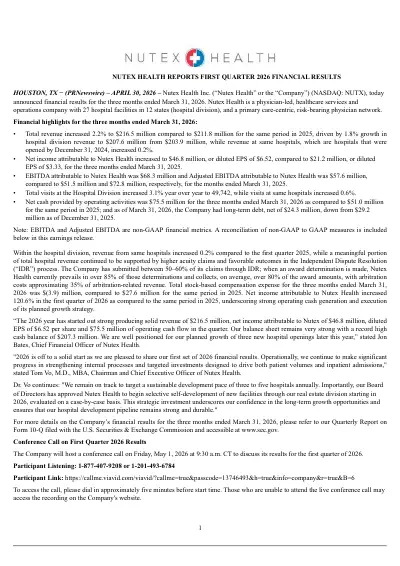
Total revenue reached $216.5 million, a 2% increase from $211.8 million in Q1 2025. Net income increased to $46.8 million, compared to $21.2 million in Q1 2025.
Adjusted EBITDA dropped to $57.6 million, down 21% from $72.8 million in Q1 2025. John will provide more detail and discuss more, but this has to do with the timing of recognition for IDR expenses in the first quarter of 2025 compared to the same period in 2026.
On the volume side, our hospitals recorded 49.7 thousand total patient visits, up 3.1% from 48.3 thousand patients in Q1 2025. 0.6% of that growth came from same hospitals, demonstrating their resilience and continued relevance in their markets.
Please note that this year's flu season was much milder compared to 2025's flu season. On the balance sheet, net long-term debt decreased from $29.2 million at December 31st, 2025 to $24.3 million at the end of Q1 2026, very low relative to our revenue and expansion pace.
Net cash from operating activities was $75.5 million for Q1 2026, compared to $51 million in 2025, a 48% increase. Cash on hand grew to $207.3 million as of March 31st, 2026, up from $185.6 million at year-end 2025.
In the first quarter of 2026, we completed our inaugural $25 million share repurchase program, retiring approximately 119,000 shares. We also initiated a second $25 million share repurchase program during the quarter, reflecting our continued confidence in the intrinsic value of Nutex Health.
Our share repurchase activity underscores management's strong conviction in the long-term intrinsic value of Nutex Health and our disciplined approach to capital allocation. Operationally, we continue to invest in infrastructure that will support sustained growth in both emergency room and inpatient volumes.
These investments are focused on scalability, efficiency, and long-term operating leverage. We are also strengthening our leadership team with targeted additions in business development, IT, AI to support our next phase of growth.
On the business development side, our focus is increasing community awareness and engagement, ensuring patients and physicians clearly understand the differentiated and unique care delivered at Nutex hospitals. From a technology standpoint, we are investing in both AI and IT to enhance patient care, streamline clinical workflows, and enable innovation within our micro-hospital model, while preserving the personalized, concierge-level experience that defines Nutex.
Technology is advancing at an unprecedented pace, and we believe Nutex is exceptionally well positioned to harness these innovations to meaningfully improve patient outcomes while driving sustainable patient volume growth across our platform. As a smaller, more agile organization, we are able to adapt quickly and deploy new technologies far more efficiently than larger, more bureaucratic healthcare systems.
In parallel, we continue to develop and grow new service lines, including: medical detox programs, behavioral health sciences, outpatient imaging, outpatient procedures, personal injury services. Wes will add more on his operational report.
With respect to our de novo pipeline, a significant development this quarter was the board's approval for Nutex to begin directly investing in the development and construction of new hospital facilities. Historically, real estate development was undertaken by third-party developers alongside local physician partners.
By internalizing this capability, Nutex can build a more secure, cost-efficient, and scalable development pipeline, while reducing reliance on external credit markets and alleviating the financial burden historically placed on physician partners. Nutex does not intend to hold these real estate assets on a long-term basis.
Our strategy is to invest capital upfront to develop and construct the facilities, and once a hospital is completed or has reached operational stabilization, we expect to monetize the asset through a sale-leaseback transaction with a third-party owner, such as a real estate investment trust, or REIT. While a specific REIT partner has not yet been identified, proceeds from these transactions are expected to be recycled into future developments, allowing us to efficiently redeploy capital and continue to expand our footprint in a disciplined and capital-efficient manner.
On the IPA front, we are expanding internal resources to bring additional management functions in-house, further reducing our dependence on third-party service providers and improving operational control and efficiency. Warren will discuss more on this later.
From a payer strategy perspective, we continue to carefully evaluate all in-network contract opportunities. Each proposal is assessed against our existing reimbursement outcome under the IDR process.
Our objective remains consistent: we are not seeking to collect more than peer hospitals offering similar services; we simply aim to receive comparable reimbursement for comparable care. Our goal is not to increase costs to insurers, but to ensure fair and equitable payments.
On the legislative front, we continue to closely monitor development related to the Murphy bill, formerly known as the No Surprises Act Enforcement Act, and we will adjust our strategy as appropriate as that process evolves. More broadly, we are actively monitoring legislative and legal developments nationwide that could impact our business.
We have seen several recent court decisions in states such as California, Florida, and Pennsylvania that may be constructive for providers like Nutex. While these matters remain fluid, we believe these developments reinforce the importance of staying engaged in the regulatory and legal landscape, and we will continue to evaluate their potential implications for the company.
Today, Nutex Health operate 27 hospital facilities across 12 states. In 2026, we remain on track to open three additional hospitals in the third and fourth quarter, located in San Antonio, Texas; Jacksonville, Florida; and West Little Rock, Arkansas.
Demand for the Nutex Health model remains strong. Physicians and community leaders across the country continue to approach us weekly with requests to bring new Nutex facilities to their markets.
With that, I'll turn it over to Jon Bates, our CFO, to walk through the financials in more details. John?
Jon Bates
Thanks, Tom, and good morning, everyone. I'm going to provide a little more color on the financials for Nutex Health's first quarter of 2026, another strong quarter where we are continuing to grow the business and prove our micro-hospital model while we build the infrastructure to handle that growth each year over year.
Now Tom's given you a little bit of the big picture, and I'm going to attempt to provide a little more detail. Going forward, when we do talk about comparisons between periods for metrics like visits and revenue, I wanted to bring to your attention we're going to begin using the term same hospital in our analytics, which basically means that the hospital data being compared period to period will have been fully opened in both periods presented.
In this case, hospitals in each period being compared under the same hospital definition were fully opened by December 31st of 2024. Starting with revenue, total revenue for Q1 of 2026 increased by 2.2% or $4.7 million to $216.5 million versus $211.8 million for the first quarter of 2025, with the hospital division revenue being $207.6 million in 2026.
Of the total revenue increase, hospital division revenue grew 1.8% to $207.6 million from $203.9 million, while same hospitals increased their revenue by 0.2% for the first quarter of 2026 compared to the same period in '25. Hospital division visits increased by 3.1% or 1,473 visits to 49,742 visits in the quarter 1 of '26 versus 48,269 visits in the same period in '25, with same hospital visits growing at 0.6% over the same period.
With regard to the population health division, it had revenue growth of approximately 14% to 18 to $8.9 million for the quarter 1 of 2026 versus $7.8 million for the same period in 2025. Now in addition to the revenue and visit growth noted above, facility and operating level costs also showed improvement for the first quarter of '26 compared to the same period in '25.
Total facility-level operating costs and expenses increased $31.3 million during the period, representing 57.6% or $124.8 million of the total revenue for Q1 of 2026 versus 44.1% or $93.5 million for the same period in 2025. Now of the $31.3 million increase for the period, $19.8 million of it were related to arbitration costs for the additional arbitration revenue recorded during the period.
The increase in these costs is primarily due to less settlement in open negotiations in the prior period, as the company was increasing its IDR submissions beginning in the first quarter of 2025. In regarding arbitration-level revenue, we've continued to submit between 50% to 60% of our claims through the IDR process, and when an award determination is made, we currently prevail in over 85% of those determinations, and we currently have an average collection rate of over 80% on those determination wins.
Regarding arbitration costs, we do anticipate we ultimately will finalize around 24% to 26% of the overall revenue realized. As a reminder, we currently are recording 100% of the anticipated costs of the arbitration effort, but only are recording revenue based upon our current 80%-plus collection rate.
During the current period, these costs approximated a higher percentage of 35% of the arbitration-related revenue, which we anticipate moving back to our lower averages in future periods. Total stock compensation expense for the three months ended March of 2026 was a $3.9 million gain compared to a $27.6 million expense for the same period in 2025, which was a $31.6 million increase in Q1 of 2026.
We did finalize one hospital earnout at March 31, 2026, and have two more facilities currently in their measurement periods, with both of them completing their measurement period in the fourth quarter of 2026. Gross profit for the three months ended March 31st of 2026 was $91.7 million, or 42.4% of total revenue, as compared to $118.3 million, or 55.9% of total revenue, in the same period in 2025, a 13.5% decrease for the three months ended March of '26 versus 2025.
From a corporate and other costs perspective, the general and administrative expenses as a percentage of total revenue for the three months ended March of 2026 increased to 6.6%, or $14.4 million, from 4.7%, or $10 $10 million, for the same period in 2025. Operating income for the three months ended March of 2026 was $81.3 million compared to $80.7 million for the same period in 2025, an increase of $0.6 million.
Net income attributable to Nutex, Inc. was $46.8 million for 2026 compared to net income of $21.2 million for the period in 2025, which was an increase of $25.6 million.
Adjusted EBITDA attributable to Nutex increase 15 decrease $15.3 million, or 21%, from $72.8 million in Q1 of 2025 to $57.6 million in Q1 of '26. Looking at our balance sheet, it remains very strong, with cash and cash equivalents at March 31 of '26 of $207.3 million, up $21.8 million, or 11.7%, from the $185.6 million we had at the end of December of 2025.
Additionally, accounts receivable increased by $20.2 million to $339.6 million at March 31st of 2026 from $319.4 million at December 31 of 2025. We had another strong collection quarter, which provides us continued confidence in this increase.
Regarding cash flow, net cash from operating activities increased by $24.6 million for the three months ended March 31, '26 to $75.5 million, as compared to $51 million for the same period in 2025. As Tom had mentioned earlier, on the liability side, our total bank equity-type debt decreased by $2.1 million to $41.3 million at December 31 of '26 excuse me, at March 30 at March 31 of '26 from $43.5 million at December 31 of 2025, with the majority of that debt, as we've talked about before, relating to equipment loans at our hospitals for such items as our MRIs, X-rays, ultrasounds, and CT machines.
With all that said, our balance sheet remains very solid, and we have provided our company the flexibility to execute on our growth plan in 2026 and beyond. Now with that, on to Warren Hosseinion, our President, for a population health update.
Warren?
Warren Hosseinion
Thank you, John, and good morning, everyone. It's great to be with you today to discuss how Nutex Health is advancing population health management.
In the first quarter of 2026, we continued to make strides in this area. This morning, I would like to again focus on our strategy and our upcoming goals.
Let's start with where we are today. Our population health management division now oversees a diverse group of almost 40,000 patients across our platform, including a mix of Medicare Advantage, commercial, and Medicaid managed care members.
Revenue for the division was $8.9 million in Q1, up from $7.8 million in Q1 2025. Our strategy revolves around physician networks.
Our IPAs, or independent practice associations, are comprised of networks of contracted and credentialed primary care physicians and specialists located around our facilities. Building strong partnerships with local doctors is critical.
By forming these IPAs, we are building awareness of our hospitals among the local community doctors and their patients. Why do physicians join our IPAs?
We offer these physicians ownership in our IPA entities. We offer them to get on the staff of our hospitals so they can admit and follow their own patients if they choose to.
We also incentivize the physicians to achieve high-quality metrics. We believe that over time, these relationships will not only increase the volume of both IPA and non-IPA patients to our hospitals, but also create a web of care that's seamless for patients.
Our vision is that our hospitals and IPAs will work hand-in-hand to amplify our reach and effectiveness. We are fostering collaboration, sharing best practices, and ensuring every provider is aligned with our patient-first culture.
We're growing our IPAs strategically, focusing on areas near our hospitals to leverage existing relationships and infrastructure. Going forward, our growth strategy focuses on three areas: one, provider network expansion by partnering with primary care physicians and specialists; second, value-based contract growth by increasing the number of covered lives under management; and three, technology scaling by enhancing our analytics and care management platform.
With that, I'll turn it over to Wesley Bamburg, our Chief Operating Officer.
Wesley Bamburg
Thank you, Warren. I'll focus my remarks on the operational drivers behind our first quarter performance and how we continue to balance growth, efficiency, and execution as we scale the platform.
Operationally, overall hospital visits increased year over year, reflecting continued demand across our markets and steady contributions from both newer and more established facilities. More importantly, we continued to improve patient acuity and drive a higher mix of observation and inpatient patients.
On the care delivery side, we continued to strengthen coordination across clinical and care management teams. These actions are improving patient retention, supporting stronger clinical outcomes, and reinforcing the operating leverage built into our model.
From a cost management perspective, operating expenses increased during the quarter, driven primarily by higher patient volumes, increasing acuity, and intentional staffing investments. Labor costs increased to $41.4 million for the quarter, representing approximately 19.1% of net revenue.
This reflects deliberate staffing decisions tied directly to demand, including expanded clinical coverage and support resources required to manage higher acuity, observation, and inpatient services. As in prior periods, our focus remains on aligning staffing models with real-time volume rather than fixed assumptions, supported by centralized analytics, scheduling discipline, and cross-training.
Medical supply costs increased modestly to approximately $4 million, or 5%, during the quarter, reflecting higher utilization rather than pricing pressure. Over the past year, we have continued to benefit from vendor standardization and group purchasing initiatives, which have created a more stable and controlled supply cost foundation.
As facilities continue to develop and utilization patterns normalize, we expect these efforts to continue supporting operating leverage and margin stability. In parallel, we remain focused on targeted technology investments that enhance operational efficiency and scalability.
These include tools designed to improve patient access, documentation efficiency, coding accuracy, and workforce productivity. What does this all mean for the patient?
During the quarter, we received over 2,400 patient reviews, delivering an average Google rating of 4.8 out of 5. This feedback underscores the distinct experience we deliver, one defined by minimal to no emergency room wait times, high-touch service, and personalized care.
These patient-centric principles remain core to our mission and a key differentiator for Nutex. In summary, the first quarter reflects continued progress in executing on our operating strategy and reinforcing the scalability of the micro-hospital model.
We remain focused on reliability, standardization, and consistent execution, ensuring that every Nutex facility delivers high-quality, patient-centered care that supports long-term value creation. Thank you for your time.
Back to you, Jen.
Jennifer Rodriguez
Thank you, Wes and team, for those updates. I will now turn it over to our operator, who will begin the Q&A portion of the call.
Operator
Thank you. We will now be conducting a question-and-answer session.
If you would like to ask a question, please press *1 on your telephone keypad. A confirmation tone will indicate your line is in the question queue.
You may press *2 if you would like to remove your question from the queue. For participants using speaker equipment, it may be necessary to pick up your handset before pressing the star keys.
One moment, please, while we poll for questions. Thank you.
Our first question comes from the line of Bill Sutherland with The Benchmark Company. Please proceed with your question.
Bill Sutherland
Thank you. Hey, good morning, everybody.
Exciting news, Tom, about taking on the hospital development internally. When will that probably initiate, and how should we think about the balance sheet impact as you get into that?
Tom Vo
Hi, Bill. Thanks for asking and great to have you on the call.
Yes, the process has already started with three new projects in Florida. Typically these project takes roughly 18 to 24 months to develop and open.
In other words, even if we start today, we may not open these for another two years. Once the facility opens, at that time we will then flip it to a REIT, like I mentioned, or some kind of a long-term real estate vehicle.
Now as far as the balance sheet change, John could probably chime in, but each of these project costs roughly $20 to $30 million to build. Our thought is to have Nutex invest the down payments, get a financing vehicle of some type, and then once we flip it, get all that reimbursed back.
John, any further thoughts on the balance sheet question?
Jon Bates
I think no, it's a great question, Bill. Obviously when you have the asset on the books, at the point you have it on the books, you're going to have the land and the building and you'll have a mortgage of some kind or whatever it costs to potentially finance it.
Outside of that, then we'll move on to the REIT concept, and there'll be some slight changes there. The main point at the start is going to be your asset and of course the mortgage.
Bill Sutherland
Tom, thanks for that. The current state of development obviously they're financed externally.
The ones planned for '27, would that include Florida? No.
That would be too soon, right?
Tom Vo
Yes, for the one that are opening this year in '26, those all have been financed externally. You're correct.
In 2027, we have roughly four to five new projects, and I would say half of those were financed externally, and we're still working on one or two that will be financed by Nutex.
Bill Sutherland
Okay.
Tom Vo
Some of the 2027 projects have been in development for roughly 6 to 12 months now.
Bill Sutherland
We're
Tom Vo
getting to a point of starting construction. The project in 2027 is essentially starting construction now, and we have a period window so that Nutex could start investing in those.
Bill Sutherland
Got it. The court cases, etc., not sure what the status is of the Murphy bill is, but it seems like the payer side is not getting any wins, basically.
I'm just curious if there's a change, as you guys approach the negotiating process prior to arbitration or even just discussions outside of that, any change and you feel like how they want to approach this whole process and maybe even being more realistic about what in-network should look like for you?
Tom Vo
The answer is that we are constantly and always looking at new contracts that are submitted by payers. We're always trying to get in-network if possible.
You are correct that recently we've had three very positive court cases that are pro-providers in California, Florida, and Pennsylvania. Those are all fantastic news for us.
However, it is a long war, to speak. We just won a few battles, but this will be a continuing process as insurance companies are always trying to fight back.
This is consistent with our experience with insurance company for the past 15 years. That's always been the case.
That would not change anytime soon. Having said that, however, the good news is that we are seeing more and, I would say, better offer from the insurance company, and we are looking at all of them.
Bill Sutherland
Okay. One housekeeping question, if I might, on the stock-based comp.
I'm just trying to understand what's in that number, right? You probably discuss it in the Q, but I just haven't gotten there yet.
Jon Bates
Yeah. Bill, your question is how is the makeup of that number for the quarter?
Bill Sutherland
It's a negative number, and 4Q was as well.
Jon Bates
I'm trying
Bill Sutherland
to
Jon Bates
Yeah. The details in the Q, more than happy to talk more about it.
Effectively what we do is remember we do the math along the way what the earnings on the last 12 months is and of each of those facilities that are in an earnout. Then there's a multiplier on that based on the share price at the time and the value of their business.
It can go up or down based on where the EBITDA is and/or the price at the time.
Bill Sutherland
Then so
Jon Bates
that we accrue that along the way. Then in this case in March, we actually had one that finalized, it actually then gets resolved to exactly what the number is.
Then whatever that changes could be up or down runs through the stock-based comp and ultimately through equity. That's what that is.
What happens, it just went down slightly cumulatively based on those factors and pushed through in the current period. Does that answer your question?
Bill Sutherland
It does. Thank you.
Then how should we think about the effective tax rate for the rest of the year on that front?
Jon Bates
Actually it's a great question. I think as you look at the first quarter, to me, it's probably more in line with what I would expect.
There's some ups and downs in that, but generally I think this first quarter is probably more representative of what we would see. Somewhere in that high teens to 20% from an effective rate.
Then we'll watch it as we go. Some of the variables that sort of swung it from previous year's higher numbers, there were some permanent differences for not getting too much detail, but the way it works in taxing.
Permanent differences that were making that a little bit higher, and now those have resolved themselves. A big piece of that was actually impact from the stock comp expense kind of now finalizing and becoming a much less of an impact as we move forward.
I think where we're at is not a bad way to start, somewhere in that high teens to 20%.
Tom Vo
Thank you, Bill.
Operator
Our next question comes from the line of Thomas McGovern with Maxim. Please proceed with your question.
Thomas McGovern
Hey, guys. Thanks for taking the time to answer my questions here.
First, on the arbitration costs, right, increased to 35%, historically it's been at mid-20% range. John, you indicated that you expect it to return to that 24% to 26% range.
Just curious, what gives you confidence in it returning back down to the lower levels? Do you have an internal timeline on when you expect these figures to return back to stable levels?
Also if you could talk about what drove the increase in the quarter, that'd be appreciated.
Jon Bates
Sure. No problem.
It's just a one slice in time on that piece. As we talk about in my earlier discussions and we've talked about before, revenue is on accrual based on collection basis.
Our costs, because of the way we're laid out, we record 100%. Technically, when that calculation comes out of being slightly higher in our financials, when the realization happens, cash ultimately goes out will only be going out at the point at which there's a win.
Right now we're anticipating 100% of every single win on the cost side, but only whatever our average collection rate is on the revenue side. That inherently brings that percentage up.
I think if you look back over the last four or five quarters, it's averaging in that mid to high 20%, which is where I think it will ultimately land when the dust settles on realization. That's kind of the technical aspect answer.
I do think over the second, third, and fourth quarter, you'll see, it'll start probably working its way back into that area we were talking about. I think just for this one period, just with the math on where the costs are, just getting everything kind of in line and recorded in the quarter relative to revenue was slightly higher.
I don't anticipate that being the case as we move forward. Another quarter or two and we'll look at it over the last three, four quarters.
I think you're going to see that it's going to resolve itself back into that lower number. Great question, Thomas.
Thomas McGovern
Understood. Appreciate that.
I also wanted to take a look at revenue per visit. Declined again this quarter slightly, but still notable.
Is that just a function of the IDR award dynamics, or are we seeing something with payer mix, patient acuity? Just, if we look forward at 2026, how do you expect this metric to trend over time?
I know you guys had some initiatives to hopefully drive this. Just kind of curious if we can get an update on that front.
Will the new service offerings play a role or are you mostly just looking to increase the inpatient visit rate? Thanks.
Jon Bates
No, good questions as well. We talked about this before.
Remember, 2025 had more of an aggregation of the beginning of the IDR process. The end of '24 was kind of the first piece, and as collection percentages increased throughout each period, which is what we're using to accrue revenue in 2025.
It's gotten to a pretty solid rate now. There was a lot more, if you look at just pure revenue per visit in 2025, which makes that piece look a little bit higher.
When probably some of that, if you look back and say, okay, if you would had the higher percentage collection rate at the end of 2024, which ultimately resolved itself, then we would have had more revenue back then, which would have shifted some of the kind of net revenue per visit in those periods and evened this out a little bit more. I think we talked about at year-end that if you looked at the rate per visit from when we really started the arbitration process back in July of '24, it was averaging right around in that four, between $4,000, $4,200 range.
I think that's where the normalization really is on a steady state. I know we're working in a lot of areas on acuity and improving in those areas.
As Wes mentioned earlier about the observation and inpatient piece, that's happening. I think the rate that we're seeing, even look back, the six quarters prior to December of '25 and then add this one in another seventh quarter, I think you're looking at kind of where we're at on a steady state assuming the same types of visits walk in the door yesterday that they do tomorrow.
I think the rate's probably in a pretty good spot there, and we're going to continue to work in the efforts that were mentioned earlier on, finding ways to get some higher acuity and improving also on the realization side as we work hard with the payers, whether it's through the IDR process or just in normal negotiations. Making sure we're getting paid fairly, which I think things are improving in that area, and as we move through this year, I do think some positive things will happen, and reimbursement should continue to stay pretty strong.
Thomas McGovern
Got it. Appreciate that response.
Final question for me. It's going to be on the selective self-development of some of these de novo facilities.
Just curious, do you guys have an internal target for the mix of how many of these facilities will be invested in by Nutex versus having the real estate partner? Does this impact how you guys look at long-term expansion strategies?
Does this open the door for more rapid expansion, more selective expansion into particular markets, or anything on that front?
Tom Vo
Thomas, great question. By the way, thank you for joining the call.
The answer is that, yes, we are looking at each location selectively on a one-by-one case by case basis. We're going to essentially develop based on what we think will bring the most value to our shareholders.
Having said that, there will be an option for other developers to come in and invest with us. All that is still open at this point.
The whole reason we're doing this, once again, is to, number one, ensure a steady pipeline as well as decrease costs and ensure that the pipeline remains robust, so that we consistently could still do three to five per year.
Thomas McGovern
Great. I appreciate you guys answering all my questions so thoroughly.
I'll hop out of queue.
Tom Vo
Thank you, Thomas.
Operator
Our next question comes from the line of Gene Mannheimer with Freedom Capital Markets. Please proceed with your question.
Gene Mannheimer
Thank you, and good morning. Congrats on a good start to the quarter and year.
I wanted to ask a little bit about patient volumes. The 3% growth year on year seems a little modest to me, considering that you opened three hospitals last year.
I'm just wondering, was it that the openings were skewed toward year-end, which is why we didn't see more throughput there on the volume side?
Tom Vo
Hi, Gene. Thanks for joining us.
The answer is multifold, but yes, you are correct in the sense that the three openings were earlier this year. In fact, two of them opened, I would say, in late December of 2025, and the last one opened in January.
They are still developing, they are growing. They are in essence growing as projected, but they are fairly new.
I think that was one of the reason why volume has been a little bit flattish. The second reason is last year, we had a very robust and, I would say, very heavy flu season compared to this year.
The flu season just didn't hit as hard as we thought it would be, and so hence leading to a slightly flatter volume. Having said that, it's still growing.
We're still developing internal processes so that we could accommodate more patients. It's a never-ending job to increase volume and increase acuity.
Gene Mannheimer
Yep. No, that makes a lot of sense, Tom.
Thank you. I wanted to ask I guess the prior question a different way on the IDR process.
Do you or can you still quantify the revenue from IDR in the quarter, and how about that pivot toward higher acuity? Is that manifesting in the numbers today?
Tom Vo
John, you want to take that?
Jon Bates
Yeah. I can talk some of that.
We've talked about we're submitting 50% to 60% of our claims going through there. I think that's a pretty good idea of the piece of it.
We look at this as part of our overall business now, we don't break it out as much as we used to because of the day-to-day. To your point of, yeah, the acuity's certainly in our numbers when it comes to the revenue side of it.
As you can see in the reimbursement rate, it's stayed relatively consistent with kind of where we looked at from almost inception of July of '24 all the way through even December of '25, kind of reimbursement rate pretty close to what it is now when you go into the first quarter of this year. I think that will continue, and I think there's opportunity for that to improve based on some of the initiatives that we have.
Gene Mannheimer
Great. Thank you, John.
I have one last one, if I could. I don't want to exclude Warren from the discussion.
Growth in the population health segment, Q1 was strong at 14% year on year, but revenues have been very lumpy there. It seems like that you're most profit around it.
I'm just wondering how do we think about this population segment longer-term in terms of growth and of both lives and contracted physicians? Thank you.
Warren Hosseinion
Hi, Gene. Thanks for that question.
Actually in 2025, each of our IPAs, in Southern California, in Houston, and in South Florida, they generated cash on a standalone basis. Just want to start with that.
Our goal again is to build these networks of physicians around our facilities. It's not just to bring IPA volume, but once these doctors join our IPAs, they're aware of our facilities, our services.
Some of them become owners in the IPA medical entities. We have seen anecdotally that they send their non-IPA, PPO/commercial patients to our ERs.
The goal is not to build the largest IPAs. It's to just build these networks, build awareness, and take really good care of our patients, bring volume, both IPA non-IPA volume to our facilities.
Really, that's the goal.
Gene Mannheimer
Got it. Okay.
Thanks very much.
Tom Vo
Bill, I want to add that the LA IPA is our most mature and our most established. That's one reason why they're more profitable than the others.
Houston and Phoenix are coming along nicely. Like Warren said, they are profitable, and we do have hospitals around both of those.
The Miami location is also slightly profitable, but we do have a hospital opening in the Hallandale area in 2027 that would complement that nicely, as well as West Palm Beach hospital that will also complement the South Miami. We're also expanding to both Dallas and San Antonio, where we have planned hospitals opening.
Strategy is to surround the hospital with a network of primary care and specialist physicians.
Gene Mannheimer
Perfect. Thank you and congrats again.
Tom Vo
Thank you, Gene.
Operator
Thank you. We have reached the end of the question-and-answer session.
Ms. Rodriguez, I'd like to turn the floor back over to you for closing comments.
Jennifer Rodriguez
Thank you all for those valuable questions and answers. For all those joining us today, if you have more questions, please email us at [email protected], and we'll get back to you promptly.
On behalf of the Nutex management team, thank you all for joining us for our first quarter 2026 earnings call. We've covered a lot: growth, strategy, challenges, and our vision.
We appreciate your time and interest. A recording of this call will be available on our website for a limited time, feel free to revisit it there.
Take care, everyone, and we look forward to keeping you updated on our journey.
Operator
Ladies and gentlemen, this does conclude today's teleconference. You may disconnect your lines at this time.
Thank you for your participation, and have a wonderful day.