Nutex Health Inc.
Q2 FY2026 · Earnings Call TranscriptAugust 7, 2026
Operator
Greetings, and welcome to the Nutex Health 2026 Second Quarter 10-Q Earnings Call. At this time, all participants are in a listen-only mode.
A question-and-answer session will follow the formal presentation. If anyone should require operator assistance, please press *0 on your telephone keypad.
As a reminder, this conference is being recorded. It is now my pleasure to introduce Vivian Sanders, Corporate Director of Marketing.
Please go ahead.
Vivian Sanders
Good morning, everyone, and welcome to Nutex Health Inc.' s second quarter 2026 earnings call.
My name is Vivian Sanders, and I am happy to serve as your moderator today. We're truly grateful for your participation and your continued interest in our company as we share the highlights of another exceptional quarter.
Please note that this call is being recorded for future reference. Joining me this morning are the key leaders driving Nutex Health forward: our Chairman and CEO, Dr.
Tom Vo; our Chief Financial Officer, Jon Bates; our President, Dr. Warren Hosseinion; and our Chief Operating Officer, Wes Bamburg.
Together, they'll provide prepared remarks to give you a comprehensive view of our performance, strategies, and vision, after which we'll open the floor for your questions. Before I turn things over to Dr.
Vo, I'd like to take a moment to address a few important points. Today's discussion may include forward-looking statements, which reflect management's current expectations about our future performance.
These statements are based on what we know today, but they're subject to risks, uncertainties, and other factors that could cause our actual results to differ from what we'll share. For a deeper dive into these forward-looking statements and the factors that may influence them, I encourage you to review the press release and Form 10-Q filed earlier this week, as well as our various SEC filings.
You'll find all the details there. Additionally, we may reference non-GAAP financial measures such as adjusted EBITDA during the call.
For those interested in how these metrics reconcile to GAAP standards, please refer to the press release and Form 10-Q where that information is included. With those housekeeping items out of the way, it's my pleasure to hand the call over to Dr.
Tom Vo, our Founder and Chief Executive Officer. Dr.
Vo, the floor is yours.
Tom Vo
Thank you, Vivian, and good morning, everyone. I am happy to join you today to review Nutex Health's second quarter 2026 results.
It was an active quarter, marked by strong financial results, important reimbursement developments, and continued progress on our growth pipeline, both internally with hospital volume and acuity, as well as new pipeline developments. Let me begin with our first 6 months financial and operational performance.
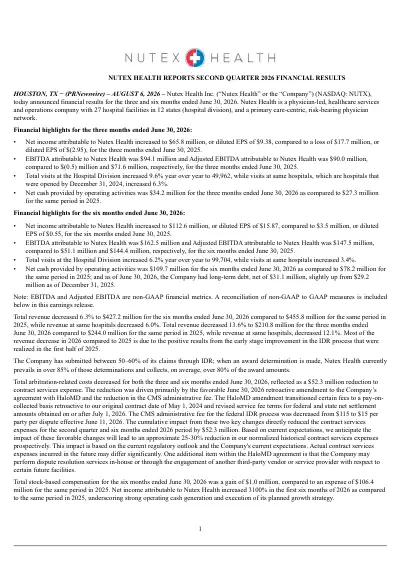
For the first 2 quarters of 2026, total revenue reached $427.2 million, a slight 6% decrease from $455.8 million for the same period in 2025. This is primarily due to timing from accrual to cash collections, as John will further explain.
Net income attributable to Nutex increased to $112.6 million for the first 2 quarters of 2026, a 31%—3100% increase from $3.5 million for the same period in 2025. Adjusted EBITDA increased 2% from $144.4 million to $147.5 million for the first half of 2026.
On the volume side, for the first 2 quarters of 2026, our hospitals recorded 99,700 total patients visits, up 6.2% from 93,800,000 during the same visit, same period in 2025. Same-hospital growth was 3.4% in the first 6 months of 2026.
Notably, same-hospital visits grew 6.3% in the second quarter of 2026, reflecting strong operational execution and the impact of our internal investment over the past year. On the balance sheet, net long-term debt increased from $29.2 million at December 31st, 2025 to $31.1 million at the end of Q2 2026, still very low relative to our revenue and expansion pace.
Cash on hand grew to $207.1 million as of June 30th, 2026, up from $185.9 million at year-end 2025. Net cash from operating activity was $109.7 million for the first 2 quarters of 2026 compared to $78.2 million in 2025, a 40% increase.
Our strong first-half performance was driven by several factors: continued growth in inpatient volume and acuity due to renewed internal initiatives and investments; lower earnout expenses as most legacy facilities that were in development as of 2022 have vested; reduced arbitration-related costs following a catch-up reconciliation; and sustained collection strength from both our internal and external revenue cycle teams. In addition, we are seeing more stabilization of revenue this year compared to this time last year.
John will also discuss this details in his report. On the reimbursement side, the quarter was highly active with important provider wins in federal courts, as well as a final federal ruling improving the administration of the IDR process.
Let us start on the legal side. During the first half of 2026, courts in California, Florida, Pennsylvania, Texas, Connecticut, and Georgia all issued decisions reinforcing the finality of the IDR awards and limiting insurers' ability to challenge arbitration outcomes in court.
The courts further indicated that insurers' objection to the high IDR loss rates are matters for Congress, not the federal courts. For Nutex, these rulings are important because they support the integrity of the IDR process and provide additional precedent for a fair federal dispute resolution system.
In fact, in the Georgia ruling, the judge stated, and I quote, "It is highly improbable to infer from these facts that there is a vast conspiracy of providers and IDREs that have conspired to defraud the plaintiff of millions of dollars in thousands of NDR, NSA proceedings over many years." He further stated, "It is highly plausible to infer that the plaintiff engages in a consistent practice of submitting lowball offers to out-of-network providers in an effort to maximize its profits," end quote.
Insurers have largely executed this low-provider payment strategy very successfully, as reflected in their record profitability during the first half of 2026, where profits were in the billions. While we are very happy for the financial successes of the insurance companies, our position is very simple: Nutex seeks fair, market-based reimbursement for comparable care.
Patients treated at our facilities should be reimbursed consistent with the cost of similar services delivered at comparable facilities. A functional IDR process promotes fair, free market competition, protects access to high-quality care, and reduces unnecessary disputes.
If insurers paid appropriately rates at the outset, fewer claims would need to proceed through the IDR process. On the regulatory side, on May 28th of this year, CMS and other federal agencies released the final IDR rules, which focuses on improving the efficiency and transparency of the IDR process without changing the core reimbursement framework.
Key improvements include better disclosures from insurers to prevent and limit future ineligible charts; a more efficient electronic portal to encourage open negotiations; lower administrative fees from $115 to $15; expanded batching for certain claims; and shorter cooling-off period. Overall, we view the final rule as constructive for providers and for Nutex.
Congress and the Centers for Medicare & Medicaid Services, or CMS, recognized that the independent dispute resolution process remains the only available meaningful mechanism through which providers may contest inadequate insurer reimbursement. In its absence and without the IDR process, insurers would have unchecked pricing authority and a monopoly position within the market.
Lastly, the final rule reflects CMS's intent to create a more streamlined, user-friendly system that providers and payers can use effectively when needed. We believe that this underscores CMS's view that the IDR process will remain in place for the foreseeable future.
On the vendor front, earlier this month, we announced an amendment with Halo MD that shifts the fee structure to pay-on-collected basis, retroactive to the original agreement. This helped reduce IDR costs in the quarter and gives us more flexibility to manage dispute resolution services going forward.
Combine this with a lower CMS IDR cost, this amendment will result in lower total arbitration-related costs in the future. In addition, we now have additional options to utilize other arbitrator vendors going forward, if necessary.
Turning to growth, we remain very excited about our hospital development pipeline and opportunities ahead. We have started internalizing the real estate development capabilities, giving us better control over timelines, cost, and scalability.
Our strategy is not to be a long-term real estate owner. We plan to develop facilities, stabilize operations, and then monetize the real estate through a sale-leaseback transactions upon hospital opening or stabilization.
Looking ahead, our current pipeline in 2026 includes West Little Rock, Arkansas; San Antonio, Texas; and Jacksonville, Florida. All three are expected to open in the third and fourth quarter of 2026.
For 2027, our pipeline includes new hospital developments in South and Central and East Florida, as well as Oklahoma. Notably, two of these projects are expected to be initially owned and developed by Nutex.
Beyond 2027, we have already approved additional Nutex-owned and Nutex-led projects in Idaho, Florida, Pennsylvania, Ohio, and Arkansas. As a public company, we are very fortunate to have the ability to continue growing through de novo hospital developments.
Because building large-scale hospitals presents significant challenges and costs, larger healthcare systems are often limited to volume growth as their primary expansion strategy. Nutex, on the other hand, can grow both internally as well as de novo by advancing a focused, national pipeline of smaller, scalable facilities.
Together, these new projects provide a clear roadmap for long-term growth and great shareholder value creation. Operationally, Wes will provide more details, but we remain focused on increasing volume, expanding service lines, and growing appropriate observation and inpatient care within our hospitals.
Patients often tell us they prefer to remain in our hospital rather than be transferred to another hospital for higher level of care. We also continue to invest in technology, diagnostic capabilities, and differentiated patient service, which are key elements of the Nutex model.
Patient satisfaction remains a key strength of our model, as reflected in our continued recognition through multiple hospital awards, as well as our reputation as the trusted hospital of choice for healthcare providers and their families in the communities we serve. With that, I'll turn the call over to Jon Bates, our Chief Financial Officer, to walk through the financials in more detail.
John?
Jon Bates
Thanks, Tom. Hey, and good morning, everyone.
Let me go through some of the details on the financials for Nutex Health second quarter and first half of 2026, another strong period where our earnings are strong and our cash flow continues to build as we plan for three future openings later this year and continue to prove out our growth model year-over-year. Now Tom's given you a little bit of the big picture, and I'll attempt to provide a little more detail.
I'm going to start with the 3 months ended June 30th of 2026 compared to the 3 months ended June 30th of 2025. Total revenue for Q2 of '26 decreased 13.6% to $210.8 million compared to $244 million for the same period in '25.
Of the total revenue decrease, Hospital Division revenue decreased 14.6% to $201.9 million from $236.3 million, while same hospitals decreased their revenue by 12.1% for the same for the second quarter of 2026 compared to the same period in 2025. Now the main reason for the revenue decrease period-over-period was due to the larger positive increase in revenue in the 2025 period as the IDR process began showing stronger realization of revenue in the first half of 2025, with us experiencing the early success with the IDR process.
If you recall, the revenue per visit, which does include both ER and the inpatient services, back during the second quarter of 2025 was approximately $5,185 per visit, while the cumulative net revenue per visit from when we started the IDR process in July of 2024 through June of 2025 was closer to $4,200 a visit, which is much more in line with what we have continued to see since then and into 2026. Now revenue per visit in Q2 of '25 was positively impacted by adjustments to our collection percentage from 65% at the end of December 31, 2024 up to 75% by June 30th of 2025.
This positive adjustment was a result of additional historical collection history as it was being recognized in early 2025. As the historical collection percentage leveled out to the current average of just over 80%, fewer adjustments have been recognized in 2026.
Now this helps explain why current revenue per visit is more in line with the historical average measured from the start of the IDR process. If there are no significant fluctuations in our collection percentage and other key metrics used to record revenue moving forward, we would expect the revenue per visit metric to remain similar.
Hospital Division visits increased by 9.6% or 4,389 visits to 49,962 visits in quarter two of 2026 versus 45,573 visits in the same period in '25, with the same-hospital visits growing at 6.3% over the same period, as Tom indicated earlier. With regard to the Population Health Division, it had revenue growth of approximately 16% to $8.9 million for quarter two of '26 versus $7.7 million for the same period in 2025.
Now in addition to the visit growth noted above, facility corporate-level costs also showed improvement for the second quarter of '26 relative to the same period in '25. Total facility-level operating costs and expenses decreased 49.6% $49.6 million during the period, representing 33% or $69.5 million of total revenue for Q2 of '26 versus 48.8% or $119.1 million for the same period in 2025.
Now of the $49.6 million decrease for the period, approximately $52 million of the decrease was reflected within our contract services line and resulted from two major positive items that took place in the second quarter of 2026. The first item was the impact from the federal IDR operations final rule that was signed in May of 2026, which reduced the CMS nonrefundable administrative fee from $115 to $15 per party per dispute initiated on or after June 11th of 2026.
This contributed to about $4.3 million of this total decrease. The other major item was the June 2026 amendment we negotiated to our original Halo MD contract that was signed in May of 2024.
Among several other positive changes in this amendment, two of the larger items were, number one, it transitioned the applicable fee payment structure to a pay-on-collected basis rather than payment being due upon award determination, with it being retroactive to the effective date of the original agreement in 2024. This contributed about $38.4 million of that total decrease.
Secondly, it favorably amended the service fee structure applicable to various federal and state net settlement amounts obtained on or after July 1st of 2026. This contributed around $9.6 million of the total decrease.
One last thing was the contract renegotiation provided the company with the right to perform dispute resolution services either in-house or through the engagement of another third-party vendor or service provider with respect to certain future hospital facilities, which Tom indicated before. Now regarding the contract services, based upon current expectations, we anticipate, the CMS fee rate reduction and the amendment to the Halo contract will lead to approximately 25% to 30% decrease in our historical normalized costs in future periods, assuming our current IDR metrics continue.
Because the pay-on-collection basis is our new reality, we will not have to record 100% of the IDR costs on every potential legal determination when, as we will now be only accruing costs using a similar collection percentage that we use for our accrual of revenue. Plus, we were able to get this changed on retroactive to when we signed the original agreement in 2024.
We believe we will better match our costs for this to the corresponding revenue we record, which should make the analysis much easier in the future periods. Now regarding arbitration-related revenue, we've continued to submit between 50% to 60% of our claims through the IDR process.
When an award determination is made, we currently prevail in over 85% of those determinations, and we currently have an average collection rate of over 80% of determination wins. Moving on, talk a little bit about stock-based compensation for the 3 months ended June 2026.
It was $2.9 million compared to $78.7 million of expense for the same period in 2025, which was a $75.9 million decrease in Q2 of 2026. Currently, there are only two facilities that are part of the major expense that goes in this line item, with both of them completing their earnout period in the fourth quarter of 2026.
Gross profit for the 3 months ended June 30th, 2026 was $141.3 million or 67% of total revenue, as compared to $124.9 million or 51.2% of total revenue in the same period in '25, a 15.8% increase for the 3 months ended June 30th, 2026 versus 2025. From a corporate and other costs perspective, the general and administrative expenses as a percentage of total revenue for the 3 months ended June of '26 increased to 7.9% or $16.7 million from 5.1% or $12.5 million for the same period in 2025.
Operating income for the 3 months ended June 30th of 2026 was $121.7 million compared to $33.7 million for the same period in '25, which is an increase of $88. $88 million.
Net income attributable to Nutex Health was $65.8 million for 2026 compared to a net loss of $17.7 million for the 2025 period, which was an increase of $83.5 million. Adjusted EBITDA attributable to Nutex increased $18.4 million or 25.7% from $71.6 million in Q2 of '25 to $90 million in Q2 of 2026.
Now let's move on and talk a little about the 6-month period ended June 30th compared to the 6 months of June of 2025. Total revenue for the first 6 months of 2026 decreased 6.3% to $427.2 million compared to $455.8 million for the same period in 2025.
Of the revenue decrease, Hospital Division revenue decreased 7% to $409.4 million from $440.2 million, while same hospitals decreased their revenue by 6% for the first 6 months of 2026 compared to the same period in 2025. As discussed earlier in the second quarter explanation for the decrease in revenue for the period, the main reason for the revenue decrease period-over-period was due to the larger positive increase in revenue in the 2025 period as the IDR process began showing stronger realization of revenue in the first half of 2025, with us experiencing early success in the IDR process.
From a hospital divisions visit perspective, it increased by 6.2% or 5,862 visits to 99,704 visits in the first 6 months of 2026 versus 93,842 visits in the same period in 2025, with same-hospital visits growing at 3.4% over the same period. With regard to the Population Health Division, it had revenue growth of approximately 15% to $17.8 million for the first 6 months of 2026 versus $15.5 million for the same period in 2025.
Now in addition to the visit growth noted above, again facility and corporate-level costs also showed improvement for the first half of '26 relative to 2025. Total facility-level operating and expenses decreased $18.3 million during the period, representing 45.5% or $194.2 million of total revenue for the first 6 months of 2026 versus 46.6% or $212.5 million for the same period in 2025.
As discussed for the second quarter of 2026, similarly, the main reason for most of the overall decrease in this line was due to the contract services decrease during the period, primarily resulting from the reduction in the CMS fee and the impact from the amendment to the Halo MD contract that we signed in the second quarter of 2026. Moving on to the stock-based compensation, again for the 6 months ended June of '26, it was a $1 million gain compared to $106.4 million expense for the same period in 2025, which was a $107.4 million decrease in cost, comparably, in 2026.
Now we did finalize one earnout at March 31st, 2026, as we talked in our first quarter call, and we have two more facilities currently in their measurement periods, with both of them completing their measurement period in the fourth quarter of 2026. The gross profit for the 6 months ended June 30th, 2026 was $233 million or 54.5% of total revenue, as compared to $243.3 million or 53.4% of total revenue for the same period in 2025, a 1.2% increase for the 6 months ended June of 2026.
From a corporate and other costs perspective, the G&A expenses as a percentage of total revenue for the 6 months ended June of '26 increased to 7.3% or $31.1 million from 4.9% or $22.5 million for the same period in 2025. Operating income for the 6 months ended June 30th, 2026 was $203 million compared to $114.3 million for the same period in 2025, which was an increase of $88.6 million.
Net income attributable to Nutex Health Inc. was $112 million for 2026 compared to only $3.5 million for 2025, an increase of $109.1 million.
The adjusted EBITDA attributable to Nutex increased $3.1 million or 2.2% from $144.4 million for the 6 months ended June 30th of '25 to $147.5 million for the same period in 2026. Now looking at our balance sheet, it continues to remain very strong, with cash and cash equivalents at June 30 at 200 June 30th of 2026 at $205.2 million, up $19.6 million or 10.6% from $185.6 million at December 31, 2025.
Additionally, accounts receivable increased by $32 million to $351.7 million at June 30th of '26 from $319.4 million at December 31 of '25. We had another strong collection quarter, which provides us continued confidence in this increase.
Regarding cash flow, net income from operating activities increased by $31.5 million for the 6 months ended June '26 to $109.7 million, as compared to $78.2 million for the same period in '25. Tom talked about this earlier, but on the liability side, our total bank and equipment-type debt decrease by $3.6 million to $39.9 million at June 30th of 2026 from $43.5 million at December 31, 2025, with the majority of this debt related to equipment loans at our hospitals for such items as MRIs, X-rays, ultrasounds, and CT scans.
With all that said, our balance sheet remains very solid, and we've provided our company the flexibility to execute on our growth plan in 2026 and beyond. Now onto Warren Hosseinion, our President, for a population health update.
Warren?
Warren Hosseinion
Thank you, John, and good morning, everyone. It's great to be with you today to discuss how Nutex Health is advancing population health management.
In the first half of 2026, we continued to make strides in this area. This morning, I would like to again focus on our strategy and our upcoming goals.
Let's start with where we are today. Our Population Health Management Division now oversees a diverse group of almost 40,000 patients across our platform, including a mix of Medicare Advantage, commercial, and Medicaid managed care members.
Revenue for the division was up 15% for the 6 months ended June 30, 2026 from the same period in 2025. Each of our IPAs in Southern California, Houston, and Phoenix were profitable for the 6 months ended June 30, 2026, while our IPA in South Florida was slightly cash flow negative for the same period.
Our new IPAs in Dallas and San Antonio are still contracting with primary care physicians and specialists, and will begin enrolling patients in 2027. Our overarching strategy revolves around physician networks.
Our IPAs, or independent physician associations, are comprised of networks of contracted and credentialed primary care physicians and specialists located around our facilities. Building strong partnerships with local doctors is critical.
By forming these IPAs, we are building awareness of our hospitals among the local community doctors and their patients. Why do physicians join our IPAs?
We offer these physicians ownership in our IPAs. They can also participate in the board and committees of the group.
We offer them to get on the staff of our hospital so they can admit and follow patients. We also incentivize the physicians to achieve high-quality metrics.
We believe that over time, these relationships will not only increase the volume of both IPA and non-IPA patients to our hospitals, but also create a web of care that's seamless for patients. Our vision is that our hospitals and IPAs will work hand-in-hand to amplify our reach and effectiveness.
We are fostering collaboration, sharing best practices, and ensuring every provider is aligned with our patient-first culture. We're growing our IPAs strategically, focusing on areas near our hospitals to leverage existing relationships and infrastructure.
With that, I'll turn it over to Wes Bamburg, our Chief Operating Officer.
Wes Bamburg
Thank you, Warren, and good morning, everyone. I'll focus my comments on our operational performance during the second quarter, including patient volume growth, service line expansion, and patient experience.
Our hospitals continue to see demand across the markets we serve. As previously mentioned, during the quarter, we recorded nearly 50,000 patient visits, an increase of 9.6% compared to the prior year, while same-hospital visits increased 6.3%.
For the 6 months of 2026, total hospital visits increased 6.2% to nearly 100,000 patients served across the enterprise. These results reflect continued growth across both our newer and more mature facilities, and demonstrate the ongoing strength of our model.
We also continue to expand patient access and increase our ability to care for more patients within our hospitals. As facilities mature, we're able to offer a broader range of services, retain more patients locally, and further strengthen our continuity of care within our communities.
During the quarter, we also made progress on service line expansion, including the launch of endoscopy services. This will allow us to provide critically needed services to the communities we serve, such as colonoscopies and diagnostic EGDs.
As we evaluate performance and demand, we see opportunities to expand additional service lines across our facilities over time. As Tom discussed earlier, we also remain focused on supporting growth across our development pipeline.
With several facilities expected to open later this year, we continue to leverage the infrastructure, experience, and the operating playbook developed across our existing network to efficiently ramp new hospitals and support consistent execution from day one. Patient satisfaction remains a key strength during the quarter, with our hospitals maintaining an average Google rating of 4.8 stars across more than 2,300 reviews.
We believe those results reflect the commitment of our physicians, nurses, and staff to delivering high-quality patient experience every day. Workforce stability also remains a competitive advantage.
Employee turnover was just 6.8% during the first 6 months of 2026, significantly below published hospital industry benchmarks, supporting consistent execution and high-quality patient care across our network. From a cost management perspective, we remained disciplined as volumes grew, maintaining focus on staffing efficiency, resource utilization, and operational standardization.
We believe our ability to combine growth with operational discipline continues to be an important differentiator as we scale the organization. Overall, the second quarter reflected continued operational momentum across the enterprise.
We delivered strong volume growth, expanded clinical capabilities, maintained excellent patient satisfaction, and continued to position the organization for future growth through both service line expansion and our new hospital development. I thank you, everyone, and I'll turn the call back over to Vivian.
Vivian Sanders
Thank you, Wes and team, for those updates. I will now turn it over to our operator, who will begin the Q&A portion of the call.
Operator
Thank you. We'll now be conducting a question-and-answer session.
If you would like to ask a question, please press *1 on your telephone keypad. A confirmation tone will indicate your line is in the question queue.
You may press *2 to remove your question from the queue. For participants using speaker equipment, it may be necessary to pick up your handset before pressing the star keys.
One moment, please, while we poll for questions. Thank you.
Our first question is from Anderson Schock with B. Riley Securities.
Anderson Schock
Hi. Good morning.
Thank you for taking the questions. Previously, the arbitration costs were expected to run about 25% of arbitration-related revenue.
I guess excluding the credit, what did this look like in the second quarter, and how should we think about the new go-forward rate after the May IDR final ruling and the renegotiated Halo MD agreement?
Jon Bates
Hey, Anderson. Great question.
If you think about it from the standpoint of the way we look at it, first of all, we talked about contract services and how that looks, and you talked about that 25% in the past if we're just talking about specifically arbitration. Normally it was a range of, in that mid 24% to 25%, 26% in the past.
Now currently, as we move forward, you should expect that to be, just that specific piece probably down more into the, high teens to low 20s, comparatively. On an overall contract services rate reductions, as we talked about, it should be more into the, 25% to 30%.
That's on overall contract services, but arbitration, you would see that correspondingly work its way down.
Anderson Schock
Got it. Then is the second quarter revenue per visit a fair steady-state run rate, or should this further normalize in the back half as the IDR catch-up rolls off the 2025 base?
Jon Bates
As we talked about in the past, if you look back at, I think we talked about it here, the cumulative rough estimate of where reimbursement has been since we started the process overall was really in that $4,000 to $4,200 range, and that's remaining pretty consistent. Even for this period, yeah, no, I think it's in line.
There'll be some, variability up and down. I know as we continue to, have more inpatients, which I think that's one of the improvements we're starting to see, you'll see a little bit higher in that area.
I think in the range that we've seen cumulatively since we started the process to through June of '26, and which is very similar to what we have in the quarter and first 6 months of '26, I think it's a fair number to be looking at as you move forward for now.
Anderson Schock
Got it. Then with the opening cadence for the next 2 years kind of at the higher end of your historic range and your new self-financing strategy funding the opening of half of these next year, should we expect an increase from the historic range of three to five hospitals openings per year in the future?
Tom Vo
Hi, Anderson. I could take that question.
No, we're still basically focusing on three to five hospitals per year. That has not changed yet at this point.
Obviously, we will continue to evaluate new locations. As we get requests to open these hospitals on a weekly basis.
As we discuss internally and in accordance with our financials, we will reevaluate that three to five hospitals per year.
Anderson Schock
Got it. Thank you for taking the questions, and congrats on all the progress.
Tom Vo
Thank you, Anderson.
Jon Bates
Thanks, Anderson.
Operator
Our next question is from Ben Haynor with Lake Street Capital Markets.
Ben Haynor
Good morning, gentlemen. Thanks for taking the questions.
First off for me, with these recent court cases that have gone the right direction for you guys, do you see any change to insurer behavior with regards to collection rates based upon those?
Tom Vo
Hi, Ben. I could take this, and maybe John could chime in.
Far, it's pretty much steady-state from insurance company payments. We are seeing more submissions to go in-network with health insurance company.
The rates are slowly creeping up, but it's still nowhere near where we should be.
Ben Haynor
Okay. Does that also imply that QPAs have come up a little bit, and QPA multiples coming down, or no?
Tom Vo
Far, we have not seen a drastic change at this point. QPA is still relatively low, hence our submission rate of roughly 60%.
Ben Haynor
That makes sense. Then I guess on the submission rate, with the lowered $15 fee, kind of the newer Halo MD rate and terms, do you see yourselves starting to challenge some of the ones that may have previously been considered, marginal or maybe good enough?
Jon Bates
I can talk about that. Look, at the end of the day, $100 for submission is great, and it helps, all providers, and it does lower the barrier of entry, I think, across the board for providers in general to hopefully get a better, fair payment if they want if they choose to do it.
We're looked at that, the $100 difference on that piece. There are a few that might we might now take through the process that, risk-wise we might not have before.
I think generally, we'll keep a similar cadence and then just watch for, opportunities in those situations where, yeah, maybe we'll go in on some that we haven't in the past. I don't think it'll be a material change for us.
I think it might be for, some other providers.
Ben Haynor
That makes sense. That's all I had.
Thanks a lot, gentlemen, and congrats on the quarter and the progress.
Jon Bates
Hey, thanks, Ben.
Tom Vo
Thanks, Ben.
Operator
Our next question is from Thomas McGovern with Maxim Group.
Thomas McGovern
Hey, guys. Thanks for taking my questions here.
A couple of my questions were already touched on, but I do want to piggyback off of the last question regarding the insurer behavior based on these court cases and the changing regulation around arbitration. It sounds like maybe there's some progress on that front, but it's been pretty slow.
I'm just curious from your strategic perspective, are you guys going to be proactively pursuing in-network agreements with payers, or are you guys just, hey, look, we're going to focus on our business and continue operating, and wait for payers to come to the table with you?
Tom Vo
Hi, Thomas. The answer is we are always looking to go in-network with insurance company, always.
We're still continue to evaluate any contracts that comes in. Like I mentioned earlier, the rates have come up a little bit over the past quarter or so, but still nowhere near where we need to be.
Thomas McGovern
Understood. Thanks for that added color.
Then looking at the patient volume and acuity growth that you guys commented on in your prepared remarks, I just want to understand a little bit better what drove that success in the quarter. Then how should we look at it as acuity as you guys are adding service line items and increasing in-house patient visits, how should we expect the revenue per patient to trend over time?
Tom Vo
I could answer that. That I think is a two-part question.
Maybe Wes could chime in also from an operational standpoint. Over the past couple of quarters, I think we have talked about increasing investment in our internal processes by getting more business development folks on the team, using AI, talking with more physicians, using the IPA network to increase volume.
Then once we get patients through the door, then our focus is on keeping the patients in the hospital to increase inpatient volume. As inpatient pays a lot better than ER payments.
If we continue to execute this, theoretically, the revenue per patient should increase because we would have more inpatient visits in the future. Then on top of that, as Wes mentioned, we are also starting to do more procedures.
For example, we're doing colonoscopy right now in one of our hospital, and we're looking at essentially any potential procedures that we could do at our hospitals, just based on the needs of the community. Wes, do you have anything else to add?
Wes Bamburg
Hey, Tom. No, I think you covered it.
As we continue to evolve, we are centralizing and focusing on our business development as an enterprise level and looking across all of our hospitals to see where there's opportunities. That may be different at different locations, but we're focusing on those opportunities, evaluating them, and bringing them in-house when we can.
Then secondarily, we continue to add the ability to take care of sicker patients, so that is increasing our inpatient volumes, which will have a positive net impact overall.
Tom Vo
One more thing that I'd like to expand is that because of the flexibility of our hospital, you could think of our hospital as a car. We could take that car, and we could drive it in any direction we want, as long as it's best for the community and meeting certain needs of the community.
The hospital, even though it's small, it's got most of the tools necessary to relieve a lot of pain points in each of the community that we serve.
Thomas McGovern
Understood. I appreciate that color.
Then finally for me, I just want to unpack this Halo MD renegotiation of the amendment to your agreement just a bit. Just kind of high level, what drove that conversation?
What made you guys come to the table with them to say, hey, look, we need to relook, reevaluate these terms? My second question to that would be, under what circumstances would you guys exercise your newly gained optionality in terms of pursuing arbitration claims in-house or using a third party for some of these newer facilities?
Tom Vo
Maybe I could start with that with the first part, and then John maybe able to answer the second part. If you remember, we started arbitration back in July of 2024.
Before that, we were investigating and researching whether or not arbitration would even work. Going back 2 years to beginning of 2024, if you remember, arbitration at that time was in its infancy stage.
We did not have any of the beautiful portals or any of the system set up. We didn't have the final rules at that time.
At that time, it was a bit of a shot in the dark, to speak. Just based on all the research that we did at that time, we found that arbitration was potentially a very good way for us to get back at fair and reasonable rate.
At that time, Halo MD was, and they still are, I would say the preeminent vendor in that space. When we signed the contract in, I would say early 2024, we didn't have a lot of knowledge, nor do we have a lot of data like we do now.
Fast forward to this year, obviously what happened in mid-2024 was ancient history in terms of the evolution of the IDR process. It was just a normal time to renegotiate the contract based on what we know now versus what we knew back in beginning of 2024.
Jon Bates
I'll add to that, Tom. Absolutely.
No, first of all, Halo's a great partner. They've done a great job.
They are, as Tom indicated, the leader in this. We've learned a ton over the last I can't believe it's been 2 years, eight quarters since we really started this process.
They have as well. The industry's improved across the board.
There's a lot more groups out there. There's a lot more data out there.
I think everyone's smarter both on the government side and, on the provider and for that matter probably payer side. I think we all realize as we've been going through this process that there's probably things that we can do or would really like done that make sense for both us and even Halo as you move forward from the partnership perspective, and they were amenable to that.
Going through and trying to better clarify kind of the original agreement and look for things that made sense for both sides. At the end of the day, that was just a really good partnership decision to kind of go through that process.
Yes, it gives us flexibility as we move forward, as we indicated earlier, to either use third party, do it ourselves, it to for some select few facilities as we move forward. I think it's a win-win, and it puts us in a really good position as we move forward to be able to pivot if things do change one way or the other, and which is one of the things I would say that as a company, we've done a fantastic job of.
If you look back to 2 and 1/2, 3 years ago where we were and where we are now, we've done a lot of that in many different areas, not just on this piece of our business. Remember, we don't use IDR for every visit.
I do believe that we'll be using it for, fewer and fewer as we move forward, because we are getting some contracts, as we talked about earlier, and there is some better paying happening by the payers, but it's just been a little slower than we would expect, and we're just watching the process. We submit through the process when we feel like we're not paid, fairly and equitably, and that's exactly what it's set up for.
Hopefully that helps explain it. Great question.
Thomas McGovern
Absolutely. Thank you, guys.
I'll hop out of queue.
Jon Bates
Thank you, Thomas.
Tom Vo
Thanks, Tom.
Operator
Our next question is from Bill Sutherland with The Benchmark Company.
Bill Sutherland
Hey, everybody. Great progress.
John, just to follow up on that question somewhat, would you ballpark kind of the numbers or the percentage of things going into negotiation that are being handled in negotiation? what I'm trying to ask is, has there been some movement on that that's measurable, that are getting settled?
Jon Bates
Bill, what are you asking again? We go into the process, what
Bill Sutherland
As I think about it, it's a two-part question. One is are you cuz you alluded to some progress with more negotiated settlement, and also I'm curious about the degree to which you're beginning to go in-network.
Jon Bates
Okay. I think we talked about this earlier, and just to remind everybody, in the process of going through the IDR process, the submission side and communication that goes to the IDRE from our end always includes a discussion about to the payer we would like to do an in-network negotiation.
That's why we do have open negotiations and ultimately only go to the arbitration side if we're not able to settle. There in every brief that's submitted, there is a request and an interest, because we do have an interest in finding something that makes sense.
That piece of it is continual. Yes, we do, every day, we have communication with multiple different payers out there that have expressed interest, or we have also reached out to some as well in some of the local areas that we have access and knowledge of and try to do the same.
We've had some scenarios where we've been successful, and I would say more than not, though, there's still a feeling that the payers don't necessarily, really want to actively provide the fair and reasonable in some payment in some cases, therefore we leave it alone. It's an active effort, and I think we will continue to get more and more of this, and we hope to build on.
Bill Sutherland
Nothing's changed, really. As you said, you have the same kind of percentages on your side as in terms of what's going to IDR.
Jon Bates
Yes, that's fair. I think it definitely has improved, but it's a slight improvement.
As we watch some of these regulatory communications, I think we're starting to see more that support a reason for where we can come up with something that makes more sense and get agreements in place down the road, but it takes time in this industry, as we all know.
Bill Sutherland
There wasn't too much in that final rule that really focused on the open negotiation part, other than make it streamlined, and but didn't really encourage the two parties to really make it happen. The and you would say your percentage of revenue that's in-network hasn't changed either?
Jon Bates
Percentage of revenue that's in-network, as in our visits and our revenue related to in-network patients?
Bill Sutherland
In-network versus out-of.
Jon Bates
It's we've had a few more, but yeah, it's not it's a slight increase in the in-network scenario, I think it's what you're asking, but yes,
Bill Sutherland
it's
Jon Bates
improved a little bit.
Bill Sutherland
Okay.
Tom Vo
It's definitely not material, for sure. Bill, I want to reiterate
Bill Sutherland
That's what I was trying to get at.
Tom Vo
Yeah. One of the thing that I wanted to reiterate, and one of the things that I like to sort of like clarify for then all the investors, is that yes, we are out-of-network.
However, with our business model, we can stay out-of-network and still do well. The No Surprises Act basically states that if you have an emergency, you can go to any hospital, whether or not it's in-network or out-of-network, and still be expected to get paid at the in-network rates.
That's essentially how we have been operating for the past 15 years or so. Yes, the the No Surprises Act encourages us to go in-network, which we are once again looking at every single contract that comes in and make strong consideration about whether or not we accept the contract or not.
Even if the contract terms are not in line with what we would like, we can still stay out-of-network. Obviously, the IDR process is a tool for us to get that fair and reasonable rate.
Then one more thing that I'd like to to bring up is that just because you go in-network doesn't mean that all of your troubles are are resolved. In fact, and I'm sure you know this, but every single hospital system has had in-network disputes with the health insurance company, every single one.
Every I would say every quarter, you hear a big hospital system that goes out-of-network because of a big dispute with the health insurance company, because of all the the contractual obligations that they have in the in-network contract. My point is that just because you're in-network doesn't mean that everything is rosy.
We're still going to take a look at every single submissions by the insurance company, but the great thing about our model is that we can stay out-of-network if we need to.
Bill Sutherland
Thanks, Tom. Then one last one, just thinking about quarterly cadence in terms of your hospital activity levels each quarter.
I noticed patient visits were pretty flat sequentially. Remind us about the seasonality as we think about patient visits going forward.
Tom Vo
Typically, the second and third quarter are the lowest, and the fourth quarter and the first quarter is the highest because of the colder season and the flu season.
Bill Sutherland
That's what I thought. Okay.
Thanks, Tom. Thanks, everybody.
Tom Vo
Thank you, Bill.
Operator
Thank you. There are no further questions at this time.
I'd like to hand the floor back over to Vivian Sanders for any closing comments.
Vivian Sanders
Thank you all for those valuable questions and answers. For all of those joining us today, if you have more questions, email us at [email protected], and we'll get back to you promptly.
On behalf of the Nutex management team, thank you all for joining us for our second quarter 2026 earnings call. We've covered a lot: growth, strategy, challenges, and our vision, and we appreciate your time and interest.
A recording of this call will be available on our website for a limited time, feel free to revisit it. Take care, everyone, and we look forward to keeping you updated on our journey.
Operator
This concludes today's conference call. You may disconnect your lines at this time.
Thank you again for your participation.