ASMPT Limited
Q3 FY2026 · Earnings Call TranscriptOctober 28, 2026
Ben Poh
Good morning, ladies and gentlemen. I'm Ben Poh, Head of Investor Relations, and today I'll be moderating the call.
Bassel Haddad
expertise and customer engagement, and the potential to position the company at the forefront of this transition is a major reason I chose to join ASMPT. My mandate from the board is clear: to build on our technology leadership and market position, and lead ASMPT into its next phase of sustainable growth, enhanced profitability, and long-term value creation.
Two months in, I have engaged in numerous discussions with colleagues, met with customers across the globe, and spoken with shareholders and investors. My conviction has only strengthened.
I have been particularly impressed by the depth of our technology and engineering capabilities, perhaps even more than I expected. Our opportunity now is to focus those capabilities where we can create the greatest differentiation, move faster, and translate our innovation into greater customer and business impact.
Technology will be central to how I lead, but it must translate into impact, solving critical customer problems, scaling faster, and creating attractive returns. We will be technology-led, customer-driven, and financially disciplined.
It is still early, and I'm continuing to listen and learn, but I'm very excited about the opportunity ahead for ASMPT. With that, let's turn to our results.
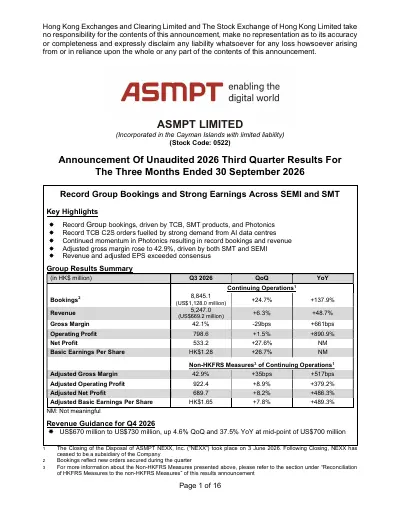
Let me briefly share our business highlights for this solid quarter. First, we achieved record group bookings, driven by all-time high bookings for TCB, SMT, and Photonics.
Next, in TCB logic, orders for our C2S solutions reached a record high, driven by strong demand from AI data centers. Third, our Photonics business achieved record booking and revenue, driven by production ramps of 800G, 1.6T, and next-generation optical modules.
Fourth, our group adjusted gross margin of 42.9% was up 35 basis points Q-on-Q and 517 basis points year-on-year, reflecting improvements in both SMT and SEMI. Finally, both our group revenue and adjusted EPS exceeded consensus.
Now let me cover our business highlights in more color. Let's look at TCB, which achieved record booking in Q3.
First, in logic, we received bulk orders for C2S solutions driven by AI data centers. Specifically, this came from strong demand for larger compound die TCB tools from the OSAT partners of a leading advanced logic customer, as well as orders for other AI-related applications.
In C2W, we secured repeat orders from a leading global IDM for advanced CPUs to support client computing and AI inference, reflecting this customer's continued confidence in our C2W solutions. In memory, the industry is reassessing the optimal balance between memory density, thermal management, and cost, reflecting a recalibration of customer investment schedules.
Thus, even though larger capability-driven investments are being pushed out, we believe the need for capacity additions and selective upgrades remains intact. Meanwhile, we continue to develop next-generation TCB solutions designed to deliver superior throughput, yield, and process performance, which positions us well for the next phase of HBM-related customer investments.
Next, for TCB panel-level packaging, we're making good progress. Our quarter panel solution is currently undergoing sample bonding with a leading advanced logic customer, while we help develop solutions for a leading global IDM's embedded and surface silicon bridge die architectures.
Our next key area of focus is Photonics. We have a comprehensive portfolio that spans pluggable optical transceivers, near-packaged optics or NPO, and co-packaged optics or CPO.
This quarter, our Photonics business in SEMI achieved record bookings and revenue, driven by production ramps of 800G, 1.6T, and next-generation optical modules. Meanwhile, our pluggable optical transceiver solutions secured significant orders, reinforcing our leading position in the transceiver market.
Notably, our AMICRA business achieved a breakthrough NPO bulk order. In addition, AMICRA's ultra-high-precision bonding solutions received major orders from a leading communication services provider for optical transceiver solutions.
In CPO, we continue to deepen our engagement with multiple leading global CPO players. Together, these developments demonstrate the breadth of our Photonics portfolio and create a multi-year growth opportunity.
In hybrid bonding, our second-generation platform combines competitive alignment precision, bonding accuracy, footprint efficiency, and throughput. We continue to work with leading logic and memory customers on programs at various stages of sampling, evaluation, and qualification.
Let's now cover the SEMI mainstream business. Revenue and bookings remained elevated, and it continued to be supported by AI-related demand for power management and server boards for data centers.
AI infrastructure expansion also drove wire bonding and die bonding tool demand, alongside high utilization in OSATs. Finally, SMT booking hit a record high for the third consecutive quarter and highest booking market share.
Demand was driven largely by AI server boards and optical transceivers. SMT's high-flex solutions for large format board assembly continued to attract strong demand for AI server manufacturing.
Notably, bookings growth in the Americas accelerated on the back of strong demand for AI servers. With these highlights, let me now hand the time over to Katie, who will walk you through our group and segment financial performance.
Katie Xu
Thank you, Bassel. Good morning, everyone.
Let me take you through the group's financial performance. I would like to reiterate that, unless otherwise specified, the numbers I'll be referring to today are for the group's continuing operations only, with adjustments made under non-HKFRS measures.
This slide covers our financial results for Q3 2026. In Q3, the group delivered revenue of 669.2 million US dollars, up 6.3% Q-on-Q and 48.7% year-on-year, driven by SEMI and SMT.
Group revenue came in above market consensus. Group quarterly bookings reached a record high at 1.13 billion US dollars, driven by continued AI infrastructure investments, one-off bulk orders, and demand pulling due to extended lead times.
Bookings increased by 24.7% Q-on-Q and 137.9% year-on-year, led by strong demand across multiple products, notably TCB, SMT products, and Photonics. Book-to-bill was 1.69, the highest since Q1 2021.
Group adjusted gross margin was 42.9%. This was 35 basis points higher Q-on-Q and 517 basis points higher year-on-year, driven by improvements in both SMT and SEMI.
Group's adjusted operating profit was 922.4 million Hong Kong dollars, up 8.9% Q-on-Q and 379.2% year-on-year, due to higher revenue and gross margin. However, adjusted OPEX was up 6.0% Q-on-Q and 16.6% year-on-year, mainly due to higher incentive provisions and increased volume.
Adjusted net profit improved Q-on-Q and year-on-year due to higher operating profit. Adjusted EPS was 1.65 Hong Kong dollars, up 7.8% Q-on-Q and 489.3% year-on-year, which was above market consensus.
Moving on to the Semiconductor Solutions segment. In Q3, SEMI revenue grew to 374.2 million US dollars, up 1.5% Q-on-Q and 68.0% year-on-year.
Year-on-year growth was largely driven by Photonics solutions serving AI-related applications, together with higher sales of wire and die bonders serving both AI and consumer end markets. SEMI bookings were 563.3 million US dollars, up 31.3% Q-on-Q and 156.3% year-on-year, the highest quarterly booking level since Q1 2021.
AI-driven demand benefited a broad range of SEMI's advanced packaging portfolio, notably TCB, Photonics, and flip chip solutions. SEMI solutions adjusted gross margin reached 46.6%, up 6 basis points Q-on-Q and 502 basis points year-on-year.
Year-on-year increase was largely due to higher volume and a favorable product mix. SEMI adjusted segment profit was 595.4 million Hong Kong dollars, down 1.3% Q-on-Q, but up 620.9% year-on-year.
Q-on-Q decline was due to higher incentive provisions, while year-on-year increase was due to higher volume and better gross margin. Next, let me move on to SMT.
SMT Q3 revenue was 295.0 million US dollars, up 13.2% Q-on-Q and 29.8% year-on-year. Bookings reached a new record high of 564.7 million US dollars for the third consecutive quarter, up 18.9% Q-on-Q and 122.1% year-on-year.
This strong performance was driven largely by robust AI server demand, and more than 100 million US dollars worth of bulk orders and pull-ins. Segment adjusted gross margin was 38.2%, up 131 basis points Q-on-Q and 425 basis points year-on-year.
Q-on-Q and year-on-year improvements were driven by higher volume. SMT adjusted segment profit was 410.4 million Hong Kong dollars, up 44.1% Q-on-Q and 143.2% year-on-year, driven by higher volume.
Now let me hand the time back to Bassel for the outlook and Q4 revenue guidance.
Bassel Haddad
Thanks, Katie. We expect Q4 2026 revenue to be in the range of 670 million US dollars and 730 million US dollars.
At the midpoint of 700 million US dollars, this represents an increase of 4.6% Q-on-Q and 37.5% year-on-year, and exceeds current market consensus. This will be driven by double-digit SMT revenue growth, while SEMI revenue is expected to be flat due to longer lead times of AP products.
We expect Q4 bookings will remain significantly elevated year-on-year, supported by sustained AI infrastructure investment across both segments. However, Q4 booking is expected to be below Q3 record level due to the one-offs and pull-in in SMT.
Looking ahead, AI demand is expected to drive sustained revenue growth in 2027. This concludes our third quarter 2026 presentation.
Thank you, and we're now ready for Q&A. Let me pass the time back to Ben to facilitate.
Ben Poh
Thank you, Bassel. Ladies and gentlemen, we now begin the Q&A session.
To ask a question, please click raise hand on Zoom, and I will request you to unmute. Please limit yourself to two questions each time.
First, I would like to request Gokul to unmute to ask a question.
Gokul Hariharan
Hi. Good morning.
Thanks, Ben, and welcome, Bassel, to this inaugural investor call that you are having. Maybe first question to you, Bassel, given that you've spent close on three months at the company.
When you look at the portfolio of ASMPT and you think about moving forward into the strong growth in advanced packaging or advanced back-end itself, could you talk a little bit about where you are seeing potential kind of areas that you could augment the portfolio further? What is the strategy to get there within the overall advanced packaging space?
Also, given previously ASMPT has indicated the inclination to potentially divest the SMT business, any updated thoughts on that thinking itself, given SMT has seen a pretty good resurgence in terms of business momentum in the last few quarters? Maybe that's the first question.
Bassel Haddad
I'll try to answer both sides of them. The first one was about my kind of three months into the company, not yet actually, two months and a half.
Let me start with that. I'm two months in, still in deep listening and learning mode with our technology teams, customers, and markets.
As I shared in my comments or prepared remarks, now I'm very convinced, as I was before, even more, that we have a strong technology, engineering depth, and customer relationship that's across advanced packaging, Photonics, and electronic manufacturing. As I also shared, we're going to be technology-led and drive where we see the biggest return on our investment.
The foundations are very strong. I'm energized with what I see, and we're going to just invest where we see the market growing, and where we see our set of IPs and portfolio and technology delivers the best results.
As I move to the second question about SMT, I cannot disclose the details at the moment of where we are in the process. We will certainly update the market when we can.
With that said, SMT record booking clearly reinforces and reflects the quality and the strategic value of that business. The assessment remains focused on maximizing long-term shareholder value.
Gokul Hariharan
Got it. Maybe one one question second question is on the TCB side of the equation.
I think you did talk a little bit about HBM, that there is some pause on HBM4 qualification and potentially some density-related concerns, which I think the market has also talked about potential de-speccing in HBM, etc. Previously, I think we've thought about memory TCB or the memory opportunity in TCB being much bigger than the logic opportunity in TCB.
Now that logic is growing quite nicely and you're starting to get some breakthroughs into chip-to-wafer as well, any updated view on the relative size of these two markets within TCB, memory versus logic? Also, this memory push-out on HBM orders, does it change your longer-term addressable market expectations for TCB at all?
I think the last one we have is $1.6 billion in by 2028.
Bassel Haddad
Thank you, Gokul. We, as we mentioned, we believe what we see in HBM layer count stagnation reflects the industry reassessment of the optimal balance between memory density, bandwidth, and thermal.
Even though we see larger investments have been pushed out, we believe there will be the need to add capacity and selective upgrades. All in all, it is an adjustment to the timing rather than a change in the underlying demand.
In that, just to summarize the HBM side of things, we continue to see long-term potential for HBM4 12-high and beyond, alongside HBM 8-high, both serving different segments of the AI market, and we are well-positioned in both areas. To address the other part of your question, in terms of the TCB TAM, we expect that TCB TAM to expand beyond $1.6 billion by 2028.
The expansion will come from different areas, including logic across CPU, panel, and C2W. We will provide the official TCB update only by the year-end earning call in Q1 2027.
However, with that said, we do see that the split or the majority of the TCB TAM in the next couple of years would come from logic versus memory, versus HBM.
Gokul Hariharan
That's very clear. Thank you very much.
I'll go back to the queue.
Ben Poh
Thank you. Thank you, Gokul.
Next, I would like to request Sunny to unmute to ask question.
Sunny Lin
Sure, thank you very much for taking my question. Good morning.
I also want to follow up on the addressable market for TCB. Bassel, may I clarify, just now you mentioned the addressable market should be larger than $1.6 billion by '28 if we also consider upside coming from silicon bridge integration and also panel-level?
Bassel Haddad
That's correct, Sunny.
Sunny Lin
I see. Also, given that estimate was provided by, I think, March 2026, and fast forward now we are indeed seeing progress being made for silicon bridge integration and also panel-level.
Understand you may not be able to update this time around, but should we expect pretty meaningful upgrade to that addressable market that you anticipate a few quarters ago? I also want to understand, especially for silicon bridge integration, could you share with us your current progress in terms of timeline for qualification and also potential volume shipment?
Also, for this specific TCB tool, how should we think about the tool price and also gross margin compared with typical TCB that is shipped to the larger foundries or relevant OSAT providers?
Bassel Haddad
Let me try to address the different parts of your question. On the TCB, the first one about the TCB market share, yeah, you're right.
As I said, we expect the logic portion of the TCB TAM to be the majority of that TAM in the next few years, and it would come from things like bridge and panel, as well as C2W demand, Sunny. Again, the numbers and the color will be provided in our year-end earning call.
Can you remind me of the second question, second part?
Sunny Lin
Want to know a bit more details around your progress for silicon bridge integration type of TCB. Timeline for qualification, potential volume shipment, and also the tool price and gross margin for this specific opportunity.
Bassel Haddad
Thank you. Our quarter panel solution has progressed to sample bonding with a leading advanced logic customer.
We're also developing solutions for a leading global IDM embedded and surface silicon bridge die architectures. Basically, the timing of it, it's dependent on the ramp of the customer, and we will be there when the ramp happens.
In terms of the gross margin and the pricing, I would say it's too early to talk into it, but we see that falling in the same range of our advanced packaging portfolio.
Sunny Lin
Got it. Thank you very much.
My second question would be to look at Silicon Photonics. Would like to have your view on the energy upgrade to NPO compared with CPO.
How should we think about the pace of ramp between these two solutions? How should we view ASMPT's position in NPO compared with CPO in terms of capability, competitive position, and etc.?
Bassel Haddad
As we mentioned, we have a very comprehensive portfolio that spans pluggables, NPO, and CPO. We're working with our customer base in the different regions to cater to their demand.
We believe we have a unique product portfolio, and we mentioned AMICRA that is gaining very good traction in the market. We're well-positioned across all of these sub-segments of the Photonics market, Sunny.
Sunny Lin
Right. Also, I think earlier management mentioned that CPO may be, for ASMPT, would be more of a driver into 2028, if not earlier.
Wonder if that's still the case based on the current visibility. Do you think NPO may potentially ramp a bit earlier compared with CPO for ASMPT?
Bassel Haddad
I think what we'll try to do is to provide you a view of the Photonics market again along the same time with our TCB market TAM update. We expect NPO to ramp earlier than CPO.
I think we look into CPO from a volume production more towards the end of this decade. Basically, all in all, we, as you probably see in the results, 2026 will be a high growth year for Photonics.
We still expect Photonics to grow significantly in second half compared to the first half. The same, we also expect growth in 2027 coming from these different segments of the Photonics market.
Sunny Lin
Got it. Sounds good.
Thank you very much.
Ben Poh
Thank you, Sunny, for your questions. Next, I would like to request Kevin to unmute to raise question.
Kevin Chen
Hey.
Ben Poh
Kevin, please,
Kevin Chen
yeah. Sure.
Thank you, management, for taking my question. My first question would be more on the order outlook side.
I think we're seeing a very strong booking to stay elevated next quarter, but at the same time, we're also seeing the SEMI revenue to be largely flat. We believe that we mentioned that this is due to a longer lead time for advanced packaging products.
I'm just wondering approximately how much, what percentage of this revenue is coming from advanced packaging? I believe last time we did mention also that some of the component lead time is getting longer.
I'm just wondering, are we seeing any kind of supply bottleneck or capacity constraint due to the changing product mix or the component supply?
Bassel Haddad
Thanks for your question, Kevin. Let me try to address them.
From a capacity, we have enough capacity to meet demand even with the increased booking we're seeing, we're not concerned in that regard. In terms of the lead time, we provided that guidance of 6 to 9 months in AP.
That continues to be the case. We're working diligently with our suppliers to ensure that we get what we need from their components and material that we can ship on time.
You're right in the fact that you see the booking kind of running a bit ahead of billing, that's because of the AP mix becoming bigger part of booking, and that realization into billing is happening over 2 to 3 quarters, 6 to 9 months. Did I miss other parts of your question?
Anything else?
Katie Xu
Kevin, could you go ahead with your second question?
Ben Poh
Kevin, are you still there? Kevin?
Kevin Chen
Oh, hello, yeah. Sorry, I was muted.
Yeah. Thank you.
The second question I have is, just wondering, can we share a little bit more on the EMIB business potentials, like what kind of process step are we currently involved? Potentially, what can we expect the timing of this potential revenue?
Bassel Haddad
As I shared before, we're working with our customer on that. We're engaged with them in all the right process development, qualification steps, and the timing of it is really, Kevin, a function of the ramp of the technology by the customer.
What we are basically looking for is to be there when the ramp happens and serve our customer needs with our products. We believe we have a very competitive product for that market.
Kevin Chen
Great. Thank you.
It's clear.
Ben Poh
Thank you, Kevin. Next, I would like to request Daisy.
Daisy, to unmute to raise question.
Daisy Dai
Hi. My first question is about HBM use TCB, because some market intelligence firm expect that 8-high is project to see sharp rise in adoption from mid-2027 onwards, overtaking 12-high configuration.
I remember, if I remember correctly, that your HBM use TCB started from 12-high back in October 2024. Do you see that any business opportunity for 8-high HBM?
Also, I want to ask, how do you see your HBM use TCB's China opportunity, because currently HBM is a bottleneck for China AI GPU shipment?
Bassel Haddad
As we mentioned before, as you've seen in industry reports, there is a kind of a stagnation in the HBM layer count. We believe TCB is needed in some architectures for HBM 8-layer.
We continue to work with our customer in this side of the industry to ensure that we have the right product and we do the qualification with them. When the ramp of the demand for TCB in HBM happens, we would be there.
We were excited about the products we have shipped and also working on that would be available for them to use when that capacity as well as capability build happens in the HBM market. Towards the China side, we don't comment specifically about customer.
We are a global business. We continue to serve our customers across all major sub-regions of the world, and we're engaging with our customer to see how our products can help them.
Daisy Dai
Thank you. My second question is for Katie.
How should we model the share-based payment, because 2026 is a very good year for ASMPT, and the next year, the management expect a sustained revenue growth, and will the share-based payment also increase next year?
Katie Xu
You're talking about the incentives, right?
Daisy Dai
Incentives.
Katie Xu
Share-based incentives actually for us is non-GAAP items. Just want to call this out.
Overall, yes, you're correct, as we continue to see sustained revenue growth, we do anticipate that the share-based payment will increase somewhat, but I do not have the details and I will not comment on the exact, but I think directionally you're correct.
Daisy Dai
Thank you, Katie.
Ben Poh
Thank you, Daisy. Next, I would like to request Arthur to unmute to raise a question.
Arthur, please.
Arthur Lai
Hi, yes. Thank you.
Welcome, Bassel. Last time we met in the SEMICON Taiwan, happy to see you again.
I have two questions. One to the overall business, and second is to the gross margin, maybe I will ask CFO.
The first question on the overall business, you mentioned that the lead time of the component is getting longer and longer, and then what else management can do for shorten the lead time and then drive the delivery? That's my first question.
Thank you.
Bassel Haddad
Thank you, Arthur, and great to meet you again here. Just to be clear, based on what we have said a quarter ago, the lead time have not increased.
We are in the same, for AP, 6 to 9 months lead time range. We are aware of kind of the industry supply situation, and we're working very diligently to ensure that we get the components on time to deliver to our customer schedules.
That includes things that we do in terms of safety stocks and risk buys for some components that we deem could be the bottleneck in our delivery time. Far, this is going according to the plan, and we don't see any change to the 6 to 9 months delivery and lead time we mentioned before.
Arthur Lai
Thank you. Second question on the gross margin.
Hi, Katie. I recall that in the SMT history, sometimes the margin was driven by the two factor: one is product mix, one is scale.
The gross margin for the consumer electronics actually was lower, and then AI or the auto actually is higher. Can you give us some color for the upcoming quarter, and also the SMT business trend?
Thank you.
Katie Xu
Thanks, Arthur. For SMT gross margin, maybe let me just comment really quick on the Q3, how it played out.
You see that Q3 gross margin for SMT has shown quite a bit of growth Q-on-Q and year-on-year, and it's mainly driven by volume. Arthur, this is the point you're making about scale.
You'll see that the gross margin level actually has pretty good volume leverage. Now going forward, we do expect that SMT gross margin to stay at this level thanks to volume will be staying at this relatively high level.
In terms of your comment on the product mix, you're correct. Auto industrial usually could command relatively better margin.
Going forward, I think other than auto industrial and the market, Bassel mentioned already, right, SMT business is driven by AI demand as well, we do see opportunity there to make sure that the gross margin again at this revenue level can sustain. Thank you.
Arthur Lai
Okay. Just to clarify, AI SMT could also improve the mix in the future?
Katie Xu
The revenue mix will be coming from AI demand.
Arthur Lai
Got you. Thank you.
Ben Poh
Thank you, Arthur. Next, I would like to request Leping to unmute and raise question.
Leping Huang
Okay. Thank you to take my question.
I have two questions. The first question is about your Photonics business.
You mentioned is you have AMICRA is adopted by a major global communication service provider. How important is this adoption?
Does that mean that the NPO is widely adopted by this customer and you will see a meaningful adoption in the future? Since typically you don't mention service provider, typically I believe your equipment is mainly sold to OSAT or the IDM companies.
Thank you.
Bassel Haddad
Thank you, Leping. As you would expect, we cannot go into the specifics of the customer.
With that said, I would say that we expect this opportunity not to be one-time order, but continuous as we continue to deliver and our product meet the customer needs. We expect some of the continuation of this customer engagement throughout 2027.
Leping Huang
Okay. Thank you.
The second question is about the panel-level packaging. What's your view on the customer's adoption, the speed of adoption on this technology?
Currently are we still in a trial phase? When you expect the high volume manufacturing or the high volume shipments of your panel-level packaging equipment?
Thank you.
Bassel Haddad
I think I touched on it before. Panel delivers good benefits in terms of scalability, cost structure, and so on.
We expect that to ramp over time. Ramp is also function of the economics of the panel in terms of yield and other things.
We expect basically orders to come potentially late 2027, with some revenue realization starting with 2028. Again, that would be based on the customer capacity ramp.
Leping Huang
Okay. Thank you.
Very clear. Thank you.
Ben Poh
Thank you, Leping. Next, I would like to request Tracy.
Tracy, to unmute to raise question.
Hi, thank you for taking my questions. My first question is about the Photonics business.
Just wondering within CPO and optical transceivers, which part of the bonding or the attachment may use more advanced equipment, such as TCB, and which part may use the hybrid bonding? Why you see it is necessary to use these advanced bonding equipment?
Bassel Haddad
You asked about the CPO, NPO?
CPO, NPO, yes.
Bassel Haddad
I think, again, as we shared in Q2, we have multiple intercept points in NPO and CPO in terms of where our machines and tools can be used. One to call out is the EIC to PIC bonding.
That bonding require the accuracy and the performance of TCB versus other bonding instances in that package. One thing would be EIC PIC as that technology ramps.
Again, we're working with our customers to ensure that our machines are available and meet their need, their specifications.
Got it. Thank you.
My second question is about the SEMI solutions gross margins outlook. Just wondering how you expect the SEMI solutions gross profit margin going forward.
Katie Xu
Tracy, this is Katie. Thank you for question.
I think looking ahead for SEMI solutions, the gross margin will continue to benefit from relatively favorable product mix on AP. I think that we've kind of looked at the mid-40s, right, and I think, again, if I take it out to the longer run, the semi gross margin could continue to expand beyond the mid-40s.
Thank you. Thanks a lot, and I don't have other questions and will go back to queue.
Thank you.
Ben Poh
Thank you, Tracy. Next, I would like to invite Charlotte to unmute and raise question.
Please go ahead.
Yeah. Good morning.
I have two questions. The first one is on the qualification progress of hybrid bonder.
Would you share any updates in terms of the qualification and what are the applications are for, whether it's C2W or W2W? I'll just ask this question first.
Bassel Haddad
We mentioned that before, our second-generation hybrid bonding solutions is competitive in alignment precision, footprint, bonding accuracy, and UPH, units per hour. We continue to work with Tier 1 foundry and IDM.
They are engaging with us as a second source. We believe that is due to pain points on higher-precision placement accuracy and void-free bonding.
We also believe that both of these customers are still very open to another player to come in. We remain very confident about the competitive capability of our second-generation hybrid bonding machine.
Yes, got it. My second question is on the orders.
Could you quantify a bit on how much within the new orders of the quarter, how much are contributed from Photonics?
Bassel Haddad
I think what we have seen and we mentioned that we expect booking of Photonics to grow significantly this year, but also significantly second half versus first half.
Thank you.
Ben Poh
Thank you. I think we have time for one last person to raise question, and as I see from the queue, Gokul, yeah, maybe just maybe last one or two questions.
Gokul Hariharan
Thanks, Ben, for the chance to ask a follow-up question. Maybe first one on the mainstream SEMI solutions.
The momentum seems to be pretty good, I think from your customers also. Could you talk a little bit about how you're thinking about it as you go into next year, especially given the traditional drivers of this business, like smartphone, PC, are still kind of quite sluggish and the volume is still declining?
Are you still expecting that mainstream solutions, the order rate continues to grow into next year, solely driven by the AI power management, and how do you kind of square the weakness in the consumer side of the equation?
Bassel Haddad
Thanks, Gokul. We have seen demand in our mainstream solutions from AI data center to what you mentioned, mostly around power, with IDMs continuing to invest in their products to really cater to the AI demand.
By the way, that also drives business for SMT as well, in terms of the board side of things for the power for AI. We are monitoring the situation on the end market in consumer.
Far, we have not seen order cuts from consumer, but we continue to monitor that. Basically, our booking on mainstream remains elevated even in Q4, supported by the AI infrastructure expansion, and also China OSAT experiencing high utilization.
I want to call out also that our exposure is much broader than consumer, right? We're not solely tied to consumer.
We have a diverse customer base across automotive, industrial, power, communication, and computing end markets.
Gokul Hariharan
Got it, understood. Just to follow up on your second source commentary for hybrid bonding for the leading IDM and Tier 1 foundry, could you give us a little bit more color on this?
Is this a recent development that you kind of become the potential second source vendor here, and any indications you're getting from the customers for potential for high-volume shipments, given that especially for the Tier 1 foundry, the big ramp is going to be second half next year and 2028?
Bassel Haddad
I want to tie to what I said, we're going to be technology-led and we will look for where we can differentiate our products and be there for our customer, and win market share, even if they have an existing leading suppliers. We're working with them.
We believe every big customer in such a new technology would look for more than one supplier, and we're counting on being the second supplier that cater to that hybrid bonding demand growth that would happen probably in the next 12 to 18 months, we start seeing some movement into qualification, Gokul.
Gokul Hariharan
Got it. That's very clear.
Thank you very much.
Ben Poh
Thank you, Gokul. I think that will be all for the questions for the day, and this will conclude our call.
Thank you very much for participating, and take care. See you guys again.
Bye-bye.