Lument Finance Trust, Inc.
Q3 FY2026 · Earnings Call TranscriptNovember 13, 2026
Operator
Morning, and thank you for joining the Lument Finance Trust third quarter 2026 earnings call. Today's call is being recorded, and it will be made available via webcast on the company's website.
I would now like to turn the call over to Andrew Tsang, with Investor Relations at Lument Investment Management. Please go ahead.
Andrew Tsang
Good morning, everyone. Thank you for joining our call to discuss Lument Finance Trust third quarter 2026 financial results.
With me on the call today are Jim Flynn, our CEO; Jim Briggs, our CFO; Greg Calvert, our President; and Zach Halpern, our Portfolio Manager. Last night, we issued a press release to provide details on our recent financial results and provided a supplemental earnings presentation, which can be found on our website.
This morning, we filed our 10-Q with the SEC. Before handing the call over to Jim Flynn, I'd like to remind everyone that certain statements made during the course of this call are not based on historical information and may constitute forward-looking statements within the meaning of Section 27A of the Securities Act of 1933 and Section 21E of the Securities Exchange Act of 1934.
Such forward-looking statements are subject to various risks and uncertainties that could cause actual results to differ materially from those contained in forward-looking statements. These risks and uncertainties are discussed in the company's reports filed with the SEC, in particular Risk Factors sections of our Form 10-K and Form 10-Qs.
It's not possible to predict or identify all such risks, and listeners are cautioned not to place undue reliance on these forward-looking statements. The company undertakes no obligation to update any of these forward-looking statements.
Further, certain non-GAAP financial measures will be discussed on this conference call. Presentation of this information is not intended to be considered in isolation nor as a substitute for the financial information presented in accordance with GAAP.
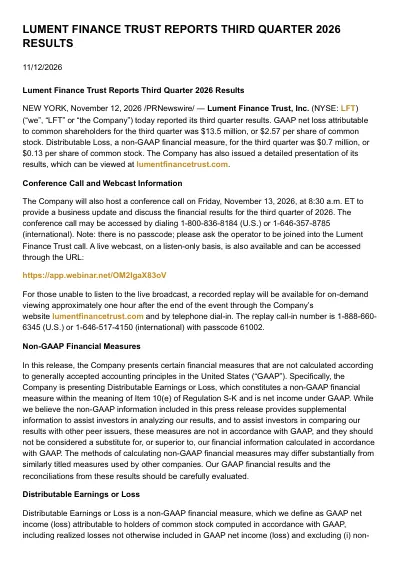
Reconciliations of these non-GAAP financial measures to the most comparable measures prepared in accordance with GAAP can be accessed through our filings with the SEC. For the third quarter of 2026, we reported a GAAP net loss of $2.57 and a distributable loss of 13 cents per share of common stock.
On September 9th, the company effected a 10-for-1 reverse split of its common stock. All per common share amounts discussed today, including for prior periods, have been adjusted, if necessary, to reflect the reverse common stock split.
I'll now turn the call over to Jim Flynn. Please go ahead.
Jim Flynn
Thank you, Andrew. Good morning, everyone.
Thank you for joining us for Lument Finance Trust third quarter earnings call. We appreciate the continued support and engagement from our investors as we work through the remaining challenges in the legacy portfolio.
Our focus remains on resolving those assets, preserving value, and positioning the company to deliver improved results for shareholders. Looking at the market, the economy continues to remain resilient, although persistent inflation and renewed uncertainty around interest rates do influence the commercial real estate markets.
Following a 25 basis point increase in September, the Fed has maintained the fed funds rate in the 3.75% to 4% range. We do expect to see a 25 and maybe as much as a 50 basis point increase coming in December and/or the first quarter of 2027.
While the path of monetary policy continues to remain uncertain, rates are likely to remain elevated, and important considerations for borrowers and commercial real estate valuations. More recently, the results of this month's midterm elections point to a divided federal government beginning in January, and while we do not expect the outcome to materially change multifamily fundamentals in the near term, we will continue to monitor its potential implications for fiscal policy, interest rates, and housing policy nationally.
In multifamily, performance continues to vary by market and asset. Flowing new supply should provide a more constructive backdrop over time, although elevated borrowing costs continue to pressure refinancing economics for transitional properties.
CRE CLO capital markets remain open and continue to provide financing capacity for the sector, although investor spreads have modestly widened on recent issuances amid broader market uncertainty. I should note this is true for really all fixed products across any asset class.
We believe the reinvestment capacity available in our current series CLO remains an important source of flexibility as we resolve our legacy assets and selectively redeploy capital. On the asset management side, which you'll hear much more about from Greg and Jim, working through the remaining legacy assets continues to be our central focus for the company.
We are actively pursuing the most appropriate resolution strategy for each asset with an emphasis on balancing the desire to protect recovery values with accelerating asset resolution so we can redeploy our investable capital into performing assets with appropriate risk-adjusted returns. While conditions for certain challenged assets remain difficult, resolution activity has begun to improve, and we are pursuing a range of alternatives across the portfolio and are encouraged by the progress we're making toward monetizing these positions and returning capital to productive use.
We continue to manage our unrestricted liquidity and CLO reinvestment capacity carefully and ended the quarter with approximately $27 million of cash on balance sheet. As we work through our remaining legacy assets, preserving liquidity remains a top priority.
As a result, in September, following extensive discussions with our board, we determined that suspending the common dividend for Q3 was a prudent step to preserve operating flexibility. As we generate liquidity through repayments and asset resolutions, we expect our emphasis will increasingly shift toward redeployment of capital into opportunities that are accretive to shareholder value.
Looking ahead, our strategy is straightforward: resolve our remaining legacy assets, preserve shareholder capital, and redeploy available liquidity into high-quality multifamily investments. Although the timing of individual NPL and REO resolutions will continue to depend on asset- and market-specific conditions, we are encouraged by the recent pace of resolution activity and believe we are making meaningful progress toward reducing these exposures.
As capital is released, our next priority is putting it back to work efficiently, which we expect will be important to rebuilding the company's earnings capacity. We appreciate the patience of our investors as we continue to navigate the challenges of our legacy investment portfolio, and we believe we have financing flexibility, support of our capital partners, and platform capabilities to execute on that strategy.
With that, I'd like to turn the call over to Jim Briggs, who will provide details regarding our financial results.
Jim Briggs
Thanks, Jim. Good morning.
This morning, we filed our quarterly report on Form 10-Q and last night provided a supplemental investor presentation on our website, which will be referred to during our remarks. Supplemental investor presentation has been uploaded to the webcast as well for your reference.
In pages 4 through 7 of the presentation, you will find key updates and an earnings summary for the quarter. For the third quarter of 2026, we reported a net loss attributable to common stockholders of $13.5 million, or $2.57 per share.
We reported a distributable loss of $700,000, or 13 cents per share. Note that all per share amounts reflected the 10-for-1 reverse stock split completed on September 9th.
There are a few Q3 P&L items I'd like to now highlight. Net interest income was $4.6 million, modestly higher than $4.5 million in the second quarter.
Ending outstanding UPB of the total portfolio was approximately $980 million, compared to $1 billion as of June 30. The weighted average coupon of our loan portfolio increased to 706 basis points, compared to 697 basis points in the prior quarter, largely due to the increase in the SOFR rate during the period.
We had fewer exit fees during the period due to lower sequential payoffs, offsetting our extension fee income that was higher quarter over quarter. Total operating expenses were $4 million, approximately in line with $3.9 million in the second quarter.
The increase was driven primarily by approximately $500,000 incrementally higher expenses relating to non-performing loans, including protective advances that have been expensed as incurred. That was partially offset by lower expense reimbursements for our manager during the period.
The difference between reported GAAP net loss and distributable earnings for the quarter was primarily attributable to an $8.6 million provision for credit losses recorded in the period, $3.9 million of REO impairment charges, and $318,000 of depreciation on REO. The $8.6 million provision for credit losses recorded during the quarter, which is excluded from distributable earnings, was driven primarily by several factors.
General CECL reserve increased $2.8 million in the quarter to a September 30 balance of $6.6 million, with the increase primarily driven by an increase in high-risk loans, as well as changes in macroeconomic assumptions employed during determining the company's model-based general reserve. We charged approximately $5.9 million to our specific reserve.
We evaluated our risk-rated 5 loans individually to determine whether asset-specific reserves were necessary. The $5.9 million provision is primarily related to two loans that had been risk-rated 5 as of June 30th and that continue to be risk-rated 5 as of September 30th, reflective of moves in collateral values on those assets.
During the period, we also charged off $2.8 million of specific allowance related to one loan that we foreclosed on during the period. As a result, our specific allowance for credit losses increased to $20.5 million, compared to $17.4 million as of June 30th.
As of September 30th, we had four REO assets classified as held for sale, with an aggregate carrying value of $49.8 million, including two REO assets with an aggregate carrying value of $24.1 million that were reclassified from held for use during the quarter, and one asset that was foreclosed on in the quarter that was classified as held for sale. During the quarter, we recorded an impairment expense on two of these held-for-sale REO assets totaling $3.9 million, after considering the current fair value of the properties, which was primarily based on recent sale offers.
At quarter end, our CLO's capital was substantially fully deployed at an 88% advance rate and a cost of funds of SOFR plus 191. As of 9/30, a portion of our loan and REO portfolio were pledged to warehouse facilities that provided financing at an effective advance rate of 68% and weighted average cost of SOFR plus 203.
As of 9/30, we had an unrestricted cash balance of $27 million, and our FL3 CLO was substantially fully deployed. The company's total book equity at the end of the quarter was approximately $191 million.
Total book value of common stock was approximately $131 million, or $24.97 per share, decreasing sequentially from $27.57 per share as of June 30th on a reverse split-adjusted basis. I will now turn the call over to Greg Calvert, who will provide details on the company's investment activity and portfolio performance during the quarter.
Greg?
Greg Calvert
Thank you, Jim. During the third quarter, LFT acquired or funded four loans with an aggregate UPB of $67 million and experienced $79 million of loan payoffs.
As of September 30th, our total loan portfolio consisted of 51 floating-rate loans with an aggregate unpaid principal balance of approximately $981 million, a weighted average floating rate of 326 basis points over SOFR, and an unamortized aggregate purchase discount of approximately $440,000. The weighted average remaining term of our book as of quarter end was approximately 18 months, assuming all available extensions are exercised by our borrowers.
100% of the portfolio was indexed to 1-month SOFR, and 93% of the portfolio is collateralized by multifamily properties. As of September 30th, approximately 70% of the loans in our portfolio were risk-rated as 3 or better, compared to 81% as of June 30th.
Our weighted average risk rating quarter over quarter increased to 3.2 from 3.1 sequentially. As of September 30th, we had six 5-rated risk-rated loans with an aggregate principal amount of $94 million, or approximately 10% of the unpaid principal balance of our quarter-end investment portfolio.
Five of these loans, with an aggregate UPB of $76 million, were also risk-rated 5 as of the prior quarter due to either maturity or monetary default. All of these loans are non-accrual status.
One of these loans, with a UPB of $18 million, was downgraded to a 5 risk rating this quarter due to a maturity default. However, the borrower is current on interest payments, and no specific allowance for credit losses was recorded on this asset for this period.
As of the quarter end, our REO portfolio in total consisted of five multifamily properties with an aggregate carrying value of $77 million and a weighted average occupancy rate of approximately 67%. As Jim Briggs mentioned, four of these assets, with an aggregate carrying value of $49.8 million, are classified as held for sale, and we are actively working on their disposition.
We have been very active in seeking positive asset resolutions and maximizing recovery values, and are pleased with the significant progress we've made so far, yet we understand there is still more work to be done on behalf of our shareholders. With that, I'll pass it back to Jim Flynn for closing remarks and questions.
Jim Flynn
Thank you, Greg and Jim. I'd now like to open the call for any questions.
Operator
Thank you, ladies and gentlemen. We will now begin the question-and-answer session.
Should you have a question, please press the * followed by the 1 on your touch-tone phone. Should you wish to cancel your request, please press the * followed by the 2.
If you are using a speakerphone, please lift the handset before pressing any keys. Once again, that is *1 should you wish to ask a question.
Your first question is from Jason Weaver from JonesTrading. Your line is now open.
Valen Alvar
Hi, good morning. This is Valen Alvar filling in for Jason Weaver.
Thank you for taking my questions here. You had seven loans that were extended in 3Q, mostly by about three months, and four of those dates have passed.
How many were extended again in October and November, and what were the paydowns or fees there? Also you mentioned on the last call flagging modified maturities in the supplemental.
Is that still coming there?
Jim Flynn
Sure, thank you for the question. Greg or Zach, do you have the specifics on those five?
Maybe give you a minute.
Zach Halpern
Apologies, can you just repeat quickly the context of the five that you're trying to get some information on?
Valen Alvar
The seven loans that were extended totaling about $180 million, but mostly by the three months, and four of those dates had already passed. Do you know how many of those were extended again in October and November and what those paydowns or fees were?
Zach Halpern
Give me a second to pull some information there.
Jim Flynn
The second part of your question was, I'm sorry, say that again? Was there a second piece besides
Valen Alvar
Yeah. On last call you guys mentioned flagging the modified maturities in the supplemental, I was just curious if that was still coming or part of the plan for the future.
Jim Flynn
Jim, and Andrew, I don't think that's in the supplemental, or is it?
Jim Briggs
It is not. It is not in the current supplemental, and we'll work to get that in there.
Valen Alvar
Got you.
Jim Flynn
On the first question, I would say that just try to look through some tape here and try to aggregate. It's not the way that we don't necessarily aggregate it in that fashion.
Largely there were some temporary extensions that occurred in Q2 that were transitioned to more permanent solutions via longer extensions in Q3. Those involved capture of fees, etc.
I'm sort of forward-looking a little bit right now into Q3, which I don't necessarily want to do too much of. Some of those have not, and some of those have not been papered formally for whatever the final resolution is.
That is true, those we shouldn't talk about, but Yeah.
Valen Alvar
Okay. Got it, thank you.
Then what distributable earnings level and resolution milestones would the board need to see to reinstate the common dividend, and is the preferred covered at any risk? I guess touched on it a little bit, but
Jim Flynn
Obviously, we revisit that question with the board during all of our meetings. The current trend on earnings is negative, certainly in part with some of these challenged assets, but also because we are significantly underdeployed relative to historical norms both in terms of leverage and assets.
While there's not a number, the key drivers of that discussion are how quickly or how many more of these assets, which we've identified, and we do expect meaningful progress here in the coming couple quarters on moving those off the balance sheet. It's really about maintaining liquidity and flexibility to resolve those assets.
Once that is at a place that we feel comfortable with and the board feels comfortable with, we'll then turn to what are the distributable earnings as a result as we go forward, and then make the decision on the dividend. We do believe that when we are able to resolve these assets, return that capital back to the company and redeploy it efficiently into the market, that our earnings will improve, but it's not so much a number of what the earnings is as it is maintaining liquidity and flexibility to get through these resolutions.
Obviously, our preference is to do so as soon as possible. As I mentioned in the first part of the call, we are making significant progress, and we do see transactions in the space in general across the industry in terms of lenders being able to sell non-performing loans or non-performing assets or REO at a higher pace today than we've seen over the last year-plus.
While from a value standpoint, that's obviously lenders resolving assets that have generated losses, which no one is happy about, but from a getting through this period and getting through legacy portfolios, that's a positive sign. If I was looking at this, I would monitor the watchlist and the number of the highest-risk loans moving off the books as the key driver of that discussion.
Valen Alvar
All right, I appreciate it. Thank you.
Operator
Thank you. Once again, that is *1 should you wish to ask a question.
Your next question is from Ward Blum from UBS.
Ward Blum
Good morning. I know we're in a tough environment, and I think the results, though they're disappointing, show a lot of hard work and effort to accomplish.
I noticed if I got it right, you've got 12 loans that matured from September 30th to today, and those may or may not be part of this legacy group that you talk about. I wonder, and this may have been partially covered in the last question, how many of them paid off or extended?
That's my first part of the question. Second part is you're talking at a 30,000-foot level about properties and so forth.
Seems like 10% of the portfolio is non-performing, and I wondered if you could give some specific property color on some of those non-performing so we get a sense of where you are in terms of a hands-on basis and what we should expect going forward. We had almost a 10% decline in book value from the largely markdowns in the last quarter, and I expect with the number of the 5-rated loans, we'll see perhaps some more of that coming at us.
I don't know when we exhaust this quote legacy period, that's really an interesting question that you could also cover and give us some view as to when we get past that and when we get to more quote normal times. There's a lot of questions.
I'm sorry.
Jim Flynn
No, that's okay. I'll do the best I can.
Zach, Greg, Jim, feel free to jump in at your leisure. The question around the assets, without getting into kind of specifics by name, I'll give some thought.
We have five REO assets. At least four of the five, we're actively pursuing sales on those assets.
There's progress being made there. Our objective is to move those off the books as soon as possible.
We hope that and feel that we'll be able to do that. Obviously, the market has proved challenging today, and for quite a while, getting buyers and sellers to agree on price, even in the performing space, forget about non-performing, but it's been a very difficult environment across our entire lending portfolio, Lument as sponsor, not just LFT.
Agreeing on price has been a very normal business practice across the entire multifamily space and, respectfully, the entire real estate space. We're working through those as quickly as we can.
To give you an example of some of the other assets and what we've dealt with in several instances, when some borrowers have been good actors who've got overextended and couldn't support their assets any longer and couldn't manage them, and have been cooperative. Others have done quite the opposite.
You've had several instances of moving toward a foreclosure so that we can pursue a sale, moving off our books, and we have borrowers file for bankruptcy. Really all that does is cost money and delay the process.
Nonetheless, it's done, and we have a few of those. Part of the issue of resolving the legacy portfolio is gaining control of the asset.
Depending on the jurisdiction, that is not always easy, or at least it's time-consuming. When you get to the last part of your question, which is when are we going to be through kind of the, call it legacy portfolio or legacy issues, there's not a great answer I can give you.
We certainly hope that in '27, we hope to be significantly moving toward being through that, but it's very dependent upon what happens in the market and how difficult it is to gain control. It's not a great answer for you because, unfortunately, I can't give it to you.
I would say that if you asked that question a year ago, I would think that we would be further along, not just LFT, but as a market, in resolving what is the challenged assets that exist in large part because of the run-up in values and the subsequent run-up in rates and inflation that has kind of been the epicenter of what's happened in the multifamily space and real estate across the market. I know that's not as specific an answer as you probably want, but that's kind of where we are, and I hope that next quarter and in each quarter after that, you'll see progress and be able to track that and have an informed view of how quickly we're moving.
Our goal certainly, and I said this earlier, too, is to really accelerate this process. We don't think things are going to get materially better by waiting.
We really just want to move as quickly as we can to move these assets off the books in a reasonable manner, and then move forward with reinvesting and redeploying that capital.
Ward Blum
You didn't really touch on the first question, and let me ask you to be specific. There were 12 loans that were scheduled to mature between September 30th and today, and I wonder if they paid off or how many went into extensions or give us some color on current events.
Zach Halpern
Hey, it's Zach. I appreciate the questions.
They're all really good questions. You are asking some good questions about current quarter activity that I don't know that we're haven't been given clearance to talk about, but what I'd say is, to Jim's point, there are multiple assets on the REO side available out for sale right now.
We don't want to name them specifically because we don't want to disrupt sales processes, etc. We are working to resolve those assets over the near term.
Of the newer vintage loans, and so you can compare note dates to maturities, we don't have any issues in the newer vintage loans at present that are not being resolved.
Ward Blum
Okay. You didn't touch on the last questioner's inquiry about the preferred dividends.
Are you comfortable that company expects to continue those dividends?
Jim Flynn
We and the board have made the decision to continue to pay that dividend this quarter. That's a quarterly decision.
We can't talk about future dividend policy on the call. That's certainly a board decision, but obviously we made that decision this quarter and have taken into account all the things that we've talked about.
It's a fully informed decision when we made the decision to continue that dividend.
Ward Blum
The comment was earlier made on your part that you're looking to do things that are accretive to shareholder value. The obvious question for many of us shareholders is you have a buyback authorization in place that you've never used, and the stock's trading at less than 20% of NAV, and I wonder at what point you think it's accretive to shareholder value to exercise some of those buy-in rights.
Jim Flynn
Sure. I think mathematically, it's accretive today, right?
That's a very simple answer, and it's an appropriate question, and it's an appropriate discussion. The only thing I would say is that among any other kind of redeployment, reinvestment decision is perfectly appropriate question for management and the board, and it's one that we've evaluated and will continue to evaluate.
Right now, our focus is on preserving liquidity, resolving the assets so that we are able to actually make those decisions, whether it's buying back stock or reinvesting into assets or any other use of capital. It's certainly something that we have discussed, but again, our focus is on ensuring that we are able to resolve and move through the existing issues in the portfolio before we make any decisions around reinvesting or redeploying capital in that way.
It's a fair and appropriate question. It's one that's certainly on our radar.
We are maintaining liquidity to get through the issues that we're managing through in the book.
Ward Blum
Thank you very much.
Operator
Thank you. Your next question is from Greg Bennett.
Your line is now open.
Greg Bennett
A suggestion: Going forward, everybody wants to know what the status of the loans that have matured in the fourth quarter. Next time we do this, why don't we have one of the board of directors or whatever give you authorization to let us know what the status is of those loans that have matured.
We can go back in the public material, I guess, but how many of those loans that have matured in the fourth quarter are I'm going to call them legacy vintage, and how much of them are part of the newer loans? Thank you.
Jim Flynn
I don't have the answer at the tip of my tongue about how many, but if they matured in the fourth quarter of '26, then they would be certainly of an older vintage. Your question around providing color on loans that matured in the quarter is fair.
We will provide an update on that information. Certainly, in many cases on the existing, they're in the process of a resolution that has not been signed.
They're in maturity default, but they are moving toward an exit. We can provide more specific detail going forward on that.
Greg Bennett
Am I correct none of these were payoff? These are all problems that you're working on an extension or a sale, that none of them paid off on the date that they were supposed to?
Jim Flynn
I don't believe that any of them paid off, but they're not all problems, some of them are just working through refinancing with other lenders, or in some cases us or going to agency. They're not all problems.
They are
Greg Calvert
I would say
Jim Flynn
Go ahead, Greg.
Greg Calvert
I'm sorry. Looking at it in general, if they missed their maturity date, it's clear they did not pay off.
The group of loans that I'm looking at is they're a mix of extensions for performing loans. There are some in here that needed extensions to finalize a payoff with another lender, and others with a sale, and others a handful of them are working through workout situations.
Hope that gives some color, but we certainly will provide more detail next quarter.
Greg Bennett
That would be a good idea. Or, my gosh, I don't know if your board will allow you, though.
It sounds to me like the last few calls, it's always good news is possibly coming or resolutions are possibly coming, but we have to wait till each quarter end. Possibly if good news is coming and you resolve these, maybe you can come out with an update in between the quarters possibly.
Maybe if your board could consider that. Thanks for the hard work.
Appreciate it.
Jim Flynn
Appreciate the feedback, and we will discuss that, but we certainly will provide more specific info, at least at the portfolio level on maturities.
Greg Bennett
I'll make one other suggestion: Why don't you just liquidate the company, or sell the company to somebody else? The discount in the book value, Mr.
Market, who knows what the discount is to the NAV, what's justified and what's not justified. Your investors have no idea.
Thank you.
Jim Flynn
We appreciate the call.
Operator
Thank you. Once again, that is *1 should you wish to ask a question.
It seems there are no further questions. Please proceed with the closing remarks.
Jim Flynn
Thank you all for joining today. We appreciate the feedback.
We know that times have been challenging. We will continue to provide as much info as we can at the end of each quarter and review what we can or are able to do inter-quarter as well.
Look forward to speaking again next quarter. Thank you.
Operator
Thank you, ladies and gentlemen. The conference has now ended.
Thank you all for joining. You may now disconnect your lines.