Lument Finance Trust, Inc.
Q4 FY2025 · Earnings Call TranscriptMarch 24, 2026
Operator
Good morning, and thank you for joining the Lument Finance Trust fourth quarter 2025 earnings call. Today's call is being recorded and will be made available via webcast on the company's website.
I would now like to turn the call over to Andrew Tsang with Investor Relations at Lument Investment Management. Please go ahead.
Good
Andrew Tsang
morning, everyone, and thank you for joining our call to discuss Lument Finance Trust's fourth quarter and full-year 2025 financial results. With me on the call today are Jim Flynn, our CEO; Jim Briggs, our CFO; Greg Calvert, our President; and Zach Halpern, our Portfolio Manager.
Last evening, we filed our 10-K with the SEC and issued a press release to provide details on our recent financial results. We also provided a supplemental earnings presentation, which can be found on our website.
Before I hand the call over to Jim Flynn, I'd like to remind everyone that certain statements made during the course of this call are not based on historical information and may constitute forward-looking statements within the meaning of Section 27A of the Securities Act of 1933 and Section 21E of the Securities Exchange Act of 1934. Such forward-looking statements are subject to various risks and uncertainties that could cause actual results to differ materially from those contained in the forward-looking statements.
These risks and uncertainties are discussed in the company's reports filed with the SEC, in particular the Risk Factors section of our Form 10-K and Form 10-Qs. It is not possible to predict or identify all such risks, and listeners are cautioned not to place undue reliance on our forward-looking statements.
The company undertakes no obligation to update any of these forward-looking statements. Further, certain non-GAAP financial measures will be discussed on the conference call.
Presentation of this information is not intended to be considered in isolation nor as a substitute for financial information presented in accordance with GAAP. Reconciliations of these non-GAAP financial measures to the more comparable measures prepared in accordance with GAAP can be accessed through our filings with the SEC.
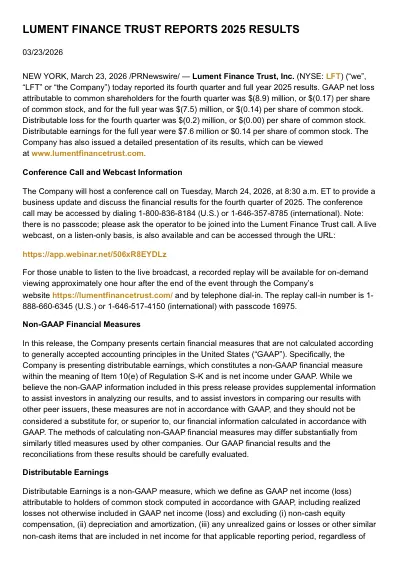
For the fourth quarter and fiscal year of 2025, we reported a GAAP net loss of 17 cents and 14 cents per share of common stock, respectively. For the fourth quarter and fiscal year 2025, we reported distributable earnings of approximately $0 and 14 cents per share of common stock, respectively.
In December, we declared a quarterly dividend of 4 cents per common share with respect to the fourth quarter, bringing our cumulative declared dividends for 2025 to 22 cents per common share. Then last Thursday, we declared a quarterly dividend of 4 cents per common share with respect to the first quarter of 2026, unchanged from Q4's quarterly dividend.
I will now turn the call over to Jim Flynn. Please go ahead.
Jim Flynn
Thank you, Andrew. Good morning, everyone.
Welcome to the Lument Finance Trust earnings call for the fourth quarter of 2025. We appreciate everyone joining us today.
Taking a quick look at the market, the U.S. economy continues to remain resilient, although growth is moderating, and uncertainty has increased modestly due to evolving monetary policy, fiscal dynamics, and geopolitical risks and considerations.
While the Federal Reserve began easing in 2025, the forward path of rates is expected to remain gradual and data-dependent, with inflation and labor market trends continuing to influence policy. Within commercial real estate, capital market conditions have improved, with increased liquidity across both securitized and warehouse financing channels.
However, transaction activity remains below historical averages as buyers and sellers continue to navigate pricing discovery in an elevated cost of capital environment. In multifamily, fundamentals are stabilizing following the peak of the recent supply cycle.
Near deliveries remain elevated in certain Sunbelt markets, but are now expected to decline meaningfully into late 2026 and 2027 due to the sharply reduced starts over the past 18 months. As a result, rent growth remains modest, but is showing early signs of reacceleration in supply-constrained markets, while occupancy has remained relatively stable overall, albeit with some continued pressure in a few high-delivery regions.
Importantly, structural demand drivers for rental housing remain intact. Affordability constraints in the single-family housing market, coupled with the limited for-sale inventory and still-elevated mortgage rates, continue to support renter demand and long-term multifamily fundamentals.
From a financing perspective, lower short-term interest rates relative to peak levels, combined with a still-positive forward curve, are constructive developments for our borrowers. While debt service coverage remains under pressure for certain transitional assets, the modest easing in index rates and improved operating trends are helping to stabilize credit performance across the sector.
The CRE CLO market remains an important source of liquidity, with issuance volumes in 2025 exceeding $30 billion and a solid pace of activity continuing into 2026. Investor demand for floating-rate exposure remains healthy, particularly for well-structured transactions backed by institutional quality collateral.
Spreads have tightened modestly, reflecting improved sentiment, though they remain wide relative to long-term averages. Active asset management remains our top priority.
We continue to work closely with borrowers to drive outcomes that preserve capital and enhance long-term value, including modifications, extensions, and asset-level strategies where appropriate. Given the still uneven operating and financing environment, particularly for assets impacted by the recent supply or capital structure challenges, we remain proactive and disciplined in managing each position.
During the quarter, portfolio credit metrics improved sequentially, primarily driven by the acquisition of additional performing assets associated with our recent CLO execution. At the same time, we increased reserves on select challenged legacy positions to reflect updated expectations and current market conditions.
We've remained active in executing our financing strategy, taking advantage of improved but still selective capital markets conditions, while maintaining a disciplined approach to leverage and cost of capital. As referenced on last quarter's earnings call, in November of 2025, we entered into an uncommitted master repurchase agreement with JPMorgan Chase, which provides the company with up to $450 million borrowing capacity to finance first mortgage loans, controlling loan participations, and other commercial mortgage loan debt instruments secured by commercial real estate.
Further, in early December, we entered into a new loan agreement with Northeast Bank that provides the company with up to $50 million in advances to finance portions of our investment portfolio. This term financing facility provides us with additional flexibility to resolve our REO holdings and achieve positive asset management outcomes.
On the same day the Northeast Bank facility closed, we executed the LMNT 2025-FL3 CLO transaction, a $664 million transaction with an effective advance rate of 88% and a weighted average cost of funds of approximately 191 basis points over SOFR, excluding fees and transaction costs. The initial collateral pool consisted of 32 first-lien floating-rate mortgage loans and participations secured by 49 multifamily and commercial real estate properties located across the United States.
A portion of the collateral was owned by LFT prior to the closing, and the remaining collateral was acquired by the company at fair market value plus accrued interest from an affiliate of Lument Investment Management LLC, the company's external manager. The weighted average collateral spread of the entire pool was approximately 321 basis points over one-month SOFR.
The FL3 CLO includes a 30-month reinvestment period, which allows us to redeploy loan principal repayments into new loan investments until June of 2028. In February, we redeemed the remaining outstanding loans and notes of LMNT 2023-FL1 financing transaction and refinanced the underlying pool with our existing warehouse facilities.
Given the relatively high weighted average cost of capital and the low current leverage of FL1, the redemption provided the company the ability to redeploy a portion of its investable capital into levered loan assets at more attractive financing terms over time. Finally, subsequent to quarter-end, we also amended the terms of our existing secured corporate term loan, extending the maturity date to 2030 and providing us with an incremental $2.3 million of liquidity before fees and deal expenses.
The term loan going forward bears an interest rate of 9.75%. During Q4, we generated approximately $104 million of payoffs, with proceeds primarily used to reduce securitization liabilities.
We also deployed approximately $400 million into loan assets, largely in connection with the FL3 transaction. We ended the year with approximately $23 million of unrestricted cash.
Combined with our available warehouse capacity, we believe our liquidity position remains appropriate to support portfolio management, asset resolution, and selective capital deployment. Our near-term focus remains on active asset management, efficient resolution of legacy positions, and disciplined balance sheet management.
While we are encouraged by improving conditions across commercial real estate credit markets, the recovery remains uneven and will likely take time to fully normalize. We continue to expect a market characterized by selectivity, with outcomes increasingly differentiated by asset quality, sponsorship, and capital structure.
Against this backdrop, we remain cautious and highly selective in deploying capital, with a focus on strong credit fundamentals, structural protections, and risk-adjusted returns. We believe this approach positions us well to navigate the current environment while preserving flexibility to capitalize on opportunities as market conditions continue to evolve.
With that, I'd like to turn the call over to Jim Briggs, who will provide us details on our financial results.
Jim Briggs
Thanks, Jim. Good morning.
Last night, we filed our annual report on Form 10-K and provided a supplemental investor presentation on our website, which we'll be referring to during our remarks. Supplemental investor presentation has been uploaded to the webcast as well for your reference.
On pages four through seven of the presentation, you'll find key updates and an earning summary for the quarter. For the fourth quarter of '25, we reported net loss to common stockholders of $8.9 million, or 17 cents per share.
We also reported distributable earnings of approximately $0. There are a few items I'd like to highlight with regards to the Q4 P&L.
Our Q4 net interest income was $5.3 million, a slight improvement from $5.1 million recorded in Q3. The weighted average coupon of our loan portfolio declined sequentially to 717 basis points, compared to 777 basis points in the prior quarter, due to lower spreads on newly acquired loans and decline in SOFR benchmark rate.
The ending outstanding UPB of the portfolio increased due to the execution of the previously discussed FL3 CLO transaction in December, in which we acquired approximately $383 million in assets from an affiliate of our manager. Total operating expenses, including fees to our manager, were elevated quarter-on-quarter at $3.8 million versus $3.1 million in the prior quarter, primarily attributable to one-time legal expenses related to REO assets, the previously mentioned FL1 redemption in November, as well as a financing initiative we elected not to proceed with after securing more attractive terms with the previously mentioned facilities.
Primary difference between reported net income and distributable earnings for the fourth quarter was primarily attributable to $8.6 million of unrealized provision for credit losses, $200,000 realized loss on sale of REO, and approximately $296,000 of depreciation on REO. As of December 31st, we had eight loans risk-rated 5.
All of these are collateralized by multifamily assets. Greg will provide a bit more detail in his remarks.
With respect to the allowance for credit losses, we evaluated these eight risk-rated 5 loans individually to determine whether asset-specific reserves were necessary. After an analysis of the underlying collateral, we recorded provision for credit losses in the quarter of approximately $8.6 million.
Our specific allowance for credit losses has increased as a result to $17.6 million, compared to $8.3 million as of September 30th. Our general allowance for credit losses decreased $5 million—decreased to $5 million from $5.7 million in the prior quarter, primarily driven by certain transfers to specific evaluation, payoffs during the quarter, and changes to the macroeconomic forecast.
We ended 2025 with unrestricted cash balance of $23 million. FL3, the CLO we closed in December, was fully deployed.
As Jim referenced earlier, FL3 provided effective leverage of 88% at a weighted average cost of funds of SOFR plus 191 basis points. The company's total book equity at the end of the quarter was approximately $219 million.
Total book value of common stock was approximately $159 million, or $3.03 per share, decreasing sequentially from $3.25 per share as of September 30th. We'll now turn the call over to Greg Calvert to provide details on the company's investment activity and portfolio performance during the quarter.
Greg?
Greg Calvert
Thank you, Jim. During the fourth quarter, LFT acquired or funded $400 million of loan assets, the majority of which were obtained as initial collateral for the FL3 transaction.
During the period, the company experienced $104 million of loan payoffs. As of December 31st, our total loan portfolio consisted of 61 floating loan—61 floating-rate loans with an aggregate unpaid principal balance of approximately $1.1 billion, a weighted average floating rate of 333 basis points over SOFR, and an unamortized aggregate purchase discount of $1.7 million.
The weighted average remaining term of our book as of quarter-end was approximately 21 months, assuming all available extensions are exercised by our borrowers. 100% of the portfolio was indexed to one-month SOFR, and 93% of the portfolio was collateralized by multifamily properties.
As of December 31st, approximately 83% of the loans in our portfolio were risk-rated as 3 or better, compared to 46% as of September 30th. Our weighted average risk rating quarter-over-quarter improved to 3.2 from 3.6.
This is primarily driven by the acquisition of additional loans for the period from an affiliate of the manager in connection with the FL3 transaction. During the period, we transitioned one loan with a UPB of $9.8 million from a 5 risk rating as of September 30th to a 4 or better rating as of December 30th due to an execution of a loan modification, which included a partial paydown of the loan by the borrower in exchange for an extension until Q4 2026.
As of December 31st, 2025, we had eight risk-rated 5 loans with an aggregate principal amount of approximately $117 million, or approximately 10% of the unpaid principal balance of the quarter-end investment portfolio. These included one loan in maturity default that was downgraded to a risk rating of 5 during the quarter with a balance of $22 million collateralized by a multifamily property in Arlington, Texas; one loan in monetary default that was downgraded to a risk rating of 5 during the quarter with a balance of $18 million collateralized by a multifamily property in Tampa, Florida; three loans in maturity default that continue to be risk-rated 5 with an aggregate principal balance of $40 million collateralized by multifamily properties in Philadelphia, Colorado Springs, and Cedar Park, Texas; and three loans in monetary default that continue to be risk-rated 5 with an aggregate principal balance of $38 million collateralized by multifamily properties in Des Moines, Iowa, Tallahassee, Florida, and Ypsilanti, Michigan.
During 2025, the company foreclosed on four REO assets. In late December, we sold one of the properties located in San Antonio, Texas to a third party for $8.2 million and recognized a $500,000 loss in the fourth quarter on the sale.
As of December 31st, our REO was comprised of three multifamily properties. Two of these remaining properties are located in San Antonio, and the other is in Houston, Texas.
As of quarter-end, the properties had a weighted average occupancy rate of 69%. Achieving positive asset management resolutions and maximizing recovery value remain our priority.
With that, I will pass it back to Jim Flynn for closing remarks and any questions.
Jim Flynn
Thank you, Greg. Thank you all for joining, and we appreciate your continued partnership and support.
With that, I'd like to ask the operator to turn the call over to questions.
Operator
Thank you. Ladies and gentlemen, we will now begin the question-and-answer session.
Should you have a question, please press the star followed by the number one on your touchtone phone. You will hear a prompt that your hand has been raised.
Should you wish to decline from the polling process, please press the star followed by the number two. If you are using a speakerphone, please lift the handset before pressing any keys.
Your first question comes from Jason Weaver with Jones Trading. Please go ahead.
Jason Weaver
Thanks for taking my question. I was wondering, can you give some context on how you view the risk/reward and opportunity today for new capital deployment against the last few weeks' backdrop of elevated rate volatility?
Jim Flynn
Sure. Obviously, the very current market environment has created some incremental challenges when reviewing the assets, but the starting point is still what is focused on the sponsor and the market, what the expectations are for growth in that market, and what the supply dynamics are along with the demand.
That is certainly an evaluation or part of the evaluation, kind of the geopolitical volatility here. We do still firmly feel resolved in the strength of the multifamily market, and have to take a bit of a longer view.
Our deals are typically structured with interest rate caps, on a short-term basis, we're protecting ourselves during the initial term of the loan. We do stress those scenarios, but I think the most important aspects of evaluating the risk around sponsor and market still carry the day, even in the most volatile of times.
Then structurally, you do your best to protect yourself both from a leverage standpoint and an interest rate volatility standpoint with structure and caps. Again, sponsor and market are going to be critical to that.
Certainly the hope is that over the two- to three-year period of a bridge loan, that you have some stability return to the market, hopefully sooner than later, but it's obviously a consideration as we deploy capital. Again, I think it makes those first components even more important.
Jason Weaver
Got it. To that point, with the new CLO closed, is there an updated comfort zone for leverage over the near term?
Jim Flynn
At a loan-level basis? Is that what you mean,
Jason Weaver
or the Just overall, really.
Jim Flynn
On the loan-level basis, I would say on average over the last couple of years, since, call it, '23, really '24, average leverage at the asset level has declined relative to historical bridge lending activity. You're seeing particularly on the lease-up side, construction deals coming out of construction, but you're regularly seeing assets in the 60s and low 70s pretty much across the board, and you're seeing very few into the 80% or higher range.
You've come down pretty meaningfully from what we were seeing in the late teens and early 2020s on a loan-level basis. Overall, corporately, we've been around the same leverage.
The leverage available in CLOs is slightly higher than historic norms that obviously we would want to take advantage of, but aside from that, we're not anticipating any material changes to the fully deployed leverage of the LFT vehicle.
Jason Weaver
Got it. All right.
That's helpful. Thank you for that color.
Operator
Thank you. The next question comes from Chris Muller with Citizens Capital Market.
Please go ahead.
Chris Muller
Hey guys, thanks for taking the questions. Looks like non-accruals as a percent of the portfolio improved in the quarter, which I assume is mostly due to the $400 million of new loans.
What was the balance of non-accruals at year-end, and do you guys have how much of a drag on earnings those assets are?
Zach Halpern
Hey, Chris. Good morning.
The non-accruals, which we touch on in the footnotes individually, is let me just quickly add this up. I don't have Sorry.
The the the the drag is about 2 cents, and the UPB is $102 million.
Chris Muller
Got it. Then, I guess on a similar note, how are you guys thinking about the path to dividend coverage this year?
I guess how it's related is, can you guys get there by cleaning up the existing portfolio and REO, or do we need to see some portfolio growth to get back to that 4-cent level?
Jim Flynn
That is the primary topic that we've been focused on with our board. The short answer is it's probably a little bit of both.
I think on a fully deployed level, we feel that the dividend would be more than covered. What we've looked at is the anticipated timing that we see on the horizon for some of these assets, including those, but also some other payoffs that are anticipated, and then redeploying that capital into newer performing assets, along with the potential for a future portfolio-level financing, whether that be a new CLO, which certainly we'd like to be able to do, but if not a CLO, some broader performing loan portfolio financing to basically have two large vehicles similar to the current CLO that we have outstanding.
When we've put together kind of the schedule of the timing for resolution and payoffs in the portfolio, the redeployment into performing loans, and the potential for more attractive financing in the future, we weighed those things together and feel that it's appropriate to keep the dividend where it is and move through this year and move back toward full coverage of that dividend.
Chris Muller
Got it. That was all I had this morning.
Thanks for taking the questions.
Jim Flynn
Thank you.
Operator
Thank you. The next question comes from Lee Zuk with Overcap.
Please go ahead.
Lee Zuk
Could you give some color on Q1 2026?
Jim Flynn
I can't give you too much, obviously, as that's forward-looking, but most critically, I suppose I'd say is our asset management and where we see resolutions and asset performance, and it's in line with our expectations on the timing standpoint as we kind of evaluated the plan for the dividend and earnings release, et cetera. That's kind of what I would say.
Where we've had the ability to redeploy capital with payoffs, we've been able to do so successfully with new performing loans. Obviously, the flurry of new financing activity between the CLO, the two warehouses, the refinancing of the term loan have all stabilized the credit side of our balance sheet.
Now we're really fully focused on resolving some of these legacy assets that have been on the books for a while, and they're moving forward. We'd like to see everything move a little bit more quickly, but they are moving according to plan and relatively on schedule.
Zach Halpern
I would just mention, as Jim Briggs mentioned in the earnings call, we did call that 2023 financing transaction that had the higher cost of funds.
Jim Flynn
Thank you. Also important.
Important.
Operator
Thank you. As there are no more questions, I will pass back to James Flynn for any closing remarks.
Please go ahead.
Jim Flynn
Thank you. Again, thank you for participation and continued interest in the platform, and we look forward to speaking to you again next quarter.
Operator
Thank you. Ladies and gentlemen, this concludes today's conference call.
Thank you for your participation. You may now disconnect.