Modiv Industrial, Inc.
Q3 FY2025 · Earnings Call TranscriptNovember 14, 2025
Operator
Good day and welcome to Modiv Industrial, Inc. Third Quarter 2025 Conference Call.
All participants will be in a listen-only mode. Should you need assistance, please signal a conference specialist by pressing the star key followed by zero.
On today's call, management will provide prepared remarks, and then we will open up the call for your questions. To ask a question, analysts may press star then one on your touchtone phone.
If you are using a speakerphone, please pick up your handset before pressing the key. To withdraw your question, please press star then two.
Please note that this event is being recorded. I would now like to turn the conference over to John Raney, Chief Operating Officer and General Counsel.
Please go ahead, sir.
John Raney
Thank you, Chloe, and thank you, everyone, for joining us for Modiv Industrial's Third Quarter 2025 Earnings Call. We issued our earnings release after market close today, and it's available on our website at modiv.com.
I'm here today with Aaron Halfacre, Chief Executive Officer, and Ray Pacini, Chief Financial Officer. Before we begin, I would like to remind you that today's comments will include forward-looking statements under the federal securities laws.
Forward-looking statements are identified by words such as will, be, intend, believe, expect, anticipate, or other comparable words and phrases. Statements that are not historical facts, such as statements about our expected acquisitions or dispositions and business plans, are also forward-looking statements.
Our actual financial condition and results of operations may vary materially from those contemplated by such forward-looking statements. Discussion of the factors that could cause our results to differ materially from these forward-looking statements are contained in our SEC filings, including our reports on Form 10-K and 10-Q.
With that, I'd like to turn the call over to Aaron. Aaron?
Aaron Halfacre
Thanks, John. Hello, everyone.
Hope you're doing well. This time we're doing everything a little bit differently.
Certainly had the call on a Friday in the afternoon. I'm surprised to see as many of you dialed in as you did.
Hopefully, you have a cocktail in your hand. We're not going to do prepared remarks.
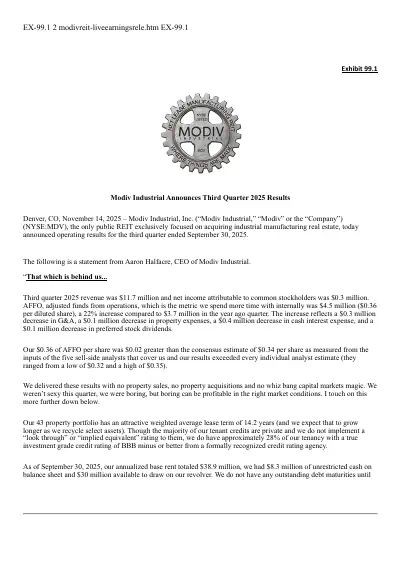
I put a little more context into the press release. We're going to free-for-all the questions.
I think what I'll say is kind of iteration, it's really grindy and I really like that. We purposely waited toward the end of the earnings season because some of the early reporters, it was interesting to see them come out like, "Wow, it's pretty solid."
Then they just got shit on in the markets. I was like, "Okay, well, let's see what else worse comes out."
Then so I really wanted to spend some time observing because I candidly doesn't really move the needle when we come out. Typically when we come out, you're stacked four deep and you guys don't have a chance to breathe, and I wanted to give you a chance to breathe.
That's the only reason, there's nothing else into it other than that. We won't do this that often.
I feel generally optimistic. Look, no one knows where Powell will be in December, are they done or not, but I think we all probabilistically underwrite that there's going to be a new Fed regime come May.
That regime has a high propensity to be easing. At some point in the future, we should see easing.
Modiv's share price is very easy to predict in a 5-minute pattern and probably on a 5-year pattern, but not sort of in between. If you think you've got easing, you think you've got a long period of capitulation.
We've started to see sort of non-equity, and when I say non-common equity, I guess, we've seen preferred and debt deals being done, which I think are tea leaves of capital market activity. I think July, we saw, I guess, a palpable sense that there was some interest, and we saw the deals like we saw with the Fundamental deal, and we saw the pre-version of the Plymouth deal announced, and then we saw the sort of ElmTree, and we were starting to see pipeline.
Then it kind of went sideways in late August, September, early October where it's just people got spooked and shadows were seen. For instance, we were in the process bidding on a pipeline deal that we liked, and it was a company that was doing a propco sale along with an opco transaction, and they were like guns a-blazing, and then they pulled it.
We've seen some of that stuff over the course of the last quarter. It was a bit of sort of a volatile quarter where people thought they had a look and then the market gave them a head fake, and then they are like, "Oh, pausing on the margin."
I think we get this real palpable sense that there's still a lot of money on the sidelines. I think still right now, a lot of people just want bloodbath returns.
They really want to shiv people who they think that are desperate. Some of those people are being picked off, right?
We're seeing more REIT stuff that I think either they waved a white flag or they just didn't have the wherewithal or whatever. I think that capital is still really sort of wants to just be patient and wants to just only get the super, super sweetheart deals.
If we start to see real easing and we start to see some consistent trends for REITs, I don't know if that means we need a consolidation on the sort of the rest of the S&P and Nasdaq to get that or not. It's hard to say, cuz you could argue that until tech and some of these names cool off, then no one's really going to ever consider boring REITs.
At the same time, if they course correct, is that just going to drag everyone back down? It remains to be seen.
It's pretty cloudy, but even despite that cloudiness, I feel pretty optimistic about what I'm seeing. Again, it's because I'm gritty and grindy, and I like that.
That doesn't mean we're off to the races, but it does feel like, for us, we're like a goddamn cockroach that could survive a nuclear war. There's no real fundamental reason why we should be as durable as we are given how small we are now and in the context.
There's a reminder, I've said this before, we came out 2 weeks before Putin invaded Ukraine, and we came out like what was it, 3 and 1/2 weeks before the Fed started raising rates. The entire publicly traded existence of us has been dog shit.
Yet, I feel like our balance sheet is stronger, I feel like our AFFO is better, I have much more clarity now than I did even a year ago. I think that leads to optimism.
Enough of me rambling, let's open it up to questions, shall we?
Operator
Ladies and gentlemen, we will now begin the question-and-answer session. To join the question queue, you may press star then one on your telephone keypad.
You will hear a tone acknowledging your request. If you're using a speakerphone, please pick up your handset before pressing any keys.
To withdraw your question, please press star then the number two. We'll pause for a moment as callers join the queue.
Our first question comes from the line of Craig Kucera from Lucid Capital Markets. Your line is open.
Aaron Halfacre
What's up, Craig?
Craig Kucera
Hey, guys. Good afternoon.
Just a few for me. Were there any one-time revenue adjustments in your other property income, and how should we think about that going forward?
Aaron Halfacre
Ray?
Craig Kucera
Yes. Can you hear me?
Aaron Halfacre
I'm trying to get Ray to respond, but
Raymond Pacini
yeah. There was a $300,000 fee that we obtained for terminating some easement rights at our Northrop property, and that's it.
Aaron Halfacre
To add a little clarity to that, our Northrop property, which is in Melbourne, Space Coast, there was a large piece of sort of underutilized, near vacant land and it was a former, I don't know what to call it, like a kids park or something, like amusement park. That's getting redeveloped into a housing project, a townhouse-type of arrangement.
The prospective buyer had come to us because there were certain easements, and they wanted certain rights. It took a while, candidly.
I would say we probably negotiated for 9 to 12 months. Basically, gave us a fee for to sign a paper.
That's what that was.
Craig Kucera
Got it. Will that all recognized here in the third quarter, or will we expect any additional fees going forward?
Aaron Halfacre
That's it. One-time.
One-time.
Craig Kucera
Okay. Got it.
It looks like you added another asset to the held for sale bucket. Can you give us some color on what you're looking to sell here, and are you actively marketing that for sale as well?
Aaron Halfacre
Obviously we've had Costco in the held for sale up to this point. Then, I guess, about 6 weeks ago, we formally engaged a broker to sell Kalera.
Kalera is held for sale. I think our anticipation is that we would try to get this sold either by the end of the year or probably early January.
That's the other property that's in the held for sale.
Craig Kucera
Got it. Speaking of the Costco property, I think KB Home was expected to extend a couple times until maybe December.
Are you getting any change in sort of their viewpoint on the asset? Are they still expected to close?
Aaron Halfacre
They did extend to December. We've had some conversations recently about they're wanting to time the closing for a demolition permit.
They've got to go through their process. As it stands right now, per the agreement, we have not been heard if they're going to extend beyond December 15th.
They have one more extension that would take us through to, I think, February 15th. Right now, it's through December 15th.
Craig Kucera
Got it. If I were to bet,
Aaron Halfacre
my bet is they'll close within.
Craig Kucera
Fair enough. Just one more for me.
I feel like last quarter, you were saying you were seeing an increasing number of acquisition opportunities. Just sort of curious, based on your opening commentary, it sounds like things were loosening up and now sort of ceased.
Is that sort of your viewpoint currently or do you think things are coming back?
Aaron Halfacre
It's interesting. I would say that we were seeing some stuff in that sort of July timeframe, and then we started throwing out some bids.
Then it kind of contracted, because we got a little sideways. I would say we've seen more in the last week and a half than we had probably in the prior month and a half.
I don't know what it was about. The markets were just volatile.
Maybe it was because the end of summer, maybe it was because we knew we had the September Fed decision, I'm not sure. We didn't see much.
Now we're starting to see more. Now it actually feels look, I'm measuring by quantity, not quality.
It's starting to feel healthier. There's definitely, I think, John, Ray, I'm thinking we've probably looked at 4 or 5 deals in the last week, right?
Raymond Pacini
At least.
Aaron Halfacre
Quality is still challenger, right? I think the one thing that, if you imagine us as a steeled blade or a knife, we're constantly sort of sharpening and sharpening on a grindstone and getting better at what we want and knowing better what we want.
Our buy box has probably gotten a lot tighter. There's stuff that I probably would have been willing to bid on 2 years ago, I'm like, "Eh, fuck it.
I'm out. I don't want to bother."
We've gotten much more selective, but that said, it feels right now, at least, and it's usually odd, because candidly you don't tend to see a lot at year end, you tend to see them waiting early January, right? Where that's where pipeline tends to pick up normally.
Now you would generally think it's going to slow down, because these take anywhere from 30 to 60-ish days to close, and so then you're smack in the holidays, and you're like. I think that's an interesting sign.
I think what we are seeing sort of tea leaves-wise is there's probably more PE activity going on, which I think is always an indicator, an early indicator, right? PE and hedge funds, you generally construe them to be smarter capital, maybe not smart capital, than sort of people who are just got long bias or doing 1031s or something like that, where they're forced by mandate to do something.
These guys are looking for something. We have seen a little bit of PE activity pick up.
Craig Kucera
Great. Thank you.
Mhm.
Operator
Our next question is from Gaurav Mehta from Alliance Global Partners. Your line is open.
Gaurav Mehta
Thank you. Following up on your comments on acquisition, can you comment on where the cap rates are for the kind of properties you're looking at?
Aaron Halfacre
Cap rates are mainly 7-handles, that's first year, right? We've seen some 8, but mainly 7-handles, not necessarily low 7-handles, but 7-handles.
I think brokers are certainly asking for the moon, and that's their job, and I get it. On a weighted-average basis, those are probably 10s, right?
Now, I guess in fairness, we've seen some wider ones, but you're like, "I don't want to own that." Have we seen any tighter ones?
I don't know that I have right now, to be honest with you.
Gaurav Mehta
Okay. Thanks for that color.
Second question on, I guess, asset recycling, as the acquisition market picks up for your target assets, should we expect that you may sell more assets to fund those acquisitions?
Aaron Halfacre
You should expect that we will be deliberate and systematic about asset recycling. If you think back, right, we did the asset recycling, the GIPRO, which was a large bulk.
Just for everyone's education purposes, generally speaking, if you do seven individual transactions to seven individual buyers in a given year, that's sort of the limit from an IRS perspective. If you go over that, you tend to have to get what is called a private letter ruling to sort of get exemptive relief, because otherwise you might be deemed trader, you're dealing.
When we sold that big bunch of office and dollar stores to GIPRO, that was one transaction. Then that was sort of kicked it off in earnest.
We sold the one in Nashville. We sold one out in California.
Then it just kind of got really super volatile. We've been sitting on the KB thing for the Costco purchase for a while, looking forward to that closing soon.
As I said, OES has purchase options, we can't do anything with that until we actually have conversations with them. Their process is they have time on their clock, so that one just wasn't going to happen immediately.
Then the solar property, it's just been 4 years of trying to get a lot split. San Diego is just really difficult to work with in terms of doing anything, so that's taken long.
It's felt really long in the tooth, like we haven't really shown much recycling. I think at the same time, we have other assets that would fly off the shelf, right?
They would just immediately go. What I say these other assets is, obviously there's the Kia asset, which is a non-core.
We also have, in our industrial bucket, some legacy assets, not all there's a handful ones that are not absolute triple nets that I don't like, because there's leakage and it's not scale efficient. Some of them are just not the very focused, sharpened knife blade of manufacturing that we want.
Those would have flown off the shelf in this period of time, but at the same time, we're saying they're not hurting us, they're very comfortable credits. Let's see if we get a little bit more stability in the cap rate markets.
If the cap rates start to tighten, then we can comfortably roll those off and we're not likely leaving a lot of chips on the table. I think what you'll see over the next period of time is we will continue to do that, start recycling those.
I think it'll be systematic, and since those have a long legacy, we'll have in terms of a low basis, we've held them for a long time, that they will be 1031 or they'll be tax-sensitive. We will be sort of timing rolling into new acquisitions with the advent of those being sold, if that makes sense.
Gaurav Mehta
Thanks for that color. That's all I had.
Aaron Halfacre
Cool.
Operator
Our next question is from John Massocca from B. Riley Securities.
Your line is open.
John Massocca
Good afternoon.
Aaron Halfacre
Hey.
John Massocca
Hey. How's it going?
As you think about maybe over a longer time horizon, the outlook for funded growth, what's kind of interesting, maybe as the Fed dynamic changes a little bit in terms of a sources of capital perspective, and I just maybe hone in on, your preferred stocks had a little bit of a run, there's been some smaller REITs that have been out there in the preferred market, but that would in some people's mind be a leveraging transaction if you did raise in that market. It's just kind of curious where we should be thinking about sources of kind of external growth capital in the future if and when the market gets a little more accommodative.
Aaron Halfacre
I think when we know the market is accommodative, I think that'll be a better time to ask that question. I think for us, and I've kind of alluded to this, is that, look, I that question predates that we have to grow and we have to find sources for it, right?
I I kind of rebel against that question in in general right now. I don't I know I don't I know the answer is underwhelming, like, "Oh, if you don't have external growth capital, you can't really grow."
I was like, "Eh, I don't, we I have several assets that are you going to, can trade low 6s and now can rotate them into mid to high 7s, and so that's growth, right?" That's something to do in the near term until it makes it clear that we're the trend,
John Raney
because, you think about we're in a downward trend in REITs, or we have been generally speaking, and, it's correlated to rates. Until we have clarity on where rates are, then I think we will start to see where pricing is.
Another way I think a couple ways I think about it, right? I'll talk about the preferred stuff too in a second.
Look at O or W. P.
Carey. I think their dividend yields are like high 5s, right?
Mid-5s, high 5s. We're what, 8?
We're roughly 250 basis points off of them, 200 to 250 basis What? That doesn't seem terrible to me.
I don't like it. I think we're certainly undervalued, right, from a from a standpoint.
Arguably, everyone is, right? O was forever was like, sub-4 dividend yield, and they're trading fairly wide.
That's much wider than a money market, and do they do they have a lot of risk in them? I don't they have risk that they may not grow.
I think we need to see the broader, more liquid, the more easily bought, the easily loved names, right, the big names, to start to see some love from the broader institutional community, which they haven't seen, because flows into REITs have not been good. When you start to see that, then then the next sign would be, okay, are we are we, we're we're we're the we're the tail.
Do we start to see that, right? Obviously, price of our share our share price, if it's at a a a run that's accretive, then then we would start to access that.
We're not there yet. Until it is, I can't do anything with that, right?
The strategic capital stuff, we're always looking. I think, look, we've had we've seen three preferred deals really in the last week.
GMRE, we saw Pine, and we saw FrontView. I thought I thought the deal that Preston and Fitzgerald did was was really I liked that.
That was clever, right? I'd love to have conversations with them, and reached out to them to do it.
I think that was a clever deal, right? I think that one is a constructive deal that will cause growth.
If I look at GMRE's and Pine's, look, I get it. It's cheaper.
That that 8% preferred is cheaper than their equity was, but you've got to step back, and and so that answers the question, which source of capital do I want to use? I want to step back with a primary question is saying, should I be using either of those?
If my if I have a hammer and the hammer says, hammer every nail that says growth on it, then you're going to use capital. Like, think about it.
If you just pull back on a time horizon, and you and you underwrite that we could be in an easy environment and that at this time next year our returns our share prices could be better as a as a category, then won't it feel a little like a chump to have issued a bunch of perpetual preferred at 8% when you could have just waited, and your maybe your dividend yield, your equity could have been issued at 7 and 1/2 or 7? Because, look, I get that they will they will make that accretive, it's not like it's bad.
It's not like they're going to destroy themselves by this, by no means. They're probably finding paper that's investments that are wider than that 8%, it's going to be accretive.
They're also just burdening their franchise with this thing that they're going to have to deal with. To me, I just want to step back and say, "Hey, what is Does that really make sense?
Do I need to post, stats for the quarter because that's what everyone else does?" That was kind of my framework about being a small REIT, is the bigger guys, yeah, I get it.
They've got super low cost of capital. They do need to show activity, right?
Our smaller folks, is that the right blueprint? Many small-cap REITs just try to follow this bigger mantra of the normalized REIT, and they're just not.
I know it's a it's a circular thing. Like you say, "Well, if you don't grow, then you're never going to get capital, and therefore you're always going to stay small."
I'm like, "Well, maybe, but maybe you could actually create a really valuable franchise that, people will buy." That's just that's it.
That's an experiment that we're doing. I I fundamentally take the view that if I improve the the durability and quality of the income coming in and I sort of right-size the balance sheet and make it stronger, not weaker, and that I continuously do the right things over time, that, as I think Warren Buffett says, "When the tide goes out, you'll see who don't have their swim trunks on."
Right now, I don't know where those buckets of I know the categories of where those buckets of capital is, but I don't have a line of sight to tell you, "Yeah, I've I've got someone who's going to give me equity at fucking $18 a share." Because if I did, I would just, I would take it and I would go put it to work.
I just I haven't seen it I haven't seen it happen in the big REITs, and so I don't expect it to happen for for us necessarily right now.
John Massocca
Okay. With the in-place portfolio, just kind of broadly, what's the feeling amongst tenants as you reach out, given maybe we have a little more certainty even versus the last earnings call around the tariff outlook, and it's still some uncertainty, but just kind of curious how they're feeling, and if there's anything maybe notable from a tenant credit perspective worth calling out?
Aaron Halfacre
No, look, most of these operators, quarters don't move that much, right? They look annually, they look at cycles, they're getting orders.
I think the tariff news is, if anything, it's old, right? The volatility's certainly tempered.
You tell me, I don't think we've heard the verdict yet on the Supreme Court, and even if we do, there's two other tariffs that he can implement, and so no one fucking knows, right? What we do know is there's no blood in the streets, and our businesses are operating.
Most of our businesses buy US and sell US, right? We own a lot of durable businesses.
We haven't seen anything new on the radar that says, "Oh no, tariffs are going to squeeze us." I think, look, people would love to have clarity on tariffs.
I think tariffs do economically impact you. The near-term noise is there's not really been anything, and like we kind of said I think two quarters ago, that the vast majority of our tenants learned from COVID and then the first Trump administration, and it's not the first time he's talked about tariffs, that they didn't want to have dependencies on places that could get squeezed, a.k.a.
China, right? A lot of them have over the ensuing years have mitigated that risk just as good business practice.
That happens to look like a good reaction to the near-term conversations about tariffs. We haven't heard anything recently or at all.
Since our first conversations, I think everyone was alarmed because like Liberation Day, people are charged, right? Now it's like, "Yeah, okay.
Let's wait till we actually know something else, and then maybe we can then sort of reforecast." Nothing yet.
John Massocca
Okay. Then, on just kind of line item by line item basis, probably more likely into 2026, what's the potential impact to property operating expense, maybe even particularly a net property operating expense, from completing the former Costco headquarters transaction, and maybe even the Kalera, if you're able to sell Kalera's former property?
Aaron Halfacre
I would characterizes that right now, as we roll, I'd say that Costco delta on operating expense vis-a-vis the fee, right, the extension fees, is we're probably bleeding about $40,000 a month on that property, right? There's a fair amount of CapEx, but we've also gotten these extension fees that sort of offset that from an AFFO perspective, but there's probably about $40,000 a month bleed on that, how we think about it sort of third quarter.
Kalera actually's, it's been lumpy, you got security fences in there, things like that. If we get that flushed out, and Ray, you correct me if I'm wrong, I don't think we're going to see world-changing property expenses go down just because those clear out.
We're fairly neutral on that, but there's a little bit of movement in 2026. I think, as we get rid of, like I said, a small handful of non-absolute triple nets, I think on the margin that could reduce property expense next year.
Ray, what are your thoughts on property expense?
Raymond Pacini
I think it'll go down a bit, maybe 100k or so. I think as we sell some of the other properties, as we do the recycling, there are some others where there's some leakage and so over time, it'll probably go down a little bit further.
Did that help?
John Massocca
That's very helpful. I appreciate all the detail.
That's it for me. Thank you very much.
Aaron Halfacre
Great, thanks.
Operator
Our next question is from Steve Chick from Sebby's Garden Capital. Your line is open.
Stephen Chick
Hey, thanks. Guys, I'm wondering if you know of what the same-store rental income would be.
Now rental income is down 2%, but I think there's an overhang, obviously, from Costco and Solar is probably in there as well. Do you calculate what same-store rental income would be or a figure like that?
Aaron Halfacre
We don't. I think the general reason why is because there's so much movement in our portfolio that we have.
I think it's fair that once we complete our recycling, that would be, and we think we're largely baked, particularly if we don't have external growth capital, I think it's fair that we would start implementing same-store. We may try to run that for you and publish that sometime before year end or something like that, but I don't think we have that handy, Ray, do you?
Raymond Pacini
No, but I'd say that our overall average is 2.5% rent growth a year just based on escalations in the leases. That gives you some idea of what's happening there.
John Massocca
Yeah. I would characterize that as we recycle those, a lot of the legacy ones have the lower bumps.
Right, they're 2s or they're every five kind of thing every 5 years. I think that if you look at there's a pie chart on our website that shows kind of the weighting of those.
A lot of the stuff that we put in the last 2 years or last 3 years, they're average north of 2.5%, I think over time our same-store could trend that way.
Stephen Chick
Okay. That's helpful.
Then, can you say, I didn't catch it, on Solar, did you say when you thought that property would be resolved or sold?
Aaron Halfacre
We're a lot, lot closer than we ever were. We literally started this process in 2021, where we engaged consultants and went through the process.
We're 4 years into it. We had to get the split and negotiate certain easements, and then had the city look at it.
Ultimately, I don't have the details 100%, but at a high level, we had to do some modest construction work to the entrance of the driveway to meet the new ADA compliance standards of the city. It took us a while to get them to give us the green light to do the construction.
The construction is now underway. After, which is not a very long job, it's probably a couple weeks, but then we have to go back and then get approval of all that stuff.
My guess right now, it's been a constant debate internally. There are some people who think we can get it done by year end, and I generally sort of hedge the downside, I think it's a first quarter event.
Ideally, it's an early first quarter event, but who knows? Once we're locked and loaded, then that property will be taken to market, so that'll be another held for sale.
It's like the tenant has just finished, they left in September, the end of their lease end of September. They cleaned it all out, it's a beautiful box inside, it's good.
We've had brokers come and looking at it. Our intent is not to lease it, but it's to sell to an owner-user.
We think that's the best end result for that property.
Stephen Chick
Okay. All right, thanks.
That's helpful. Appreciate it.
Operator
There are no questions at this time. I would now like to turn the conference back to Mr.
Halfacre. Please go ahead.
Aaron Halfacre
Great. Thank you, everyone.
Appreciate for you dialing in and listening. We look forward to giving you updates as time goes ahead.
Hope you have a great weekend, and hope you can all rest up for the Thanksgiving holiday. For those who are curious, we will not be at NAREIT.
I don't want to go to Dallas in December, and it's not relevant for us, I think, at this point. Enjoy the conference and I wish you guys all the best.
Operator
This concludes today's conference call. Thank you for participating.
You may now disconnect.