NeuroOne Medical Technologies Corporation
NNASDAQ:NMTCQ3 FY2026 · Earnings Call TranscriptAugust 13, 2026
Operator
Good day, ladies and gentlemen, and welcome to the NeuroOne Medical Technologies Corporation's Third Quarter Fiscal 2026 Financial Results Conference Call. Today's call will be conducted by the company's Chief Executive Officer, Dave Rosa; Chris Volker, the company's Chief Financial Officer; and David Wambeke, the company's Chief Business Officer.
Before I turn the call over to Mr. Rosa, I'd like to remind you that this conference call will include forward-looking statements within the meaning of the US federal securities laws with respect to future operations, financial results, including events, trends, and performance, including our 2026 guidance, which are based on management's beliefs and assumptions as of today's call.
Forward-looking statements may involve known and unknown risks, uncertainties, and other factors which may cause actual results to differ materially from those expressed or implied by such statements. See NeuroOne's financial results press release and SEC filings for information regarding specific risks and uncertainties that could cause actual results to differ.
Except as required by law, NeuroOne undertakes no obligation to update such forward-looking statements. With that, I will turn the call over to Mr.
Dave Rosa, CEO of NeuroOne. Sir, please go ahead.
Dave Rosa
Thank you, operator, and thank you to everyone for joining us today. I'd like to welcome you to our third quarter fiscal 2026 financial results conference call.
Before I begin, I want to first welcome both Chris Volker, the company's Chief Financial Officer, and David Wambeke, the company's Chief Business Officer, as both will be presenting for the first time in their respective roles. Now let's get started with a brief financial summary of the quarter.
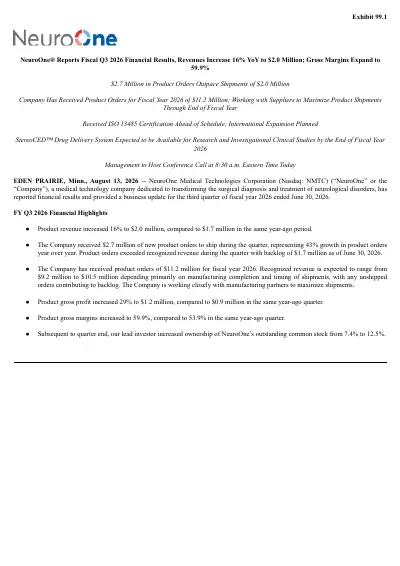
Product revenue for the One RF brain ablation system in the third quarter of fiscal 2026 grew 16% year-over-year to $2 million compared to $1.7 million in the third quarter of fiscal 2025. Orders for the quarter totaled $2.7 million, and we expect aggregate fiscal year 2026 product orders of approximately $11.2 million.
Recognized revenue for the fiscal year is expected to be between $9.2 to $10.5 million depending on the timing of shipment of those orders. We are working closely with our suppliers to expedite manufacturing in order to address any remaining backlog by the end of the fourth calendar quarter of 2026.
Moving forward, we are working towards the qualification of a second manufacturing site, which will increase capacity and potentially reduce lead times. We also saw gross margins expand to 59.9% during the quarter compared to 53.9% year-over-year due to a favorable product mix.
More recently, following the end of the quarter, our lead investor also increased their holdings from 7.4% to 12.5%. Moving on from current revenue growth, let's discuss future growth opportunities and new geographical markets.
As you may recall from previous releases, the company has been pursuing ISO 13485 certification, which is the international quality standard that companies must meet to market products internationally. I am very proud to announce that we received our certification recently, which now provides the opportunity to enter international markets with our One RF brain ablation system, One RF trigeminal neuralgia ablation system, and evo cortical and sEEG diagnostic product lines.
We will be working closely with our distribution partner, Zimmer Biomet, to start the process to enter geographies that optimize their existing customer relationships and with a focus on countries that have favorable economics. For those geographies that remain exclusive to NeuroOne, we will explore independent partnerships.
As a reminder, certain geographies have additional requirements, which could range from providing additional documentation and submissions to providing clinical data. This is another major milestone that the company has reached earlier than projected and really speaks to the quality of our procedures, processes, quality system, and employees.
Now let's discuss the exciting progress we've made with our product portfolio. Regarding our One RF brain ablation system, as I mentioned earlier, we experienced 16% year-over-year revenue growth for the quarter while purchase orders for our product showed growth of 43% year-over-year.
We also had a significant clinical milestone this month as the Journal of Neurosurgery published a retrospective, observational study completed by the Mayo Clinic in Jacksonville, Florida titled, "Stereo-Electroencephalography-Guided Radiofrequency Thermocoagulation in Patients with Implanted Neuromodulation Devices: A Patient Series". The study evaluated the use of NeuroOne's One RF brain ablation system in patients who have implanted neuromodulation devices.
The article concluded that these procedures may be performed without interfering with existing hardware, as well as providing meaningful seizure reduction. This was exciting to hear as it expands the pool of treatable patients to include those with existing neuromodulation implants.
We continue to build a compelling series of clinical experience that supports our goal of providing meaningful improvements for patients suffering with seizures or trigeminal neuralgia. Regarding our One RF trigeminal nerve ablation system, I want to share a recent experience that highlights the potential impact of this therapy.
A patient recently treated with the One RF trigeminal nerve ablation system was featured in a television interview on Cleveland 19 News, an affiliate of the CBS television network. She described living with trigeminal neuralgia as being worse than experiencing childbirth 10 times and that the condition made her feel like a zombie.
Following her treatment, we are happy to state that she reported being pain-free. Stories like this underscore both the devastating burden of this disease and the life-changing potential of our technology.
Stories like this continue to demonstrate successful clinical outcomes as measured by freedom from pain, enhanced patient comfort, while also having the potential to significantly reduce procedure times. US market for disposables excluding hardware is estimated at $40 million.
Because the majority of these cases are performed in approximately 30 centers, we plan on leveraging current personnel in combination with independent distributors to expand commercialization. Based on our limited market release experience, we also expect a short learning curve, which will minimize the cost of having to support every case.
We are currently interviewing distributors with the intent to hire them once the agreements are finalized. Now I am turning the call over to David Wambeke to provide an update on our drug delivery system, which we have named STEREO-CED.
David Wambeke
Thanks, Dave. I joined NeuroOne a little over 5 months ago, and since then I've had the opportunity to fully assess the intracranial drug delivery landscape.
The more I've learned, the more convinced I've become that we have a definitive technological edge. Brain-delivered therapeutics are approaching a major inflection point.
Dozens of promising programs are now in development, but one challenge continues to stand out: How do you deliver these therapies efficiently, reproducibly, and in a way that hospitals can realistically adopt at scale? While today's delivery technologies have enabled important clinical progress, many current procedures remain complex and resource-intensive.
Depending on the indication, procedures can range from 8 to 12 hours in the operating room and rely entirely on intraoperative MRI guidance. We believe those workflow challenges matter even more at commercial scale.
That's exactly the future STEREO-CED is designed for. Our robotic-assisted platform is intended to leverage neurosurgical equipment and workflows already established in leading hospitals.
We believe it has the potential to significantly reduce procedure times through simultaneous multi-trajectory delivery while avoiding the need for hospitals to purchase an entirely new robotic platform. Before discussing our progress, I'd like to highlight an important industry milestone.
In June, the FDA reversed its earlier position, allowing uniQure to submit an accelerated approval BLA, or Biologics License Agreement, for AMT-130 in Huntington's disease based on its existing 3-year clinical data. If approved, AMT-130 could become the first commercially approved blockbuster therapy delivered directly into the brain.
Wall Street analysts project global peak sales exceeding $2 billion, but also highlight the commercial risk associated with a complex workflow and lengthy procedures that can take 8 to 12 hours. We were pleased to recently publish a white paper highlighting the potential scalability of our STEREO-CED platform.
We anticipate that it will be ready for investigational human clinical studies by the end of September and possibly sooner for animal research. The feedback we've received from pharmaceutical companies and key opinion leaders has been extremely encouraging.
A common theme is the familiarity of the platform. Thousands of NeuroOne sEEG electrodes have already been implanted in patients, making drug delivery feel like a natural extension of an already familiar technology.
On the preclinical front, we've also made excellent progress. We've announced collaborations with the University of Minnesota in epilepsy and with Mayo Clinic in diffuse midline glioma.
The first animal studies are scheduled to begin this month, and we expect data from both programs this fall to support future clinical development. In parallel, we're expanding our academic collaborations and expect our first device sales to a pharmaceutical company for a nonhuman primate study later this year.
In closing, I believe we're still in the early innings of what could become a transformational growth opportunity for NeuroOne. There is strong pull from potential customers, and we are eager to have devices ready for human investigational studies shortly.
I'll now turn the call back over to Dave.
Dave Rosa
Thanks, David. Before I provide an update on our BVNA, or basivertebral nerve ablation, system for back pain, I just want to reiterate what I said last quarter with the hiring of David Wambeke.
He brings invaluable expertise in the gene and cell therapy space and has made a great impact in the short time he has been with us. Moving on to our BVNA back pain management program, this quarter we completed the user design requirements for the system and initiated preclinical testing to support continued development of the program.
Our strategy remains to leverage our existing One RF generator, temperature accessory, and ablation electrode while outsourcing access tools either through outside vendors or potential distribution partners. In addition, we also completed our assessment of the regulatory path to gain clearance and reconfirmed it is likely a 510(k) submission.
You may remember that the total time it took to gain clearance for our One RF trigeminal nerve ablation system was approximately 4 months, which is lightning speed in medical regulatory submissions. While there are no guarantees, we have experienced success with both of our 510(k) submissions to FDA and expect to submit this for FDA clearance in the second half of calendar 2027.
Finally, I want to reiterate that everything we develop at NeuroOne must offer unique device advantages over our competitors and the potential for better clinical outcomes for patients in a cost-effective manner. We believe these goals will also enhance shareholder value and appreciate the support we have received during volatility in the world today.
I would now like to turn the call over to Chris Volker to provide a review of our third quarter fiscal 2026 financial results.
Chris Volker
Thanks, Dave. Product revenue was $2.0 million in the third quarter of fiscal 2026, a 16% increase compared to product revenue of $1.7 million in the third quarter of fiscal 2025.
The increase was driven by higher sales of One RF products. The company received $2.7 million of new product orders during the quarter, representing 43% year-over-year growth.
Product orders exceeded recognized revenue during the quarter with a backlog of $1.7 million as of June 30, 2026. Product gross profit was $1.2 million, or 59.9% of product revenue, in the third quarter of fiscal 2026 compared to product gross profit of $0.9 million, or 53.9% of product revenue, in the same quarter of the prior fiscal year.
The increase in gross profit percentage was due to a more favorable sales mix toward higher-margin products. Total operating expenses were $3.6 million in the third quarter of fiscal 2026 compared to $2.8 million in the same quarter of the prior year.
Research and development expense in the third quarter of fiscal 2026 was $1.4 million compared to $1.2 million in the same quarter of the prior year. Selling, general, and administrative expense in the third quarter of fiscal 2026 was $2.2 million compared to $1.6 million in the same quarter of the prior year, with the increase being driven by increased headcount and sales and marketing costs.
Net loss in the third quarter of fiscal 2026 was $2.0 million, or 23 cents per basic share and 28 cents per diluted share, compared to a net loss of $1.5 million, or 19 cents per basic share and 22 cents per diluted share, in the same quarter of the prior year. The net loss in the third quarter of fiscal 2026 was favorably impacted by a $0.4 million gain from the fair value change in the warrant liability.
All share and per share amounts have been retroactively adjusted to reflect the 1-for-6 reverse stock split of the company's issued and outstanding common stock, which began trading on a split-adjusted basis on the Nasdaq Capital Market on April 16, 2026. As of June 30, 2026, the company had cash and cash equivalents of $2.0 million compared to $6.6 million as of September 30, 2025.
The company also had $1.1 million in accounts receivable as of June 30, 2026, which should be converted to cash in the fourth quarter of fiscal 2026 based on normal collection patterns. During the third quarter of fiscal 2026, the company raised $0.4 million through its at-the-market offering program.
Subsequent to quarter end, on July 13, 2026, the company raised another $1.0 million through the issuance of 400,346 shares under the ATM program, representing the second time in calendar 2026 the ATM was utilized. The company had working capital of $3.7 million as of June 30, 2026 compared to working capital of $7.9 million as of September 30, 2025.
NeuroOne had no debt outstanding as of June 30, 2026. I'll now turn the call back to Dave for his closing remarks.
Dave Rosa
Thank you, Chris. In summary, this was a very successful quarter for the company.
We delivered 16% year-over-year product revenue growth, increased gross margins of 59.9%, and received product orders of $2.7 million representing an increase of 43%, received ISO 13485 clearance paving the way for international revenue growth, was selected by prestigious teaching institutions for upcoming animal and human studies, and identified potential partners to accelerate the development of our BVNA system. Moving forward, the catalysts include: continued commercial expansion of the One RF brain ablation system and One RF trigeminal neuralgia ablation systems in the US and internationally, commercial availability of our drug delivery system for FDA-approved IDE studies and animal research, and continued progress on the development of our BVNA system.
When I look at what we have accomplished and what is ahead of us, I believe the NeuroOne story offers compelling value to doctors, patients, and investors. With that, operator, at this time we can open up the call for questions.
Operator
Thank you. Ladies and gentlemen, at this time we'll be conducting our question-and-answer session.
If you would like to ask a question, please press *1 on your telephone keypad. A confirmation tone will indicate your line is in the question queue, and you may press *2 if you wish to remove your question from the queue.
For participants using speaker equipment, it may be necessary to pick up your handset before pressing the star keys. One moment, please, while we poll for questions.
Thank you. Our first question today is coming from Jeffrey Cohen with Ladenburg Thalmann.
Your line is live.
Jeffrey Cohen
Hey, good morning, and thank you for taking our questions. I guess, Rosa, could we talk about that study at University of Minnesota for epilepsy?
Could you give us a sense of is that focal or general epilepsy that's being studied, and what the size of the study is, and what you would anticipate from a timeline perspective?
Dave Rosa
Thanks for attending today, Jeff. Good to talk to you again.
At the University of Minnesota, it pertains to focal. The first step in the process is for them to actually conduct preclinical testing on the therapy they've developed.
That will happen most likely in the next quarter. Then once they've been able to successfully complete the testing, and assuming that it's showing any efficacy, then they would look to go to a Phase 1 where they would then start testing it in patients.
The preclinical work is going to be happening very shortly.
Jeffrey Cohen
Got it. Then give us a sense of your supplier and backlog into fourth quarter.
Is it related to components, or it's related to labor? Then give us a sense of the second site that's come online, Do you expect to catch up with all the backlog during the fourth quarter and balance of the year?
Also, could you talk about some of the ex-US discussions you're having as far as distribution, at least in the case of One RF?
Dave Rosa
I couldn't hear the last part of what you said, but let me take the first big question, and then whatever I don't answer, just let me know. The supplier situation is, yeah, the company has lead times, and the lead times can take as long as 6 months.
There is a ordering process that's in place with Zimmer Biomet today where they give us orders in advance so that we can manufacture the product and then ship it to them on time. We basically build to order to minimize the cost of having to carry a lot of inventory.
What happens is that if there's any changes to the product mix, if they specify on a particular order that, for example, they want 1,000 devices at a particular size and then 500, and if they come back a few months later, our ability to respond in the time frame is limited based on the way the ordering is done now. We've experienced less of that in the past.
I would say more of that this year. There's a few ways of dealing with this.
One is you carry inventory, and work with your partner to make sure that it's not impacting the company from a cost perspective. I think the most effective way is to get our second site up and running, and that's what we're working on now.
That's what we expect to go online in the first part of 2027. We're going through all the work to do that.
If you've got two facilities capable of manufacturing product, and the second one is actually much larger than the one we use now, that should allow you to address it. Now, there is the other option that if, say, for example, the product mix involved maybe 500 units, would the company consider placing a one-time order for that difference?
Then what happens if you do that is your gross margins obviously are impacted, and you're not able to take advantage of the economies of scale. We try to place big orders in, which worked very well for us from a margin perspective, it makes it much more difficult if we're making small changes here and there.
It's just not as efficient. What was the other question that I may not have answered?
Jeffrey Cohen
Could you talk about the ISO certification of the second site and maybe give us a sense of some OUS potential opportunities for One RF as far as distributors and territories?
Dave Rosa
The ISO certification is kind of like your key to admission to be able to ship product internationally. There are certain geographies that will recognize FDA clearance, and at times just rely on the company registering the product in that geography.
Other geographies might require that you supply documentation of your quality system, your design records, and then others, when you look at Europe, for the most part, you've got to be able to provide also data. Depending upon which area you're going to, there's going to be different timelines to that.
Zimmer, per our last amendment that we signed over a year ago, they have certain geographies internationally, and they're assessing which ones they want to go to first. Again, the idea is how can we hit the ground running, and you really have to work on your targets.
Everything from where you can go today to start planning on how do you get to Europe as well. There's ways of even addressing clinical data.
We've just released obviously information on the study that was done in the Mayo Clinic in Jacksonville. There was an earlier press release that talked about a number of patients they treated.
If you're able to use some existing data, you may be able to even shorten that timeline. That's all in process.
Now that's the geographies that Zimmer has, but there's others that they do not have. Those are the areas where we're assessing are the economics in those geographies, do they make sense?
Are there distributors that we could utilize to commercialize the products there? That's all in process, and I don't expect that we'll have a firm answer on that until probably next quarter when we've had time to sit down with Zimmer and go through this.
Excuse me.
Jeffrey Cohen
Okay. Perfect.
Thanks for taking our questions.
Operator
Thank you. Our next question is coming from Justin Walsh with Jones Trading.
Your line is live.
Justin Walsh
Hi, thanks for taking the question. I was wondering if you could provide some additional color on how you view the STEREO-CED opportunity.
Do you think it's meaningful when used with drugs in the development stage, or do you think it has to be adopted as a standard for an approved agent?
Dave Rosa
That's a good question. The answer is no, I think it could be used in the preclinical stage, which is what we're seeing now with the University of Minnesota, as well as the clinical stage and then obviously the commercialization piece as well.
We really feel there's some significant differences and advantages of our system, even as it pertains to just how much time it takes to infuse a patient that may have one of these neurological conditions. Now the limitations that you would see with the device being used in a clinical study is, if a pharmaceutical company has an ongoing clinical study, say they've completed their Phase 1, they're happy with the results, they're not going to make any changes.
No company would be interested in introducing a new technology, even if it's a delivery device, into a Phase 2. You can never really predict what might happen.
Just as a way for them to mitigate any risk, if they start with a particular technology, unless there's issues with their clinical data or with that technology, they're likely to stay with that through clearance. Once clearance has been gained, then a company like us would submit an application under what we would expect to be a 510(k), to be able to be used with whatever approved therapy has just been granted FDA approval.
Operator
Thank you. Our next question is coming from Jeremy Pearlman with Maxim Group.
Your line is live.
Good morning, thank you for taking the questions. Firstly, related to trigeminal, again, just correct me if I'm not reading between the lines correctly, you said you're going to leverage existing personnel that you have on staff and then other distributors for that product.
Does that mean that Zimmer is not interested in adding that or amending that onto their agreement, or maybe I'm just misinterpreting that?
Dave Rosa
That may be what it sounds like, but it's not the case at all. When you look at discussions that we've had in the past with any of the strategics that we've spoken to, you always think that it should take a lot less time, but there's other factors that may be going on, not even our company, the potential partner, that may delay those things.
I think at some point we as a company have to say, "Look, we need to move forward. We can't sit and wait to conclude these discussions."
It does not mean that there is no interest. There is interest on their end.
Some of what's delayed us with trigeminal is this backlog that we're dealing with the brain ablation devices. We've really prioritized the units that go to Zimmer, because that is today the larger opportunity.
As we make progress on that, we'll start to get more devices for trigeminal sales. Currently this month, we have cases scheduled at the sites that did our limited market release.
We have additional sites that I even talked about last quarter that want to do an evaluation. What you don't want to do when you're trying to address demand from another area, and that's your biggest source of revenue, you don't want to shortchange that by an opportunity that, while compelling, is smaller.
We haven't opened up additional centers, but we will be beyond this quarter. It hasn't been, I would say, a major issue for us to address because we weren't able to really do much given the backlog that we experienced on the other side.
Short answer, they're definitely interested. It doesn't mean that it won't happen, but we're going to move forward, and if there's an opportunity, then great.
Understood. Then lastly, in the past you've guided towards revenue of at least $10.5 million, and know there's been some manufacturing delays.
In the press release you put out this morning, you said, I think it was between $9.2 and $10.5. You'll hit any of that within that range is based on how fast you can get those products made and shipped out, or is there anything else that's baked into that range?
Thanks.
Dave Rosa
No, it's manufacturing. It's also the reason why we did alert the market that our orders actually are $11.2 million.
Based on the feedback that we have from vendors, the multiple vendors, that number is very unlikely to happen. We think what's more reasonable, more conservative is that range, but it's completely dependent on everything from the vendors being able to deliver what they say they deliver, with some risk that we've built into that, but from an order standpoint, the number if we were able to meet the manufacturing would have been almost, or around $11.2 million.
Understood. Great.
Then this is the last question from us. Maybe you might not have this, I know Zimmer is the one who's pushing the One RF ablation device, but is there any data, maybe KPIs you have regarding new accounts versus utilization in pre-existing accounts, how that's going, growth within those accounts?
You can share anything on that?
Dave Rosa
Contractually, we don't have the right to get that information. We have asked for more detailed information.
Zimmer, and it's not just Zimmer, it's other companies as well, they like to keep that close to the vest. Other companies, you wouldn't see them reporting on an area like this either.
Zimmer does it because they don't want their competitors to really know what's going on, but in anecdotal discussions, their feedback is they're continuing to gain additional traction. As far as giving you hard numbers, I don't have that.
Understood. Thank you for taking my questions.
Have a nice day.
Dave Rosa
Sure, thank you.
Operator
Thank you. That appears to be the last question at this time, I'd like to turn the call back over to Mr.
Rosa.
Dave Rosa
I just want to thank everyone again for attending the call today. We really look forward to connecting with the investor community throughout this quarter and beyond.
If we were unable to answer any of your questions today, please reach out to our investor relations firm, the MZ Group, and they'd be more than happy to follow up.
Operator
Thank you. Ladies and gentlemen, this concludes today's conference.
We thank you for your participation. You may disconnect your lines at this time, and have a great day.