NeuroOne Medical Technologies Corporation
NNASDAQ:NMTCQ1 FY2026 · Earnings Call TranscriptFebruary 17, 2026
Operator
Good day, ladies and gentlemen, and welcome to the first quarter fiscal 2026 financial results conference call for NeuroOne Medical Technologies Corporation. Today's call will be conducted by the company's Chief Executive Officer Dave Rosa and Ron McClurg, the company's Chief Financial Officer.
Before I turn the call over to Mr. Rosa, I'd like to remind you that this conference call will include forward-looking statements within the meaning of U.S.
federal securities laws with respect to future operations, financial results, including our 2026 revenue guidance, events, trends, and performance, which are based on management's beliefs and assumptions as of today's call. Forward-looking statements may involve known and unknown risks, uncertainties, and other factors which may cause actual results to differ materially from those expressed or implied by such statements.
See NeuroOne's financial results press release and SEC filings for information regarding specific risks and uncertainties that could cause actual results to differ. Except as required by law, NeuroOne undertakes no obligation to update such forward-looking statements.
With that, I will turn the call over to Mr. Dave Rosa, CEO of NeuroOne.
Please go ahead, sir.
Dave Rosa
Thank you, operator, and thank you to everyone for joining us today. I'd like to welcome you to our first quarter fiscal 2026 financial results conference call.
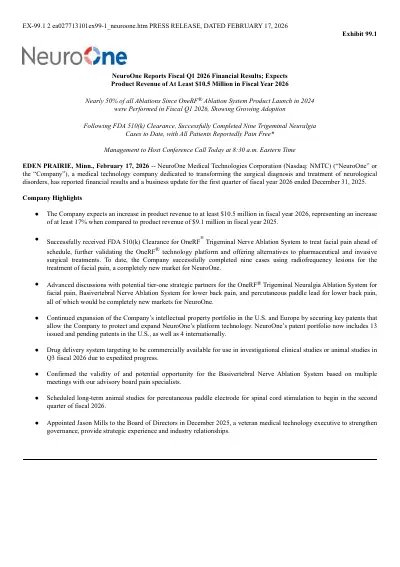
The company continued the positive momentum from fiscal year 2025 by making progress in a number of different areas of the business. Our first quarter sales were sequentially higher than the previous quarter and down slightly, as expected, from the initial stocking order that was placed in Q1 of fiscal 2025 with the launch of the OneRF brain ablation system.
We are also projecting fiscal year 2026 sales to be at least $10.5 million, which is a minimum 17% increase from fiscal year 2025. With respect to our existing product portfolio, we continued to make exciting progress across all of our programs.
First, regarding our OneRF brain ablation system, the number of ablations performed in fiscal Q1 2026 was nearly half of all ablations performed since the launch of the technology. This demonstrates continued penetration and adoption of the technology in the market.
We also reported that Mark Brunell, a professional pianist from Chicago, was able to resume his career after receiving an ablation with our system. These types of success stories are not only exciting to hear, but also confirm our enthusiasm for future potential growth with this platform.
As previously mentioned, we are also establishing a registry to capture these outcomes and hope to enroll the first patient by the end of the third fiscal quarter. We also attended the American Epilepsy Society meeting in December where our system was exhibited at Zimmer Biomet's booth.
In addition, doctors from the Mayo Clinic in Jacksonville, Florida provided their experience with the system at the booth. We also believe there's an opportunity internationally for our technology and continue to work towards receiving ISO 13485 certification as a first step towards commercializing internationally.
Moving on to our OneRF trigeminal nerve ablation system, we previously disclosed that in August of 2025, we received FDA 510(k) clearance for this system to treat facial pain by ablating the trigeminal nerve. In the first quarter of fiscal 2026, we initiated a limited commercial launch and reported that the first two patients were treated at the University Hospitals Cleveland, with both patients reporting pain relief from the procedure.
To date, nine total patients have been treated at three centers, and all are reported pain-free, which is extremely encouraging. As a reminder, unlike traditional ablation systems, our probe was intended to be placed once due to the multiple contacts present on the device.
Traditional systems typically require multiple probe placements, which can cause additional patient discomfort. Given the positive outcomes to date, we expect to complete this limited launch by the end of Q2 fiscal 2026.
We are currently in diligence discussions with a strategic to potentially license this technology and look to conclude these discussions as quickly as possible. Regarding our drug delivery program, we were able to accelerate the program and expect that we will have devices available for commercial use in investigational clinical studies or animals in Q3 fiscal 2026.
This is approximately six months sooner than originally expected. We are currently organizing an advisory board of leading oncology experts that treat challenging brain tumors such as glioblastomas to provide guidance in utilizing the system to deliver therapies to the brain for this application.
We are also continuing discussions with various pharma and biotech companies regarding the potential use of the device for animal and/or investigational human studies for gene and cell therapies in development. As reported last quarter, we are evaluating opportunities with two organizations interested in forming a partnership to use our drug delivery technology to deliver their experimental therapies to the brain to treat a variety of different neurological conditions.
Moving on to our two lower back pain management programs, I will first provide an update on our percutaneously placed paddle electrode. This system is designed to offer broader, customizable stimulation, less energy consumption, and can be inserted through a 14-gauge needle, eliminating the need for an incision in the patient's back.
We plan to initiate a long-term animal study next month in preparation for our first human implant. We are actively engaged in diligence discussions with strategic organizations regarding their interest in this platform.
The second technology in development to treat lower back pain is our basivertebral nerve ablation system. This past quarter, we held multiple advisory board meetings with leading pain experts to confirm the product requirements as well as to validate the system's potential benefits compared to existing technologies.
We are confident in our strategy to leverage our existing OneRF generator and SEEG probe for this application. We are also in diligence discussions with strategics regarding this product technology and a potential partnership.
Next up in development is to identify firms that can provide manufacturing for the required access tools for the system. Finally, we were excited to announce the appointment of Jason Mills to our board of directors.
Jason is currently the executive vice president of strategy for Penumbra, Inc., which was recently acquired by Boston Scientific for $14.5 billion. Prior to that, Jason was managing director at Canaccord Genuity and has held similar roles in other investment banks over his career.
We believe his expertise will translate smoothly into helping address the company's business development opportunities currently in process. I would now like to turn the call over to Ron McClurg, Chief Financial Officer, to provide a review of our first-quarter fiscal 2026 financial results.
Ron McClurg
Thanks, Dave. Product revenue was $2.9 million in the first quarter of fiscal 2026, compared to product revenue of $3.3 million in the first quarter of fiscal 2025, which included Zimmer's initial stocking order.
On a sequential basis, revenue increased 5.5% from $2.7 million in the fourth quarter of fiscal 2025. The company had no license revenue in the first quarter of fiscal 2026, compared to license revenue of $3 million in the first quarter of fiscal 2025, which was derived from the expanded exclusive distribution agreement with Zimmer.
Product gross profit was $1.6 million, or 54.2% of revenue, in the first quarter of fiscal 2026, compared to product gross profit of $1.9 million, or 58.9% of revenue, in the same quarter of the prior fiscal year. On a sequential basis, product gross profit increased 2.6% from $1.5 million in the fourth quarter of fiscal 2025.
Total operating expenses were $3.3 million in the first quarter of fiscal 2026, compared to $3.2 million in the same quarter of the prior year. Research and development expense in the first quarter of fiscal 2026 was $1.4 million, compared to $1.2 million in the same quarter of the prior year.
Selling, general, and administrative expense in the first quarter of fiscal 2026 decreased 7.7% to $1.9 million, compared to $2 million in the same quarter of the prior year. Net loss in the first quarter of 2026 was $1.4 million, or a loss of 3 cents per share, compared to net income of $1.8 million, or 6 cents per share, in the same quarter of the prior year.
Net income in the first quarter of fiscal 2025 included the license revenue of $3 million related to the distribution license granted to Zimmer for the OneRF product in October of 2024. As of December 31st of 2025, the company had cash and cash equivalents of $3.6 million, compared to $6.6 million as of September 30th, 2025.
Of note, NeuroOne is funded through fiscal 2026, potentially longer if key milestones are hit. The company had working capital of $6.8 million as of December 31st, 2025, compared to working capital of $7.9 million as of September 30th, 2025.
NeuroOne had no debt outstanding as of December 31st, 2025. I'll now turn the call back over to Dave for his closing remarks.
Dave Rosa
Thank you, Ron. As I mentioned at the top of the call, we continued the positive momentum from fiscal year 2025 by making progress across all of our programs.
In addition, we are projecting revenues of at least $10.5 million in fiscal 2026 and look forward to providing updates on our progress in other areas of the business as well throughout the year. In addition, we will be attending the Oppenheimer 36th Annual Healthcare MedTech and Services Conference and invite investors to meet with NeuroOne March 16th through 19th, and join our presentation at 1:20 p.m.
Eastern Time on Tuesday, March 17th. Lastly, before we move into the Q&A portion of today's call, I and everyone at NeuroOne would like to extend our sympathies for the unexpected loss of Dr.
Sanjeet Grewal, a brilliant neurosurgeon, valued collaborator, and friend to NeuroOne. Our deepest condolences to his wife Angela, his children, and the entire Mayo Clinic family.
Operator, at this time we can open up the call for questions.
Operator
Thank you, sir. At this time, we will be conducting our question-and-answer session.
If you would like to ask a question, please press star one on your telephone keypad. A confirmation tone will indicate your line is in the question queue, and you may press star two if you would like to remove your question from the queue.
For participants using speaker equipment, it may be necessary to pick up your handset before pressing the star keys. One moment, please, while we poll for questions.
Thank you. Our first question is coming from Jeffrey Cohen with Ladenburg Thalmann.
Your line is live. Oh
Jeffrey Cohen
hey, good morning, Dave and Ron. How are you?
Ron McClurg
Good.
Dave Rosa
Great, Jeff. Good morning.
Jeffrey Cohen
Couple of questions from our end. Could you talk about trigeminal firstly?
I know, congrats on getting up to nine cases. Could you give us a sense of number of physicians or number of centers that did the nine cases, and then maybe talk about interest from Zimmer and/or others for trigeminal, please?
Dave Rosa
Sure. I'll take that.
The nine cases that we've done were done at three centers. One of those centers, by the way, was Dr.
Grewal's, that I mentioned just recently passed away. In all nine cases, the patients were reportedly pain-free.
That's really the objective of this therapy, so that was very encouraging to see. Really, one of the major advantages of the technology is that due to the multiple contacts on the electrode itself, you're able to place the device once instead of multiple times to really find the area of the nerve that's triggering the pain.
It's a much more comfortable procedure, let's say, for patients and may require less time because you're only placing the device once. In terms of strategic interest, yes, there are discussions underway.
Obviously, you would always like to conclude those discussions as soon as possible, and that's really the goal. Right now we're in diligence with the company, but would be prepared, if we don't move forward in diligence, to commercialize this ourselves.
Jeffrey Cohen
Got it. Could you give us a sense—I don't know how much clarity and transparency you have—could you give us a sense of number of physicians or number of centers for which, Zimmer is present domestically?
Dave Rosa
We don't have that information. The information that I referred to earlier in the discussion was that they've told us that the first fiscal quarter, in terms of number of patients, that there were almost half of all the patients they've treated since they launched this were actually completed [cough] in the first fiscal quarter.
We don't have clarity on the number of centers or the number of cases.
Jeffrey Cohen
Got it. Then one more for me, maybe a question for Ron.
Could you talk about OpEx, generally speaking? Would you expect that to be fairly flattish off of Q1 levels for the balance of the year?
Ron McClurg
Thanks, Jeff. We would expect that the SG&A would be fairly flat the rest of the year, but we do expect that the R&D may fluctuate as we're depending on what phase of the projects that we're working on.
As Dave mentioned before, we did accelerate our drug delivery project and made significant progress there. We're not sure exactly that there will be some near-term expenses and then that project will start to taper off a little bit.
Jeffrey Cohen
Got it. The animal studies for drug delivery and also spinal cord will pick up in the back half of the year, it looks like, Q2 and Q3.
Ron McClurg
Yes. Yes.
Not significantly, but it will pick up a little bit.
Jeffrey Cohen
Perfect. That does it for me.
Thanks for taking the questions.
Ron McClurg
Thanks, Jeff.
Operator
Thank you. Our next question is coming from Jeremy Pearlman with Maxim Group.
Your line is live.
Jeremy Pearlman
Thank you. Good morning.
A question regarding any clinical feedback you may have received from neurologists or surgical teams that are using the installed products so far that you could share? Thank you.
Dave Rosa
Yes. In general, what we're finding is that the device is very successful or has been successful in either reducing the number of seizures that patients are having, or completely eliminating them.
Now, those metrics are really measured over time, one of the reasons why we want to capture those, despite our enthusiasm for it, this is the main reason why we started the registry, as a way to really capture what the results are long-term. I think the results speak for themselves to date.
The feedback that we have is the actual generator, the device that creates the ablation, it's very easy to use, and the system itself is very easy to use. These procedures do not require patients to be in the operating room for it, at least from what we know, all of them to date have been done at the patient's bedside, that is the actual ablation itself.
I've never seen a procedure, a surgical procedure, done by a patient's bedside. It's kind of exciting to really see the results that we're getting, and really the feedback on ease of use.
Jeremy Pearlman
That's great to hear. Then maybe again, you might not have this information, it might be more at Zimmer's end, but is there a specific region in the U.S.
where they are seeing the most traction and adoption of the technology, and then maybe how do they replicate that across the rest of the country?
Dave Rosa
That information we don't have.
Jeremy Pearlman
Okay. Then just last question, sales and marketing, your expectations for '26, are you going to share that burden with Zimmer to promote the products, or is that fully on Zimmer's shoulders?
Dave Rosa
Part of our agreement that we signed way back in 2020, the responsibility for all marketing and sales costs lie with Zimmer. We're obviously responsible for providing all the training and field support, as is reasonable, and it has worked very well.
It's actually their responsibility to cover all commercialization and marketing costs.
Jeremy Pearlman
Okay. All right, great.
Then just this last question, the revenue breakdown for the first quarter, was that just predominantly or all just restocking, or was there any additional purchases that Zimmer made, maybe beyond what they had originally expected to use the device, and they were restocking even within the quarter?
Dave Rosa
I Ron--
Ron McClurg
I'll take that, Dave. Most of the revenue is what you're calling restocking, which is replenishing and selling into the market.
A year ago, if you remember, in the first quarter of fiscal 2025, that was their initial stocking order, and pretty much everything since then has been the continuation and restocking.
Jeremy Pearlman
Okay. Got it.
Understood. All right, thank you for taking my questions.
Have a nice day.
Dave Rosa
Thank you, Jeremy.
Ron McClurg
Thanks, Jeremy.
Operator
Thank you. That appears to be the last question at this time, I would like to turn the call back over to Mr.
Dave Rosa for any closing remarks.
Dave Rosa
Thank you, operator. I would like to thank everyone again for attending the call, and we look forward to connecting with the investor community throughout the quarter.
If we were unable to answer any of your questions today, please reach out to our investor relations firm, MZ Group, who would be more than happy to assist.
Operator
Thank you. Ladies and gentlemen, this concludes today's conference.
We thank you for your participation. You may now disconnect your lines at this time, and have a great rest of the day.