NexPoint Real Estate Finance, Inc.
Q4 FY2025 · Earnings Call TranscriptFebruary 26, 2026
Operator
Thank you for standing by. My name is Jordan, and I'll be your conference operator today.
At this time, I'd like to welcome everyone to the NexPoint Real Estate Finance Q4 2025 earnings call. All lines have been placed on mute to prevent any background noise.
After the speakers' remarks, there will be a question-and-answer session. If you would like to ask a question during this time, simply press *, followed by the number 1 on your telephone keypad.
If you'd like to withdraw your question, press *1 again. Thank you.
I'd now like to turn the call over to Kristen Griffith, Investor Relations. Please go ahead.
Kristen Griffith
Thank you. Good day, everyone, and welcome to NexPoint Real Estate Finance's conference call to review the company's results for the fourth quarter ended December 31st, 2025.
On the call today are Paul Richards, Executive Vice President and Chief Financial Officer, and Matt McGraner, Executive Vice President and Chief Investment Officer. As a reminder, this call is being webcast through the company's website at nref.nexpoint.com.
Before we begin, I would like to remind everyone that this conference call contains forward-looking statements within the meaning of the Private Securities Litigation Reform Act of 1995 that are based on management's current expectations, assumptions, and beliefs. Listeners should not place undue reliance on any forward-looking statements and are encouraged to review the company's annual report on Form 10-K and the company's other filings with the SEC for a more complete discussion of risks and other factors that could affect the forward-looking statements.
The statements made during this conference call speak as of today's date, and except as required by law, NREF does not undertake any obligation to publicly update or revise any forward-looking statements. This conference call also includes an analysis of non-GAAP financial measures.
For a more complete discussion of these non-GAAP financial measures, see the company's presentation that was filed earlier today. I would now like to turn the call over to Paul Richards.
Please go ahead, Paul.
Paul Richards
Thanks, Kristen, and good morning, everyone. I'll walk through our quarterly results, cover the balance sheet, and provide guidance for Q1 before turning it over to Matt for a deeper dive on the portfolio and the macro lending environment.
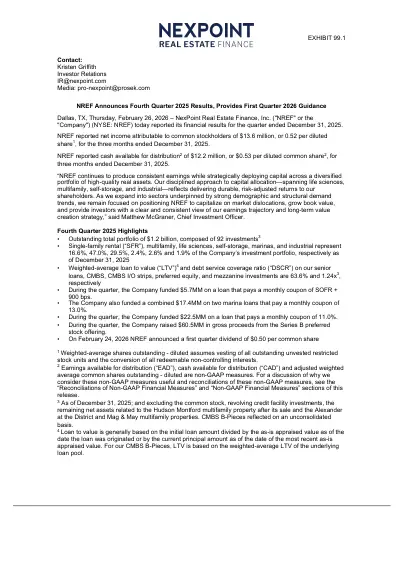
Fourth quarter results are as follows. We reported net income of 52 cents per diluted share, compared to 43 cents in Q4 '24.
The increase was driven by unrealized gains on our preferred stock and stock warrant investments. Earnings available for distribution came in at 48 cents per diluted share, compared to 83 cents in Q4 '24.
Cash available for distribution was 53 cents per diluted share, up from 47 cents in the prior year—our prior quarter. We paid a regular dividend of 50 cents per share in the fourth quarter, which was 1.06 times covered by cash available for distribution.
The board has declared a dividend of 50 cents per share for the first quarter of 2026. Book value per share increased 1.4% from Q3 to $19.10 per diluted share, primarily driven by unrealized gains on preferred stock investments and stock warrants.
Turning to new investment activity during the quarter. We funded $5.7 million on a loan with a monthly coupon of SOFR plus 900 basis points with a 14% floor, along with $22.5 million on a loan paying an 11% monthly coupon.
We also funded a combined $17.4 million across two marina loans at a 13% monthly coupon. On the capital markets side, we raised $60.5 million in gross proceeds from our Series B preferred stock offering.
For the full year, we reported net income of $2.09 per diluted share, more than double the $1.02 we reported in 2024. The increase was primarily driven by high—higher net interest income.
Interest income increased $17.4 million to $89.9 million for 2025, up from $72.5 million in the prior year, driven by higher rates on the portfolio. At the same time, interest expense declined from $44.4 million to $42.8 million.
Earnings available for distribution was $1.84 per diluted share, up 3.4% from $1.78 in 2024. Cash available for distribution was $1.97 per diluted share, compared to $2.42 in the prior year, a decrease of 18.6%.
Moving to the portfolio and balance sheet. Our portfolio consists of 92 investments with a total outstanding balance of $1.2 billion.
By sector, we are allocated as follows: 47% multifamily, 30% life sciences, 70%—17% single-family rental, and the balance across storage, marina, and industrial. By investment type: 28% CMBS B-Piece, 23% preferred equity, 20% mezzanine loan, 14% revolving credit facilities, 10% senior loans, and the remainder in IO strips and promissory notes.
Geographically, our collateral is concentrated in Massachusetts at 24%, Texas at 16%, and California at 7%, with the Massachusetts and California exposure heavily weighted towards life science. Florida, Georgia, and Maryland round out the top states, reflecting our continued preference for Sunbelt markets.
The collateral on our portfolio is 82.5% stabilized, with a 63.6% loan-to-value ratio and a weighted average debt service coverage ratio of 1.24 times. We have $771.2 million of debt outstanding at a weighted average cost of 5.3% and a weighted average maturity of roughly 1 year.
Our secured debt is collateralized by $689.2 million of assets with a weighted average maturity of 3.6 years and a debt-to-equity ratio of 0.92 times. During the quarter, we refinanced $36.5 million unsecured notes with a new $45 million unsecured offering at 7.875%, a modest step up from the 7.5% notes we issued in October of 2020 when we were in a zero interest rate environment.
The new notes carry a two-year term with prepayment flexibility, which positions us well well in a declining interest rate environment. We're pleased with this execution and look forward to terming out the remaining unsecured notes in the first half of 2026.
On that note, we have $180 million of unsecured notes maturing in May, and we are actively reviewing reviewing several options to achieve the best execution and pricing on the refinancing. We also recently launched our Series C 8% preferred stock at $25 per share.
Through the end of the year, we have sold approximately 80,000 shares for a total gross proceeds of $2 million and a total of $14.1 million through today. Lastly, subsequent to quarter end, we entered into a re-REMIC transaction on our FREMF 2017-K62 D B-Piece with Mizuho.
Under this structure, we're selling the B-Piece and purchasing the horizontal risk retention tranche, which represents roughly 5.8% of the re-REMIC. This transaction reduces our mark-to-market repo financing by $75.2 million and our debt-to-equity ratio would decrease to 0.83 times, and the HRR tranche carries an expected yield of 18.5%.
On a go-forward basis, the interest expense savings and reinvestment capacity are expected to be around 30 to 44—30 to 34 cents per share accretive to annual CAD. We view this as a compelling example of actively managing our B-Piece portfolio to unlock value and improve our capital efficiency.
Moving to guidance for the first quarter. Earnings available for distribution: 40 cents per diluted share at the midpoint, with a range of 35 to 45 cents.
Cash available for distribution: 50 cents per diluted share at the midpoint, with a range of 45 to 55 cents. With that, I'd like to turn over to Matt for a detailed discussion of the portfolio and the current market environment.
Matt?
Matt McGraner
Appreciate it, Paul. I'm excited to speak to everyone today about NREF's pipeline and trends in our main verticals.
I also want to thank our team here, as Paul just mentioned, and all of our partners for another quality quarter for the business and our shareholders with great execution. As it relates to our main verticals, I'm very pleased with our portfolio of assets in this era of major AI disruption.
Indeed, NexPoint has been steady and intentional about our asset selection, and thankfully, NexPoint, and by extension, NREF especially, is not investing in AI-scared trade assets or assets historically levered to these property types. We are intentional about our residential and self-storage exposure, both recession-resilient property types necessary for everyday life.
Indeed, the introduction of AI to these property types is only improving efficiency and margins in these businesses and not rendering them obsolete. Even our life science exposure is in first-to-fill assets in elite educational districts producing this AI talent.
What's more, the demand funnel for our life science collateral is widening to AI companies themselves, which need the purpose-built lab-type buildings to house their compute infrastructure. Our Alewife project is a perfect example.
Lab and AI tenants could go to older converted assets for half the rent, but they must have the infrastructure and bones of these purpose-built, well-located assets, and they'll pay for it. Let me start there with life science for the quarter.
Our largest single asset exposure in life science, Alewife Park, is now 64% leased at a 9% debt cap rate, with RFPs, LOIs, and leases now totaling 2.8 times the square footage of the project. Momentum has materially increased since the Lilly lease, and we expect this trend to continue, to have the project fully leased in 2026, yielding a debt cap rate with a 12-handle.
More broadly, certainly less expensive alternatives exist in the suburbs or in second-gen space, but first-to-fill buildings in impossible-to-recreate locations, again, in elite educational centers, is our exposure. What we are fairly certain of are two things: Number one, health, wellness, and longevity of life was already a rapidly growing trend before the latest AI disruption.
If we do get the productivity gains and GDP growth as a result, we believe the population will prioritize spending in their health, i.e., living longer, and entertainment. Drug discovery and delivery are key tenants of life science demand, and we believe each of these have a massive tailwind for purpose-built new life science product in elite academic ecosystems.
The second tenant of our thesis in leaning in when we did is that new supply over the near term is nonexistent. Our basis in our collateral is 30 60—30% to 60% below replacement cost for these assets, and that's just replacement cost, let alone the need to justify a profit for a new life science development.
In short, we really like our portfolio and where it's positioned, especially relative to comps, and the demographic and AI tailwinds are real. On the residential front, we continue to work through the highest supply cycle since the 1980s and do see the new lease inflection this year.
I detailed this on prior calls, but just to quickly repeat, we think multifamily rents will inflect positive, with most of our market exposure occurring in the second half of 2026. We attribute this to four main factors: persistent structural demand, the cost to own a home is three times more to rent an apartment in our markets; a 60% decline in new market rate deliveries from the peak; construction starts running approximately 70% below their 2020 peak, locking in a multiyear supply trough; and finally, concession burn-off resulting in immediate gains to gross potential rents.
We do think AI will have some job-cannibalizing effects, particularly in the entry-level white-collar job market, but also see an encouraging residential trend offsetting potential job weakness, that is, advances in health and wellness are adding longevity to the population, creating somewhat of a demographic backstop to demand. The 65-plus population is growing at 3% to 5% across our markets, and a late 2025 study from Harvard projects the senior renter population to double from 5.8 million households to 12.2 million households by 2030.
On the self-storage front, Q3 REIT earnings came in at or slightly above expectations—excuse me, Q4 REIT earnings came in slightly above expectations, but revenue was flat to slightly negative year over year. Looking forward, full-year performance is expected to show flat revenue and a 50 to 150 basis point decline in NOI.
Some sell-side analysts have already trimmed their 2026 and 2027 estimates. Occupancy generally remains under pressure, with industry average ending 2025 at 89%, down 210 basis points from the start of the year.
The primary culprit is a sluggish housing market as home sales remain near multiyear lows and mortgage rates stay elevated, reducing a key demand driver for self-storage. Rates are the bright spot, however.
After two years of falling rates, some down 20% from COVID-era highs, move-in rates have been trending up since May of 2025 and should help offset some of the occupancy weakness. Also good news, supply remains constrained at just under 3% of existing stock, with Yardi projecting deliveries as low as 1% over the next couple of years.
Again, high financing costs, expensive land, and material cost inflation are deterring new development, which should eventually restore pricing power and return NOI growth to the historical 3% to 5% range. Our NexPoint storage portfolio significantly outperformed the broader industry in 2025, finishing the year at 91.7% occupancy, exceeding its NOI budget by 3.2%, and growing NOI 13% over 2024.
Looking into 2026, NOI growth is expected to moderate to 4%, reflecting portfolio stabilization, softer demand, and rate constraints on our two LA properties, but still notably higher than the broader industry. On the SFR and BTR front, fundamentals continue to outperform the broader multifamily segment generally.
Our SFR collateral remains some of the best-performing within our portfolio, with steady occupancies in the mid-90s, with positive new lease and renewal growth as well. In recent discussions with the agencies, and notwithstanding recent proposed regulation limiting institutional ownership in the sector, Fannie and Freddie remain open to finance build-to-rent assets.
Indeed, we believe this is an immense area of opportunity, regardless of regulation, to either take subordinate risk off of the agencies or fill a direct lending void to institutional portfolios of scattered-site SFR, should this void materialize. I'm also very pleased with our pipeline and the menu of capital options available to us to capitalize on these opportunities.
Today, our 90—our rolling 90-day pipeline consists of senior and mezzanine investments in $90 million of multifamily product, 55—$55 million of BTR, $45 million of small-bay industrial and self-storage, and $70 million of life sciences and advanced manufacturing. As Paul mentioned, our underlying credit profile of the portfolio remains very strong, atop the commercial mortgage REIT sector.
Also given our healthy dividend coverage, very low leverage, stable book value, and capital options available to us, you can expect that we will also continue to opportunistically buy back stock while pursuing these new investments, particularly after the refinancing of our bonds. Again, very pleased with the portfolio's performance and look forward to deploying more capital this year in 2026.
Again, I want to thank the team here for their hard work, and now we'd like to turn the call over to the operator for questions.
Operator
As a reminder, if you'd like to ask a question, simply press *, followed by the number 1 on your telephone keypad. Your first question comes from the line of Crispin Love from Piper Sandler.
Your line is live.
Ben Graham
Hi, how's it going? Can you guys hear me all right?
Matt McGraner
Yeah.
Paul Richards
Hear you great.
Ben Graham
Awesome, thank you so much. This is Ben Graham in for Crispin Love.
Thanks for taking the question. I'm wondering if you could discuss dividend sustainability and your confidence in the current level.
The EAD guidance range is below the dividend, but cash available for distribution is in line, and I'm wondering what the major factors are that are dividing yours and the board's decision on the dividend here. When do you believe you could be covering the dividend on a more consistent basis with EAD?
Thank you.
Paul Richards
Hey, great getting to talk to you. Yes, our EAD is a little below our CAD, but the majority of that is, again, the bridge from EAD to CAD, amortization of premiums, some accretion to discounts, and depreciation on REO.
We believe that CAD is the better indicator of dividend coverage and sustainability, hence why we have continued to recommend a 50-cent dividend to the board, and they have approved it every time. We feel very good on the go-forward, one, from the re-REMIC transaction we discussed; two, from the continued Series C raise and redeployment at 200 to 400 basis point net interest margin for that number to grow over time as well.
We feel well-positioned for the future, for dividend sustainability.
Matt McGraner
I'd just add to that, we've consistently outearned our dividend since our inception, again, have stable book value, going on the offensive, and really like our cost of capital, again, to drive the results that you're seeing here, which, relative to the comps, we think is pretty good.
Ben Graham
Awesome, thank you so much for the color there. Then if I could ask one more question.
When you look at your portfolio areas between multifamily, single-family rental, self-storage, life sciences, etc., I'm wondering what areas you're most excited about today, and then further, how do you expect the administration's focus on real estate mortgage and single-family affordability to impact some of the areas where you're invested? Thank you.
Matt McGraner
I think I'm glad, as I mentioned, that we leaned into life sciences when we did last year, at a time when there was no capital available, because we're starting to see folks reenter that market, which are going to reduce spreads. Right now, I think where we're spending the most time is on the BTR in the multifamily front, on the new construction and stretch-senior side, providing B-notes and selling off A-notes for both new construction and/or new lease-up deals, both on the BTR front and on the multifamily front.
As it relates to the recent proposed regulations, I think it's still too early to tell, but our organization has been involved in some of the regulatory process, if you will, and lobbying process in DC, and I think from our exposure, we feel very good about mainly focusing on built-to-rent assets, which are adding to the housing stock and not detracting from it. We still think that there's going to be a need to provide capital in that space.
I think the opportunity remains for BTR assets. What's more interesting, and I think more in the bull's-eye of the proposed regulations, are scattered-site SFR.
There's been proposals on limiting institutional buyers from purchasing homes off of the MLS and how that all shakes out in terms of the financeability. It's probably too early to tell, but I think the ABS market on the scattered-site front is still very active and still, I'd say wide open, even post-announcements.
I think that market still continues to trade well and still I think the origination volume is still open. To the extent that it's closed and scattered-site becomes a little bit out of favor with the broader lending environment because of political pressure, I do think that that's an opportunity for us to enter that market and provide capital and liquidity, because we're very, obviously, very comfortable with it.
Ben Graham
Awesome. Thank you so much for taking my questions.
Matt McGraner
You bet.
Operator
Your next question comes from the line of Jade Rahmani from KBW. Your line is live.
Jade Rahmani
Thank you very much. Can you touch on the provision for credit loss that took place in the quarter, around $12 million, and what you expect on that going forward?
Paul Richards
Absolutely, Jade. Hey, this is Paul.
I would say that 1/3 of it was just our general reserve. We updated our calculation to be, again, more conservative, and now includes a severe downside component to the CECL provision to align with our peer group.
The other, call it 66%, more on deals that we've already taking a CECL reserve on, which were on a few of the pref deals that we spoke about last quarter. On the go-forward expectations, again, I think you're kind of at that trough, and there aren't any more problem areas on the pref book or in the portfolio.
I think this would probably level off in '26.
Jade Rahmani
Thank you very much. Just on the life science project, which has bucked the trend in the industry of a downdraft in leasing activity, could you give your thoughts as to what the project-specific characteristics are that drove the positive performance, and if you're seeing, outside of this project, any uptick in life science leasing activity that might make you look at other deals in that sector?
Matt McGraner
You bet. I'd say that Alewife Park project is one of the very few purpose-built life science, slab on grade, all the qualities that you need, and, more importantly, in West Cambridge on mass transit lines.
I think when this project opened and TCO'd, it was probably into, I would say, some of the worst market dynamics that we faced historically in life science. I think part of it is the, again, the infrastructure that Lyra Sciences needed, we were the only building that could, at that time, house their needs and their infrastructure.
Then it's the cluster effect. Once you get a good tenant, such as Lyra, backed by a very well-heeled investor base, those tenants can continue to drive more leasing activity and if people want to be around them.
I think we might have gotten lucky, but I'll take it, I would say. More broadly, I think across the portfolio, I think activity is, in the last 30, 60 days coming out of JPMorgan in San Francisco, there's been, I would say, a lot of optimism.
We're seeing more capital, CFOs, folks in charge of capital allocation decisions start making those decisions finally. Then I do think some of the biggest demand and winding of the funnel will come from AI.
Whether or not it's AI-designed life sciences, I don't think we really care. I think, again, these buildings and these companies, these AI companies with this compute infrastructure, they have to go into purpose-built new buildings, with all the air quality, the infrastructure, I think that's helped our leasing activity a lot, and I don't see that waning anytime soon.
Jade Rahmani
Thank you.
Paul Richards
Thanks, Jade.
Operator
Your final question comes from the line of Gabe Poggi from Raymond James. Your line is live.
Gabe Poggi
Hey, good morning, guys. Thanks for taking the time.
Can you give a little more details around the loans you made in the quarter, specifically the $22.5 million loan at 11%? I assume the SOFR 9 is at Alewife.
Just any kind of incremental color around those loans would be helpful.
Paul Richards
Sure, yeah, as you mentioned, there was the one loan, which was our continued commitment on the Alewife project. The other two loans, which were roughly, I think it was around $10 million plus on the preferred side for two marinas that we really believe in the cash flow, etc.
The last one was a self-storage deal in Hialeah. Again, very sound, very great attachment point, covered 13%.
Again, we expect to find these types of deals using more of a rifle-shot approach, as Matt mentioned, in our sales or in our pipeline funnel. You can expect to see more of the multifamily and these types of deals in the future.
Gabe Poggi
Got it. Then, Matt, you talked about the potential regulation out of DC, but the opportunity set just to go direct on build-to-rent, right?
Whether you're that solution capital, to speak, pref, mez, etc. Can you just talk about how big that sandbox could be for you guys, as you just think about what NexPoint holistically looks at, what NREF has touched, and how you think about how big that bucket could be over time?
Matt McGraner
You bet. It's a great question.
For our single-family equity business, they have roughly $550 million of BTR under contract or reviewing in any given month, about $200 million of new build-to-rent construction and product. We're seeing all of that, obviously, in terms of deal flow and look at both the debt and the equity.
It's been a steady pipeline, and it's been an origination funnel for us and one that we're really trying to get the word out with the Walker & Dunlops and the JLLs and CBs and say, "Hey, we're open for business on build-to-rent new construction, CFO financing, we can take over at CFO, to play up and down the cap stack wherever the opportunity is." Again, you got to be smart about the asset selection.
We're not going to go finance a new Greenfield project next to a cow pasture. We're looking mainly on the smaller side, 50 to 125, 150 units that just feel more like an extension of the community versus, like I said, random housing project in the middle of nowhere.
Like the backdrop for it, and certainly think there's plenty to do there in 2026 and beyond.
Gabe Poggi
Thanks, guys.
Matt McGraner
Thanks, Gabe.
Operator
There are no further questions. I'd like to turn it back over to the management team for closing remarks.
Paul Richards
Thank you very much this morning for all your interest and participation in NREF, and we look forward to speaking to you next quarter. Thanks again.
Operator
This concludes today's meeting. You may now disconnect.