New Era Energy & Digital, Inc.
NNASDAQ:NUAIQ1 FY2026 · Earnings Call TranscriptMay 18, 2026
Operator
Operator: Thank you for standing by, and welcome to NuEra's first quarter 2026 earnings conference call. Currently, all participants are in a listen-only mode.
After the speakers' presentation, there will be a question-and-answer session. To ask a question during the session, you will need to press *11 on your telephone.
To remove yourself from the queue, you may press *11 again. I would now like to hand the call over to Lincoln Tan, Investor Relations.
Please, go ahead.
Lincoln Tan
Thank you, Operator, and good afternoon. My name is Lincoln Tan, Investor Relations for NuEra.
Thank you for joining NuEra's first quarter fiscal 2026 business update call. Joining me today are Will Gray, Chairman and CEO; Charlie Nelson, President and COO; and Ted Warner, Chief Financial Officer.
Before we begin, I'd like to remind everyone that today's call is being recorded and will be available on the Investor Relations section of our website. For those dialed in by phone, you can elect to ask a question through the moderator after our prepared remarks.
Please note that during the course of this call, we may make forward-looking statements. These statements reflect our current views and expectations and are subject to risks and uncertainties that could cause actual results to differ materially from those expressed or implied.
Please refer to slide 2 of the accompanying presentation and our SEC filings for more information. With that, I'll now turn the call over to Will Gray.
Will Gray
Lincoln, thank you very much, and appreciate the introduction. Good morning, everyone, and welcome.
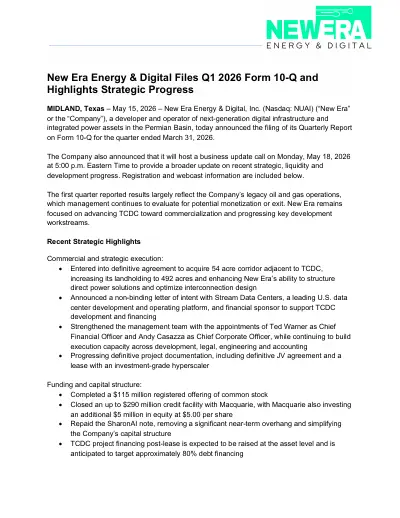
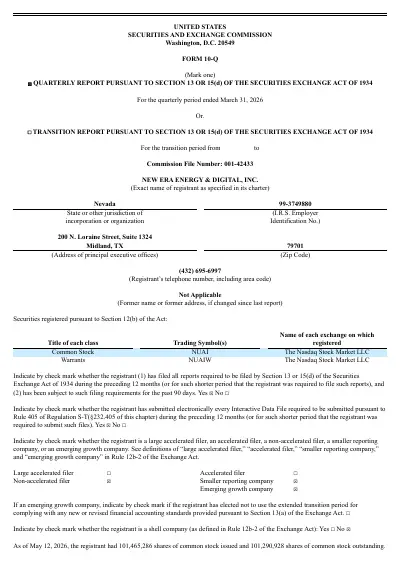
First, I want to thank everyone for participating in NuEra's Q1 earnings call. Because the numbers in the 10-Q still largely reflect the legacy natural gas and helium business, we see our current valuation as being tied directly to our data center project.
Management will use today's call to provide a business update on TCDC, Texas Critical Data Centers, including what we've accomplished since our last update in March, and what we are working on now, and what milestones we expect in the coming months. It is our view that the company has moved essentially from platform formation into a much more execution-focused phase.
We've simplified the structure around TCDC, raised a significant amount of capital, signed an LOI with a new development partner, strengthened the team, and made progress across several work streams that we think are extremely important to getting the project ready for the next stage.
Charlie Nelson
The goal for today is to walk you through that progress in a practical way. I'll start with a high-level picture of exactly what has changed since our last update.
We will then walk through the site, the power plan, and what we mean to talk about when we say Phase 1 readiness. Ted will cover capital structure, liquidity, and how we're thinking about funding our Phase 1.
Then we'll open it up to questions. Good to start it?
Before that, Will?
Will Gray
Yep. Again, hey, I appreciate it, Charlie.
Again, just like Lincoln mentioned previously, before we begin, I'd ask everyone to review the forward-looking statements and disclaimer language in the presentation. Let's go to slide 3, Charlie.
Charlie Nelson
This is where we really get to the core of what we're trying to show today. If you compare where we're at now versus our last update, the picture looks materially different.
Just a few months ago, the market was looking at shared ownership, the Sharon AI note overhang, lien complexity, and uncertainty around near-term funding. That's not the same picture that we have today.
First off, TCDC is now free of the overhang related to the Sharon AI transaction. We've cleaned up that large short-term liability, removing what we believed to be the largest overhang on the stock.
Second, we've brought in stronger institutional counterparties, both on the capital side and on the development and execution side. Third, we have a much cleaner, accessible, and less dilutive funding path ahead of us after raising $120 million in equity and closing on a $290 million credit facility with Macquarie.
We ended April with more than $80 million in cash on hand, which combined with the funding flexibility from the Macquarie facility provides sufficient liquidity to support NuEra's equity contribution for TCDC Phase 1 and beyond. Fourth, while the priority itself hasn't changed, we've wanted to get the lease done for some time, the path to getting there is now far more defined as we have begun working closely with our new development partner on power, permitting, and leasing.
Finally, I'd like to point out that the 54-acre corridor acquisition is another good example of that. We don't look at that as just adding a little bit more land.
It gives us the flexibility around direct power solutions. It helps with interconnection and overall infrastructure design, and it gives us more control over how the site is laid out as we look towards Phase 1 readiness.
For us, that's a practical step forward, and it's not just an acreage headline. It's a very meaningful thing.
In summary, these core changes have put us in a stronger position to obtain the full suite of permits that we need, move our Stream JV to close, advance power-related work streams, and ultimately sign the hyperscaler lease that we're after. Additionally, our financial health coupled with the current helium and hydrocarbon markets leave us in a better position to evaluate strategic alternatives for our legacy business assets.
With that, let me turn it over to Will.
Will Gray
Hey, thanks, Charlie, and that was a great update there. Again, let's look at the leadership team, built to match the execution needs.
Again, this slide's really about reinforcing what the team's about, who we have in place today, and how does that match the phase of the business is how we're entering. I've talked before about Charlie and Ted, but I think it's worth revisiting briefly how the leadership structure fits our story today, especially because this is still a relatively new story for many investors.
For those investors, we very much welcome you and look forward to providing more information. My role continues to be centered around sponsorship of the platform, management of local relationships in Ector County, obviously which is the Permian Basin here in West Texas where I'm born and raised, energy relationships, and helping drive the broader direction of NuEra.
Wouldn't be here without Charlie. Charlie been here since day one when he joined us as an independent board member, then has essentially moved over in the executive capacity in February this past year, leading operations and execution, and that includes the practical work required to move TCDC from concept towards development readiness and ultimately construction.
We believe his midstream and power expertise create a unique advantage for NuEra amongst our peers as it relates to behind-the-meter data center project execution. Again, that's a key here, folks, again behind-the-meter power execution.
I think that's something that we are definitely going to be centering on more towards the future. Ted, who joined us in March, has just been one of our rock stars today.
This is important because this is very much a finance story. I think we all understand the complexity and the need for capital in this market.
His background in capital formation and digital infrastructure financing with many of our peers has already resulted in a complete financial transformation of our company and has essentially positioned us to be able to fully invest alongside Phase 1 and beyond with minimal dilution. It will serve us well in the remainder of 2026 as we work towards transformative announcements that will require deep expertise in financing data center developments.
Finally, we welcome Andy Kazasa. I've known Andy for quite some time and very much pleased that he joined our team.
Definitely the newest addition. He adds depth, corporate integration, governance, and execution experience against the types of counterparties and structures we are now working with.
His expertise as a former energy CFO bolsters our strength in finance and accounting. Please note that we do continue to actively pursue top talent in development, legal, engineering, and accounting, with the focus on adding key executives with hyperscaler backgrounds and relationships.
The point here is not simply that we've added people. That's great, don't get me wrong, but this is the leadership team that's putting the foundation that reflects what the business needs right now: operations, project finance, corporate execution, strategic direction, as we move from formation towards execution.
The next question then is, how do we actually execute from here? That's really what the next slide's about, and Charlie's going to walk us through the partner-based approach while we're taking a shot here at TCDC and why we think it matters from an execution standpoint.
Charlie Nelson
Just so everyone's aligned, slide 6 is where we're at right now, and it really speaks to something that I've talked about before, which is our partner-led model. We've been consistent from the beginning that we are not trying to build every piece of this project internally, and we also don't try to boil the ocean.
The way that we're approaching TCDC is by working with the right specialist partners across key parts of the project, and that covers development, capital, power, engineering, and manufacturing. At the development and operating level, we have Stream Data Centers.
Stream is a leading US data center development and operating platform backed by Apollo, one of the largest alternative asset managers in the world. Stream's been around for a long, long time in this space, legacy operator.
This platform has significant expertise and demonstrated track record of developing, financing, and delivering large-scale data center campuses for hyperscalers across North America. That's why we went with them.
This is extremely important because it means we're not trying to invent the execution model ourselves, and we are not looked at as a first-time developer in the eyes of our potential tenants. This is something we feel helps reduce friction and execution risk just kind of across the board.
We're also pleased to onboard a bunch of new investors and financing partners to help support and grow the platform just across the board, and Ted will cover that in a little bit more detail as he goes through our broader funding strategy. Beyond that, we've assembled additional capital partners around energy storage, behind-the-meter power, design, engineering, and modular manufacturing, which we believe is the future of the data center space.
All of this is important if you want to move a project like this forward efficiently and with less execution risk. For me, the slide isn't just about logos, this isn't what we call a NASCAR slide, just slapped with logos.
It's about how we're executing. This partner-led model is how we intend to move the project forward in a practical way.
With the right counterparties responsible for the different parts of the project, which they know best, we view this as a huge risk-off standpoint. It also helps to explain why a number of these work streams can move together in parallel.
In a more traditional development model, you might finish one step and then move on to the next. Our approach is to advance all of these pieces of the project at the same time.
We call ourselves maestros of an orchestra. What this does is that, once these key commercial milestones are in place, we're not starting from zero on design, power, financing, and site readiness, it all comes together at the same time.
That's why and that's how we're thinking about the execution of TCDC, that's how it's been done in the industries we've been in before, and really that leads kind of into the next slide, which is the project itself, and with that, I'll hand it off to Will.
Will Gray
Yep, thanks, Charlie. Again, this kind of goes near and dear to my heart.
Today, our TCDC remains our flagship execution priority. Today we own 438 acres in Ector County, which is, again, part of the Permian Basin.
Also, please note that we've entered into the definitive agreements to acquire the previously announced additional 54-acre corridor. TCDC sits in the Permian Basin energy corridor.
Again, Midland-Odessa, the heart of the Permian, adjacent to generation assets operated by Vistra and Calpine. Our thesis has been easiest place to build power is where it already exists, and that continues to be one of the key things that makes this asset stand out.
From our perspective, that advantage shows up in a few practical ways. It supports speed to power, it gives us more flexibility around direct power solutions, it helps with interconnection and broader infrastructure design, and it gives us a site with the size and continuity that needs to support phased expansion over time.
Now, the long-term expansion potential towards the 1.4 GW is clearly important, and that remains part of the broader TCDC story. Near term, the focus is much more specific than that.
The focus is Phase 1, and the focus is getting the commercial and development work streams around Phase 1 lined up right away. This slide is really here as a reminder: this is a large, well-located, powered, advantaged site, and the work we're doing now is about putting that site in position to move forward once the key commercial pieces are in place.
Charlie Nelson
Moving on to slide 7 here, this is another slide that many of you have seen before, I'm not going to overexplain it. This is a very important slide though, because it shows how we're thinking about the development pathway here at TCDC.
At a high level, this is a phased, powered development plan. Phase 1 is 200 MW.
Key point here is that our deployment is expected to be supported through adjacent generation. In other words, we're not starting with a traditional grid buildout, waiting on the grid or significant new electrical infrastructure to complete our first step.
That gives us a more practical path to getting this site ready and moving towards initial commercial execution. Phase 2, we're going to put another 450 MW, and that's going to be behind the meter.
That's supported by a physically diverse gas supply across three pipelines, and we have turbines on order for that, as well as receps. A lot's gone into that power plan, and I know we've talked about that ad nauseam.
Phase 3, and the final phase, is the longer-dated expansion towards the complete 1.4 GW, which is what the JV is working towards. This will involve additional behind the meter, bidirectional grid interconnects, and so it's a more complex power step here, but that bidirectional grid interconnection is important because it gives us the ability to put power back on the grid when that makes sense, and it may also support a more streamlined approval path versus a traditional unidirectional interconnect approach.
The big takeaway here is that we're not waiting around in the typical grid queue to get started. The way we're approaching this is by engineering around that constraint.
We're using site control, power relationships, behind-the-meter capabilities, and, frankly, this phased buildout model, which is driven by some pretty logical decision-making here. That's a big part of why we believe this site and this region are differentiated.
When we talk about this Phase 1 readiness, or more narrowly, site readiness, we mean the more practical work that's required to position the site to move into construction and delivery once the core commercial and contractual pieces are in place, as we described before. We don't mean that every downstream step is complete, and I want to be clear about that.
In practical terms, the readiness work including things like civil engineering, site planning, permitting, pipeline removal and reclamation, site clearing, earthworks, etc., etc., all of that is underway and generally making sure that those development tasks are aligned with the parallel commercial, power, and JV work streams. Those are all moving forward.
When we talk about near-term milestones, we're talking about real construction-enabling and development-enabling activities that enable us to reduce friction and move the project closer to execution. I hope that gives everyone a sense of how we're thinking about the site, the phased power strategy, just pretty much what we mean when we talk about Phase 1 readiness.
The next logical question is all around how that gets funded. Obviously, that's incredibly important, and what does that mean for NUAI at the parent level.
With that, I'm going to pass it off to Ted to talk through that.
Ted Warner
Thanks, Charlie. One of the biggest questions we get from investors is how TCDC gets funded and what that means for NUAI at the parent level.
The first point we want to make is the most important one: we are not funding multi-billion-dollar project CapEx at HoldCo. That is not the model.
The model is to raise the vast majority of project capital at the asset level, at the JV level. The way we think about that is a target cap structure of roughly 80% debt and 20% equity with NUAI participating as a sponsor and GP.
In practical terms, that means NUAI contributes what is scarce and strategic, which is site control, development work, local execution, relationships, as well as a maximum co-investment. In return, we retain long-term material equity ownership in the asset.
That matters because investors should not think about this as a story where NUAI has to fund the entirety of Phase 1, 2, and 3 off its own balance sheet. That is simply not how we intend to build this platform.
The second point is that the capital structure around TCDC is materially cleaner than it was before. The $120 million in equity that we've raised, the repayment of the Sharon AI note, and the removal of all those liens all improve the financeability of the asset and our company as a whole.
The Macquarie facility adds an initial project-level funding pathway. Macquarie's additional $5 million equity investment at a premium is, in our view, another meaningful signal of validation around both the asset and the direction of the business from one of the top infrastructure investors in the world.
Third, I want to be very clear on this, we believe we are positioned to fund more than our expected share of Phase 1 development without material near-term dilution. That's an important point because we know dilution is top of mind for our investors, and understandably so with the amount of CapEx we talk about when we talk about building data centers.
The way we think about this is straightforward. Two large transactions we did in April were meant to put us in the position to tell our shareholders and any prospective shareholders that based on our current liquidity position and the funding flexibility available to us, we believe we have a path to fund not only our burn until Phase 1 becomes operational, but also more than our expected share of Phase 1 without being required to raise additional NUAI equity for that purpose.
To make this more tangible, if you assume a 50/50 split in the JV, as one of our covering analysts has, and a project-level capital structure that is 80% debt and 20% equity, then the equity burden that actually lands on NUAI is only a fraction of the total project cost, not the whole thing: 50% of 20%, which is 10% of the total build cost. For illustrative purposes, we assume a 1.5 PUE, like our covering analysts have, and a $13 million per megawatt critical IT CapEx.
We assume all that, and our cash needs for Phase 1 would be roughly $180 million before the credit that we'd get for the land contribution. Now that is exactly why the GP/LP structure matters.
Top-level equity is there to unlock a much larger pool of project capital, not to fund the asset directly. Finally, on liquidity, we ended April with over $80 million of cash on hand.
We view the cash balance as giving us real flexibility to support growth and development while also improving confidence among counterparties that we can meet our obligations as this project advances. Note, we also have access to up to $270 million more from our Macquarie facility available over time upon certain milestones.
Clearly, that theoretical $180 million investment is more than covered for Phase 1. The takeaway is pretty simple, folks.
This is a cleaner structure, better counterparties, a project finance model built around third-party capital, and what we believe is sufficient path to fund our expected share of Phase 1 without additional NUAI equity in the near term. Hopefully, that gives you a clearer sense of how we're thinking about capital, liquidity, and Phase 1 funding.
I'll turn it back over to Charlie to wrap up where we are today and what we think the market should be looking for next.
Charlie Nelson
Thanks, Ted. Just to kind of wrap this up here, this slide kind of ties everything together.
We've highlighted some of the near-term milestones, and we've highlighted the work streams that are top of mind for the team. Firstly, in terms of commercial milestones, our continued focus is the definitive JV with Stream, the hyperscaler lease, and finalizing the power contract.
Secondly, on development milestones, it includes the ongoing pipeline removal and reclamation work, earthworks, site clearing, the industrial district designation, and securing key development permits. Finally, on corporate milestones, we continue to add key people, capability, and this is across all corporate business functions including development, engineering, operations, finance, FP&A, etc., with a focus on talent from hyperscalers.
What we want investors to understand here is that all of these work streams are advancing in parallel. It's not one after the other.
The parallelism is important. We're not trying to do this the old-fashioned sequence where you wait 9 to 12 months to finish lease negotiations, then begin design, then begin power work, and then do the financing.
We're trying to reduce the overall cycle time by moving these work streams together. Obviously, some of them are interdependent, some remain subject to third parties.
That's something that we do our best to control, but from a management perspective, that is the operational philosophy: compress the path to readiness by doing things concurrently. The way I'd summarize all this is pretty simple: the business is moving forward.
We've simplified TCDC structurally, we've brought in strong counterparties, we've improved the funding pathway, we're now through the set of commercial, development, and financial milestones that we believe can move TCDC from a well-formed concept to a financeable, executing project. With that, Operator, we'll open the line for questions.
Operator
Thank you. As a reminder, to ask a question, you will need to press *11 on your telephone.
To remove yourself from the queue, you may press *11 again. Please stand by while we compile the Q&A roster.
Our first question comes from the line of Mike Grondahl of Northland. Please, go ahead, Mike.
Mike Grondahl
Hey, guys. Thank you.
Clearly NUAI is moving towards near-term construction-enabling activities. What permits or hurdles still need to happen for you guys to get there?
Then secondly, is there a way we should think about the sequence of the Stream JV, the PPA, and the lease being finalized?
Charlie Nelson
Yeah, [unclear] Charlie Nelson. Real quick, and then Will, feel free to chime in.
I think like we've mentioned before, the lease remains the key commercial priority. As mentioned here, the work streams are not strictly sequential.
We've got ongoing and have had ongoing permitting work streams, and all of these pathways that have been ongoing. This includes things like an industrial district designation, which has been ongoing for quite some time.
That allows us to essentially almost become a pseudo part of the municipality and access some of the water and sewer and stuff like that there. That's a big piece of it.
There's kind of two other buckets of permits here. We're talking bucket number one, which is to release early grading, and you need stuff like, we've been going through the SWPPP permit, early grading permit, finalizing the exact site plan with our development partner, Stream, and then finally to release vertical construction, you just need that full grading permit, sub-platting and plat plan approved, recorded, building permit and fire protection review.
All these things are well underway. I don't know, Will, you want to chime in anything else on that?
Will Gray
That's a good point, because I think one thing, Mike, this is Will by the way, that we've not really kind of articulated with our investors is where does this property sit? Is it in the county?
Is it within the municipality? Or is it in the buffer zone, which is what they call ETJ.
I think what we need to better help understand is that, listen, this sits in what they call an ETJ, right? An extraterritorial jurisdiction.
Essentially, it's a buffer area, right? We're within a 5-mile radius of the City of Odessa, Texas.
Yet, we're within Ector County. A lot of the constructs we've been working through have been, okay, if we're not going to file an industrial district, as we've warned previously, then we were just going to have to work with the county zoning laws, permitting regulations, which are very very different than the municipality ones, if that makes sense.
With having the new partner on board, obviously wanting the potential to have the access to the municipality services such as water, wastewater, fire, that whatnot, we would have to form the industrial district, which would be basically a way not to be annexed into the city in lieu of a PILOT tax. As Charlie previously mentioned, the kind of pre-plan that we intend on doing, I would think, in June, is the preliminary site plan, because essentially our JV partner, Stream, which has been doing this for 25-plus years, has essentially taken what we've built and just basically tailored it specifically to our intent.
By doing that, now they've kind of taken our ALTA survey, transposed it onto the acreage, so that can be now submitted to the City of Odessa Council, which you go through a minimum of two reviews before approval. Then you can start your grading process.
As Charlie mentioned, the three major ones are site plan, SW3P, and then our early grading permit. Those things, that's our June, July, boom, boom, boom, let's get going.
Charlie Nelson
For what it's worth, just to chime in on that, these are things we're dealing with. Even today had multiple calls on this with the city, etc.
These are ongoing efforts. This isn't something that's well off in a distance that we're sitting here staring down.
These are active multiple times a week going through all of this and locking this all in. These are well underway.
Will Gray
That's a good point. We've had meetings with both, my goodness gracious, the county officials, city officials.
I walk daily still, again, as I tell people near and dear to my heart, I'm out there on the site quite often, with all the reclamation we've done, because again, this used to be an active oil field. We've remediated over 13,000 ft of old flow line.
We have abandoned and reclaimed old pipelines. This has all been done.
Site clearing, there is a lot of activity moving forward. Even though there may not be active permits in place, there are still a lot of activities that are ongoing in order to make certain that this thing can actually be shovel-ready once permits are approved.
Mike Grondahl
Got it.
Will Gray
Then
Mike Grondahl
the sequence of the JV, the PPA, and the lease, any way to think about that?
Charlie Nelson
Just looking at the sequencing, the JV docs are well underway, multiple turns already with the lawyers. The lease as well, as well as the PPA.
All of these are progressing concurrently. They're all interdependent, right?
Could we execute the JV docs and not the lease? Yes.
Can we execute the PPA and not the JV docs? Yes.
Do you need all of them to proceed with the project? Also yes.
All of these are progressing, and multiple turns on legal docs already with all of them. I would think of it as we may execute one before the others, but with that, like the PPA, for example, we will likely execute that before the others.
All of these most likely, and this is how it goes with most of these types of industrial developments, concurrent execution, especially when they're all kind of lining up around the same time, just makes sense, and you just kind of have a signing day, if you will. A very fun day, by the way, for any industrial development.
All of these are progressing fast and logically. So...
Mike Grondahl
Got it.
Charlie Nelson
Yep. Then,
Mike Grondahl
hey, I wanted to ask, too, clearly in the media, there are some counties, cities, municipalities putting bans on data center development, not in my backyard concerns out there. Any of those issues you're seeing in Ector County, Odessa area?
How do you feel about your relationships there?
Will Gray
Mike, this is Will. That's a great question, because obviously we have seen that.
You've seen, I think it's Hill County or one of the counties there. First off, that's illegal in the state of Texas, that moratorium.
I think that's going to be challenged. Listen, I can't speak about what other counties are doing.
I can speak about what Ector County is doing, and they are 100% on board with the development of TCDC. In speaking with Judge Fostet, speaking with city council members, speaking with City Mayor, with the Odessa Development Corporation, we interact weekly, daily with these individuals.
They were even in a major metropolitan area this past week, both county and city officials meeting with a major hyperscaler to promote Ector County. Because I think what they're really focusing on is, listen, we have ample water here through the technology of the desalinization of the oilfield water.
There's ample water here. That's not really a problem.
Not that our data center designs use a lot of water to begin with, and then most of everything out here is going to be behind the meter. We're not seeing the me too things that you see in other metropolitan areas.
Right now, we feel very blessed that our backyard is very power-friendly. We are the Permian Basin.
We power the world. Not just our country, the world.
That's what we're doing here. I don't think [laughter?]
you're going to get much pushback on creating a data center.
Mike Grondahl
Got it. Then one more question, guys.
Last week, Friday, actually, your former partner, Sharon AI, hosted an earnings call, and they kind of called out a signed LOI as it related to TCDC with a hyperscaler back in 2025, almost I would say implying that this hyperscaler walked away, but they never used the term lease. Can you help us connect the dots here on what this LOI Sharon was commenting that it sounds like you guys entered into last year?
Is it the same one NuEra and Stream are sort of working with, or is it something else? Any help there would be appreciated.
Ted Warner
Mike, this is Ted. Am I coming through okay?
Mike Grondahl
Yes.
Ted Warner
Glad you asked that, cuz it is something we wanted to clear up today, cuz I've had a lot of calls on this today, obviously. I can't speak for Sharon directly on why they chose to word the paragraph the way they did, but I can say that I don't blame investors for being confused.
I can also say that you are very astute for pointing out the fact that the word lease was not included in that paragraph, though I do think they seemed to want to imply that somebody walked away from an LOI with a lease. I had to read this thing 100 times today, I know what it is.
The first they said, we signed a non-binding LOI with a hyperscaler. Now that statement right there is the core of the confusion, and I'll say at the least it's disingenuous for a number of reasons.
Now, we put out a press release on July 20th or July 1st of 2025, and related to an LOI, and we didn't say it was with a hyperscaler. Particularly at that time, this group was not considered a hyperscaler, and I don't think they would be today.
Improved, sure, but we didn't call them that then, and we're not calling them that now. It was a non-binding LOI.
That's right. However, I bet everyone on this call, just like a lot of the investors that called me today, assumed that when they heard that statement, that this LOI was for a lease, because in this industry, when you say I have an LOI with a hyperscaler, you're typically referring to a lease.
That LOI was not related to a lease, and it wasn't with a hyperscaler. It was related to a sale, and us hopefully providing some behind-the-meter power, and that's exactly what was written in the press release.
I don't know why that got reclassified the way it did, and I think again leaving out exactly what that LOI was for was confusing to people. Look, that's what that was.
That's what they're referring to. Then it's even more confusing, particularly when the next sentence is, we did a bunch of engineering and design work.
It ties it together, and it makes it seem as though they're referring to a lease. No, that did not happen.
Then the sentence after that was, I believe, let me just find it here, then they said, we then went into exclusivity with the hyperscaler. I think the definitive article there, the hyperscaler.
Now they're referring to the same party that they were mistakenly referring to at the beginning. That is just factually incorrect.
We never announced an exclusivity agreement with a hyperscaler, though they're not incorrect about that. We did sign an exclusivity arrangement with a hyperscaler.
It was not the party that we were planning to sell to with that LOI. After we signed that LOI, and then the stock all of a sudden improved dramatically in the near term, we were ecstatic because that meant we didn't have to sell this piece of land.
It was a great offer on that LOI. I saw the price.
I knew the party. It was a great offer.
We all know the real value comes from owning the data center and owning the dirt and owning the NOI attached to contracts with IG tenants. We wanted to move in that direction.
We were also getting offers to buy this from actual hyperscalers, and one of those we did. We signed an exclusivity agreement because we kept turning them down on selling, and we wanted to work with them on how can we partner with you to own something here?
Essentially it was, you got to work with a really reputable developer. We went and tried to find one, and that exact same party, as we've said before, sort of led us to a different party, and now here we are with that party, Stream.
They've been incredible to work with, just every day checking boxes. It's been awesome to watch them work.
This same party, that hyperscaler, is still the person that we hope will be our tenant, that our designs are specifically for. That paragraph that everyone read and heard from that call on Friday, again, you hit the nail on the head.
It seemed to be very negative implications that a single hyperscaler had signed an LOI on a lease and then walked, and that was why they walked away. None of that has happened.
I don't know why they walked. We have a different business model than them.
We want to own dirt and infrastructure and NOI, and with IG tenants, they're doing cloud computing, I don't know why they left. Again, I understand why they could want to make the street think that leaving this deal was a good idea.
Obviously we're very happy that we have all of it now. I hope that clears it up for you, Mike.
Will Gray
I think, I don't know about you, Charlie, but I certainly would pay $70 million for something I think is worth about $3 to $5 billion.
Charlie Nelson
So... I don't know what it'll be worth in the end, but...
For us,
Will Gray
yeah.
Ted Warner
Obviously if we can own a material portion of this whole project, it's going to be worth a lot more than what that initial LOI was in July, which we're very happy we were never forced to go through with that deal. Again, that is different from the exclusivity arrangement, and neither of them were related to a lease, and no one has walked away from anything.
Hope that that's helpful, Mike.
Mike Grondahl
All right. Hey, that is, guys, and best of luck over the summer.
Thank you.
Operator
Thank you. Our next question comes from the line of Derrick Whitfield of Texas Capital.
Your line is open, Derrick.
Derrick Whitfield
Thank you. Good afternoon, all, and thanks for your time.
Maybe a bigger-picture question for you guys. Regarding your project schedule on slide 15 of the PowerPoint, I think you have previously discussed initiating Phase 1 construction by the end of 2Q and first power by year-end 2027.
Where does that likely stand now, and how much cushion do you have in your schedule to meet your year-end 2027 objective?
Will Gray
I would say, just talking about the schedule, look, our schedule is largely driven by power availability. The power that we have available in Phases 1 and 2 is in second half of '27.
Everything that we're doing is kind of backsolving from those dates. For what it's worth, everything is on track right now.
The inclusion of Stream as an execution partner into the deal significantly enables us to accelerate those schedules. Everything from having preapproved designs with this particular hyperscaler, and which is why we were guided into the relationship with them frankly, to the fact that they house long-lead-time equipment that goes towards these projects, and it's a rinse-and-repeat design.
All of this and look, it boils down to GC availability, just construction crew availability, all of those things. That's everything that when you talk about working through the permits, we're talking about everything concurrently is being worked through on those as well.
We still feel good about the second half of '27 in-service date for the first phases of this.
Derrick Whitfield
Great. Maybe just with regard to your commercial discussions, how are you guys thinking about the potential to earn fit-out payments based on the progression of your discussions?
Will Gray
Sorry, can you say that one part again, to earn what payments?
Derrick Whitfield
Fit-out payments, technical fit-out payments, based on the progression of your discussions.
Will Gray
Oh, I don't think that we've factored in technical fit-out payments. Ted, do you want to chime in on that?
Ted Warner
I can't comment publicly on where we are on that front. On that level of negotiation is definitely more of Stream's work at this point.
As we transitioned over to them, we had to restart on a lot of things. Now we're back to being where we were, with an excellent development party who has an excellent relationship with our prospective lease counterparty.
They're far more knee-deep in that than we are at the moment. It's a good question.
I'm hopeful we can have an update on how things are progressing on that front in the near term. Like Charlie said, I think all things are going to be progressing together, and I'd love to be able to tell people that when the lease is closed and how far we are the JV docs and all that stuff.
Look, we tried to short-circuit the traditional timeline by working with a known developer who has an existing relationship and plenty of hyperscalers, they have designs and they have commercial agreements with them. That is the most important thing.
We're really letting them spearhead that front. I don't know those details.
Derrick Whitfield
Perfect. Maybe just one more, kind of thinking about really the progress that you guys have accomplished over the last 6 to 9 months, and I understand really for now the focus is really on executing on Phase 1 and Phase 2.
As you guys have had such great progress, how have tenant discussions gone even beyond kind of this first tenant that we're speaking to now? Have you guys seen a considerable inbound increase in interest just based on everything that's been announced so recently?
Will Gray
It's been interesting. Derrick, this is Will, that regarding the inbound, is it really about behind the meter and what we've discussed.
I think that's where Charlie and I were a bit ahead of our time. Trying to better understand how do you create an islanded data center?
We've had some great discussions thus far around that. Obviously, we want to get this notch on our belt first and foremost, and then go out and execute on Sites 2, 3, 4, etc., etc.
There has been extreme amount of interest, and Charlie, you may want to expound on that as well.
Charlie Nelson
From the tenant side, as this has moved, clearly, we have gotten outreach from other prospective tenants as well. Again, we are really, really happy with our development partner.
We are really, really happy with our current prospective end tenant, and we want to work with them, and we're in exclusivity with them to get this thing done, all finished as fast as possible. We are just head down working with these parties.
There's definitely been interest in inbounds that we can't entertain. At this point, we're really happy about that cuz we're excited by the progress we're making.
Derrick Whitfield
Great update. Thanks.
I'll hop back in queue.
Will Gray
Yep. All right.
Thanks a lot, Derrick.
Operator
Thank you. I would now like to turn the conference back to management for closing remarks.
Will Gray
Appreciate that. Again, listen, as we finish out today, like to leave everyone with a few final thoughts.
We recognize the recent trading activity and share price volatility has been challenging. We understand that, and we do not take shareholder support lightly.
You guys have been faithful, supportive. 99% of you, there's maybe a few that have said some things, but we still like you guys.
Again, from our perspective, however, listen, our focus is still on execution. Over the past several months, we've taken extremely important steps to strengthen the foundation of the business, simplifying the structure around TCDC, improving our liquidity position, aligning with strong institutional counterparties, and obviously advancing the key commercial, development, and financing work streams.
We've done all this in parallel, and we've done all this on a tight, shoestring budget. It's been pretty impressive to today.
Our conviction and opportunity remains unchanged. We're barreling down the path to believe that TCDC is completely differentiated opportunity given its unique location within the Permian, obviously the power advantages, development pathway, and I think more specifically the long-term scalability.
Again, listen, significant work ahead. The number one priority is to execute methodically against the milestones that we've mentioned today and to move the project forward.
Again, just from the bottom of our heart, we just appreciate the continued support. As a shareholder, I sit here with you, and I wish I could announce who the prospective tenant is, and I can't wait to announce it one day.
We've been working very, very hard to get there, and we continue to do so. Just again, we continue everyone's patience and understanding, and we will continue to communicate as much as we possibly can.
Just thank you again for joining us today. I know summer is about to kick off, we wish everyone a great summer.
Thank you very much.
Operator
Thank you. This concludes today's conference call.
Thank you for participating. You may now disconnect.