New Era Energy & Digital, Inc.
NNASDAQ:NUAIQ2 FY2026 · Earnings Call TranscriptAugust 17, 2026
Operator
Good day, and thank you for standing by. Welcome to the New Era second quarter 2026 earnings conference call.
At this time, all participants are in listen-only mode. After the speakers' presentation, there'll be a question-and-answer session.
To ask a question during the session, you will need to press star 1 1 on your telephone. You will then hear an automated message advising your hand is raised.
To withdraw your question, please press star 1 1 again. Please be advised that today's conference is being recorded.
I would now like to hand the conference over to your first speaker today, Lincoln Tan, Investor Relations for New Era. Please go ahead.
Lincoln Tan
Thank you, operator, and good afternoon. My name is Lincoln Tan, Investor Relations for New Era.
Thank you for joining New Era's second quarter business update call. Joining me today are Charlie Nelson, Chairman and CEO; Ted Warner, President and CFO; José Rodriguez, COO; and Evan Pierce, Chief Development Officer.
Before we begin, I'd like to remind everyone that today's call is being recorded and will be available on the Investor Relations section of our website. Please note that during the course of this call, we may make forward-looking statements.
These statements reflect our current views and expectations and are subject to risks and uncertainties that could cause actual results to differ materially from those expressed or implied. Please refer to slide two of the accompanying presentation and our SEC filings, including our Form 10-Q filed on Friday for more information.
With that, I'll now turn the call over to Charlie Nelson.
Charlie Nelson
Thanks, Lincoln. Thanks, everyone, for making the time.
I want to start with the headline because I think it's a simple one this quarter. Our focus has been on the parts of this project where the outcome sits with us rather than with a counterparty.
That means permitting, land, and site works. This quarter, we delivered on them.
We now have our construction permits in hand, and we believe that that meaningfully reduces the development risk at the site. We expect to begin site grading in the coming weeks.
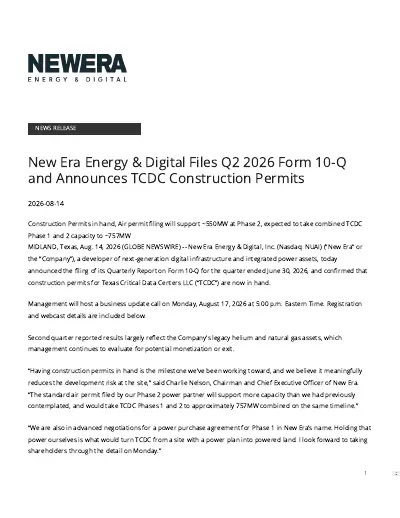
Our Phase 2 power partner has also filed a standard air permit supporting approximately 550 megawatts. This takes TCDC Phases 1 and 2 together to roughly 757 megawatts of gross capacity.
On the commercial side, end-tenant negotiations and the joint venture with Stream continue to advance, along with Phase 1 power arrangements. The one I would highlight today is power.
In early July, we were given the opportunity to step in and negotiate a PPA in our own name, and we are currently finalizing that PPA after a period of negotiation. On the balance sheet, we finished the quarter with $84.8 million of cash, and we have a $270 million undrawn in the Macquarie facility.
This more than covers our expected TCDC Phase 1 equity contribution, and Ted can cover this more in detail later. Then there's the team, which I want to spend a minute on because I think it's the one thing that's changed the most about this company in the last quarter.
When you look at this page, what I'd ask you to notice isn't the number of names, it's where they've come from. First, we have José Rodriguez, our Chief Operating Officer, who has run data center engineering and critical environment operations at Microsoft, AWS, and TikTok.
Earlier in his career, he led engineering teams across gas turbine and nuclear power at GE and TVA. He's built and operated the kind of facility that we're building.
Then we have Evan Pierce, who joined as Chief Development Officer in June. 20 years in hyperscale data centers and energy infrastructure, most recently running site and energy development for the Americas at EdgeConneX.
He also comes from AWS and TikTok as well. He's helped us plan and deliver more than 5 gigawatts of capacity.
We've got Michael Johnson, who joined at the same time as Evan, and he joined as General Counsel and Chief Compliance Officer. He's got 30 years of legal and commercial work under his belt, and it's in this asset class.
Most recently, he was at CoreWeave, and before that Switch, covering leasing, power/land acquisition, and construction contracting. Ted Warner, you know.
Ted took on the expanded role of President and Chief Financial Officer in June and recently joined our board. We've got Darren Novell, who's our Chief Accounting Officer, and Andy Casazza as our Chief Corporate Officer.
Finally, Will Gray, who founded this business, as and took it from an idea to a listed company and is now the President of the Permian, where his relationships with landowners, operators, and the local community here are invaluable. Beyond our C-suite hires, we've also expanded capability across management.
That includes the additions of James Sheppard, our VP of Site Selection, and Morgan O'Connor, our VP of Construction. James joins us from HDR, a global engineering firm in the data center space, and Morgan joins us from AWS, where she was the Senior Manager of Construction.
A project like TCDC is won or lost on execution. It needed people who have done it before.
6 months ago, we were a company with a very good site. Today, we're a company with a very good site and a team that's built this before.
I'll say plainly, it's a privilege to lead them. Turning to the next page, I want to address the Texas backdrop entirely.
Governor Abbott has recently issued a directive calling for stronger oversight of data center development in Texas. More transparency on power and water requirements, on infrastructure costs, on ownership, and on community impact.
The principle behind this is that large-scale development should bring additional energy to Texas rather than push costs and burden onto Texans. We put out a release this week supporting it.
I'd like to make the point plainly: we're not supporting this because we've been asked to. TCDC and our entire business was designed this way from the start.
On power, our strategy is built around dedicated generation, including behind the meter. We are not competing for constrained grid capacity.
We're supplementing Texas power, not drawing it away from anyone. On water, the design prioritizes closed-loop liquid cooling and reclaimed water, and we're evaluating independent and wastewater solutions to keep produced water in productive use.
In the Permian, that matters. On community, we've got jobs, training, local programs, and community impact programs, and Evan can cover this more in detail.
On transparency, we're committed to engaging openly as the state's process move forwards. We think clearer and higher standards are good for the industry and, frankly, good for us because we're already building to them.
Finally, one related point: Phases 1 and 2 are islanded and behind the meter, they are not dependent on ERCOT Batch Zero processes. The broader point here is that behind-the-meter designs answer the concerns behind the Governor's directive structurally rather than through mitigation.
That was a design choice made long before this directive, and it is increasingly what large customers are looking at. With that, I'll hand it over to Jose to take you through the power positions across Phase 1 and 2.
José Rodriguez
Thanks, Charlie. Our flagship TCDC site is situated on 492 acres of owned land outside of Odessa in Ector County.
That puts us in the middle of the Permian Basin energy corridor. We sit adjacent to generation assets operated by Vistra and Calpine, with access to existing energy, water, and fiber infrastructure.
We have a phased development plan that scales towards 1.4 gigawatts over time. The important word there is phased.
We are not trying to build 1.4 gigawatts at once, and we're not funding it that way either. Power is the constraint of this industry right now.
Let me be specific about how we structure ours across Phases 1 and 2. Phase 1 is 207 megawatts.
Power comes from existing generation adjacent to the campus, islanded and behind-the-meter gas. What that means practically: no ERCOT interconnection required and no air permit required for Phase 1 because there is no on-site generation.
We are not standing in an interconnection queue for power. That is the single biggest reason we can move on the timeline we're talking about.
What has changed this quarter is that we're working on finalizing the Phase 1 PPA in New Era's own name. Structuring in our name provides a direct path to power land and further de-risks the project.
Phase 2 adds approximately 550 megawatts, up from the 450 megawatts previously contemplated. The increase reflects different generation equipment and more effective emission controls, which lowers emissions per megawatt and allow more capacity within the same emission ceiling.
That's behind-the-meter gas again, this time on the TCDC site with physically diverse gas supplies across three pipelines. We have partnered with Thunderhead Energy Solutions to deliver this power solution, and a subsidiary of Thunderhead has filed for the standard air permit applications with the TCEQ.
Turbines are on order through TurbineX. Taken together, that's approximately 757 megawatts of gross capacity across Phases 1 and 2, against the roughly 650 megawatts previously contemplated.
The campus remains master planned to scale towards 1.4 gigawatts over time. With that, I'll hand over to Evan to take you through what actually moved on the ground this quarter.
Evan Pierce
Thanks, Jose. Starting with permitting, this has been a core focus for the team this quarter.
We are pleased to confirm the receipt of two key permits from Ector County: the development structure permit and the drive approach permit. The Phase 1 plat has also been submitted to both Ector County and the city of Odessa, and we have now received approval of the notice of intent to TCEQ to commence grading.
We are looking forward to crews being on-site in the coming weeks to begin erosion control and site grading. Touching briefly on the land and title, we flagged the 54-acre corridor acquisition at our previous update, and we are pleased to report that that has now successfully closed.
That corridor matters more than the acreage suggests because it's what lets us structure power directly and optimize the site layout. This takes us to 492 acres, which is all the land we need for the planned development now secured.
We note that Phase 1 and Phase 2 will require less than half of our current acreage. On the air permit, the only thing I'd like to add to Jose's point is timing.
Because our application has followed the standard Texas state guidelines, we expect an expedited review process. In our experience, this has typically involved a 1 to 2 month review process as opposed to an 18-month timeline for major source review.
Moving to the operator surface waivers, we've been progressing this in the background, and we are now awaiting the final surface waiver from a single leasehold operator. Finally, pipeline removal: we've removed 22 abandoned pipes across 12 rights-of-ways, clearing legacy oilfield infrastructure across the site.
We continue to progress further removals with the operators. To summarize, these are the work streams that sit with us rather than a counterparty, and we've made solid progress: land secured, site development permits in hand, key documentation filed, and moving towards the beginning of construction.
Now we have to push through it. The people running this have built this at this scale before, we're not figuring it out as we go.
It's heads down from here. Turning to the next page, I want to spend a moment on the community because I know it is in the front of the mind of many of our investors.
There are counties and municipalities across the country putting moratoriums on data center development, and the fair question is whether we're exposed to that here. First, I'd like to start with where we're located.
Ector County is an energy-producing county. This is a working industrial region.
We are not dropping our campus in a residential suburb. I would like to personally thank Ector County, including the Ector County judge and commissioners, for being such great partners in this project.
If not for their guidance and support, this project would not be possible. Then there's the design approach we are taking.
Most of the opposition you read about data centers rely on two key issues: one, residential concern about their power bills; and two, residential concerns about their water. Our power is dedicated and behind the meter, we are supplementing Texas power rather than competing for grid capacity, and we are not putting pressure on residential rates.
Our cooling is closed loop and prioritizes reclaimed water. Once the initial system is charged, water losses to ongoing evaporation are minimal.
We are also evaluating independent and wastewater solutions to keep produced water in productive use. Are we seeing organized opposition?
Not really. We're getting questions rather than opposition, and they're mostly people wanting to understand exactly what's being built.
We'd much rather answer those questions early than late, and that's why the engagement here is done in person by our senior team rather than delegated out. That means the mayor, the county judge, the Rotary Club, and local business owners.
If you're asking a community to trust a project size, turning up yourself is the least you can do. Our approach to develop in TCDC is with the community, not around it.
On the economic opportunity, this project is expected to create jobs and training opportunities through construction and operation. We're using local procurement and local companies.
Once complete, TCDC will be a meaningful contributor to the local tax base. That's what any development of this scale should deliver.
Taken alone, I don't think that earns you an enduring place in the community. We've also committed to supporting broader community initiatives.
These include library programs in Odessa and funding after-school childcare for working families. Those serve people irrespective of whether they work for us or not.
As we've said publicly, we intend to be part of the community and not just an investor in it. I'll now hand over to Ted to talk through the commercialization pathway and our approach to funding.
Ted Warner
Thanks, Evan. Tying it all together, we are pushing forward on four parallel work streams to commercialize TCDC and progress towards construction commencement.
Power, as we spoke about earlier, underpins any data center development, and we are working towards finalizing the PPA in our own name. Permitting, as Evan covered, is progressing to plan, and significant progress has been made this quarter.
On the joint venture with Stream, we're continuing to finalize definitive documentation. This encompasses the development, financing, and ongoing operation of the campus.
Finally, on the leasing work stream, recent events have highlighted the strategic value of behind-the-meter assets such as TCDC, and we continue to have constructive engagement with potential end tenants. I want to walk through the funding structure carefully because it continues to be an area where we receive a lot of questions, understandable given the capital intensity of data center developments.
Let's start with liquidity. At June 30, we had $84.8 million of cash, cash equivalents, and restricted cash.
This is actually an increase from our last reported number despite our burn and significant CapEx at TCDC. This is mainly due to the exercise of a significant amount of cash pay $2 struck warrants during Q2.
Then the Macquarie facility: it's an up to $290 million project facility with a three-year maturity, and it's staged. Term Loan A1, $20 million, is drawn.
That was at our close on April 7. Term Loan A2, $30 million, is available pre-lease at Macquarie's discretion.
Term Loan A3, $40 million, and the $200 million delayed draw both sit behind conditions precedent, the main one being a final lease making those two chunks of capital available. That's $270 million remaining undrawn on that facility.
Two things I'd stress about the facility: it's not balance sheet cash, and it is not an obligation to draw. We see this as the right structure for a project at this stage where tranches unlock as we hit milestones.
It gives us maximum flexibility if we have needs for immediate capital, especially post-lease. Moving on to what funds what: parent-level liquidity funds operating costs and early development, and together with Macquarie facility, it more than covers our expected TCDC Phase 1 equity contribution.
Our current cash position covers multiple years of burn at our current rate. Project capital, the larger number, gets raised at the asset level after lease execution, targeting roughly 80% debt, which will be funded at the JV level.
We are not funding multibillion-dollar CapEx at parent level. Beyond that, we continue to develop non-dilutive funding paths.
We have strong relationships with leading credit funds that could support both pre- and post-lease development, power contracts, land, and long lead time procurement. There are also equipment finance options where lending is secured against hard assets like electrical and data center infrastructure.
The last point I'd make about discipline and capital allocation: we've assembled a strong team that is clearly capable of growing New Era beyond just a single site, and the pipeline of opportunities in front of us keeps building given their networks. However, our default position is to stay focused on TCDC and be disciplined with our capital until key milestones there are executed.
If something genuinely compelling came to us and it could be structured so it wouldn't materially compete with TCDC for our near-term capital, of course we would do the work and look hard at it. To us, an accretive deal on top of TCDC would be defined as something that would require an immaterial amount of cash in the near term and would result in NOI far sooner than TCDC, likely from smaller inference sites, which we want to be a big part of our future growth profile.
The point here is the bar is high, and right now the team remains firmly in TCDC execution mode. With that, let's open the lines for some Q&A.
Operator
Thank you. At this time, we'll conduct a question-and-answer session.
As a reminder, to ask a question, you'll need to press star 1 1 on your telephone and wait for your name to be announced. To withdraw your question, please press star 1 1 again.
Please stand by while we compile the Q&A roster. Our first question comes from the line of Mike Randall of Northland.
Your line is now open.
Mike Randall
Hey, thanks, guys. Congratulations on all the progress.
Busy summer, obviously. Can you talk a little bit about the process to get the PPA and kind of the likelihood you can get it and give us some sense for timing?
Charlie Nelson
We can talk about the process there. Basically it just comes down to contracting and so, as far as the progress there, the contracts are materially drafted, things agreed to, and then it's just coming down to approvals at this point.
Obviously it's sensitive commercial undertaking right now. Can't exactly tell you all the details on that.
PPA is a contract like anything else. We've just been going through the contracting process.
Ted Warner
Mike, we've been working on that for a long time and it's substantially in its final form, in our opinion. We feel like we're in a good place there.
Mike Randall
Great. Okay.
Given that you guys own the land, you're in this process of getting that PPA as well, it feels like you're going to have some leverage in negotiations. Has there been other tenants or development partners that have shown interest in the site?
Or is it still just kind of that original IG hyperscaler?
Ted Warner
They're still there. We've had interest from pretty much every potential major tenant you could want.
Especially with the recent announcement from the Governor's office. Our site has become even more attractive due to the fact that we pretty much already meet all of those standards.
That's been great. The PPA in our name is a great thing for leverage, but honestly our plan is still to try to move forward with the guys that we've been rowing this boat with for the last 4 months.
Mike Randall
Got it. Then I think lastly, you guys called out in the press release that the 757 megawatts gross in Phase 1 and 2 align with Governor Abbott's data center directive, and the project is designed to move forward unimpeded by ERCOT Batch Zero delays.
Can you just clarify that to help us understand kind of why that is and the strategic value of TCDC's power strategy?
Charlie Nelson
Yeah. Plain and simple, that directive was aimed at new parasitic load being requested from the grid, which in the state of Texas is referred to as the Batch Zero process.
We are not exposed to the Batch Zero process. Ours is either existing power that's in a pun or new power that we are building.
Therefore, it's just not exposed to the Batch Zero process whatsoever. The reason why they're doing these audits, etc., is to kind of untangle that process and ensure that the data centers that are being built, especially if they're requesting parasitic load that would otherwise go to everyday Texans, etc., is being used responsibly.
Again, this has been built into the plan, built into the DNA. It's something that we've been planning on since the onset of this.
That is why.
Ted Warner
The other half of that, Mike, is water, right? Water is the other concern there.
What we've done here is we've built and permitted a data center site in the heart of the Permian Basin where we have ample opportunity to, as Evan said earlier in his remarks, to keep produced water there in the basin, not ejecting it downhole and using it to have a data center that really doesn't add to any water needs in the basin.
Mike Randall
Got it. Okay.
Hey, thanks, guys.
Charlie Nelson
Thank you.
Operator
Thank you. One moment for our next question.
Our next question comes from the line of Nick Giles of B. Riley Securities.
Your line is now open.
Nick Giles
Thanks, operator. Hey, good afternoon, guys.
I think Mike asked the right questions there initially, but just wanted to clarify. From what you know today, should we still think about initial timing at Phase 1 in kind of the 4Q '27 time
Ted Warner
frame? That's definitely still what we're shooting for.
I don't know if you'd care to comment on there, but that's part of the value here is the power will be available, and now that we have permits in hand, we think if everyone is rowing the boat in the right direction together, that that's definitely still achievable to get that Phase 1 in and have it be 2027 power. That's everybody's goal.
Nick Giles
Understood. That is helpful.
And Go ahead, Charlie.
Charlie Nelson
No, no. Agreed with that.
Yep.
Nick Giles
Great. Okay.
Maybe just back on Phase 1, given that you have some of those permits in hand, it sounds like some dirt can be moved in the near term. Are there any long lead time items you might need to make deposits on, or any sense for how much capital you'd be willing to spend on kind of pre-lease development?
Charlie Nelson
In terms of the quantum of capital for pre-lease development, obviously we've been spending dollars on pre-lease development, preparing the site, doing pipeline removal, remediation on the site. In terms of the quantum of capital that we'd be willing to spend, I don't think we have a firm dollar figure where we limit it to.
We're going to be responsible with our topco cash. That's our primary mode of responsibility there.
To the extent that there are items that come up that can significantly reduce time to delivery to RFS, we will do that. Again, it's very subjective when we make those decisions.
For the most part, just how this development is going to roll out, there is an upper bound just naturally in what you do before you go full final investment decision on the asset.
Ted Warner
I think the fact that we're working with Stream and with their connections and what they actually have on hand, the Thunderhead partnership that we have, the long lead time items that they have already procured, that makes it a whole lot easier. We don't foresee any major CapEx items on our front prior to a lease related to long lead time stuff.
It's more about making sure that the site gets ready and it's moving in the right direction to meet the timeline.
Nick Giles
Got it. Thanks for that.
Maybe one more if I could. Just given that the commercial nature of Phase 1 is kind of expanded, can you just speak to kind of what design options from a data center perspective are on the table?
Are you mostly considering ground-up type builds, or would you explore maybe modular options? What are you comfortable with?
José Rodriguez
Yes, thank you for that question, Nick. For the first phase, working with our partners, we're looking at a stick-build approach initially.
However, we're also considering modular data center options that we're working with different suppliers to deploy that offer a pretty aggressive RFS timeline, better than stick build. We are not closing any options, and we'll do whatever gets us closer to capacity delivery on the site.
Nick Giles
Got it. Okay.
That's helpful. Guys, nice work on the progress.
I'll turn it over, but thanks for the update.
Operator
Thank you. One moment for our next question.
Our next question comes from the line of Derrick Whitfield of Texas Capital. Your line is now open.
Derrick Whitfield
Good afternoon, all, and congrats on the team that you've assembled.
Charlie Nelson
Thank you.
Derrick Whitfield
I wanted to start with the bigger picture at TCDC. As highlighted by Governor Abbott's press release today, you guys are the model citizen for bring your own generation.
Kind of thinking beyond his endorsement, I wanted to ask more broadly your views on how this may play out for competing projects that are subject to Batch Zero and data center reviews, and what it means likely for the level of competition you'd expect for capacity at TCDC.
Charlie Nelson
I'd say, just right off the bat there, there is a high level of uncertainty both in terms of are people going to get power, the recipients of that are still up in the air for Batch Zero, and then, furthermore, what the timing of that is. The process has taken some turns and had some adjustments.
I would say just in terms of the competitiveness, one thing is definitively clear that we have a very firm grasp on what we have. Everything just comes down to timing of resources for end users and tenants.
If that's uncertainty, it definitely throws some questions around other sites. In terms of the competitiveness, those that get Batch Zero power, there's going to be an absolute green light on those.
For us, we're feeling pretty confident in our position right now because of this.
Derrick Whitfield
Great. As my follow-up, I wanted to focus on the opportunity beyond TCDC.
We've heard from several in the industry that lease rates have materially increased over the last 6 months. With the benefit of your entire team being in place, could you speak to where you'd like to take the business beyond TCDC?
Charlie Nelson
I think we've spoken pretty openly about this, but really we see two main opportunities, and we've kind of assembled a team to tackle them accordingly. As you've heard with the team introductions and what we've brought on, we're building a team for growth.
This isn't just to build TCDC, this is to build beyond. The two opportunity sets really lie in inference and then rinse and repeat on these large-scale sites.
What do I mean by inference? That's 100 megawatt and below, opportunistically, a little bit bigger than that.
Those are kind of rinse and repeat modular sites. Then on the larger-scale stuff, obviously those are greenfield developments kind of like what TCDC is.
We like the blueprint that we've established here with TCDC. The plan going forward is to kind of just rinse and repeat those.
That's why we built the team to do just that. We view the market for inference to be a very strong one though.
Derrick Whitfield
Terrific. Maybe just one last, if I could.
In your decision to expand Phase 2 capacity, could you speak to what led to that decision to go from 450 to 550 and how we should be thinking about expansion potential beyond Phase 2 based on this revised generation equipment, if you guys choose to use that for Phase 3?
Charlie Nelson
It really just came down to what we were able to get under a standard air permit with the equipment packages. Really it just came down to what we can permit.
Because above that, we go to a PSD permit, which is typically an 18-month cycle, those have been delivered quicker now in recent months. Standard air permit is a very straightforward process.
It really just came down to some revisions on our ability to put a little bit more under a standard air permit.
Derrick Whitfield
Terrific. Great update, and again congrats on the team that you guys have assembled.
Charlie Nelson
Thank you.
Operator
Thank you. One moment for our next question.
Our next question comes from the line of Nick Giles of B. Riley Securities.
Your line is now open.
Nick Giles
Hey, thanks for taking my follow-up. I think earlier you mentioned there's one more surface waiver pending, and I was hoping you could just give us a sense for what timing could look like there and ultimately what having that solved for does for the site.
Charlie Nelson
Sorry, you cut out there for a second. Could you repeat the question?
Ted Warner
Charlie, he was asking about, I think, in the PR on Friday, that we have one more signature on the surface lease waiver side, only one remaining, and what we thought timing was of that.
Charlie Nelson
It should be pretty soon. Everyone's pretty much agreed in principle on it.
It should be relatively soon.
Ted Warner
Verbal sign-off on that is great. We don't really dive into that, how unique and unique in a good way our situation is compared to a lot of people trying to develop data centers in the heart of the Permian Basin, you need to find a site where you don't expect to have any pads or roads drilled.
You're in the right part of a section, and, even if you own the land, if you're sitting on top of minerals that haven't been developed yet, you need to make sure that those mineral owners are going to be able to have access to those minerals regardless if you own the land on top of them or not. Fortunately for us, we got two operators that have leased this acreage, and they've all but drilled up in Wine Rack basically all the productive formations, outside a couple more permits, I think, two or three, I can't remember the exact number, but those pads are going to be nowhere near our site.
They can get drilled, and we've got 40-plus years worth of production out of those wells. It makes it really easy for us to get insurance related to that, whereas a lot of people who come into West Texas on sites that really don't have a ton of development on them yet, or they're in a part of the section where a bunch of pads and roads need to be put in for the mineral owners to get their minerals, and that has derailed a lot of projects in the heart of the Permian Basin.
Again, we feel really fortunate with this site for many reasons, and that's one of them. Just one more signature remaining from an operator, and we're good to go.
Nick Giles
Great. No, thanks for that background, Ted.
Then one more that just came to mind, if I can. When we think about exploring other kind of smaller-scale data center projects, just to clarify, these would be kind of New Era independent opportunities, or would this be something that Stream might be interested in pursuing as well?
Charlie Nelson
Look, we think of them as New Era opportunities. Obviously Stream has been a wonderful partner here at TCDC, and to the extent that we can work together in the future where it makes sense, why not?
Our team is built for everything from development all the way through execution and operations at this point in time. The idea being that carving our own path forward on future sites is the likely outcome.
Nick Giles
Got it. Okay.
Thanks again, guys.
Operator
Thank you. Again, as a reminder, to ask a question, you'll need to press star 1 1 on your telephone.
I'm showing no further questions at this time. I would now like to turn it back to Charlie Nelson for closing remarks.
Charlie Nelson
All right. First off, thanks everyone for the questions, and thank you for making time on this afternoon.
I'm going to close where I started on this. Our focus this quarter was on the parts of TCDC that sit with us and de-risking.
That's all this is. This is a giant function of de-risking.
The construction permits are now in hand. The land is obviously secured.
The team, a fantastic team, is built. On the commercial side, we're working hard across the end-tenant negotiations and with the Stream JV, with the Phase 1 PPA.
Look, we appreciate your support. The team is always available here if you need to follow up.
Again, thank you for your time and appreciate you.
Operator
Thank you for your participation in today's conference. This does conclude the program.
You may now disconnect.