Vital Infrastructure Property Trust
Q3 FY2026 · Earnings Call TranscriptNovember 12, 2026
Operator
Welcome to Vital Infrastructure Property Trust Third Quarter 2026 Earnings Conference Call. At this time, all lines are in listen-only mode.
Following the presentation, we will conduct a question-and-answer session. If at any time during this call you require immediate assistance, please press star zero for the operator.
This call is being recorded today, November 12, 2026. I would now like to turn the conference over to Steven Hong, Vice President of Investor Relations.
Steven Hong
Thank you, operator. Good morning, everyone, and thanks for participating in our third quarter results conference call.
This is Steven Hong speaking. Joining me are Zach Vaughan, CEO; Stephanie Karamarkovic, CFO; Mike Brady, President; Tracey Wigle, COO; and Dave Casimiro, EVP.
Earnings announcement was released yesterday evening, and we posted an updated investor relations presentation on our website and which listeners can refer to during the call. Following comments, we will be glad to take questions from analysts.
Today's discussion includes forward-looking statements. As always, we want to caution you that such statements are based on management's assumptions and beliefs.
These forward-looking statements are subject to uncertainties and other factors that could cause actual results to differ materially from such statements. Please see our public filings on SEDAR+, including our MD&A and annual information form, for a discussion of these risk factors.
During this call, we'll also reference certain non-GAAP financial measures. A reconciliation to the most directly comparable IFRS measure is provided in our MD&A and earnings release.
Unless otherwise noted, all amounts discussed today are in Canadian dollars. With that, I will now hand it over to our CEO, Zach Vaughan.
Zach Vaughan
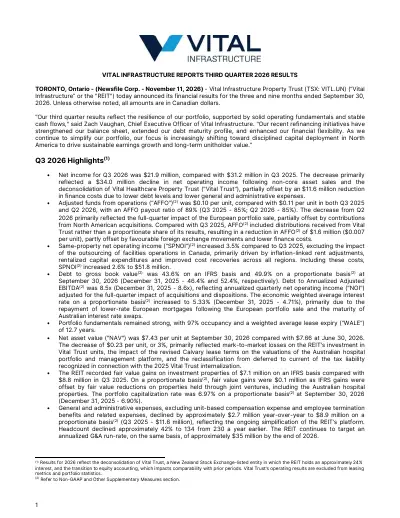
Thanks, Steven, and thank you, everyone, for joining us today. Starting with our quarterly results, we're pleased with how the portfolio performed this quarter.
Same-property NOI grew by 3.5%, excluding a step-up in costs relating to facilities outsourcing. Portfolio occupancy ended the quarter at 97%.
We generated AFFO of $0.10 per unit and ended the quarter with over $350 million of liquidity. Our debt currently sits at 50% of book value and 8.5 times EBITDA, well within our target ranges.
Beyond the financial results that Stephanie is going to detail shortly, we executed several key initiatives across our balance sheet, our property portfolio, our cost structure, and our app and and our capital allocation strategy. Starting with our balance sheet and capital structure.
In August, we established a new $500 million unsecured credit facility, replacing our previous secured facility. Following quarter end, we also completed a $300 million unsecured debenture offering at a coupon of 4.86%, using a portion of the proceeds to redeem our outstanding 6.25% Series H convertible debentures.
I'm very pleased with this execution. We achieved a credit spread more than 100 basis points tighter than our inaugural bond offering last year and attracted significant new institutional investors to our debt register.
A clear reflection of our progress and improved credit profile. Together, these transactions diversify our funding sources, extend our debt maturities, and strengthen our financial flexibility.
Turning to our property portfolio. A critical milestone this quarter was the resolution of the Healthscope situation in Australia.
As previously announced, Healthscope's creditors approved the sale of the of its remaining hospital operations, and and Calvary Health Care is expected to become our new tenant across 12 properties across all of our 12 properties. Key components of this transaction include rent incentives over the first 48 months of the lease, an extended lease term that brings the portfolio WALE to approximately 18 years, enhanced annual rent indexation, and a future rent review mechanism tied to profit tied to property-level profitability.
This arrangement provides long-term certainty and brings in a top-tier operator with an integrated healthcare business that includes retirement living, home care, and residential aged care, all of which are going to further support the performance and profitability of our hospitals. The broader fundamentals in the Australian hospital sector also continue to improve.
Currently, the hospital benefit ratio, which is the proportion of private insurance premiums paid back to hospital operators, sits at about 86%, which is still below the pre-pandemic average of 90%. As this ratio continues to normalize upward, operator margins are going to improve, which is going to allow us to participate in that upside through our future rent review.
On to our cost structure. Our efforts to streamline the business continue to flow through to the bottom line.
Stephanie is going to walk through the specifics, but we remain on track to achieve our targeted annualized G&A run rate by year end. With a more focused operating platform, we can now scale and support new investments with minimal incremental overhead, creating meaningful operating leverage and driving longer-term earnings growth for unitholders as we reposition our portfolio.
That brings me to capital allocation, where we continue to redeploy capital into attractive investments across North America. During the quarter, we completed approximately $170 million of acquisitions across three properties in in in in Brooklyn, New York; Burlington, Ontario; and Edmonton, Alberta.
As previously guided, we remain on track to complete about $250 million of acquisitions by the end of the year. Our acquisition pipeline continues to build across both Canada and the US, and we're well positioned to deploy capital at compelling returns.
Recent volatility in the bond markets is creating opportunities as certain owners face pressure to either refinance at higher rates or sell. Increasingly, we are seeing sellers place a premium on execution certainty rather than basing their decisions on price alone.
Our ready access to debt capital and asset recycling proceeds, combined with a favorable transaction environment, positions us well to capitalize on these opportunities as we reorient the portfolio. Now, before concluding, I want to address Brazil.
Following the surprise election results, Brazilian equity and currency markets experienced a significant pullback, and our unit price was not immune. However, it's important to look at the fundamentals.
Our Brazilian assets are 100% leased under long-term, triple-net, uncapped inflation-linked contracts. Our primary tenant, Rede D'Or, continues to deliver strong operation operational performance both within our properties and at the corporate level.
Now, a critical gauge of the caliber and sustainability of triple-net lease real estate is rent cover, or what the US peers often refer to as four-wall coverage, which measures the EBITDAR generated within a specific property or portfolio of properties against the rent paid. The higher this number is, the greater tenant's is is a tenant's ability to meet its existing lease obligations and absorb future rent increases.
For context, Realty Income, the largest US net-lease REIT with over 15,000 properties, whose credit is A-rated, and who has a market cap exceeding the entire Canadian REIT index, typically cites four-wall coverage in the 2.5 to 3 times range. Across our Brazilian portfolio, our four-wall coverage sits at approximately 7 times.
Given that exceptional unit-level profitability and the fact that nothing in the recent election alters the structural demand for private healthcare in Brazil, we have high conviction in the dura- in the durability of our properties and the creditworthiness of our tenant. The credit markets agree.
Post-election, bond spreads for Rede D'Or debt have not moved and are, in fact, down by 20 basis points year-over-year. While Stephanie is going to touch on near-term foreign exchange impacts, the underlying operating fundamentals and profitability at our Brazilian assets remains exceptionally strong.
To summarize, I want to leave you with four key takeaways. First, our portfolio is performing well, and the Healthscope resolution has removed significant uncertainty.
Second, we have enhanced our financial flexibility through highly successful financings, while our simplification efforts continue to drive down G&A. Third, we continue to find attractive acquisitions across North America, supported by a growing pipeline and an increasingly favorable pricing environment.
Fourth, despite recent market volatility in Brazil, the fundamental impact on our business is minimal, and our portfolio continues to deliver strong performance, backed by exceptional rent coverage. With that, I'll turn the call over to Stephanie.
Stephanie Karamarkovic
Thanks, Zach, and good morning, everyone. We've made good progress on our strategic initiatives this quarter, supported by stable operating performance.
I will review our third quarter results, cost reductions, and NAV movements, followed by an update on our balance sheet, liquidity, and recent financing activities before we move to Q&A. Starting with our third quarter operating results.
Our portfolio continued to deliver stable operating performance, support- supported by contractual rent growth and the strong fundamentals of our healthcare real estate assets. Same-property NOI on a proportionate basis increased by 3.5% year-over-year, excluding the impact of the transition to outsourced facilities operations in Canada.
Growth was driven by contractual rent increases, rentalized capital expenditures, improved cost recovery, and higher parking income. Including these transition costs, same-property NOI increased 2.6% year-over-year to $51.8 million.
Moving to earnings. Reported FFO was $0.10 per unit or $0.11 excluding accelerated amortization of deferred financing costs.
On this adjusted basis, FFO was consistent with the prior period. AFFO was $0.10 per unit, compared with $0.11 in both the second quarter and the same period last year.
The modest decline from Q2 primarily reflects the timing of capital redeployment. We fully redeployed the European sale proceeds into North American acquisitions by quarter end, but because these investments closed during the quarter, they did not fully offset the earnings from the disposition.
In addition, the related G&A savings are still being realized and will reflect will benefit future quarters. Year-over-year AFFO reflects an approximately $1.6 million reduction from the deconsolidation of Vital Trust, and this was partially offset by North American acquisitions, lower financing costs, favorable foreign exchange, and G&A savings.
Our AFFO payout ratio was 89%, as compared to 85% last year. Moving to our cost structure.
Proportionate G&A, excluding unit-based compensation and employee termination-related costs, declined to $8.9 million. This compares with $11.6 million in Q3 last year and $10 million in Q2, reductions of approximately 24% year-over-year and 12% quarter-over-quarter.
These results reflect restructuring and efficiencies achieved over the past year. We remain on track to achieve our targeted annualized G&A run rate of approximately $35 million by the end of 2026.
Turning to NAV and recent valuation adjustments. Our NAV per unit was $7.43, compared with $7.66 at the end of Q2.
The decline reflects three principal items. Firstly, fair value adjustments from the revised Calvary lease terms, which was a $7.5 million reduction at our share of the Australian hospital properties, and a $19 million reduction in our management platform valuation, together reducing NAV by approximately $27 million.
Secondly, mark-to-market adjustments in our Vital Trust investment, and lastly, the reclassification of certain tax liabilities tied tied to the Vital Trust internalization from current from deferred to current. These impacts were partially offset by operating earnings and favorable foreign exchange movements.
As Zach noted, the Brazilian real has been volatile following the recent election. While the appreciation of the real earlier this year provided a favorable foreign exchange benefit to our reported FFO, AFFO, and NAV when translated into Canadian dollars, the currency has since moderated and is now trading at approximately the same level it was at the beginning of 2026.
We will continue to monitor the developments in Brazil as part of our normal quarterly valuation process. Moving to our balance sheet and leverage.
Debt to gross book value was 49.9% on a proportionate basis, compared with approximately 52% at the end of 2025. Debt to annualized adjusted EBITDA was 8.5 times, within our 8 to 9 times target range.
As outlined in our non-GAAP disclosures, this measure annualizes quarterly adjusted EBITDA and adjusts for acquisition and disposition activity that occurred during the quarter. Given our level of capital recycling, we believe it is a more representative view of our of our leverage based on our portfolio at quarter end.
Turning to liquidity and debt maturities. We ended the quarter with approximately $357 million of available liquidity on a proportionate basis.
That's comprised of $297 million of undrawn borrowing capacity and $60 million of cash. As Zach noted, we also completed several important financings during and after the quarter.
In August, we established our new $500 million unsecured credit facility, replacing our secured facility and extending the maturity to August 2031. Importantly, the transition to an unsecured facility was supported by our growing pool of unencumbered assets, which reached approximately $2.1 billion at quarter end, up from $1.2 billion at the end of 2025.
In October, we completed a $300 million Series C senior unsecured debenture offering at a coupon of 4.865%, maturing in October 2029. We subsequently used a portion of the proceeds to redeem all outstanding 6.25% Series H convertible debentures, eliminating our August '27 maturity and lowering financing costs, which will benefit our results starting in the fourth quarter.
In Australia, we refinanced approximately A$715 million of joint venture debt, representing approximately CAD 210 million at our share, extending the maturity from December '26 to December '28. Together, these financing transactions have addressed significant near-term maturities, diversified our funding sources, and improved our financial flexibility.
Our economic weighted average interest rate was 5.33%, as compared with 4.71% at the end of 2025. This increase reflects the repayment of lower-cost European mortgages last quarter, higher floating-rate higher floating rates in Australia, and changes in our overall debt mix.
With approximately 72% of proportionate debt at fixed rates, including hedges, and an improved maturity profile, we do not anticipate material refinancing headwinds over the next 12 to 24 months. Finally, on capital deployment.
We deployed approximately $170 million of North or completed approximately $170 million of North American acquisitions in the quarter, funded through capital recycling and available liquidity. We have also received TSX approval for the renewal of our normal course issuer bid, or NCIB, allowing us to repurchase approximately 22 million trust units and $8.5 million principal amount of our Series I convertible debentures over the next 12 months.
Any repurchases will be evaluated alongside other capital allocation priorities, considering market conditions, relative value, and available liquidity. In closing, this quarter demonstrated the resilience of our portfolio and the real progress on our priorities.
We have strengthened the balance sheet, redeployed capital to North America, and moved closer to our G&A target. Our earnings still reflect the transitional impacts of dispositions and redeployment, but we believe these initiatives position us well for the next phase of our strategy.
With that, I'll turn it back to the operator to open the line for Q&A.
Operator
Thank you. We will now begin the question-and-answer session.
If you have dialed in and would like to ask a question, please press star one on your telephone keypad to raise your hand and join the queue. If you would like to withdraw your question, simply press star one again.
If you are called upon to ask your question and are listening via loudspeaker on your device, please pick up your handset and ensure that your phone is not on mute when asking your question. Your first question comes from the line of Himanshu Gupta with Scotiabank.
Your line is now open.
Himanshu Gupta
Thank you and good morning.
Zach Vaughan
I have a couple of
Himanshu Gupta
I have a couple of Brazil questions. First on the currency exposure, we saw some volatility.
Is there a way to hedge the currency exposure here? Have you guys looked into that?
Stephanie Karamarkovic
We've definitely have looked into it, Himanshu. The problem is is it's it's quite punitive to try to hedge the Brazilian real through kind of any kind of derivatives.
Therefore, what we try to do is just have local debt to the extent it makes sense from an interest rate perspective. We're not able to, in an economic way, hedge the currency otherwise.
Himanshu Gupta
Got it. Okay.
Zach, obviously with the new government in place, any stated policy changes with respect to healthcare, or which could impact your tenant in, favorable or unfavorable way?
Zach Vaughan
Yeah. No, nothing that they've stated that would have any impact on on our tenant, which is primarily private healthcare.
It is it it is a public and private system. In fact, if you look at everything from broader credit spreads to some of the noise recently now coming out of what will be the new administration, it it it feels pretty positive.
They're they're, talking about spending limits, spending controls. Changes in tax policy.
That's for the broader market and economy. For our tenant, we continue to see very positive results.
Their their insurance division alone added almost 75,000 members last quarter. They they seem to be firing on all cylinders and just continuing to get better.
There's nothing out there that would im- impact that. We think the impact primarily, on our units was just pure exposure to Brazil, which is probably unwarranted given the actual cash flows that we're generating there.
Himanshu Gupta
Got it. Then given that you have rental indexation linked to inflation in Brazil, has there been any change in inflation expectations post the government change?
Zach Vaughan
I I think there's been some expectations that it it it may be slightly higher. If if if you re- recall, Himanshu, interest rates were had were on a downward path there.
I think that sort of halted as kind of, just general global economic issues surfaced. I think now people are anticipating, when they were anticipating rate cuts, they're not they're sort of anticipating flat flat interest rates for the next while, not a cut in the near term.
Some of the forecasts have slightly higher inflation, sort of high fours, right?
Stephanie Karamarkovic
That's
Zach Vaughan
it.
Himanshu Gupta
Got it. Just the last question on Brazil here.
What does this mean in terms of your plan to exit the country, exit the exposure? Does it push us out further?
Anything you're hearing on investment activity, which could slow down, or probably stay put, or anything on that motion? I
Zach Vaughan
Look, I I think how how we've always looked at Brazil is given some of the characteristics I talked about, these are just incredible assets with an incredible tenant, and they're just so incredibly profitable. They are true triple-net lease with a lot of term.
Our our feeling was in terms of capital recycling, this was one that it was never in our kind of 12-month-ish plan. It was sort of towards the back end to try and figure it out.
I don't think it it changes our view because we hadn't anticipated doing anything with Brazil in the near term, as compared with Europe, New Zealand, etc. I I would say it it has not changed our our plans.
Himanshu Gupta
Got it. Thank you so much, and I'll turn it back.
Zach Vaughan
Thanks.
Operator
Your next question comes from the line of Jonathan Kelcher with TD Cowen. Your line is now open.
Jonathan Kelcher
Thanks. Good morning.
Just just one more on on Brazil. Is there an opportunity to put more debt on that portfolio to sort of, I guess, kind of increase the hedge?
Stephanie Karamarkovic
At the moment, interest rates are in that 13%, 14% range in Brazil. Local debt is is probably out of the question for us.
I think the the short answer is no.
Jonathan Kelcher
Okay. Then Zach, you talked about the the pipeline growing, I guess, largely because of volatility in in global rates.
Does that imp- is that sort of a double-edged sword for you, kind of impacting what you can sell as well?
Zach Vaughan
I think it I I think where we're seeing it's interesting, I I think it would if we were selling in North America to buy in North America, in in in essence. I do feel like given kind of the more levered nature, particularly of the US markets and and kind of how the debt markets work, and that a lot of assets there are hel- it's just a big universe of assets that are held by limited life vehicles, we're probably seeing the impact of that more quickly relative to say Europe, New Zealand, Australia, etc.
It's it's it's It's obviously it's somewhat of a double-edged sword, but given where we're trying to place the capital, we're definitely seeing yields react more quickly in in those markets than than others. I I I guess the answer is I I'm probably more bullish on the fact that I think yields are yields are widening, and I think you'll see that in the coming quarters on on some of our acquisitions.
Most importantly, the the property levered buyers are increasingly struggling in this market, whereas, nine months ago, a year ago, there was a lot of competition from them.
Jonathan Kelcher
That's that's that's helpful. Then just on with Healthscope settled, how do you think about timing for for exiting that investment?
Zach Vaughan
I think now that it's And now I I'd say settled in that it's we have a firm contract. At some point, either by the end of this year or next year, they're going to step into the role of start operating these hospitals.
I do think that we're going to need some period of time to just see how those run, which we think will be positive. I think, in terms of anyone's going to want to look at it and go, "All right.
I want to see a bit more of kind of how how this is working out with with the new tenant." We we've never really contemplated exiting Australia in the very near term.
Our our near-term focus is really Europe, New Zealand. I I think in the in the relatively near term, that's where we'll be focused.
I just think Australia, the the the new tenant has to season a bit.
Jonathan Kelcher
Okay. It'd be like end of '27 be into '28 before you kind of look at that?
That fair way to think about it?
Zach Vaughan
I think so.
Jonathan Kelcher
Thanks. I'll I'll turn it back.
Operator
Your next question comes from the line of Sairam Srinivas with ATB Cormark Capital Markets. Your line is now open.
Sairam Srinivas
Thank you, operator. Good morning, everybody.
Zach Vaughan
Zach, Stephanie, just one question from me on Brazil, and I will keep it at that. That's basically, keeping in mind the cadence of $0.10, $0.11 of FFO on a quarter-to-quarter basis, does that change, or the impact of it flowing to Q4 in terms of what you saw on the real and the translation risk?
Stephanie Karamarkovic
Yeah. What what we've said is that about a 5% depreciation in the in the real is about $0.01.
That that could be impacted. It didn't really change until midway through the quarter, it's probably not a full-quarter impact of that.
There could be some movement in the quarter based on where the the rates end up on average throughout the quarter.
Sairam Srinivas
Just to clarify, that's $0.01 on an annualized basis, correct?
Stephanie Karamarkovic
Yes.
Sairam Srinivas
Okay. All right.
That's that's great. Okay.
Switching gears then probably to Europe. I know, Zach, you probably referred to it already, but we've spoken about Europe and dispositions in Q4 being something where you could probably dispose more and probably exit Europe.
Is that something still in the cards, or is it more of a mid, like Q1, Q2 activity next year?
Zach Vaughan
I think so we sorry, we we really have two investments left in Brazil. We we have sorry, not in Brazil, in Europe.
We have a a portfolio of triple-net lease clinics in Germany and and we have an asset outside of Rotterdam. The the clinic as- assets are are probably closer to liquidation.
I think that's probably We We've generally assumed it's kind of a Q2 type of thing by the time it's it's it's it's all said and done. Having done a lot of stuff in Europe in my career, it just takes time there.
Ev- Every transaction just takes longer. That's what I would anticipate.
Then we're substantially exited from Europe. Then the following asset, I'd assume maybe six to nine months after that.
Sairam Srinivas
That's that's that's great, Zach. Maybe just looking at the Vital unit scene sorry, in in Australia, obviously, the, the units have come down a bit.
Does that change your view in terms of the timing of the dispositions there?
Stephanie Karamarkovic
No, I don't think so. Slight movements in the unit price aren't that material to us on a on net proceeds basis if we're able to redeploy that at higher rates.
I think what, how we're thinking about those are those are are fairly easy to exit, and so those are are probably our first source of of capital should we have stuff to deploy it into. We'll be opportunistic.
If if we're needing capital for redeployment, that is a that is an easy easier source of of liquidity. I
Sairam Srinivas
I think
Stephanie Karamarkovic
it will probably stop, yeah.
Sairam Srinivas
Sorry, I guess so is it probably fair to think that it's more of a acquisition and deployment opportunity dependent in terms of when you could exit those and reinvest?
Stephanie Karamarkovic
I think so, unless there's something opportunistic that,
Zach Vaughan
that that I think it I I guess how we look at it is it's something that's mark-to-market every quarter here, and it it's a ready source of liquidity when when when we want it. We'd probably That's one that, unlike exiting Europe or doing something with Brazil or Australia, those are tougher to match fund.
This is slightly easier in that sense.
Sairam Srinivas
That's fair. Stephanie, remind me, is there any term loan that's secured by these units anymore?
Stephanie Karamarkovic
Yes, we do have some debt there. It's about $70 million Canadian.
Sairam Srinivas
All right. Fair enough.
Thanks, guys. I'll turn it back.
Zach Vaughan
Thanks.
Operator
Again, if you would like to ask a question, press star one on your telephone keypad. Your next question comes from the line of Giuliano Thornhill with National Bank.
Your line is now open.
Giuliano Thornhill
Hey, guys. Good morning, everyone.
Just one on Brazil, sorry, but I got to ask about it. The the cap rate that you guys have in your in your quarterly report, the 8.9%, I'm going to assume that does not has not been adjusted to reflect the recent moves.
I guess I guess my question is how how do you come up with that 8.9%? Like what kind of rate or inflation outlook does that is that based off of, and and what would kind of be the impact from from the recent election to that?
Stephanie Karamarkovic
When we look at our our cap rates, we kind of look at them relative to the what the bond yields are doing there. I think what we looked at at the beginning of the year is we're pretty much back to where we were when we look at rates today, bond yields today versus the year.
We didn't move them as bond yields were moving over the course of the year, and we're kind of back to to back where we were. We do have kind of look at the spread on our cap rates relative to to bond yields.
Zach Vaughan
I think if, Giuliano, if you look at it, the implied cap rate sort of reflects a discount rate that is 8.5-ish percent. Which was definitely wide of where the NTN bonds was before, pre-election, so that never really got adjusted.
Then and now we're I mean essentially we own an an asset-backed inflation-linked bond. The NTNs have come down.
They're sort of 7.80-ish now. We're definitely wide of that.
Giuliano Thornhill
Just
Zach Vaughan
Again, we'll we'll we'll we'll we'll be revisiting it
Stephanie Karamarkovic
Yeah, as a Q4.
Zach Vaughan
as part of the Q4.
Giuliano Thornhill
Okay. It's Yeah, just just the combination of the inflation and and bond yield expectations really, so that's what we should be basing it off of.
Zach Vaughan
Yeah.
Giuliano Thornhill
Okay. I guess the the other question I had was, as you kind of unwind this portfolio through Brazil or Australia or the the units, is there any like NAV risk here from a tax perspective?
I noticed the the Vital deconsolidation and the management contract buyout, that that led to a little bit of NAV leakage. I'm just wondering if that risk relates to anywhere else in the portfolio.
Stephanie Karamarkovic
I think I think what we said is that there are, inherent tax leakage as we exit these things depending on how things are structured. Vital units, no, there's no leakage there anticipated from a tax perspective.
I think when you think about exiting full regions, there there is bound to be some. Kind of in that 15% range, I think, is probably safe to assume depending on how how it ultimately gets structured with the with the buyer, but there definitely is there will be further movements.
Giuliano Thornhill
Okay.
Stephanie Karamarkovic
Then It's been baked into IFRS NAV, yeah. Right.
Giuliano Thornhill
Right. Then just my last one, just on the the G&A run rate.
You guys have done a good job bringing it down over the balance of the year. I'm just wondering if Q3 is is a good run rate for for going forward.
Obviously, you're tracking kind of, pretty much at your next year target, I'm wondering if there's any more room for that, or if there's going to be, some normalization?
Stephanie Karamarkovic
What's like We saw that the the real benefit this quarter because, again, the team that was supporting the portfolio in Europe fully left with the portfolio and and so that was a big impact of the G&A savings that we saw this quarter. The other things that we have left to realize are are probably going to be less material and probably will trickle in over some in the Q in Q4, but maybe even into next year, because they're things like, licenses that we had bought that kind of have to see out the end of their their life, or audit fee, like those types of professional fees and whatnot that kind of have full-year impact, but then probably won't reset until we renew next year.
I think in the in the fourth quarter, you could see a little bit more reduction, but it's going to be very much more modest than what we saw this quarter.
Giuliano Thornhill
Okay. Thanks, Stephanie.
I'll turn it back.
Operator
Your next question comes from the line of Pammi Bir with RBC Capital Markets. Your line is now open.
Pammi Bir
Thanks. Good morning.
Just just given the commentary around the acquisition opportunities and the pull back in the units here, of course, what are your thoughts with respect to maybe getting more active on the NCIB versus I guess balancing that with, keeping some dry powder for for acquisitions?
Zach Vaughan
Yeah. Look, I think you used the right word, balance.
It it is Look, I'd say they do compete, right? To the extent like I I think when when you see something happen to your units that's a reaction to a macro factor that really doesn't have an overly material impact on on the sustainability of your business, obviously, you start to look at that.
We did renew it. We were active.
We we were trying to be as active as we could on on the Series H converts. We can do the I's, and now we can do the equity.
I'd say, look, it's it's it's competing with new acquisitions. I think what we are seeing, though, Pammi, is people that that need to sell in the current market, particularly in the US, we're we're we're definitely seeing a much more favorable environment.
We just want to be conscious of that and our leverage metrics, that if we're going to lever lever up slightly for a period, we we we also want to keep that in mind. I guess what I'm saying is we're we're being flexible and and we're we're trying to have every lever available.
It's certainly something that's going to compete.
Pammi Bir
Okay. Just maybe on on that last comment with respect to the US, how much has maybe pricing moved relative to or even I guess maybe the opportunity set, but how much do you think it's it's it's increased in terms of where valuations are or cap rates relative to, let's say, maybe, 6, 9 months ago?
Zach Vaughan
Yeah. I would say in the US, probably even though bonds are up, I don't know, what, 100 basis points in rates, it's it's I'd say you you could probably say on average the the the statistics would tell you it's sort of a it always lags, Pammi, and so it's probably like 50 basis points or so.
That being said, the levered buyers that had started to enter the market in in a bigger way with institutional levered capital, private equity capital, in in in in this type of environment are just struggling, that it, again, if you're trying to generate a certain levered total return, you have to generate a certain amoun- amount from net levered cash flow, and it's harder in this environment today. We do have an advantage given that we're recycling out of lower-yielding stuff and and we don't need property-level financing.
I guess I'd say on we're sort of when we were looking at initially when we were first talking about redeploying in the US, I think we were sort of thinking in the sort of low- to mid-6s range. I I I'm I'm targeting 100 basis points wide of that today.
Pammi Bir
Got it. No, that's that's helpful.
Last one for me and just coming back to Brazil for for a second here. With the rates Stephanie that you quoted in that 13% to 14% range versus, where you have it on the books, I guess just is it fair to say that at this point, an exit of that portfolio is just likely not going to happen until there unless there were a sort of a material reduction in where rates are, or and this is maybe a more of a multiyear outlook?
Zach Vaughan
I guess, Pammi, I'd sort of look at it a a little differently versus kind of the Selic rate, which is the sort of, over what ECB tells the short-term rate, which is right now sitting at, under 13.5%-ish or sorry, 13.75%. I'd sort of look at Like what we really own is an inflation asset-backed, inflation-linked bond in Brazil, and those inflation-linked bonds started the year at 7.5%, they dipped to sort of 6.8%, now they're back to 7.8%, but like our yield today is is still pretty wide of that.
That being said, we never really anticipated we'd probably exit in the very near term, and but I'm not sure, given the caliber of the assets, that this has materially changed anything we're thinking about it, because it's not like we were saying we're going to exit in the next six months. If that were the case, we'd probably hold off a bit.
I think we're
Pammi Bir
we're
Zach Vaughan
pretty comfortable right now.
Pammi Bir
Okay. Thanks for that that clarification.
I'll turn it back.
Operator
Your next question comes from the line of Giuliano Thornhill with National Bank. Your line is now open.
Giuliano Thornhill
Hey, just had one follow-up. On the same-property for North America, was there anything one-time related to recoveries, or driving that quarter-over-quarter increase higher?
Tracey Whittall
No. I think, there was a little bit of lease-up, and I think parking is starting to impact our our numbers fairly materially.
That's just because we're, been more focused on parking operations, we've put in a new parking operator and equipment, and are starting to see the benefits of that. Like, costs are coming down, revenues are are slightly up.
I think that that will well that trend will continue.
Zach Vaughan
Maybe I'd just add, Giuliano, in North America in general, that when I started, it was pretty glaring where the Canadian portfolio sat. I think it's a reflection of when you end up in periods where you have to hold back on capital.
Sometimes that happens, leasing capital and and and other capital. We have made an effort in the past year to reinvest in in that space, in in in our space, in our leasing, in our marketing, and we're starting to see that come through.
I think in terms of same-store growth, particularly in North America, most of our US stuff is longer-term fixed, but in in Canada in in in particular, I I I think you could see that. Tracey, do you want to give a few, comments on that?
Tracey Whittall
Sure. I think just what Zach referred to in terms of our renewed focus and efforts to drive performance in the Canadian portfolio, after a period of time where we've been diverting capital to other preservation needs, we have started to invest again, both in the team and in the portfolio itself in the assets.
What we're starting to see is those efforts coming to fruition, as activity across the portfolio has increased over the last quarter. We're seeing future commitments achieved and early renewals coming through with some of our strategic tenants, such as Albany Clinic in Toronto where we secured a early extension of 15 years pushing us out, to the 49,000 square feet with them.
Those are the types of things we're now starting to see come into the portfolio, and and is what we'll start to see in our results as we move forward.
Giuliano Thornhill
The the renewal expectations for that segment are still mid-single digit digits or so?
Zach Vaughan
Yeah. I I'd say you're sorry, you're talking about renewal spreads?
Giuliano Thornhill
Yeah. Like is it case by case, or?
Look
Zach Vaughan
I think So I'd sort of split it between Canada and the US, in that what we see in Canada is is is is a very stable, high renewal environment. In fact, a lot of our tenants have just fixed 3% increases.
We recover our capital. Plus, a lot of tenants have just auto-renewals.
Although you look at our lease term, a lot of tenants just automatically renew for five years and rents just keep growing by 3%. I I do think that the the bigger spread opportunity could well be in some of the US multi-tenant assets.
Dave, I don't know, you want to
Dave Casimiro
Sure. Sure, happy to to touch on that.
To your point, when we see the multi-tenant outpatient buildings in the US, given that there's a consistency on the reimbursements from state to state, we do see near-end or closer-term expiry that opportunity to hit those higher rent spreads on a mark-to-market basis.
Zach Vaughan
I think I I I think you're seeing that in some of the US publics that that sort of focus on outpatient. It's one of the reasons we're pretty excited about it because it has been an area that where, with with some knowledge of the sector and some active and some proactive leasing, I I I think you can do quite well over time in in in in that space.
Giuliano Thornhill
Okay. Thank you, everyone.
I'll turn it back.
Zach Vaughan
Thanks.
Operator
That concludes the question-and-answer session. I will now turn the call back over to Mr.
Steven Hong for closing remarks.
Steven Hong
We appreciate your time attending our Q3 conference call. Please feel free to reach out to me directly at at at [email protected].
Have a wonderful day. Thank you.
Operator
Ladies and gentlemen, that concludes today's call. Thank you all for joining.
You may now disconnect.