Porch Group, Inc.
Q3 FY2026 · Earnings Call TranscriptOctober 28, 2026
John Campbell
Good afternoon and thank you for participating in Porch Group's third quarter 2026 conference call. Earlier today we issued our earnings release and filed our related Form 8-K with the SEC.
The earnings release and today's presentation are available on our Investor Relations website at ir.porchgroup.com. Before we begin, I'd like to review the company's safe harbor statement within the meaning of the Private Securities Litigation Reform Act of 1995, which provides important cautions regarding forward-looking statements.
Today's discussions, including responses to your questions, reflect management's views as of today, October 28th, 2026. We undertake no obligation to update or revise these remarks.
We will make forward-looking statements that involve risks and uncertainties, and actual results may differ materially. Please refer to the information on this slide and our SEC filings for additional detail.
We will also reference certain non-GAAP financial measures. Reconciliations to the most directly comparable GAAP measures are included in today's earnings release, available at ir.porchgroup.com.
A replay of this webcast will also be available after this call on our Investor Relations site. Joining me here today are Matt Ehrlichman, Porch's CEO, Chairman and Founder; Shawn Tabak, Porch's CFO; and Matthew Neagle, Porch's COO.
With that, I'll turn the call over to Matt for his key updates.
Matt Ehrlichman
Thanks, John. Good afternoon, everyone.
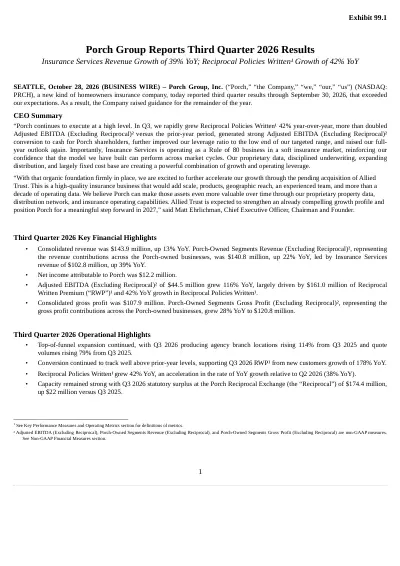
Q3 was another strong quarter for Porch, and we are proud of the team's execution. Reciprocal policies written grew 42% year-over-year, adjusted EBITDA excluding the Reciprocal more than doubled, and Insurance Services delivered its sixth consecutive Rule of 80 quarter, combining 39% revenue growth and 49% adjusted EBITDA margin.
These results drove another healthy raise to our full-year outlook. In my view, the key takeaway is that our organic growth system is working well.
We have significant capacity at the Reciprocal, an expanding distribution funnel, rapid new customer growth, and disciplined underwriting. As that volume moves through our largely fixed Porch cost structure, it generates higher earnings, strong cash flow, and an improving financial profile.
Our performance allows us to complement organic growth selectively through M&A. We recently announced the pending acquisition of Allied Trust, a high-quality regional insurance company, which is expected to add scale, products, geographies, talent, and more than a decade of claims data.
I'll turn to Allied shortly, but first, let's review our strong third-quarter results. All right, a few highlights: Reciprocal written premium, or RWP, was $161 million, up 17% year-over-year.
Reciprocal policies written of 68,000 grew 42% year-over-year, which accelerated from Q2's 38% growth rate. As a reminder, we generate some of our Insurance Services revenue based on premium and some based on the number of policies.
RWP flowed through to Insurance Services adjusted EBITDA at a 31% conversion rate, reflecting continued operating leverage in Insurance Services. At the company-wide level, adjusted EBITDA excluding the Reciprocal was 28% of RWP.
The strengthening earnings power is clear to see in the year-over-year comparison with adjusted EBITDA excluding the Reciprocal of $44 million, more than doubling from the prior-year period. Taken together, the quarter provides another clear proof point that the model is working.
The framework for scaling Insurance Services remains straightforward. The Reciprocal statutory surplus provides capacity, agencies and quote volume creates opportunities, conversion turns those opportunities into policies and premium, our proprietary data and underwriting discipline help determine which risks we want to win and at what price, producing leading loss ratios and more margin in the system.
Let's look at total policy growth and then each component that builds to that result. You can see here in Q3, total Reciprocal policies written across new and renewal grew 42% year-over-year to 68,000.
The rate of growth accelerated from Q2, and we expect policy growth to remain strong in Q4. The expansion of the customer base is the purest indicator of our growth and momentum.
Supporting continued growth begins with maintaining a strong capital position at the Reciprocal, which we measure primarily through statutory surplus as well as non-admitted assets. Since the launch of the Reciprocal, statutory surplus has increased by almost $75 million, ending Q3 at $174 million.
This is up $22 million from the prior-year period and higher sequentially for the sixth consecutive quarter. The expanding surplus demonstrates the strength of the underlying underwriting results and provides substantial capacity to support disciplined premium growth.
Exiting this quarter, the Reciprocal statutory surplus supports what is approaching $1 billion of premium. The Reciprocal also holds non-admitted assets, primarily Porch shares, which we can turn into statutory surplus at our discretion or use in M&A to create substantial value.
Including non-admitted assets, the Reciprocal has the ability to support over $2 billion of premium. With that capacity in place, the next component of the growth engine is expanding the distribution funnel.
Our land-and-expand strategy continues to add new producing agencies and deepen production within existing relationships. In Q3, producing agency branch locations increased 114% year-over-year, while quote volume grew 79% and increased sequentially for the eighth consecutive quarter.
We see a considerable runway to add producing agencies, increase production within existing relationships, and expand into additional geographies. Next, conversion rate, which was approximately flat versus Q2 and up 53% year-over-year.
Conversion rate is one of the levers we use to manage the policy and premium growth needed to achieve our internal revenue and profit objectives. In certain hard market cycles, there will be more premium and less policies, and in soft markets, the inverse.
Given the strength of our top of funnel, we are in a fantastic position. We can manage conversion, maintain exceptional loss ratios to maximize overall margin in the system, and achieve our goals.
Conversion rate strengthened throughout October, supporting accelerating premium and policy growth in Q4, while maintaining the underwriting discipline and attractive earnings flow-through that are producing this year's substantial outperformance. Together, quotes and conversion produced RWP from new customers, which almost tripled year-over-year, increasing 178%.
We're doing this while producing exceptional underwriting results. For the quarter, the Reciprocal's overall gross loss ratio was 24%, and attritional losses, which exclude catastrophic weather events, was 18%.
This excess margin in the system generates substantial cash flow, which can be used to supplement our organic growth with M&A. Speaking of which, a few weeks ago, we announced the proposed acquisition of Allied Trust, an established regional insurance company with meaningful operations in Texas and Louisiana and additional presence in the Carolinas.
It's a strong strategic fit. Following closing, we expect to leverage Porch's proprietary property data to identify and reduce exposures that do not meet our internal targeted returns, improve pricing across the retained book, and focus future growth on the most attractive risks.
We've constructed this deal to be efficient and accretive for Porch shareholders. The approximately $200 million of aggregate consideration, or $140 million net of Allied statutory surplus, is separated between the Reciprocal and Porch Group.
The Reciprocal is funding $105 million to acquire the insurance carrier, which is expected to have approximately $60 million of statutory surplus at closing, which immediately comes back. Net of that acquired surplus, the Reciprocal's effective purchase consideration is expected to be approximately $45 million, funded with a small amount of its non-admitted Porch shares.
Overall, the deal is expected to be approximately statutory surplus neutral for the Reciprocal. Porch expects to spend $95 million to acquire Allied's managing general agency and captive reinsurance entities: $75 million in cash and $20 million in stock.
For Porch, this represents an acquisition multiple of less than 4 times EBITDA, given the approximately $25 million of adjusted EBITDA expected to accrue to Porch in the first full year following closing. Allied, similar to other homeowners insurance companies, generates lower premium to earnings conversion than what Porch sees today.
Following closing, we expect to improve those economics by applying our data and unique capabilities, as we did with HOA previously. We expect those benefits to develop progressively over the 12 to 24 months following closing, and with this, we expect the cash earnings generated by Allied to repay Porch's investment within three years.
While we aren't providing 2027 guidance until next quarter per our standard rhythm, we wanted to provide some initial visibility into what the baseline looks like next year, assuming a full year of Allied contributions. Our internal combined company 2027 target includes more than $900 million of RWP, more than 360,000 Reciprocal policies written, and more than $180 million of adjusted EBITDA excluding Reciprocal.
Overall, we are making substantial progress toward the medium-term financial targets we established at our 2024 Investor Day of $3 billion of premium and $660 million of adjusted EBITDA. With that, I'll turn the call over to Shawn to review our financial results and updated 2026 outlook.
Shawn Tabak
Thank you, Matt. It's an exciting time at Porch: strong results, confidence in our growth outlook, and M&A execution underway.
The Allied transaction also expands our premium and EBITDA scale, improves our 2027 cash flow profile, and creates more attractive refinancing options, generating additional shareholder value. Let's dig into Q3 financials, starting with a high-level summary.
Our Insurance Services segment is the growth and cash flow engine for Porch and was the principal driver of our financial performance again in Q3. As Matt discussed, Reciprocal policies written grew 42%, expanding the current customer base and the future renewal opportunity.
RWP of $161 million and policies written of 68,000 drove adjusted EBITDA excluding the Reciprocal of $44 million, growth of 116% year-over-year. As it does, cash and investments for Porch shareholders increased in line with adjusted EBITDA.
We also delivered a significant improvement in GAAP profitability. Net income attributable to Porch was $12 million, up $23 million over the prior year.
These results demonstrate the operating leverage in the model. As policies and RWP scale, a meaningful portion of incremental Insurance Services revenue can flow through to adjusted EBITDA and cash for Porch shareholders.
Let's walk through the revenue and segment results supporting that profitability. First with revenue, total consolidated GAAP revenue was $144 million, up 13% year-over-year.
Revenue for the Porch-owned segments, excluding the Reciprocal, was $141 million, up 22% year-over-year. Insurance Services was again the primary growth driver, with segment revenue up 39% year-over-year to $103 million.
The Insurance Services growth and cash flow engine are the key drivers of our performance, let's take a closer look at that segment. Insurance Services revenue of $103 million grew 39% year-over-year, driven by higher fee-based revenue with higher policies written, RWP volume, and new customer additions.
In the quarter, we saw 42% growth in policies written year-over-year, which was a 400 basis point acceleration from the Q2 growth rate. Gross profit increased 46% year-over-year to $91 million.
Gross margins in this segment are strong and predictable at 89% for Q3. Insurance Services adjusted EBITDA was $50 million, up 98% year-over-year.
The adjusted EBITDA margin was 49%, driven primarily by strong fee-based revenue growth and operating leverage. As a reminder, the majority of the management fee is recognized upfront, with a portion deferred over 18 months.
As 2025 was the Reciprocal's first year, 2026 is when we first benefit from that deferred revenue and margin. Overall, the Insurance Services segment was better than Rule of 80 when adding the 39% revenue growth with the 49% adjusted EBITDA margin.
Let's now turn to our other businesses, which provide strategic advantages for insurance. Software and Data revenue was $22 million.
The year-over-year decline primarily reflects the previously announced exit from a lower-value product serving small home service contractors. The adjusted EBITDA was $4 million.
Consumer Services revenue was $18 million, with adjusted EBITDA of $3 million, benefiting modestly from the timing of certain operating expenses. As insurance has scaled, we are prioritizing these teams for their strategic impact: data, distribution, and customer access, over pure P&L performance.
Overall, an easy way to think about our business: Insurance Services is the primary earnings engine. As the housing market recovers over time, Software and Data and Consumer Services earnings should largely offset corporate expenses, making Insurance Services adjusted EBITDA a close proxy for total company adjusted EBITDA excluding the Reciprocal.
Shifting now to the Reciprocal, statutory surplus remains very strong, $174 million at the end of Q3, up $22 million year-over-year. Our objective is profitable growth with strong underlying loss ratios at the Reciprocal, supported by our data advantage.
We are pleased with the underwriting performance in Q3: gross loss ratio was 24%, while the attritional loss ratio was 18%, remaining in the teens for the eighth consecutive quarter. As we shared when we announced the Allied acquisition, we also expect to establish an at-the-market, or ATM, program.
This would allow the Reciprocal to sell a portion of its existing Porch shares over time. Because these shares are largely non-admitted assets, selling them converts that value into statutory surplus, which then supports further premium growth capacity.
Shifting to the balance sheet, we present Porch and Reciprocal liquidity separately so investors can clearly understand the capital available to each entity. Porch ended Q3 with $165 million in cash and investments, up $38 million versus Q2.
The increase was driven by the adjusted EBITDA in the quarter of $44 million, partially offset by the final payoff of our 2026 notes of $8 million. Adjusted EBITDA to cash flow conversion continues to be very strong.
I am also pleased to share that our net leverage is now 2.4 times our trailing 12-month adjusted EBITDA, within our target range of 2 to 3 times. This was a key goal we first outlined at our 2024 Investor Day that we have now delivered.
Shifting to the Reciprocal, cash and investments was $333 million at the end of Q3. The combination of higher earnings, stronger cash generation, and growing liquidity provides Porch with increasing financial flexibility as we look ahead.
Shifting to guidance, we are pleased to provide another annual guidance raise. Given our Q3 outperformance and expectations for the remainder of the year, we are raising the midpoint across each guidance measure, driven by Insurance Services.
We're increasing guidance for Porch-owned segments revenue, which excludes the Reciprocal, to a range of $518 million to $523 million. The midpoint of $521 million represents a 24% year-over-year growth rate, up from the 22% growth implied in the prior guidance midpoint.
We are increasing guidance for gross profit excluding the Reciprocal to a range of $438 million to $443 million, now representing 28% growth at the midpoint, up from 23% growth at the prior midpoint. This now represents an 85% gross margin at the midpoint.
We are increasing our guidance for adjusted EBITDA excluding the Reciprocal to a range of $135 million to $140 million. The midpoint of $138 million represents 79% year-over-year growth, up from 59% growth at the prior midpoint.
The increase in the guidance here is driven by Insurance Services, based on Q3 performance and our expectations for a strong close to the year. For the full year, we continue to expect positive net income attributable to Porch.
Now, I'll turn the call over to Matthew for an update on our strategic and operating priorities.
Matthew Neagle
Thank you, Shawn. I'll start with a few overarching business updates and then walk through the key KPIs across our segments.
Starting with Insurance Services, we continue to broaden distribution and provide a strong agent experience, with agent NPS now at 48. We're also modernizing certain core insurance infrastructure.
Investments in policy administration, data science platform, and claims systems are designed to improve speed and results. AI is enabling us to take on more ambitious projects faster.
Our Software and Data and Consumer Services businesses provide important strategic advantages that strengthen the insurance strategy. For example, we have now productized more than 100 home factors for use within our insurance operations.
Together with our moving and warranty capabilities, these businesses provide valuable data, customer access, and unique capabilities that strengthen Insurance Services and the Reciprocal. I'll now turn to our segment KPIs.
Starting with insurance KPIs, the key operating story remains volume growth. For Q3, Reciprocal policies written of approximately 68,000, Reciprocal written premium was $161 million, and RWP per policy written was $2,384.
RWP per policy remains lower year-over-year, primarily due to customer mix. New customers represented a significantly larger share of policies written and generally began at lower premium levels than renewing customers.
Importantly, premium per new customer declined just 2% year-over-year. As these newer customer cohorts mature and move into renewal periods, we expect the mix comparison to become more balanced over time.
Moving to Software and Data and Consumer Services, the KPI trends are comparable to what we have seen in recent quarters. For Software and Data, the average number of companies served of approximately 18,000 was lower than the prior-year period, driven largely by the previously mentioned planned sunset of a legacy product for small home service contractors, which resulted in the removal of roughly 4,000 companies.
The positive offset from the focus on higher-value customers is evident in the annualized average revenue per company KPI, which grew 17% year-over-year to $4,840. In Consumer Services, the number of monetized services declined 11% year-over-year, largely due to continued housing and moving softness.
Average revenue per monetized service grew 6% year-over-year. The revenue per service improvement reflects continued upsell and cross-sell execution.
I'll now pass it back to Matt to wrap us up.
Matt Ehrlichman
Thank you, Matthew. I want to wrap up briefly by reinforcing the most important messages from today.
First, the organic growth system is working. The customer base continues to expand rapidly, with Reciprocal policies written up 42% year-over-year.
Insurance Services delivered its sixth consecutive Rule of 80 quarter, adjusted EBITDA more than doubled, and we generated strong cash flow. Second, both Porch and the Reciprocal are operating from positions of strength.
At Porch, rising earnings and strong cash conversion increased liquidity and reduced net leverage to 2.4 times, on the lower end of the target range established at our last Investor Day. Separately, the Reciprocal has far more capital than it needs and an exceptional 18% attritional loss ratio in the quarter.
Third, the proposed acquisition of Allied Trust represents an exciting step forward. It creates additional opportunities to apply Porch's strategic advantages to create more margin and growth as we look to the future.
As I said, assuming a full year of Allied contributions, our initial 2027 combined company target includes more than $900 million of RWP, more than 360,000 policies written, and more than $180 million of adjusted EBITDA excluding the Reciprocal. It's kind of fun, just looking back, it was just 2024 when we did $7 million of adjusted EBITDA, 2025 when we did $77 million, and now we've raised guidance for 2026 from $102 million at the start of the year to now $138 million.
This 2027 baseline will represent significant progress toward our medium-term target of $660 million of adjusted EBITDA, with substantial opportunity still ahead thereafter. We're proud of the team's execution and the company we're building, and remain focused on creating long-term shareholder value.
With that, John, please open the call for questions.
Operator
Thank you. Ladies and gentlemen, we will now begin the question-and-answer session.
At this time, I would like to remind everyone in order to ask a question, please press star followed by the number one on your telephone keypad. If you would like to withdraw your question, press star, one again.
Our first question comes from the line of Daniel Kurnos with StoneX Financial Inc. Please go ahead.
):
Daniel Kurnos
Awesome, thanks. Good afternoon, guys.
Another phenomenal quarter. I guess, Matt, I'm sure you're going to get a bunch of questions on Allied, I'll ask kind of the two sort of primary ones, which are: one, just as you look at their book, obviously having an A rating, Demotech, is excellent.
Just as you think about having to re-evaluate their book, I assume that you're not anticipating a ton of churn on policies. Two, you kind of outline this in your prepared remarks, but their conversion ratios are lower than yours.
I think I can still do math this early in earning season, but three years on $25 million implies higher EBITDA for them over time, just how much room is there and sort of how should we think about them getting to your ratios over time?
Matt Ehrlichman
Thanks, Dan. Good to get those questions.
Maybe I'll take the second one first. I think everyone in the industry has lower premium to EBITDA conversion ratios than us.
Just as I would set expectations, I think any company in the category that we would acquire, I would expect to have lower conversion ratios. That's part of the uniqueness of what we built.
We are excited about being able to apply our data, as I mentioned, I expect 12 to 24 months to be able to apply the data, prune the policies that aren't the right fits, be able to make the right adjustments with pricing, but we would expect it to be able to move toward what we've shown we can do at HOA in terms of the conversion rate of premium to revenue and premium to EBITDA. That would be our initial expectations.
In terms of the first question, I made comments previously that as we look at different M&A opportunities, the bar would be very high, and we'd be looking at things that truly would be exceptional fits. We think this certainly falls into that category.
To your point, Allied is A-rated, exceptional. It is a strong company, a well-run company.
We think the people there are going to be great fits into our team, and we're going to simply be able to help them with the unique data and capabilities that Porch has to just help it grow faster and more profitably, as we look ahead. It's a strong company.
In terms of how much of the policies we would non-renew or prune, that's TBD. We obviously have to go and get the deal closed, and then we can start to do that evaluation.
TBD, but it is a strong company to your point. ):
Daniel Kurnos
Then maybe just I guess more theoretically, Matt, as you look forward here, you've done the deal, you got to digest it, the market, I think Matthew said you're down 2% on a like-for-like basis, it's really just been mixed to new customers that's been driving price down. You've talked about getting a little more aggressive to get the policies that you want, just how do you think about remaining aggressive knowing that you have this acquisition coming in and knowing that you can now fund the surplus more with the ATM?
Matt Ehrlichman
Having this acquisition come in doesn't really impact what we're doing or what we're managing to this year or even ahead from an organic perspective. We expect to continue to grow our business very effectively, both in terms of premium and in terms of policies.
I mentioned we expect premium and policies both to accelerate nicely here in the fourth quarter, and we think it's set up for continued strong performance in 2027. I'm not sure if it really impacts us in terms of what we would have done anyway.
One of the points that I made is that we have lots of capacity at the Reciprocal. There's plenty of capital for us to be able to grow at a really nice clip like we've talked about in the past.
This really is just additive to what we would have done anyway. ):
Daniel Kurnos
Got it. Thanks for all the color and congratulations.
Matt Ehrlichman
Appreciate it. Thanks.
Operator
Our next question comes from the line of Jason Helfstein with Oppenheimer & Co. Please go ahead.
):
Jason Helfstein
Thanks. I guess maybe first high level about the industry.
To the extent that if the pricing dynamic kind of in the industry stays where it is into next year, I guess, look, you've you've kind of given us the gross written premium outlook for next year, but just how could that change if the pricing dynamic, kind of doesn't change, I guess, just to maybe opine there? Then on take rate, Shawn, you've obviously come in meaningfully better, I think, each last few quarters than than the implied guide.
We can obviously see where the implied guide for the fourth quarter quarter is, but I guess, how should we think about like take rate for next year prior to the acquisition impact? Kind of yeah, just give us some help there, because I think most people are modeling it kind of a little bit weaker next year, but you're you're just coming in better.
Thank you.
Matt Ehrlichman
Why don't you take that one, Shawn, and then I can loop in behind with the first question?
Shawn Tabak
Overall with guidance, I would just say, it serves focusing closing out this year. We're really pleased with what we're seeing.
Matt mentioned, we started the year with $102 million of adjusted EBITDA at the midpoint, and we've raised guidance every quarter this year. We're seeing great momentum here, also accelerating growth as we're closing out the year.
We were pleased today to update our guidance again to $138 million of adjusted EBITDA at the midpoint. With respect to the take rate, we don't guide at the segment level, but if I do look back over the last four quarters, that take rate has ranged from 60% to 64 66%.
This quarter it came in at 64%, kind of toward the middle of that range. Then with respect to next year and going forward, we'll provide an update with our normal cadence in February for guidance for next year.
For now, I'd just point folks to kind of the trailing four-quarter trend.
Matt Ehrlichman
In terms of the first question, one great thing that we have certainly that provides tailwinds is very significant agency and quote growth. We can continue to grow premium, just because there's more opportunities without having to make meaningful changes in terms of pricing and conversion rates.
Again, Matthew noted, price per new customer was down only 2% year-over-year this quarter. That we think is a great data point in terms of kind of how comparable that really is.
Now, obviously the market did soften this last year, and we manage to where the market is. I would just make the point that we're able to manage to our growth goals and our financial results while being very disciplined in terms of our underwriting, and you can see that in the attritional loss ratios in particular that still are just exceptional.
We would expect to continue that going forward.
Operator
Our next question comes from the line of Jason Kreyer with Craig-Hallum. Please go ahead.
Jason Kreyer
Thank you. Great results, guys.
Wanted to focus on the 100-plus percent growth in agency locations and 80% growth in quote requests. Just what is it that drives that?
What is it that makes more carriers and more agencies want to sign on and work with Porch? Then maybe how do you think about that after the acquisition?
Do you think that opens up even greater opportunities in terms of branch locations and quotes?
Matthew Neagle
I can take that. It is a lot of blocking and tackling.
There's not a magic solution to it. We just go talk to agencies, and I think we've shared this previously, but there's still a lot of room for us to grow agencies.
We still only have a subset of the total agency population. What I will say is we've gotten very good at talking about why we are special and why we're differentiated, and agents want to work with carriers who are differentiated, and we treat them well and we have great tools.
Those are the things that they care about: a good product, good tools, and to be treated well. In terms of Allied, there are certainly some synergies there.
They open up distribution for us in Louisiana, it's a whole new state where we can go and build our growth engine. We haven't done a full analysis yet, but we believe there are going to be agencies where we can coordinate and cross-sell.
Agencies that they have that we don't have, agencies that we have that they don't have, and so that's going to help both of the companies to grow more quickly.
Jason Kreyer
Thank you. Then just a follow-up on the Allied Trust acquisition.
You called this out as being surplus neutral. Surplus ended at $174 million in the quarter.
If we take that 5x ratio to that, that gets you to kind of the $900 million that you called out for 2027. Just maybe help us understand your comfort with that capacity or what objectives you have in place over the next year to help create incremental capacity to maintain the current growth trajectory?
Shawn Tabak
We're set up really well from a capacity perspective. To your point, Jason, the statutory surplus at the end of Q3 here was $174.
The year's not over yet, we expect that to continue to go up, especially with Q4 here being especially the low seasonal claims period for the Reciprocal. One other note just for folks, as a reminder, it's actually, I think we've said, it's better than 5 to 1, and so we're set up really well from a capacity perspective.
Jason Kreyer
Understood. Thanks, Shawn.
Operator
Our next question comes from the line of Randy Binner with Texas Capital Securities. Please go ahead.
Randy Binner
Hey there. Thanks for this.
It was really helpful to hear about Allied. I guess I'm going to try and ask this question maybe a little more directly than the previous analyst.
Just on the pricing expectation with the guide of accretion from Allied, because and maybe it's more a question of how pricing is expected to be in Louisiana in their book. It seems like if you add that number of policies, if you get to 360,000, I think your rate would stabilize if I'm running the numbers correctly.
I guess am I running that correctly? Are you expecting to see kind of better rate activity in the book?
Just more broadly, as you diversify away from Texas, how is pricing in your kind of your core business and then what you expect to add with Allied?
Matthew Neagle
I can take that. You guys can layer on.
The first thing I would kind of refer back to is, it is a softening market. When you look like-for-like for new customers, we're down just 2%.
We are being selective and strategic in how we respond to the softening market. Now, we do have a strong growth engine, and what's great about that is the premium will compound on itself.
Right now the level of growth that we have is relatively larger compared to our renewal book, and so you're seeing the softening in the overall price. As we build up that renewal book, there'll be less of that and we'll see it balance out over time.
The other dynamic is in the industry, the price per policy tends to be lower for newer customers, and then as they stay with you, the discounts unwind, the age of the home increases, and so you naturally see premium per policy increase over time with your book.
Matt Ehrlichman
Randy, to your question, you can do the math. We said better than $900 million of premium and better than 360,000 policies.
To your point, that's pretty straightforward math in terms of what the average premium is going to be per customer. Let me just make one quick comment on this topic generally, which is what I'm excited about, and we'll just continue to prove it, it's certainly what we proved with HOA and we'll do it again here, is it's not that difficult to grow policies quickly but not be very profitable, and similarly, it's not that difficult to not grow policies, but to be profitable.
What we've been able to do uniquely is to be able to grow very rapidly at very exceptional margins. Really it's just a very small set of customers, generally speaking.
If you were perfect at predicting risk, a very small set are going to file a claim each year. If you can have unique advantages to be able to identify who those people are and either make sure they're priced correctly at a meaningfully higher price, or just not carrying that risk, well, you can transform the margins of the business.
You can actually have the price be a little bit lower for the really good risk customers, especially those new customers, and you can then grow while maintaining or even improving margins. For us, that's what the system does.
What we're excited to be able to demonstrate that again here.
Randy Binner
That's super helpful to kind of understand how the business is running versus maybe the way it's running through our spreadsheet. I also had a question on Allied, just in regard to the potential share issuance that would finance it.
There's a deferred consideration piece for the Reciprocal acquisition, and then which is $50 million, which could include Porch shares owned by the Reciprocal. Then for the MGA piece, I believe it's plainly stated that it's $20 million in Porch shares.
Those shares, I think, would all be unregistered. I think we'll probably assume the $20 million in our forward numbers, but maybe a little more color on the piece that's the deferred consideration and how we might think about how those shares would work their way into the share count?
Thank you.
Matt Ehrlichman
You want to take that, Shawn, or shall I?
Shawn Tabak
They
Matt Ehrlichman
Go ahead. No, you go ahead.
Shawn Tabak
I was just going to say, yeah, they are being issued to the counterparty as part of the consideration. Ultimately, eventually will be included in the share count.
Matt Ehrlichman
Just to make sure it's clear, Randy, $20 million of Porch stock paid by Porch upfront, those are shares that we would issue. The Reciprocal right now has 16 million shares.
We'll use a very small set of those shares for that deferred purchase price.
Randy Binner
The deferred consideration will be in Porch shares?
Matt Ehrlichman
We have the option, but I think that's reasonable to assume that.
Randy Binner
Got it. Very helpful.
Appreciate it.
Operator
Our next question comes from the line of Ryan Tomasello with KBW. Please go ahead.
Ryan Tomasello
Thanks, everyone. The 42% growth in policies written, obviously really solid, nice to see the sequential acceleration on that as well.
The gap between growth in written premium dollars versus policies continues to widen over the last few quarters. How should we think about that gap persisting?
With part of the RWP dollar growth running in the high teens, can you just help us understand if anything's changed around how you're thinking about the organic RWP CAGR targets that you originally set out? I think you had talked about 20-plus percent.
Sounds like you're expecting an acceleration in the fourth quarter, but just how are we thinking about the gap between those two growth drivers here over the next year? Thanks.
Matt Ehrlichman
Sure. Generally in terms of what we had talked about in terms of premium for the year, yeah, we continue to be on track toward the objective.
New business is performing well like we've mentioned, and to your point, yeah, we are seeing a really nice acceleration in RWP and policy growth in October and expect such for Q4. One reminder on that, Ryan, it was Q4 of 2025 when we really started increasing new business sales, and those policies are now renewing and lapping here, and so that does provide tailwinds, certainly, in terms of both policy and premium growth.
Reminder, and this probably good for everybody, but just how we run the business, we manage to our financial results, and our results are driven by both premium and policy count. We're just managing premium policies to hit our internal goals.
Certain markets, again, it might be like I said, higher premium or less policies. If we were to have less premium, it would just mean because we'd have more policies coming through, cuz again, we're just managing the balance of those two to get to our objectives.
I don't know, Shawn, if there's anything else you would want to layer on there?
Shawn Tabak
No, longer term, we've talked about organic growth of 20-plus percent premium growth. I think you asked about that, and that's still the same, no changes there.
Ryan Tomasello
Great. Then I know you already mentioned a few things around the take rate dynamics, but just entertaining another question there, I would assume given these policyholder fees that is accretive to the take rate when you're seeing accelerating growth and an accelerating contribution from new customers.
Let me know if that logic is off, but as the book continues to roll here and more premium comes from renewals, how should we think about the impact to the take rate if that inevitably comes down as the premium in force continues to scale and renewals are driving a greater portion of growth?
Shawn Tabak
Look, I think as I was mentioning, we're really pleased with Insurance Services and the conversion that we're seeing to EBITDA there has been really strong from the RWP, and with respect to the take rate itself, now mind you, we don't guide to segment level. As I mentioned, over the last year or so, it's ranged from 60% to that mid-60s range.
Then when we come back in February, when we do Q4 earnings, we'll give our guidance for next year at that time. For now, I guess I would just again point back to that 60 to mid-60s range.
Ryan Tomasello
Appreciate that, but just not looking for guidance here, but just in terms of the logic, all else equal, is what I laid out makes sense in terms of
Shawn Tabak
that relationship on the mix, higher mix of new customers being a driver? Yes.
Yeah. Yeah.
Ryan Tomasello
Yeah. Great.
Thank you, guys.
Matt Ehrlichman
You bet.
Operator
Our next question comes from the line of Timothy D'Agostino with B. Riley Securities.
Please go ahead.
Timothy D'Agostino
Hi. Thanks for taking the question.
Just given the Allied acquisition and that Louisiana is a new state, because Allied has already underwritten in that state, can you be a little bit more aggressive in the policy growth in Louisiana? I guess trying to think about when you enter a state more organically like Michigan versus when you enter a state like Louisiana through an acquisition, does that allow you to be more aggressive in policy growth?
Matthew Neagle
Yes, it is a great
Matt Ehrlichman
You can take it. Go ahead.
Go ahead.
Matthew Neagle
Yeah. One of the benefits of entering states through acquisition is you acquire a lot of know-how and data.
A lot of what drives effective pricing is building models based off of historical claims and then combining it with the data that we have, which we are national in terms of our home factors data. You have built-in relationships with agencies, you have customer brand.
We have certain strategies that we have built for our growth engine that we can apply directly to the Allied distribution network. Certainly it is an accelerant and a meaningful one to enter a state via an acquisition with an established brand distribution network and claims set of claims data.
Timothy D'Agostino
Great. If I can ask a second question here, just on the 2026 updated guidance at the adjusted EBITDA level, I think at the midpoint it implies around $34 million of adjusted EBITDA in 4Q.
Is that stepped down quarter-over-quarter mostly seasonal? Are there any one-time items you might want to flag there?
Then also just thinking into 2027 with the closing of the Allied acquisition, if that seasonality is being shown in this guidance for fourth quarter, would you expect to potentially outgrow that seasonality again in '27 as Allied rolls into Porch?
Shawn Tabak
Overall there is some additional factors to consider there, and again, we don't guide at the segment level, but I did mention today in the prepared remarks that Consumer Services benefited in some expense timing in Q3, and so you have some of that going the other way in Q4. There is seasonality, especially in the non-insurance businesses.
Most of the revenue there and EBITDA therefore is tied to home transactions, which are at a seasonal lower point in Q4 relative to Q3, and so we would expect typical decline there. Then also just we mentioned today on the call that some of our non-insurance businesses have seen declines in revenue at least year-over-year cuz we've shut down some of those businesses.
Then I guess the last point that I would make, we are continuing to invest. Matthew talked about some of the items on the call that we're continuing to invest in to accelerate growth, I think all of those are probably relevant.
Timothy D'Agostino
Great. Thank you so much for taking the questions today.
Shawn Tabak
Thank you.
Operator
Our next question comes from the line of Oscar Nieves with Stephens Inc. Please go ahead.
):
Oscar Nieves
Hello, and thanks for taking my questions. My first one is, you've talked about a soft insurance market, I just wanted to touch on that and what's behind it.
Is it mostly competition or is it reinsurance costs and capacity? Related to that, how long do you think that lasts and what does that mean for your growth margins and the Reciprocal's reinsurance and surplus?
Matt Ehrlichman
It's tied to both the reinsurance market and competition. Reinsurance prices come down, generally there's just less cost that carriers have, and then therefore they're able to lower the price sequentially for new customers.
Those, I would say, are linked and certainly a factor. We were able to experience a meaningful decline in our reinsurance costs because we were able to include our data, our savings on reinsurance was actually more than what the market experienced, but still that applies, and that then creates a softening market, you would call it.
This is where it's a huge advantage to have just more margin in the system, like we do, where you can really then just manage our results to the outcomes that we want. You saw certainly throughout this year that we were able to still manage to our targets and our results, despite changes in the market.
When there is bad weather, reinsurance prices go up, for us, we're going to be a real standout performer in those market cycles because we don't have that weather volatility on our P&L. Our results would be exactly the same regardless of what happened in terms of weather or reinsurance pricing.
Again, that's part of the beauty of how the system was designed. ):
Oscar Nieves
Thank you. My next one is on capital structure.
Looking out the next year or two, how are you thinking about capital structure? I'm thinking about the 2028 converts, the surplus notes, and you've talked about leverage earlier, and also, what are the priorities you guys have for the cash that the business is generating and you guys expect to continue to generate?
Shawn Tabak
I can take that one. I think as we talked about today, we've done, I think, a pretty good job getting our leverage within the target range and actually toward the lower end of our target range there.
As we look ahead to next year, we'll look at refinancing the converts ahead of obviously when they're coming due. We think we're set up really well.
Obviously, today we updated our guidance again, this year it's $138 million at the midpoint, and then on top of that, you also add in, pro forma the $25 million of additional contribution from Allied, which will come next year. We think we're set up really well there.
The company's moving in a great spot. Then on the surplus notes, with what we have with the Reciprocal, no changes expected there.
We really like the setup, the way things are working, and it's working really well.
Matt Ehrlichman
You also just asked about cash,
Oscar Nieves
and
Matt Ehrlichman
the business is, to your point, I suppose, generating a lot of cash, and we think there's going to be very attractive places for us to be able to deploy that excess cash. Obviously, we announced the Allied acquisition here just recently, but M&A is one of those places that we do think we could deploy cash in a very attractive way for shareholders.
):
Oscar Nieves
Thank you. The last one I have is related to Allied.
You mentioned how that deal gets you closer to your medium term targets, that $3 billion in premium and the $660 million of adjusted EBITDA. What's the timeframe that you have in mind now and what are the biggest swing factors in getting there versus before you had Allied in the picture?
Matt Ehrlichman
I'm not going to tell you the specific timeline, but we certainly have a good sense for what that's going to be, and, I'm sure that when we did the Investor Day back in 2024, in fact, I remember conversations with people about how we were going to be able to get there, and I know that they're realizing now that it's going to be a lot faster than they had expected at that point in time. Clearly we've made great progress.
Again, from $7 million in EBITDA to 180 just in a few years. We're not commenting on specific timeframes.
For us, it's just about continued execution. We don't certainly need other acquisitions to be able to go and get there.
It's just when there is an opportunity like Allied or anything else in the future, that certainly just can just accelerate the pace. ):
Oscar Nieves
All right, very helpful. Thank you so much.
Matt Ehrlichman
Thank you.
Operator
Our next question comes from the line of Matt VanVleet with Cantor Fitzgerald. Please go ahead.
Mason Marion
Hi, this is Mason Marion on for Matt. Thanks for taking our question here.
Does the Allied deal and other potential future deals change your thoughts around selling home factors data to other insurers?
Matt Ehrlichman
It's a good question, no. Certainly our insurance business is growing fast, and, to your point, not only organically, but with M&A it's going to grow very, very fast, and we expect that to continue here as we look ahead.
We obviously want to be able to give our insurance business unique advantages, and so we certainly are limiting what type of data we would make available to anyone else in terms of geographies and in ensuring that it's not competitive. That's certainly something that we're thinking about, will continue to be thinking about, but no changes here today.
Mason Marion
Thank you.
Operator
That is all the time we have for Q&A. I would now like to turn the call back over to Matt Ehrlichman for closing remarks.
Matt Ehrlichman
I'll just say really appreciate the the time. Certainly appreciate the the continued execution and support from our employees and partners and customers and shareholders.
I mentioned in the prepared remarks just, on the journey over the last few years, we are excited about where we are. We're really excited about how we're entering this next phase of of growth and margin and doing so from a true position of strength.
Getting the business, progressed to where it is from a balance sheet perspective, from a margin and and earnings perspective just gives us lots of tools now, lots of flexibility to make great choices so we can continue to deliver meaningful share shareholder value. With that, appreciate it.
Have a great rest of the day. See you soon.
Operator
Ladies and gentlemen, this concludes the meeting. You may now disconnect.