PROG Holdings, Inc.
Q3 FY2026 · Earnings Call TranscriptOctober 28, 2026
Operator
Good day, and thank you for standing by. Welcome to the PROG Holdings third quarter earnings conference call.
At this time, all participants are in a listen-only mode. After the speakers' presentation, there will be a question-and-answer session.
To ask a question during this session, you will need to press *11 on your telephone. You will then hear an automated message advising your hand is raised.
To withdraw your question, please press *11 again. Please be advised that today's conference is being recorded.
I would now like to hand the conference over to your speaker today, John Baugh, Vice President of Investor Relations. Sir, please go ahead.
John Baugh
Thank you, and good morning, everyone. Welcome to the PROG Holdings third quarter 2026 earnings call.
Joining me this morning are Steve Michaels, PROG Holdings Chairman, President, and Chief Executive Officer, and Brian Garner, our Chief Financial Officer. Many of you have already seen a copy of our earnings release issued this morning, which is available on our Investor Relations website, investor.progholdings.com.
During this call, certain statements we make will be forward-looking, including comments regarding our revised 2026 full year outlook and our outlook for the fourth quarter of 2026. Listeners are cautioned not to place undue emphasis on forward-looking statements we make today, all of which are subject to risks and uncertainties, which could cause actual results to differ materially from those contained in the forward-looking statements.
We undertake no obligation to update any such statements. On today's call, we will be referring to certain non-GAAP financial measures, including adjusted EBITDA and non-GAAP EPS, which have been adjusted for certain items which may affect the comparability of our performance with other companies.
These non-GAAP measures are detailed in the reconciliation tables included with our earnings release. The company believes that these non-GAAP financial measures provide meaningful insight into the company's operational performance and cash flows, and provides these measures to investors to help facilitate comparisons of operating results with prior periods and to assist them in understanding the company's ongoing operational performance.
With that, I would like to turn the call over to Steve Michaels, PROG Holdings President and Chief Executive Officer. Steve?
Steve Michaels
Thank you, John, and good morning, everyone. I appreciate everyone taking the time to be with us today.
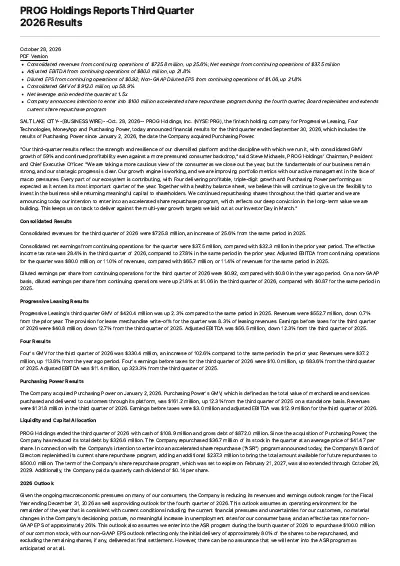
I want to start with the quarter highlight. PROG Holdings delivered strong top-line growth, with every business in our ecosystem contributing.
At the consolidated level, GMV grew 59% year-over-year, matching the pace we set in the second quarter. Revenue grew roughly 26%, with non-GAAP EPS of $1.06, up 21.8% year-over-year.
All of those growth metrics include the contribution of our Purchasing Power business, which we acquired in January 2026. At Progressive Leasing, we grew GMV in the low single digits, even after tightening our decisioning posture, a sign of real underlying demand.
Additionally, our gross leased asset balance, the leading indicator of future revenue, was higher year-over-year at quarter end. At Four, GMV grew triple digits for its 12th consecutive quarter, and it did so profitably, with a quarter-over-quarter step-up in adjusted EBITDA margin.
At Purchasing Power, we delivered double-digit GMV growth. Producing this kind of top-line growth while deliberately tightening our decisioning is exactly what a diversified, disciplined platform is built to do.
Taken together, that performance put our consolidated results within the outlook ranges we provided for the third quarter, with revenue and non-GAAP EPS landing near the midpoint. Adjusted EBITDA came in towards the lower end of its range.
Drivers landing us at the lower end of that range were concentrated in leasing and largely reflect headwinds we expect to be temporary as our portfolio quickly turns over following our recent tightening actions. As a reminder, we tightened our decisioning for the leasing business late in the second quarter, and we implemented some additional tightening actions since our last earnings call as the pressures on our customer persisted and in pockets even intensified.
The impact on adjusted EBITDA traces to two factors in our leasing portfolio. The first is a reflection of an improving customer profile.
On our newer, post-tightening lease pools, improved payment behavior resulted in more customers exercising their 90-day purchase option than we had expected, which compresses near-term yield. The second factor is on our older, pre-tightening pools.
Those customers have proven remarkably resilient, but a prolonged stretch of elevated inflation, exacerbated by higher gas prices since March, has worn on their day-to-day liquidity, which creates a headwind to portfolio yield. One framing point before I turn to the businesses.
The customer pressure we are seeing is showing up differently across our three segments, and that dispersion is one of the benefits of the ecosystem we are building. It shows up in different ways and to different degrees across Leasing, Four, and Purchasing Power, each serving a distinct customer need at a distinct price point.
Having a range of products that has the ability to respond differently to the same macro pressures is why the consolidated result held steady, even as one of the businesses, in this case Leasing, worked through a headwind. Our ecosystem of offerings does two things for us.
The first is resilience, which I've just described: a range of products that respond differently to the same macro environment. The second, and increasingly the more powerful one, is growth, and it's where we believe our durable, long-term advantage lies: the same customer engaging with more than one of our products.
The number of customers actively engaged with more than one of our products has grown since January, and these multi-product customers now represent a more meaningful percent of our total active base. We expect to compound this share over time, and it matters more than the number suggests.
Customers who use more than one PROG product tend to transact with us more frequently and stay with us longer. Every shopper we add to Four, every client account we bring on through Purchasing Power, and every lease we originate widens the top of that funnel and creates another opportunity to serve the same customer across more of their financial life.
That's the flywheel we've been building, and we are optimistic about the early momentum. The strength of that flywheel comes from each business that feeds it.
Let me take you through them, starting with Progressive Leasing. Progressive Leasing GMV grew low single digits year-over-year, with September being the strongest month of the quarter, a trajectory we like heading into the fourth quarter.
As I mentioned, an important number is the gross leased asset balance, which turned positive year-over-year at quarter end for the first time since April 2025. For a business where revenue is a function of the size of its lease book, that is the inflection we've been working toward, and it tells us the revenue calm is set to turn.
Let me put that growth in context. We tightened our decisioning late in the second quarter and during the third quarter, and even so, leasing grew despite that pullback.
Growing through tightening is exactly the kind of signal we want because it tells us the expansion is coming from wider distribution, deeper share with our retail partners, and a real customer demand, not a relaxation of our standards. The proof is in our approval rates, which were down nearly 300 basis points year-over-year, both in the quarter and year-to-date.
We are increasing share and growing the book while holding the line on who we approve. On portfolio performance, leased merchandise write-offs came in at 8.3% of Progressive Leasing revenue, a slight improvement versus last quarter.
As we discussed in July, the second and third quarters are seasonally our two highest write-off periods, and with the GMV growth from the last two quarters, some elevation is expected. That is how it played out.
We will adjust as needed, and we believe we will land near the high end of our 6% to 8% targeted annual range. I also want to place today's leasing portfolio in the context of where it was a few years ago.
Measured against the last time an inflation spike hit our customer, our leasing gross margin is up on average over 200 basis points. The model we are running today is structurally stronger than the one that navigated the last inflation shock: a durable, well-managed business inflecting back to growth, not a declining one.
We continue to invest in the customer experience to keep it that way. Those investments are already showing up in the numbers.
In the quarter, we shortened the application process for returning customers by an average of 3 to 4 minutes while continuing to provide applicants with fulsome and transparent disclosures. On the marketing front, by personalizing the language and messaging customers see, we lifted application submissions by double digits.
Our direct-to-consumer and digital efforts across Progressive Leasing's marketplace app and e-commerce were meaningful contributors, supported by our personalized marketing. Year-over-year, PROG Marketplace GMV grew 85% in the third quarter and approximately 128% year-to-date, continuing to reinforce its role as a complementary channel that strengthens our retail ecosystem and expands customer engagement opportunities.
Our e-commerce channel also gained ground, supported by an improved digital experience, reaching 26.4% of Progressive Leasing GMV in the quarter, up from 23% a year ago. Before I move on from Progressive Leasing, a brief word on business development.
We feel good about our retail partner pipeline and the progress the team has made this year. We see near-term opportunity, even with the window shortening in which decisions get made ahead of holiday readiness.
We like how we are positioned and encouraged by where things stand. We will have more to share when it is appropriate.
At Four, we delivered the 12th consecutive quarter of triple-digit GMV growth at 103% and did so profitably. Revenue grew 113.8% year-over-year to $37 million, and it generated $11.4 million of adjusted EBITDA, a 30.6% margin that stepped up from the second quarter.
The scale here is compounding fast. From under $15 million of total GMV in 2021, Four is on track to grow roughly 100-fold in just 5 years.
That growth is increasingly powered by returning customers, who make up the large majority of Four's orders, while average order value rose over 10% year-over-year as shoppers bought across newly added categories. We're pairing that loyalty with efficient organic and paid acquisition, reinforced by this year's investments in engagement, a catalog past 37 million items, and more flexible ways to pay.
Importantly, Four is achieving this growth while responsibly underwriting applicants separately on each transaction. Four's customer engagement is showing up across the metrics that matter.
Average purchase frequency held at roughly 5 transactions per quarter, and active shoppers grew roughly 68% year-over-year. Four Plus subscribers are contributing approximately 80% of total GMV, a clear signal that customers are finding value in the offering.
Four's take rate, which we define as revenue as a percentage of GMV over the trailing 12-month period, was 10.8%, up from 10.7% in the third quarter of last year. Four continues to sharpen its underwriting as well.
Its Q3 provision as a percentage of GMV decreased approximately 100 basis points compared to the same period last year. This quarter, we put an enhanced underwriting model into production built on a deeper set of applicant attributes, which in testing caught more potential credit loss without declining additional business.
AI is also improving how Four serves customers. FourBot, Four's AI support agent, now handles Four Plus cancellations and refunds end-to-end, which is our first support flow that issues refunds automatically within defined eligibility rules.
In early September, FourBot resolved approximately 90% of refund claims without human intervention. Our analysis shows that customers who contact support or file a claim keep ordering at the same or higher rates as those who never reach out, a sign that these interactions are building loyalty, not eroding it.
The unit economics are healthy, the business is scaling rapidly and profitably, and Four is increasingly a front door into the broader PROG ecosystem. We could not be more pleased with its growth or the quality of what's driving it.
Purchasing Power had a strong quarter, generating $161.2 million of GMV, which is a 12.3% growth compared to the same period last year. Adjusted EBITDA rose sequentially to $12.9 million or 9.8% of revenue, which is a step-up from the 8.1% achieved in the second quarter as it moves into its seasonally strongest period.
Subsequent to quarter end, Purchasing Power signed a large new client with over 50,000 eligibles, which we expect to launch in Q1. As a reminder, Purchasing Power signed a large 80,000-eligibles employer in July that we expect to launch in Q4.
Purchasing Power is performing as expected when we brought it into the portfolio, adding a resilient, recurring-payment business that broadens our reach and deepens the ecosystem. Lastly, we are ahead of schedule in capturing the operational efficiencies we identified during the acquisition and on track with integration of systems and streamlining processes.
Now I want to touch on capital allocation. During the quarter, we repurchased 885,000 shares for $36.7 million.
We brought debt down again sequentially, and we ended the quarter with a net leverage ratio of 1.5 times. Returning capital at this pace while continuing to fund growth and improve net leverage reflects both the strength of our balance sheet and our conviction in where this business is headed.
Our capital allocation priorities remain unchanged: reinvest in the business, pursue strategic M&A, and return excess capital to shareholders through share repurchases and dividends. Brian will take you through our updated full year outlook in a moment.
We have reduced our revenue and earnings outlook ranges to reflect the challenged consumer we saw this quarter, which we expect will continue through the balance of the year. I want to put that in perspective because I think it is a very important point.
The midpoint of our revised adjusted EBITDA outlook is now at the high end of the initial range we gave in February. When we set that original outlook, we did not anticipate the conflict in the Middle East or its effect on gas and other input prices for our consumers.
Even so, after a year of real pressure on our consumer, we still expect to deliver the best case we laid out at the start of the year. That reflects this team's execution and the resilience of the platform we've built.
That's why I'm confident in where we're headed. We are putting capital behind that confidence.
This morning, we announced our intent to enter into a $100 million accelerated share repurchase program, under which we expect to receive an initial delivery of approximately 2.7 million shares, which will be an immediate benefit to WASO and EPS. The final number of shares repurchased will be determined based on our volume-weighted average share price over the course of the program.
In connection with its expected ASR program, our board replenished our share repurchase program, bringing the total amount available for future repurchases to $500 million, giving us substantial capacity to keep returning capital to shareholders in the years ahead. Let me speak to why and why now because the timing is deliberate.
Two things give us both the room and the conviction to act. First, the balance sheet.
Having repaid $260 million of recourse debt since the Purchasing Power acquisition in January and having returned to within our targeted net leverage range, we have the flexibility to return meaningful capital without pulling back on our growth investments. Second, our conviction in this business.
Progressive Leasing's portfolio is short in duration, which means it turns over quickly and gives us clear, current visibility into how it is performing and the ability to adjust in real time. Nothing we have experienced in this environment dampens our optimism for the long-term prospects of that business.
If anything, it reinforces that the model is working as intended. The fundamentals are strong, the model is proven, and our ecosystem is contributing.
Even as we take a more cautious near-term view on the macro and bring down our adjusted EBITDA range, our belief in the long-term earnings power and cash flow generation of this business is unwavering. Committing to returning capital to shareholders at this scale is a clear indication of that confidence.
We believe we remain on track to achieve the 3-year compound annual growth targets we laid out at our Investor Day in March across all metrics. This accelerated share repurchase program is expected to be accretive to our 2027 earnings per share, and we would not be acting at this scale if we were not confident in the earnings power of this business in 2027 and beyond.
With that, I'll turn it over to Brian. Brian?
Brian Garner
Thanks, Steve, and good morning, everyone. Before I move through the results, let me headline the quarter.
As Steve said, this is a quarter of strong, profitable top-line growth in the face of intense macro headwinds and further tightening in our decisioning posture. The diversified platform absorbed pressure in the Progressive Leasing portfolio and still delivered revenue, EBITDA, and EPS within our outlook ranges for Q3.
I'll begin with some commentary on the Progressive Leasing segment before moving through the rest of our results. Starting with Progressive Leasing, GMV grew 2.3% year-over-year to $420.4 million, a continuation of the positive trajectory that began earlier this year, even after the tightening we deployed late in the second quarter and again since our last earnings call.
I'll also note that GMV showed acceleration exiting the quarter, with September posting the strongest month of the quarter. As we analyze the growth trajectory of the business, a key metric turned positive this quarter.
Our gross leased asset balance grew for the first time since April of 2025. As revenue follows that asset base, this represents a positive trajectory for Progressive Leasing's revenue.
Revenue for the leasing segment was $552.7 million, down 0.7% year-over-year compared to down 3.4% last quarter, a clear sequential improvement in the comp, and we expect revenue to comp positively in the fourth quarter as the asset base rebuilds. Progressive Leasing's gross margin came in at 31.8%, down 20 basis points year-over-year and stepped down from the unusually strong gross margin performance we saw in the second quarter.
I want to provide some additional color on the headwind we saw in the portfolio yield for the leasing business in the third quarter. As you may recall, in Q2, we experienced favorable portfolio yield dynamics, where we saw gross margins and EBITDA margins at elevated levels, even as higher delinquencies driven by macro challenges for our consumer played through the portfolio.
The overall mix of lower 90-day buyout rates and customers staying in their leases longer more than offset some of the delinquency pressures we had observed. Further, we deployed iterative tightening measures in Q2 and early Q3 aimed at improving write-off rates.
That tailwind subsided during the third quarter. As we began to see the mix of lease outcomes begin to decline from Q2 levels, including 90-day buyouts trending higher on the post-tightening pools.
At the same time, delinquencies continued to be impacted by persistent inflation, driven in part by higher fuel prices, particularly on the pre-tightening pools. The net result was the pressure on the lease portfolio we saw in the quarter.
As Steve mentioned, Progressive Leasing took incremental tightening steps since the July earnings call, but we do not believe these changes alter our ability to deliver GMV growth in Q4 and beyond, as we remain focused on growing our gross leased asset balance. I'll also note that Progressive Leasing's decisioning posture and approval rates are more conservative year-over-year, but we are still expecting to grow against that dynamic.
Finally, as we have seen over the years, the short duration of the leasing portfolio allows us to quickly alter performance to remain within our long-held guardrails. We believe we have taken the correct tightening actions and will monitor lease portfolio performance in the periods ahead.
Write-offs in the quarter came in at 8.3% of leasing revenue versus 8.4% in the second quarter and 7.4% a year ago. The year-over-year comparison looks elevated largely because of the significant tightening in Q1 of a year ago and the more intense macro headwinds our customers faced.
We are monitoring payment behavior, delinquencies, and vintage-level performance continuously. We expect full year 2026 leasing write-offs to land near the high end of our targeted annual range of 6% to 8%.
Progressive Leasing's SG&A for the quarter was $83 million or 15.2% of revenue, as we balance cost control with targeted investment in technology, customer experience, and AI. Turning to Four Technologies, GMV grew nearly 103% year-over-year to $330.4 million, and segment revenue more than doubled to $37.2 million.
The key financial point on Four is that this growth is both profitable and well-controlled. We recognize expected losses upfront as we originate, and loss performance is tracking in line with our seasonal expectations.
As Steve noted, the enhanced underwriting model we rolled out earlier this year is already proving out. Four's loss provision as a percentage of GMV improved by roughly 100 basis points year-over-year while achieving this impressive growth trajectory.
Four generated adjusted EBITDA of $11.4 million or 30.6% margin and a step-up from the second quarter. It is pairing rapid scale with healthy and improving unit economics and is increasingly meaningful to the consolidated model.
Purchasing Power generated GMV of $161.2 million, delivering double-digit growth, revenue of $131.8 million, and adjusted EBITDA of $12.9 million or 9.8% of revenue, up from 8.1% last quarter. The seasonal strength of the fourth quarter is still ahead of us.
The drivers of the sequential improvement were operating leverage as we captured efficiencies, favorable product mix, which lifted margin, and lower interest expense on securitized debt as we pay down a portion of the remaining warehouse facility with our excess cash. As a reminder, we treat that ABS interest expense as a form of cost of operations, Purchasing Power segment adjusted EBITDA is burdened by that cost.
Purchasing Power was acquired at the start of this year, it did not contribute to the prior year consolidated base in our financial reporting. Moving to consolidated results, GMV grew 59% year-over-year to $912 million, and revenue from continuing operations grew roughly 26% to $725.8 million.
This year-over-year revenue performance was driven by the addition of Purchasing Power and triple-digit growth of Four, partially offset by Progressive Leasing. Consolidated adjusted EBITDA was $80 million, representing an 11% margin, and non-GAAP diluted EPS was $1.06, up 21.8% year-over-year.
Turning to the balance sheet, we end the quarter with $108.9 million of unrestricted cash and total available liquidity of $458.9 million, including our revolving credit facility. Recourse debt was at $600 million, and since closing the Purchasing Power acquisition, we have paid down $260 million of recourse debt, bringing our net leverage ratio to 1.5 times trailing 12 months adjusted EBITDA.
We have now operated within our long-term target range of 1.5 to 2 times for three consecutive quarters, having stepped down quickly after the Purchasing Power acquisition in January of 2026. The result is a balance sheet that gives us real flexibility, the capacity to keep investing in our growth priorities, to pursue selective value-creating opportunities, and to return capital to shareholders, all while preserving the financial strength to navigate a dynamic consumer environment from a position of confidence.
We also returned capital to shareholders during the quarter. We paid our quarterly dividend of 14 cents per share and repurchased 885,000 shares at an average price of $41.47.
We continue to evaluate opportunities to return capital to shareholders while funding GMV growth across the business. The intended accelerated share repurchase program Steve mentioned reflects the same discipline, putting the balance sheet to work while preserving capacity to keep funding growth across the platform.
I'll now touch on some key aspects of our revised full year outlook provided in this morning's release. We're taking a prudent view of the consumer as we close out the year.
The payment and buyout behavior we saw this quarter tells us households are still absorbing the cumulative effect of several years of elevated prices, as well as the significant increase in fuel prices since March of 2026, and we think it's appropriate to reflect that caution rather than count on sharp fourth quarter improvement. As a result, we're revising down our revenue and adjusted EBITDA outlook ranges.
However, our GMV grew across all three segments, and we are encouraged by the metrics around our recent portfolio of vintages. Our revised consolidated outlook for continuing operations in 2026 calls for revenue in the range of $3.015 billion to $3.05 billion, adjusted EBITDA in the range of $345 to $355 million, and non-GAAP EPS in the range of $4.70 to $4.85.
This outlook assumes an operating environment for the remainder of the year that is consistent with current conditions, including the current financial pressures and uncertainties for our customers, no material changes in the company's decisioning posture, no meaningful increase in unemployment rates for our consumer or for our customer base, and an effective tax rate for non-GAAP EPS of approximately 26%. This outlook assumes we will enter into an ASR program during the fourth quarter of 2026 to repurchase $100 million of our common stock, with our non-GAAP EPS outlook reflecting only the initial delivery of approximately 80% of the shares to be repurchased and excluding the remaining shares, if any, delivered at final settlement.
However, there can be no assurance that we will enter into the ASR program as anticipated or at all. To wrap up, the third quarter presented more macro challenges for our customer, and leasing worked through portfolio challenges, but we delivered the consolidated results within our outlook range.
Progressive Leasing's portfolio inflected positive in the period, Four delivered its 12th straight quarter of triple-digit growth, and Purchasing Power grew double digits in line with our expectation. We delivered that performance while managing the portfolio with discipline and maintaining a conservative balance sheet with leverage comfortably inside our target range.
During the quarter, we continued to return capital through our dividend and share repurchases. We aim to close out the year focused on profitable growth and an improving portfolio.
I'll now turn the call back over to the operator for questions. Operator?
Operator
Thank you. As a reminder, to ask a question, please press *11 on your telephone and wait for your name to be announced.
To withdraw your question, please press *11 again. We ask that you please limit yourselves to one question and one follow-up.
One moment while we compile our Q&A roster. Our first question is going to come from the line of Kyle Joseph with Stephens.
Your line is open. Please go ahead.
Kyle Joseph
Hey, good morning, guys. Thanks for taking my questions.
Just wanted to touch base on the consumer health and just not totally understand what's going on, and obviously, it seems like it's impacting the leasing business, particularly when you contrast that with Four's really strong results. Is that really a function of kind of end consumers being different or do you think it's more product-related and, tied to kind of the size and the duration difference between those two businesses?
Would just like to get your thoughts there, Steve.
Steve Michaels
Kyle. Good morning.
I'll start with the consumer. Obviously, all of our products are consumer-exposed, I would say, and near-prime and below.
In July, I said the consumer was stressed but resilient. I think that's still accurate, although I would admit that the longer the stress, particularly this gas price shock and just general input cost shock that's causing things to get more expensive, the longer the stress goes on, the harder it is to maintain resiliency.
That's why we can adjust our portfolio and decisioning processes to make sure that we let the right folks into the portfolio. All of our businesses benefit from a very short duration and quick turnover, but to your point about Four versus leasing or other products, leasing has a longer duration than Four, and one of the benefits that Four has is the lower ticket, but also the fact that even on returning customers, we decision or underwrite that customer the next time.
While a lease gets written for 12 months and has an average life of 6.5 months, a Four transaction is much shorter in duration, and then to the extent that some gas price or other shock impacts that consumer and they come back, we have the ability to assess their wherewithal and the ability to pay again in a very short duration. I think that is one of the big things that helps us across the different portfolios.
Kyle Joseph
That's really helpful. Thanks.
Then just a follow-up, probably for Brian. Obviously, this is our first quarter trying to model out Purchasing Power.
We get the seasonality of that business, but just in terms of timing, kind of in terms of originations, thinking about provision and whatnot there, is it one of those things where originations are pretty back-weighted based on holidays spending, or is it, holiday spending feels like it moves up a bit every year? Just kind of want to think about how we should be modeling that in the timing around originations there.
Thanks.
Brian Garner
I think, Kyle, I think the seasonality dynamic with Purchasing Power is certainly pronounced and anchored in Q4, and you see that with our guidance, kind of the year-to-date performance and where they're at from a revenue perspective, and what we're implying in our outlook for Purchasing Power. They've certainly again, it's the first year under our operations, and we are getting better each quarter at our degree of precision around the metrics.
Certainly the holiday season is significant for Purchasing Power, and we've got the right team and processes and plan in place to execute here in Q4. Your sense is right, and I think you can see the order of magnitude just from the guidance that we have provided.
Kyle Joseph
Yep. Absolutely.
Thanks for taking my questions.
Operator
Thank you. Our next question will come from the line of John Hecht with Jefferies.
Your line is open. Please go ahead.
Good
John Hecht
morning, guys. Thanks very much.
I guess first on back on Purchasing Power Q4, number one, what can you tell us about how October is trending? It sounded like September saw some good activity.
In addition to that, on Purchasing Power, maybe talk about, call it customer trends, the B2B side of the relationship and activity in that regard?
Steve Michaels
John. We're not really commenting beyond the quarter end as to trends on Purchasing Power.
We did see, like you said and like you mentioned, double-digit GMV growth in Q3. As Brian just discussed, Q4 is an all-important quarter.
As a retail platform, we experience the most seasonality in that business, and we're going to be executing through our first Black Friday and holiday period. The consumer is generally employed, which is a good thing, and we're pleased with our client roster and line-up.
On the biz dev side, we have had some activity. We did sign a sizable new client partner here subsequent to quarter end that won't impact this year.
It's a Q1 launch. Then the signing that we announced last quarter, we do expect to launch here pre-holiday, we're expecting that to have an impact for us in Q4.
We've got lots of other lines in the water on the biz dev front. This particular business's biz dev season, I would say, is impacted by open enrollment.
Whereas on the leasing side, we kind of hit code freeze and holiday readiness for retailers, on the Purchasing Power side, total rewards teams are certainly busy during open enrollment season. While we keep the conversations going and the pressure on, it's likely that a lot of those things will start to move forward again once we flip the calendar page to '27.
John Hecht
Okay. That's super helpful context.
Then with Four, still very strong momentum there. I think a lot of the customer activity over the course of a lot of this year has been just sort of organic kind of pull growth.
I think you guys were maybe exploring some sort of more outreach in terms of different marketing programs. Maybe can you give us an update on that and how that's translating into, call it customer inflow?
Steve Michaels
Yeah. We're very pleased with Four across all the channels.
We continue to have a very robust organic acquisition and just kind of a word-of-mouth and referral network that we're pleased with. We are testing and leaning more into paid acquisition and placement in the app store.
We see a definite correlation between how we're positioned in the app store, and also Google Play for that matter, but mostly App Store, and installs and acquisition. Very data-driven optimization around marketing, mostly through social, as you would imagine.
We're seeing good results there. We have a good plan here for Q4, and we are spending more in marketing this year than we did last, and we expect that will continue.
We're still very, very pleased with the return on that ad spend and the ability to drive new customers into the platform, which then become Four Plus customers and then become repeat multiple-time customers, which is a good thing for lifetime value and general GMV production.
John Hecht
Okay. Great.
Thanks very much.
Steve Michaels
Thanks, John.
Operator
Thank you. Our next question is going to come from the line of Hal Goetsch with B.
Riley Securities. Your line is open.
Please go ahead.
Hal Goetsch
Thank you. Hey, can you guys give us a little more color on the tightening actions you took and maybe give us a feel for maybe what the impact was on GMV?
Because if you did tighten Q2, a little bit in Q3, but then also saw GMV growth, that's some pretty powerful stuff. Want to know maybe what that impact was, and then given the short duration of the portfolio on leasing, what's your confidence level of getting into that 6% to 8% range or at least in the 7% range on lease charge-offs after a couple different tightenings and comfortable with the cohorts that are currently showing right now?
Thanks.
Steve Michaels
Hal. I'll start, and Brian can certainly fill in any gaps that I miss.
As we mentioned in July, we did some tightening in Q2. We saw the need to do some additional tightening in Q3.
Post-call, we did see some deterioration in the performance of the pre-tightening pools, which caused us to take some more action. I think I appreciate your focus on the fact that we're continuing to grow through that.
That's because of a lot of the initiatives that we have, both with retail partners as far as partner marketing as well as additional integrations, as also our direct-to-consumer business with marketplace growing very robustly, and just generally digital channels becoming a more impactful part of our business at almost 27% of GMV in the third quarter, and certainly holiday season we expect it to be even more than that. We feel like we've got the approvals amounts or amounts and rates dialed in.
It certainly had several, I'd say several hundred basis points of pressure on the GMV production in Q3, and we would expect that probably in Q4 as well. The reason we have such confidence is because we've executed this business through these cycles before, and we've seen this movie before.
We have the ability to manage the portfolio in a fairly tight band, we think, very tight band. It turns over quickly.
The pre-tightening lease pools will be largely through the portfolio by the end of this year, with some remnants into Q1. We do believe we have the ability and made the appropriate moves to land near the high end of that 6% to 8% long-held range.
I'm not making news here and changing that range, but I would say the six part of that 6 to 8 is not really appropriate anymore. I'm not even sure that we or you would want us to run the business down in the sixes.
As I mentioned in my prepared remarks, the gross margin of the business has structurally changed over the last several years. Being in that whatever, 7% to 8% part of the range is probably more appropriate and not knowingly leaving EBITDA dollars on the table.
We look forward to operating the business through this holiday season. The portfolio will do what it does on a short-duration portfolio, and it'll turn over, and we'll be in good shape with a lot of the things that we've got on the table for '27 and beyond, which is why we're confident and really excited about hitting those three-year CAGRs from the Investor Day and taking this opportunity to bring so quite a few material amount of shares back in through the ASR while still having confidence in the earnings power of the business and cash flow generation.
That's very helpful.
Hal Goetsch
You mentioned some technology improvements. You shortened the application time 3 to 4 minutes.
That's a lot of friction taken out of the process. I was wondering if you had any comments on how that might have decreased any cart abandonment or close rates or something like that to share with us?
That sounds like a pretty good efficiency gain.
Steve Michaels
We're pleased with the innovation that our product team is bringing in the improvements or the removing of friction from the process. This particular stat was related to returning customers, and that's really just kind of changing the flows and making it easier for us to use the data that we already have on the customer to make it easier for them to come back and do business with us.
We certainly have plans to remove friction from new customer flows as well. We're tracking conversion at every point and different abandonment points or cut-off points across all the flows.
As you can imagine, the flows are a little different in our direct-to-consumer, whether it be the PROG Marketplace or just generally DTC, or in an integrated flow with a large retail partner. We're looking to make changes everywhere we can while still providing the most fulsome disclosures for our consumers.
Clearly, the consumer would like to have zero friction, and that's what we're working towards, but we also have to make sure that they understand the transaction. Returning customers, it's a little easier because they've done business with us before, and we also have to make sure that we're protecting the portfolio, which we know is job one.
A lot of great progress made there, more to come, certainly. Really proud of the teams for what they're delivering.
Hal Goetsch
Terrific. Thanks.
Operator
Thank you. Our next question is going to come from the line of Bobby Griffin with Raymond James.
Your line is open. Please go ahead.
Bobby Griffin
Hey, guys. Thanks for taking the questions.
Steve, you spent some time on the credit side, but obviously there was a public report out that kind of pushed back on some of Four's credit aspects. I think you mentioned that loss provision improved year-over-year by 100 basis points, but maybe can you spend a little bit of time just unpacking that further, how it trended sequentially, how you guys are, anything more just to kind of unpack credit there on that business as it's obviously growing very helpfully, and just to help us get comfort around that level of growth with managing the risk side of that growth?
Steve Michaels
I'll start, and Brian can chime in. The reality is that business is performing very well.
We couldn't be more pleased. Massive growth, improving portfolio dynamics.
It's inappropriate to compare December to June or September due to the seasonality of the business, but things are getting better there, right? The provision expense is down year-over-year, and the underwriting changes and model improvements and enhancements are doing what we want them to do.
We still have a pretty good percentage of our GMV production coming from new customers, and they inherently come with higher risk. Things are performing as we would expect.
You wouldn't want me to get into talking about CECL, I'll turn it over to Brian.
Brian Garner
Bobby, appreciate the question. I think I would echo Steve's comments there.
We're very pleased with what's going on at Four and the credit performance, and a lot of credit to John Trainor and the team over there that are managing that, and we are leveraging much of the expertise we feel like we have throughout the organization around this. The construct around that, it's typical CECL accounting, you're reserving up front for the anticipated losses.
As we look back historically and kind of compare what we thought the reserve should be versus what actually charged through, we've got a very narrow delta really going back each quarter. We have a high degree of confidence in our reporting around that, and it's like you indicated, it's trending in the right direction.
Really, it's part of the long-term Four opportunity around margin expansion. This loss rate dynamic, and as you lean more on repeat customers, certainly the margin profile improves.
Here you've got 30-plus percent in the quarter with EBITDA margins already starting from a strong base, and I think some improvement to be had as we get smarter. It's been pretty boring plain vanilla on the accounting front with Four.
We were right down the middle of the fairway in terms of how we go about our business there, no re-agings, no nothing to suggest that there's anything to communicate there. Hopefully, that's helpful.
Bobby Griffin
That's very helpful. I appreciate the detail, and I appreciate you kind of going into a little bit of the accounting side of it as well.
I guess secondly for me, just on Purchasing Power, first holiday you guys have owned it for. I think last year, the business was negatively impacted by the 40-plus-day government shutdown.
Just I guess anything there on how that impacted the business that happened before the holiday, maybe it wasn't as big of an impact, but does that set up where the comparisons at least in your favor as we think about this year, or anything more there?
Steve Michaels
I would say, yes, the business, even though we didn't own it, was impacted by the government shutdown. The segment of the business that we refer to as non-core or FedGov is actually fairly small, it's not like it's a major factor in this year's comp, but certainly something, there's always something.
Seems like every year and every quarter there's something. In this year, you've got what we have experienced in the past with the election, and usually it's more in the presidential cycle than it is in mid-term, but you could have some kind of distraction or malaise that might be a loft after the election day.
It is a thing, but it's not going to be a driver of it because of the smaller portion of the business that's from that segment.
Bobby Griffin
Very good. Best of luck here on holiday.
Appreciate the details this morning.
Steve Michaels
Thank you.
Operator
Thank you. Our next question is going to come from the line of Brad Thomas with KeyBanc Capital Markets.
Your line is open. Please go ahead.
Brad Thomas
Thanks. Good morning, Steve, Brian, John.
Steve, I wanted to just follow up on some of your comments that you made after talking about the ASR, where you spoke to your confidence in 2027. That's where I was wondering if you could just highlight a bit more about what is it that you're seeing in the business that gives you that confidence to want to do an ASR right now at a time where there's so much uncertainty for the consumer?
Thanks.
Steve Michaels
Brad. I think it just goes to our confidence and our ability to control the businesses and our ability to profitably originate deals across our portfolio of businesses.
Right now, we're dealing with the pre-tightening and post-tightening pools on the leasing side that'll largely be through the pipeline by the end of the year, and we're seeing some nice activity in our leasing business. I briefly talked about business development in the prepared remarks, and we're hoping that we can get some things across the goal line here that'll certainly help 2027.
Four continues to grow very robustly. We'll be in year two of the Purchasing Power ownership and execution, and nothing about this quarter or our guide for Q4 has changed our outlook for the 3-year CAGRs that we put out at Investor Day.
If you take those 3-year CAGRs against 2025, you come up with a very positive picture for PROG Holdings for 2027 and 2028. We see this as an opportunity to put some capital to work, investing in our own business, and because the balance sheet allows for it, and the EPS guide that we put out there did not anticipate this type of action.
Those 3-year CAGRs can actually be impacted by bringing shares in. We see it as an opportunity.
Brad Thomas
That's great. Brian, you guys continue to generate a tremendous amount of cash flow.
I don't think you have formal guidance on it, but can you help give us a range of maybe where you think the free cash flow shakes out for the year based on the new earnings guidance? Then maybe just as a first blush on '27, assuming the PROG business continues to keep GMV more positive, should we be thinking about free cash flow for next year being perhaps a touch lower than what we do this year just because of the working capital needs, or are there any other puts and takes to think about from a free cash flow standpoint?
Thanks.
Brian Garner
Yeah. Let me maybe give you a couple of data points to help you kind of visualize the cash picture.
Obviously, for the year, we've been highly cash generative, which has allowed us to pay down the debt related to Purchasing Power, also get back into the cadence of share repurchases in Q2 and Q3, and now we're talking about this ASR. All that being said, we started the year at 2.5 turns of leverage immediately after the Purchasing Power acquisition.
We're now down to 1.5 times, and even with this heavy Q4 that we talked about with Purchasing Power that we were looking at, some of that will be some of that will be leaned on with their securitization, but we continue to also contribute cash towards subsidiaries and Four and PPC along the way to help pay down some debt. That 1.5 turns, we're expecting even with the ASR of $100 million here in Q4 to be, call it right at the top end of our range of two turns of leverage.
We'd like to try to keep it in between 1.5 to 2 turns. Even digesting the growth and the ASR, we're still within our range, and then you're looking forward to tax season that'll start to bring that down again.
That's certainly the cash flow dynamic that we're proud of. As you look forward to 2027, there's obviously we haven't given any guidance yet, and we will look to talk more about that in February, but structurally, on the Progressive Leasing segment, I see no reason why we would see softer cash flows than what we saw here in the year.
From a margin profile, here we're going to end the year at 11.6% EBITDA margin, which is kind of midpoint of our 11% to 13% that we talk about. Like Steve said, that nothing's changed in how we view the business.
If we're talking about in 2027, hey, Four grew at a very strong clip at the end of 2027 and used up some cash, that's a good problem to have. We have optionality, we don't anticipate additional facilities beyond what we have today with our outstanding revolver and securitization.
We're going to be self-funding for the foreseeable future. That speaks to the cash flow dynamic.
Brad Thomas
Appreciate it. Thank you, Brian.
Operator
Thank you. Our next question is going to come from the line of Hoang Nguyen with TD Cowen.
Your line is open. Please go ahead.
Hoang Nguyen
Good morning, guys, and thanks for taking my questions. Just curious, how would you characterize, I guess, this round of tightening versus maybe the round that you guys did last year in 2025, in terms of magnitude and maybe the impact?
Maybe one for Brian, when we think about this tightening, how should we think about the impact on maybe the nascent growth of gross leased asset going forward?
Brian Garner
Yeah. I guess just with respect to the leased asset dynamic, we comped positively this quarter, which has been a long time coming, and there's been a lot of work to fight against the headwinds that have been in place in order for us to grow.
As you kind of see implied in our guidance, what we're saying for Q4 for Progressive Leasing is that we're going to see a couple percentage points at the midpoint of revenue growth. That has everything to do with our ability to grow that portfolio.
Going forward, we also in my prepared remarks talked about even in the face of tightening, we're anticipating Q4 our ability to grow GMV. You stack those things together, and I think we've got a good story here on leasing from a GMV trajectory even in the face of tightening, and kudos to the sales team and everyone involved in making that happen because that, certainly has been some headwinds.
Again, we'll talk more about 2027 in February, but exiting the year, we had a little bit of a macro portfolio dynamic that I think will work through pretty quickly here, and hopefully we're talking more about the top-line and the growth and the stable portfolio into 2027.
Hoang Nguyen
Got it. Maybe the difference between this year's tightening versus last year?
Brian Garner
Yeah. I think the difference that I would speak to, we tightened pretty dramatically, I would say, or significantly is probably a better word, in Q1 of 2025, and that was based upon the data we had available to us at the time.
It was in one fell swoop that we made that change and let the portfolio play through. I think what you've seen this year in terms of how we've approached this, we tried to be more a little bit more real-time in the data.
We have made smaller iterative tightening in Q2 and in Q3 and here into this year, based upon what the data is telling us. We're trying to offset some of the pressures that we're seeing in the pre-tightening pool predominantly, and the post-tightening pools are showing some encouraging trends of sequential improvement from those pre-tightening pools.
To answer your question, it's been more iterative, less significant in each iteration, and I don't anticipate that we're, for the next year talking about a one point in time getting past that difficult comp because of the way that it's kind of played out this year. Again, I think that's evident here in Q4 with the growth that we're signaling.
Hoang Nguyen
Got it. Thank you, guys.
Operator
Thank you. Our last question is going to come from the line of Casey Coates with Loop Capital Markets.
Your line is open. Please go ahead.
Casey Coates
Good morning, and thank you for taking my question. First, I wanted to ask about Purchasing Power had a strong 3Q.
Given that, please explain a little bit of the reduction in the guidance for 4Q given the strong 3Q and the 4Q weighting of the company?
Brian Garner
Of the guidance story, obviously the preponderance of it was with the leasing segment and the portfolio dynamics we discussed. There's way to a much lesser extent here on Purchasing Power.
Again, I think a large part of it is just us learning the business, the mix dynamic with respect to the product offering, and just looking forward to Q4 and just the broader pressures, I think, on the consumer that have reared its head here late in the year. We're looking at that and as I mentioned how consequential Q4 is for Purchasing Power, and we just thought it was the prudent thing to do to maybe trim around the edges to a lesser degree for Purchasing Power.
There's nothing more significant than that.
Casey Coates
As a quick follow-up, thinking about Purchasing Power and really that ecosystem strategy, when should cross-selling and the shared decisioning benefit become more meaningful in results?
Brian Garner
We're working on those every day, obviously. The teams are partnering well together.
The data science team is being integrated, and small iterative changes are being deployed. Cross-selling is happening, of course, on the B2B B2B2C business like both leasing and Purchasing Power.
There's these times of the year where they're less fruitful, as I called out earlier, related to open enrollment periods and things of that nature. Nothing has changed in our view as to how these businesses can be better together than during diligence or since we've owned Purchasing Power.
Casey Coates
Thank you.
Operator
Thank you. I would now like to hand the conference back over to Steve Michaels for closing remarks.
Steve Michaels
Thank you, operator, and thank you all for joining us this morning. The third quarter asked more of our customer, and our leasing business worked through some portfolio challenges, but our diversified platform delivered consolidated results within our outlook ranges.
Progressive Leasing's portfolio size inflected positive, Four delivered its 12th straight quarter of triple-digit growth, and Purchasing Power grew double digits. We're putting capital behind our conviction because the fundamentals are strong, the model is proven, and our ecosystem is contributing.
I firmly believe the best chapters of PROG's story are still in front of us. Thank you all for joining us today.
Operator
This concludes today's conference call. Thank you for participating.
You may now disconnect. Everyone, have a great day.
Goodbye.