Sanmina Corporation
Q4 FY2026 · Earnings Call TranscriptNovember 9, 2026
Operator
This call is being recorded on Monday, November 9th, 2026. I would now like to turn the conference over to Paige Melching.
Please go ahead.
Paige Melching
Thank you, Marissa. Good afternoon, ladies and gentlemen, and welcome to Sanmina's fourth quarter and fiscal 2026 earnings call.
A copy of our press release and slides for today's discussion are available on our website at sanmina.com in the Investor Relations section. Joining me on today's call is Jure Sola, Chairman and Chief Executive Officer.
Jure Sola
Good afternoon.
Paige Melching
Jon Faust, Executive Vice President and Chief Financial Officer.
Jon Faust
Good afternoon.
Paige Melching
Before I turn the call over to Jure, let me remind everyone that today's call is being webcasted and recorded and will be available on our website. You can follow along with our prepared remarks in the slides provided on the website.
Please turn to slide three of our presentation and take note of our safe harbor statement. During this conference call, we may make projections or other forward-looking statements regarding future events or the future financial performance of the company.
We caution you that such statements are just projections. The company's actual results could differ materially from those projected in these statements as a result of factors set forth in the safe harbor statement.
The company is under no obligation to, and expressly disclaims any such obligation to, update or alter any of the forward-looking statements made in this earnings release, the earnings presentation, the conference call, or in the Investor Relations section of our website, whether as a result of new information, future events, or otherwise, unless otherwise required by law. Included in our press release and slides issued today, we have provided you with statements of operations for the fourth quarter and fiscal year end October 3rd, 2026, on a GAAP basis, as well as certain non-GAAP financial information.
A reconciliation between the GAAP and non-GAAP financial information is also provided in the press release and slides posted on our website. In general, our non-GAAP information excludes restructuring costs, acquisition and integration costs, non-cash stock-based compensation expense, amortization expense, and other unusual or infrequent items.
Any comments we make on this call as it relates to the income statement measures will be directed at our non-GAAP financial results. Accordingly, unless otherwise stated in this conference call, when we refer to gross profit, gross margin, operating income, operating margin, taxes, net income, and earnings per share, we are referring to our non-GAAP information.
I would now like to turn the call over to Jure.
Jure Sola
Thanks, Paige. Good afternoon, ladies and gentlemen.
Welcome and thank you all for being here with us today. First, I would like to take this opportunity to recognize our employees and Sanmina's leadership team for doing a great job.
To you, Sanmina's team, thank you for your dedication, hard work, and delivering strong execution for our customers. Please turn to slide four.
Ladies and gentlemen, I can tell you that I'm very pleased with our performance. We delivered a great results for the fiscal year '26.
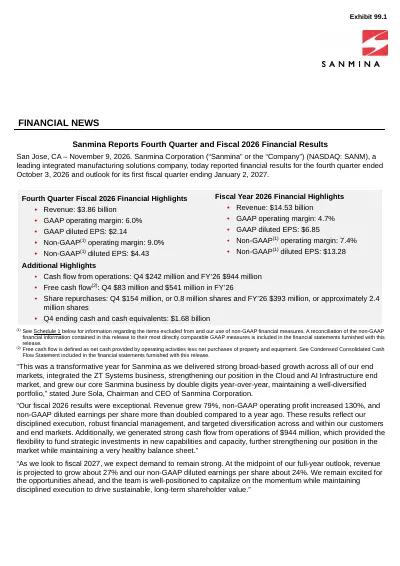
Revenue grew 79% year-over-year to 14.53 billion. Non-GAAP operating margin expanded from 5.7% operating margin to 7.4% operating margin year-over-year.
Non-GAAP diluted EPS more than doubled to $13.48. Cash flow from operation was also very, very strong.
Came in at 944 million. I can tell you that we are executing according to our plan with strong execution in both Core Sanmina and Sanmina AI Group ZT Systems.
Now let's go to our agenda for today's call. We have Jon, our CFO, to review details of the results for you.
I will follow up with additional comments about results and future goals, then Jon and I will open for question and answers. Now, I like to turn this call over to Jon.
Jon?
Jon Faust
Thank you, Jure. Good afternoon, ladies and gentlemen, and thank you for joining today's earnings call.
Before I review our financial results for the quarter and the fiscal year, I want to acknowledge the entire Sanmina team for their focused execution and thank them for delivering a great fourth quarter and a strong finish to the fiscal year. This was a transformative year for Sanmina as we delivered strong, broad-based growth across all of our end markets while largely completing the integration of the ZT Systems business, expanding our position in the cloud and AI infrastructure end market.
I'm very proud of the team's performance, and I'm excited about the opportunities ahead across our entire business. Now please turn to slide six, where I'll speak to the financial highlights.
As Jure mentioned, we are very pleased with our financial results, which as you can see, exceeded our previously communicated outlook for both the quarter and the fiscal year across all metrics. Revenue exceeded the high end of our outlook ranges.
This was driven by both the Core Sanmina business, which exceeded its outlook ranges with growth coming from all end markets, and the ZT Systems business, which came in line with our outlook. Additionally, our non-GAAP operating margin and our non-GAAP diluted earnings per share both exceeded our outlook, driven by strong execution, mix, and disciplined cost management.
We also had about $30 million of tariff recoveries primarily associated with legacy ZT Systems products, which wasn't factored into our outlook and contributed about 75 basis points of favorability to our non-GAAP operating margin and about 42 cents to our non-GAAP diluted earnings per share. All in all, this was an outstanding quarter for Sanmina, which closed out a strong fiscal year, and with our proven track record of solid operational execution, we're now well positioned to take advantage of robust market demand in the new fiscal year ahead.
Now please turn to slide seven, where I'll speak to our non-GAAP P&L performance. As shown on the prior slide, we delivered revenue of $3.86 billion, which was up 84% versus the same period a year ago.
Our Core Sanmina business revenue of $2.97 billion grew 42% versus the same period a year ago, exceeding our outlook, with broad-based strength across all of our end markets, several of which grew double digits year-over-year. Our ZT Systems business revenue of $884 million was in line with our outlook.
Our non-GAAP gross profit was $444 million, or 11.5% of revenue. This was up 210 basis points versus the same period a year ago and above the high end of our expectations.
Our non-GAAP operating expenses were $96.3 million, or 2.5% of revenue, in line with our expectations. Our strong revenue and non-GAAP gross profit results, along with ongoing cost discipline and operating leverage, enabled us to achieve non-GAAP operating profit of $348 million, or 9.0% of revenue, up 300 basis points versus the same period a year ago.
Our non-GAAP other income and expense was a net expense of $20.9 million, lower than our expectations, largely due to strong cash flow generation. Our non-GAAP diluted earnings per share was $4.43, based on approximately 55 million shares outstanding.
This strong non-GAAP diluted earnings per share performance represents a 166% increase versus the same period a year ago and showcases the high potential of our combined Core Sanmina and ZT Systems businesses. Now please turn to slide eight, where I'll speak to the segment results.
IMS revenue came in at $3.08 billion, up 83.3% versus the same period a year ago. This was driven by growth in all of our end markets, including the contribution from the ZT Systems business.
Core Sanmina IMS revenue was $2.2 billion for the quarter, up 30.8% versus the same period a year ago. ZT revenue was $884 million for the quarter.
Our total IMS non-GAAP gross margin was 11.2%, up 340 basis points versus the same period a year ago. This was driven primarily by favorable mix, including the impact from the addition of the ZT Systems business, plus the tariff recoveries that I mentioned previously.
CPS revenue came in at $822 million, up 83% versus the same period a year ago. This was driven by strong growth in our Viking Enterprise Solutions storage business, our metal fabrication business for AI system racks, and our high-technology printed circuit board business for aerospace and defense related products, all of which we've been investing in since the end of last fiscal year.
CPS non-GAAP gross margin was 12.0%, down 250 basis points versus the same period a year ago. This sequential and year-over-year decrease was primarily driven by mix, as well as the impact of the depreciation and other expenses related to investments to support future growth that I've spoken about on prior earnings calls.
Now please turn to slide nine, where I'll speak to our P&L performance for fiscal year 2026 as compared to fiscal year 2025. At the beginning of the year, when we provided our high-level expectations for fiscal 2026, we said we expected Core Sanmina revenue to grow in the high single digits and ZT Systems revenue to be at a run rate of $5 to $6 billion as it was being integrated into Sanmina and going through a product transition, and we delivered on both of those commitments.
Core Sanmina revenue came in stronger than expected with growth of 18.3% compared to the prior year, driven by a solid performance across all end markets. ZT Systems revenue came in at $5.4 billion on an annualized basis, falling well within the $5 to $6 billion annualized run rate.
As you may recall, we provided a formal full-year outlook in April during our second quarter earnings call, and then we increased that outlook in July in our third quarter earnings call. Pleased to report that we exceeded the July outlook with revenue of $14.5 billion, which is up 79% year-over-year and $225 million above the high end of that outlook.
Non-GAAP gross profit was $1.47 billion, or 10.1% of revenue, up 90 basis points compared to the prior year. Non-GAAP operating income was $1.07 billion, or 7.4% of revenue, representing a 170 basis point improvement compared to the prior year and exceeded the high end of our outlook.
Non-GAAP diluted earnings per share was $13.48, which represents an increase of 120% versus the prior year and exceeded the high end of our outlook provided in July by $1.08, and the outlook we provided back in April by $1.93. These improvements were the result of strong revenue growth, favorable product mix, and solid operational execution.
Now please turn to slide 10, where I'll speak to the balance sheet highlights. We continue to have a very strong balance sheet with prudent leverage and ample liquidity, giving us the capacity to invest in support of our growth objectives.
Cash and cash equivalents were $1.68 billion. We ended the quarter with inventory of $2.6 billion, net of customer advances, which is up 131% versus the same period a year ago, driven by the ZT Systems acquisition and material staging required to support current and forecasted revenue growth.
Inventory turns, net of customer advances, were 5.2 times for the quarter, down from 6.7 times in the same period a year ago. It's important to remember that inventory is bound to firm customer purchase orders and binding forecasts and that we do not make purchases on a speculative basis.
In addition, we continue to utilize customer advances and prepayment agreements to derisk against shifts in end market demand. Our strong earnings growth and disciplined working capital management resulted in non-GAAP pre-tax ROIC of 48.8% for the quarter, which is well above our weighted average cost of capital and an improvement from the 28.3% from the same period a year ago.
Our net leverage ratio was 0.33 times for the quarter, below our long-term target range of 1.0 to 2.0 times, but we still expect to increase into that target range this coming year as we invest in working capital to support the growth of the business. That being said, we remain committed to maintaining a healthy balance sheet, which means carefully managing the liquidity needed to invest in the business and capitalize on the strategic opportunities that further strengthen our position in the market.
Now please turn to slide 11, where I'll speak to our cash flow highlights. As a result of the team's disciplined working capital management, cash flow from operations came in at $242 million for the fourth quarter and $944 million for the fiscal year.
Capital expenditures were $159 million for the quarter and $404 million for the fiscal year, and free cash flow was $83 million for the quarter and $541 million for the year. For the last several quarters, we've been making strategic investments in new capabilities and incremental capacity across both the Core Sanmina and ZT Systems businesses, and we will continue to do so to support future growth.
In the Core Sanmina business, these investments include metal fabrication capacity for AI system racks, new capabilities for high-technology printed circuit boards for both AI and aerospace and defense related products, and capacity and equipment for the new medium voltage transformer business for the rapidly growing energy end market. In the ZT Systems business, the focus has been on incremental power, liquid cooling, test cell capacity, and automation for the next generation of accelerated compute.
We believe these strategic investments will help drive profitable growth and future cash flows and generate an attractive ROI for the company and shareholders. In the quarter, we repurchased about 825,000 shares for $154 million, and for the full year, we've repurchased about 2.4 million shares for $393 million.
At the end of our fourth quarter, we had approximately $446 million available under our board-authorized share repurchase program. Now please turn to slide 12, where I'll speak to our liquidity position.
We ended the quarter with total available liquidity of over $3.83 billion, which consists of $1.68 billion in cash and cash equivalents, an undrawn revolver and other similar facilities of $1.55 billion, and a Term Loan A delayed draw of $600 million. After the end of the quarter, we refinanced our debt, further enhancing our financial flexibility and increasing our liquidity while reducing our interest cost.
The refinancing, which was very well received by our existing and new lenders, increased our funded Term Loan A amount back to $1.4 billion, which was the original amount of that facility before we repaid approximately $70 million over the past year, only a nominal increase. In addition, the maturity of both our revolver and the Term Loan A facility was extended by one year to October 2031, and our option to borrow the delayed draw component of the Term Loan A facility, which is currently undrawn, has been extended by six months to April 2027, which better aligns with our actual needs.
The annual mandatory repayment amounts have also been reduced, giving us further financial flexibility. Finally, the credit spreads have been reduced by approximately 25 basis points and are now linked to our credit rating rather than our leverage ratio, providing us with an additional opportunity to further reduce our interest cost in the future.
As I mentioned previously, we remain committed to maintaining a healthy balance sheet, which means carefully managing the liquidity needed to invest in the business and capitalize on the strategic opportunities that further strengthen our position in the market. Now please turn to slide 13, where I'll speak to our capital allocation strategy.
When it comes to capital allocation, it's incredibly important to have a clear strategy and a well-defined set of priorities when making decisions. As we've shared with you before, our first priority is to invest in our business to drive long-term organic growth and margin expansion.
We evaluate all investments with discipline and take a structured, ROI-based approach. Second, we continuously evaluate strategic acquisition and partnership opportunities, which need to meet our ROI expectations to help accelerate our growth.
Third, we carefully manage our balance sheet and liquidity position with a focus on our long-term net leverage target, as well as our long-term goal of achieving an investment-grade rating. Finally, when appropriate, we return capital to shareholders through share repurchases, subject to maintaining a strong balance sheet and liquidity position.
We have and will continue to execute on this strategy by utilizing these options, which enables us to take advantage of opportunities to grow our business. Now please turn to slide 14, where I'll speak to our cloud and AI infrastructure strategy.
Earlier this year, I provided an overview of our three-phase plan for the ZT Systems business, and I explained how we have clear objectives for how to realize the full value of combining the two companies. In that plan, the first phase was focused on executing the immediate post-transaction integration actions, including making the necessary capital investments in incremental power, liquid cooling, and test cell capacity to be production ready for the next generation of accelerated compute, all of which is largely complete at this point.
The second phase was focused on the successful execution of a product transition process, which required that we win new accelerated compute business, which we've now done with hyperscale, frontier AI lab, and OEM customers. The third and final phase is about driving growth and expansion.
That's what I'd like to speak about today. First step is focused on our AMD partnership.
Over the past year, we've made tremendous progress in establishing our partnership with AMD by winning new business with hyperscale, frontier AI lab, and OEM customers for the Helios accelerated compute program. The customer validation process is going well, and we're working in very close collaboration with AMD and our joint customers to support pre-production activities, providing the quality, delivery, and services to support customer needs.
We've finalized the operating models for several customers and are working to do the same for the others, and will continue to do so as new customers get added. We've also received preliminary production schedules from our customers, which will continue to get refined and updated throughout the program launch process.
I'm also pleased to announce that we've now begun to ship the Helios product, albeit in small quantities, and we're very excited about the opportunity ahead as we grow and scale the program. The second step is focused on adding new platforms.
In our last earnings call, we announced that we won new programs on a second platform, which we're very excited about, as it took place earlier than expected. These new programs, which will start to ramp this fiscal year, are included in our fiscal year 2027 outlook, which I will provide shortly.
This past quarter, we also started discussions to win programs on a third platform. These programs are not included in our fiscal 20 year fiscal year 2027 outlook, but could lead to upside later in the year.
We're very pleased with the progress we've made with these new platforms, which demonstrate our value proposition through a full suite of product and service offerings and of our ability to build upon what we acquired with ZT Systems to significantly scale our business in the cloud and AI infrastructure end market. The third and final step is focused on vertical integration.
While we didn't expect to participate in vertical integration with the Helios program, due to high demand and our ability to demonstrate our key technology offerings, we've won some initial programs. Our close collaboration with customers during the pre-production validation process has given us the opportunity to showcase our unique value proposition.
By combining ZT Systems' large-scale systems integration capabilities with Sanmina's extensive subassembly expertise, we can deliver a full suite of offerings that includes our components, products, and services. We plan to continue investing in our engineering capabilities to support all platforms, and in doing so, we expect our vertical integration opportunities and wins to grow and scale throughout the year and into the future.
Now please turn to slide 15, where I will provide our outlook for the first quarter. Our outlook is based on current customer forecasts, the return to a 13-week quarter, and takes into account ongoing market uncertainties and the geopolitical environment.
With that said, we expect revenue between $3.8 and $4.1 billion. With the ZT Systems integration largely completed, going forward, we will report revenue for Cloud and AI Systems, which includes ZT Systems, as well as the additional platforms and other related products and services that I just spoke about.
To be clear, Cloud and AI Systems is a subset of our cloud and AI infrastructure end market. We expect Cloud and AI Systems revenue to be between $1.3 to $1.5 billion.
As we mentioned last quarter, we expect this part of our business to accelerate throughout the year, primarily driven by the timing of the Helios program ramp, as well as the additional platform opportunities and other related products and services. At the midpoint, total Sanmina revenue would be $3.95 billion, which represents 23.8% growth versus the same period a year ago.
Non-GAAP operating margin at 7.0% to 7.5%, depending on mix, above the high end of the expectations Jure and I set for the combined business when we first announced the ZT Systems acquisition. We expect other income and expense to be a net expense of approximately $24 million.
We expect our non-GAAP effective tax rate to be between 21% to 23%. We estimate an approximate $5 $5 million non-cash reduction to our net income to reflect our India joint venture partner's equity interest.
Non-GAAP diluted earnings per share in the range of $3.50 to $3.85, based on approximately 55 million diluted shares outstanding. At the midpoint of $3.675, that represents a 54.4% increase compared to the same period a year ago.
We expect capital expenditures to be $150 million as we continue to invest strategically to support our future growth expectations. Finally, depreciation of approximately $48 million.
Now please turn to slide 16, where I will provide our outlook for the full fiscal year 2027. Much like our outlook for the first quarter, our fiscal year 2027 outlook is based on current customer forecasts and takes into account ongoing market uncertainties and the geopolitical environment.
With that said, we expect revenue between $17.5 and $19.5 billion. We expect Cloud and AI Systems revenue to be in the range of $7.5 to $9.0 billion.
As I mentioned earlier, Cloud and AI Systems is a subset of our cloud and AI infrastructure end market and includes ZT Systems, as well as additional platforms and other related products and services. When we first announced the ZT Systems acquisition in May 2025, we said we expected Sanmina revenue to double from about $8 billion to about $16 billion within three years.
At the start of fiscal 2026, we accelerated that timeline to two years. Based on this fiscal 2027 guidance, we're now setting that bar even higher with a revenue midpoint of $18.5 billion, which represents 27.4% growth versus the same period a year ago and sets us on a great trajectory for the future.
We expect non-GAAP operating margin at 7.0% to 7.5%, depending on mix, which is above the high end of the expectations Jure and I set for the combined business when we first announced the ZT Systems acquisition. We expect other income and expense to be a net expense of approximately $140 million.
We expect our non-GAAP effective tax rate to be between 21% to 23%. We estimate an approximate $20 million non-cash reduction to our net income to reflect our India joint venture partner's equity interest.
Non-GAAP diluted earnings per share in the range of $15.50 to $17.50, based on approximately 55 million fully diluted shares outstanding. At the midpoint of $16.50, that represents a 24.2% increase compared to the same period a year ago.
We expect capital expenditures to be $450 million as we continue to invest strategically to support our future growth expectations while carefully managing our liquidity position in order to maintain a strong balance sheet. Finally, depreciation of approximately $200 million.
In summary, I'm very pleased with our results for both the fourth quarter and fiscal year 2026, as the team did an excellent job staying focused on the Core Sanmina business while we worked to integrate the ZT Systems business and work through a transition process, and did so in a very dynamic market. On top of that, we exceeded expectations on all fronts, not only for the fourth quarter, but also on a full-year basis, from a revenue growth, non-GAAP operating margin expansion, and non-GAAP diluted earnings per share growth perspective.
There's still a lot of work to do, but we're on a great trajectory, and that is clearly evident in our outlook for the full fiscal year 2027. With that, I would like now to turn the call back over to Jure.
Jure Sola
Thank you, Jon. Ladies and gentlemen, please to turn to slide 18.
As you heard from Jon, we delivered strong financial results. Also, you heard from him, there's a lot of things that we're doing making this company a stronger company for the future.
We are executing to our business plan. As you heard from Jon, we exceeded all our outlook, both for fourth quarter and fiscal year '26.
Also, we've been adding new customers and expanding our partnerships with existing customers. This allowed us to deliver the growth across all end markets in fiscal year '26.
Most important, again, is that Sanmina is well positioned for growth in fiscal year '27 and beyond. Please turn to slide 19.
Let me share with you some of the performance by market. As you heard, cloud and AI infrastructure did really well in our last quarter, 2.37 billion, that's a growth of 179% year-over-year.
For the year, we delivered in this segment 9.25 billion, up 198%. Industrial, energy, medical, defense, aerospace, and automotive did well in the fourth quarter and delivered 1.49 billion in revenue, up 19% year-over-year.
For the year, delivered 5.27 billion, up 5%. Also, exciting news for us is when we look at our business is the bookings.
Bookings in the fourth quarter were very strong. Book-to-bill came in 1.2 to 1.
Please turn to slide 20. Now let me talk to you about market view for fiscal year '27 and beyond.
I can tell you that we see strong demand across our customer base. For cloud, AI infrastructure, communication networks, bookings continue to be strong.
We are winning new AI platform business. We added new customers.
For this segment, we see strong demand not just for '27, but also for '28 today and beyond. For industrial and energy, we have very strong customer base.
We expect growth to accelerate in fiscal year '27, driven by expanding our energy business for AI data center and others. A lot of other new programs that we have in a pipeline to drive the growth in fiscal year '27 beyond.
For medical, in this medical business, we are well diversified. We have a great customer base.
We're leveraging our regulatory knowledge and experience to expand our customer base and programs. For fiscal year '27, we expect to see improvements in demand mainly driven by new programs that are coming up.
For defense and aerospace, we expect the growth in traditional USA defense and aerospace business to continue to grow. We are expanding our customer base in a satellite market, which is very exciting for us.
We continue to see strong demand also in this segments not just for '27, but also for '28 and beyond. For automotive and transportation, overall, we see stable demand.
We continue to win new programs from new and existing customers. We also have a great customer base in this segments.
Please turn to slide 21. Let me talk to you about a few things as Jon was talking about.
We've been investing into diverse set of industry-leading capabilities. We also, as we got more and more involved in AI business, we look into increasing our addressable market through vertical integration and engineering.
We've been beefing up our full system architecture and design. We've been investing in our traditional high-technology business around military and AI.
We're expanding our assembly capabilities, mechanical precision machining around racks and enclosure. We're investing in liquid cooling, including cooling manifolds and busbars.
We've been expanding our joint development and ODM products, such as compute and storage. Our custom memory has been doing well, and we're expanding that.
We also expanding our custom optical modules and investing in that segment. Jon talked to you a lot about the AI investments around the ZT.
Of course, all the way to global order fulfillment and services. Really excited what's in front of us from that point of view.
Please turn to slide 22. Let me talk to you now what are my personal priorities, I call internally back to basics.
Number one is continue to diversify our customer base. On the positive side, we are expanding our long-term customer partnerships.
We are adding new customers through building strong partnership by providing industry-leading technology solutions to them. Number two, we're executing cloud and AI strategy.
Just to add a few things what you heard from Jon, ZT System has been a great acquisitions for us. Not just from a technology and capabilities, but from the people that we acquired.
Also in the last 12 months, we made a lot of investments to drive operational excellence. Company is well positioned in AI segment and expanding partnership with AI market leaders.
Very exciting time for us. Number three, we are focused on long-term growth, margin expansion, and cash generation.
For fiscal year '27, we see strong demand, and we expect strong demand to continue into fiscal year '28. In this market, we expect to maximize our operating leverage to expand profitability.
Number four is always to maximize shareholders' value by focusing on long-term shareholders' returns. We do have lots of opportunities to drive the growth in next two years, and the goal is to build Sanmina bigger and stronger company.
In longer term, we expect to see continue to improve margin. We still believe there's room for improvements there.
Now please turn to slide 23. In summary, we delivered a strong fourth quarter and a fiscal year '26.
Exciting time for us. We're executing strategic priorities to drive sustainable growth.
We'll continue to expand our industry-leading capabilities and manufacturing footprint. Investments that we making today, it's not just for a growth for '27, but also for a growth for '28.
We are seeing the new products and platforms being introduced in fiscal year '27. Very positive trends for us.
We expect the growth from all of our key end markets in fiscal year '27 based on what we see today. Our outlook for '27 reflects a strong demand and a relentless focus on operational execution.
As you heard from Jon, for fiscal year '27, we're well positioned for profitable growth. As he shared our outlook for a year, revenue of 17.5 billion to 19.5 billion and operating margin of 7 to 7.5%, and non-GAAP 15.5 $15.50 to $17.50.
The key for our success, as always, is being delivering competitive advantage to our customers, and I believe we are doing that. Ladies and gentlemen, now I would like to thank you all for your time and support.
Operator, we are now ready to open the lines for question and answers. Thank you again.
Operator
Thank you, Mr. Sola.
Ladies and gentlemen, we will now begin the question-and-answer session. Should you have a question, please press star followed by one on your touchtone phone.
You will hear a prompt that your hand has been raised. Should you wish to remove your hand from the queue, please press star followed by two.
If you're using a speakerphone, please lift the handset before pressing any keys. Your first question comes from Ruplu Bhattacharya with Bank of America.
Please go ahead.
Jure Sola
Hello, Ruplu.
Ruplu Bhattacharya
Hi, Jure. Thanks for taking my questions.
For fiscal '27, you're guiding to a strong 8.25 billion of cloud and AI infrastructure revenue. Can you comment on how we should think about the cadence of that, like how much is first half, how much is second half, how much is the mix, GPU versus CPU, and how much is consignment versus non-consignment?
I have a follow-up.
Jure Sola
You got a lot of questions to close out. Let me add a few to it, and then maybe Jon can add more to it.
We expect a strong demand for AI hardware in a second half of fiscal '27. We see it today.
It's all about now where customers will accept the deliveries. The good thing is we starting to deliver, we are learning a lot, and it's very exciting time for us.
Not to break it in all details, as when we deliver the full system, includes everything that you just said, from GPU, CPUs, and so on. These are very expensive system.
That's why performance, engineering performance, quality is very, very critical for us. At the same time, we are expanding, if you look at our Sanmina customers, I don't want to talk about and name them today, but we have a lot of customers that have typically been in networking business for a long time, but now also growing this business, a lot of their products that we used to ship to them will actually be shipping it to ourselves to integrate in a systems that we build.
It's a very strong demand, Ruplu, and now it's all about executing and delivering when our customer needs it. Jon?
Jon Faust
Just to add to what Jure said, I agree with all that. Ruplu, in short, not a whole lot has changed.
From a timing perspective, still expect it to be back-end loaded to the second half. Still early days, we wanted to give a full-year perspective, we did that, as committed, both a Q1 guide and a full-year guide, but still expect it to be more back-end loaded.
In terms of the mix, no real change either, right? A lot of that revenue, the 7.5 billion to 9 billion for the full year, is related to ZT Systems and the GPU and the Helios business.
As far as some of these other platforms, we expect those to ramp throughout the year, we'll see what those are able to deliver. Then yes, the assumption is still that net accounting basis of the consignment model.
As I said in my prepared remarks, we've finalized that with a couple of the customers already, the rest are in the works, but no change to the core assumptions.
Ruplu Bhattacharya
Got it. Thanks for the details there.
Can I ask, you're guiding for the full year 7.25% operating margin at the midpoint. Again, how much is that being contributed by the core business improving versus having AI become a bigger part of the mix?
How does that impact working capital and free cash flow for fiscal '27?
Jon Faust
Yeah. The contribution is from both parts of the business or all of the business, I'll say that.
When Jure and I first announced the ZT Systems acquisition, we made an assumption that that business would have Sanmina-like margins, and we talked about a 6% to 7% operating margin range. Now that we're guiding fiscal year '27, we're a little bit above that, which is great.
A big part of that is the contribution of the core business. The core business is doing very well.
It grew quite a bit in the second half of this past year, and we expect that trajectory to continue. We've been driving margin expansion there, too, both in terms of the mix of the business, operational improvements, and just operating leverage.
Then yeah, on the ZT Systems side or what we're calling Cloud and AI Systems, is doing well, too. All in all, we're in a pretty good place.
We're very happy with where we're at from an execution standpoint, essentially being ahead of the curve of what we initially thought in our investment thesis. What I mean by that is winning programs on new platforms, starting to get things going with vertical integration.
Now on the working capital front, this past year, we had a great year for cash flow. We saw that with what we just reported.
Cash flow from operations coming in at $944 million, almost a billion dollars was great. As we head into this next year, we do expect working capital to build, right?
As I was saying in my prepared remarks, I do expect we'll start to fall within our target range of that leverage ratio, but that's to be as expected. No different than what we've said before, and we're certainly still very well capitalized.
Ruplu Bhattacharya
Can I just ask a quick clarification? When you say second platform and third platform, Jon, are these still with AMD or does ZT have the capacity now to move beyond AMD to other platforms as well?
Jon Faust
It's moving beyond AMD. When we talked about last quarter, that was a second platform, separate from AMD.
Just early stages of that, but it is included in our guide and part of that Cloud and AI Systems revenue, because we do expect that to ramp throughout the year. Still a lot of work to get that off the ground, but we're making good progress.
The third platform that I mentioned is not included in our guide. Now that's still early stages, not definitive enough to be able to include in guidance.
That's why I said in my prepared remarks, we're very positive about that third separate platform. Hopefully, if all goes to plan, we'll be able to talk more about that, and it could provide some upside potential.
Again, it's a little bit too early, first we've got to get that deal done, and then we can start thinking about the timing of revenue and profit that comes from that.
Jure Sola
Yeah. For short-term, we have
Jon Faust
plenty on our plate.
Ruplu Bhattacharya
Right. Thanks for all the details.
Appreciate it.
Jure Sola
Thanks, Ruplu. Thanks, Ruplu.
Operator
Your next question comes from Manmohanpreet Singh with J.P. Morgan.
Please go ahead.
Jon Faust
Hey, MP. How are you?
Jure Sola
Hello, MP.
Manmohanpreet Singh
Hi, Jure and Jon. Thank you for taking my questions, and congrats on the strong print and guide.
For my first question, just wanted to double-click on the fiscal '27 guide. I think it's a pretty wide range than usual.
Can you just help us understand what are the drivers which are making you give a wider range and over time what would help you to narrow that range down to a more discrete guidance? I have a follow-up.
Jon Faust
Sure. It's really just the length of the fiscal year, MP.
If you look at our Q1 guide, our guidance ranges are very much in line with what we've been doing historically, right? A revenue range of about $300 million, EPS range of 35 cents, below 10% on both fronts, very very much similar to what we've done for the last several quarters.
On a full-year basis, you're right, right? The revenue range of $2 billion and the $2 of EPS, a little bit wider, above that 10% mark.
Really the rationale is that we've got a lot of new programs, big programs that are coming online. It's a little bit early.
Like we said on the call, everything that we know about from a customer forecast perspective, there's a lot of demand, as Jure said. Geopolitical perspective, all those things have been factored in, but yeah, still a lot of risk out there when you have a big new program, a complex program.
There's always some risks. Even if you look at the Cloud and AI Systems revenue guide, if I point you to that on the full year, $7.5 billion to $9 billion.
That's 1.5 of the $2 billion overall range. That's really the context.
It's really just the length of time and just the dynamic nature of the market. Over time, we should expect to tighten that up.
Jure Sola
If I can add to that, also the supply chain. We have right now shortages out there and then there's some uncertainties around supply chain.
Jon Faust
Exactly.
Manmohanpreet Singh
No, that's helpful. A quick follow-up on the fourth quarter results.
The Core Sanmina business growth accelerated to I think over 40% in fiscal 4Q, while firstly I just wanted to double-click on what exactly are the drivers within there, is it some new market share wins or new program wins or what's really driving that? Then when we look into fiscal '27, Core Sanmina growth kind of moderates into '27.
Is it just conservatism given it's early into the year, or are there any definite drivers which are making you to kind of imply a moderation in growth rate there? Thank you.
Jure Sola
MP, on a Core Sanmina or legacy Sanmina business, in the last couple years we invested lot of how do I say? time with our critical customers.
We had a lot of new programs coming in end of '25 into the '26. We see a lot of those now programs starting to mature.
We believe that's what drove the growth. Well-diversified customer base, across all the key markets.
If you look at our industrial, energy, medical, defense and aerospace, that market today is well positioned, grew nicely in that fourth quarter of 19%. We expect the Sanmina's business to grow low double digits.
There's a lot of strong programs in our pipeline, and it's a good time for us, and when you combine the opportunities we have with the ZT AI, that's why we're excited about the fiscal year '27 and beyond. Jon, you want to add anything to that?
Jon Faust
No, I think you said it well, Jure. We're not reporting Core Sanmina versus ZT Systems anymore, right?
You're kind of backed into the high-level math of kind of low double digits growth of that core business. I think that's a good proxy at the end of the day.
The reality is both cloud and AI infrastructure, communication networks, for a while, we had six quarters in a row of 20% year-over-year growth. Like last quarter in Q3, now this quarter, that accelerated.
We expect that to continue into the first half, but then in the second half, we'll have some tougher compares, right? The rest, industrial, energy, medical, defense and aerospace, that's really been accelerating, we expect that to continue.
Jure Sola
So. Yeah.
If I can add and really give a compliments to our operational team, our team is executing really well. Anytime you do a major acquisition as we did a year ago, you always kind of worried.
If you look at our forecast from a year ago and what we delivered, we delivered better than 40% than what was the forecast beginning of the year. That's all really to our operational team by executing.
Our customers are being very supportive because of our execution and technology that we bring to them, and that's what we are building on. In this business, MP, you never can relax.
It's a one day at a time, but team has been doing well, and I think that's what reason we are winning the new programs and hopefully that will continue.
Manmohanpreet Singh
Thank you. Thanks a lot for the color there.
Jon Faust
Thanks, MP.
Operator
Your next question comes from Steven Fox with Fox Advisors. Please go ahead.
Steven Fox
Hi, good afternoon and congrats on all the great numbers. Hi.
I guess first of all, just thinking about the full-year margin guidance, how would we think about that on sort of an apples-to-apples comparison? You had the tariff benefits in Q4, but you also had some unusual margins on some pre-engineering work you called out in prior quarters.
Like what are we comparing the 7% to 7.5% to you would you say, just to get a sense for that? Within that question, can you just give us It sounds like mix is the biggest driver on top of volume, but I just want to make sure I got that right.
Then I have a follow-up.
Jon Faust
No, that's exactly right, Steven. I think it's a fairly apples-to-apples comparison.
The NRE, the non-recurring engineering that we saw with the Helios program, the reality is that's part of our business model, not just on the ZT Systems side of the business, but the Core Sanmina business, too. We always do that.
Just happens that Helios is a very large program with large customers, and so that had a pretty big impact and it was just more than what we had expected within the year, so that kind of led to some of the beat that we saw. That will continue, and hopefully, if we win the programs after Helios, we'll see some of that again.
It exists on both sides of the business, kind of apples-to-apples. Tariffs was kind of a unique one-time thing, the $30 million.
At the end of the day, that was related to some legacy ZT Systems products because it's not part of the Core Sanmina business model, and it won't be part of ZT Systems going forward either. You could kind of adjust for that on a full-year basis, which isn't a huge amount.
That's why if you think about where we exited in '26, full year, compared to our full-year '27 outlook, not too far off aside from mix adjustments.
Jure Sola
Also if you look at, Steve, what we've been investing in the last 12 to 18 months, we've been in all more advanced technology product that should help us sometimes in '27 add to the bottom line.
Steven Fox
Great, that's very helpful. That actually leads into my second question, which is if I think about sort of the revenue guidance for the Cloud and AI segment that you're now defining, ZT plus additional platform business, is basically the difference between the total and whatever would be ZT related to you guys getting more attach rate on your vertical capabilities?
Is that how we should think about it? Is there anything else that's getting in there that you're having success with?
Then what do we think about the attach rate, maybe now versus exiting the year for some of those vertical skills?
Jure Sola
Let me let I'll let me try to take that question, Steve, more from a from a business where we are being focused on. Every year is a different year, and the mix of the business is is very critical.
We've been strategically investing in in in our in a businesses that they will allow us Well, they're a lot more difficult to build, require bigger investments, but it should deliver us a better margin in the future. We're not there yet.
We think there's a room for improvements as we go out a few quarters. Jon a little bit talked about energy investment that this is a new business building large transformers that are over 12 tons.
We have a huge demand on that right now. That, once we start the production there in January, we expect to to start seeing some good, profitable business middle of the next year.
All those things, and we think differently today, and even ZT, ZT is completely a different company today from capabilities point of view than when we acquired it. We invest a lot of money into that.
We're strategically positioned for the You build We're building some very, very advanced system that can't fail. Those type of things, if you can do it right, you can you can squeeze out based on on our efficiencies and and and and and and leveraging your capabilities, a penny here, penny there should help us move in the right direction.
Jon Faust
Yeah. Just to add to that, Steve, when we did the ZT Systems acquisition, that was a decision Jure and I made to expand deeper into the data center end market.
Big focus on rack integration, but other opportunities, too. When you think about adding new platforms, for example, some of that could happen in the ZT plants, but some will be done in Core Sanmina plants.
The lines are starting to blur, right? Even some of the vertical integration opportunities that we have, we win with a Helios program, for example, is you don't get incremental revenue for that, but helps on the profit side because it gets eliminated.
We could also sell some of those products and services to non-Helios, right? If you think about mechanical racks, right, we can give mechanical racks for Helios for those customers, that revenue gets eliminated, but if we sell mechanical racks to other customers, now that's upside.
The point is the lines are blurring as we've talked about between Core Sanmina and ZT Systems, which is why we shifted to this Cloud and AI Systems category to help give some insight in this first year as we turn the corner and grow.
Steven Fox
Great, that's all very helpful. Thank you.
Jure Sola
Thanks, Steve. Operator, we have time for one more question.
Operator
Wonderful. We have
Jure Sola
two more questions, sorry.
Operator
Two? Okay.
Absolutely. The next question comes from Mehdi Hosseini with SIG.
Please go ahead.
Jon Faust
Hi.
Mehdi Hosseini
Very good. Thank you.
Thanks for taking my question. Hey,
Jure Sola
Mehdi, I almost forgot you here for a second.
Mehdi Hosseini
That's all right. I'm sure you've been busy.
Actually, speaking of being busy, if I just take the midpoint of your fiscal year '27 guide for Cloud and AI System, can you talk into diversification of customers? I know you talked about a second platform, but I also want to get a better sense of how big the second platform is, and I'm sure if I ask, you're not going to give me the dollar amount, but perhaps you could talk about the diversification of the customer mix in the Cloud and AI System midpoint for 2027?
I have a follow-up.
Jon Faust
A couple of things, Mehdi. One, even with the AMD platform business, primarily Helios, we've got a very diversified business, right?
We've got multiple customers. Talked about hyperscalers, the frontier AI labs, OEMs, neoclouds, and that's across both the US and non-US or international.
Pretty diverse base. Then you add on top of that, to your point, additional platforms, and other products and services.
Now one thing I'll point you to, if you didn't notice it, but in slide 19 in our earnings presentation, it's the end market mix that Jure covered, we did actually put in there the Cloud and AI Systems baseline for FY '26, you got a comparison point. What you can see is that ZT was $4.9 billion for last fiscal year, Cloud and AI Systems 5.3, again, it's mostly ZT.
Now we'll see how things progress throughout the year, this is why we have that broader range, right? We've always wanted to drive diversification within the AMD business and then across the broader category overall.
Mehdi Hosseini
Gotcha. Which is all encouraging.
This leads to my next question. If I just take your commentary and midpoint of the overall revenue, you're exiting fiscal year '27 in a quarterly revenue of 5.5 to 6 billion.
Given this diversification of AI customers and a prospect of the third platform materializing, can I see a continued double-digit growth into FY '28 given the run rate you're exiting '27 at? Would you agree with that thought process?
Jure Sola
Everything is possible.
Mehdi Hosseini
Yeah.
Jure Sola
Has a potential. We are very positive with the key customers that we have today about future, definitely '27, but we also see a lot of positive things in '28.
I think potential is there to grow. That's what we want to do.
That's what we are hoping for and working for, not just hoping. We making things happen to position the company to have that potential.
Jon Faust
I think Jure said it well earlier when he said that there's a lot of demand out there, right?
Mehdi Hosseini
If
Jon Faust
you can go out and execute, we can manage the supply chain well, and that's done in coordination with our partners and with our customers, if we can take advantage of that demand, anything's possible. I agree.
Mehdi Hosseini
John, sorry, I forgot your CapEx guide, of $450 million 450. I'm sorry, 450, right?
Jon Faust
Correct. That's correct.
Mehdi Hosseini
Yeah. Is that CapEx for fiscal year '27 be enough to sustain a double-digit growth into FY '28?
Jon Faust
The one thing I'll remind you of, Mehdi, is that third platform that we talked about is not part of our guide either on the P&L perspective, either CapEx as well, right? Put that aside.
The guide that we have right now, 450, very much supports the P&L that we guided, the 17.5 to 19.5. Now if things go very, very well, we start to see that demand develop, right, that you were just asking about for FY '28 and beyond, and we start trending towards the higher end of 19.5 billion, then certainly could we invest a bit more?
Sure. We will always look at those opportunities, following our capital allocation strategy that I talked about as a part of my prepared remarks.
So.
Mehdi Hosseini
Got it. Okay.
Got it. Thank you.
Jure Sola
Thanks, Mehdi.
Operator
Your final question comes from Anja Soderstrom with Sidoti. Please go ahead.
Anja Soderstrom
Hi. Thanks for taking my questions and congrats on the nice quarter here.
Jure Sola
Thanks, Anja.
Anja Soderstrom
Most of my questions have been answered already or addressed already, but I'm just curious, you're talking about the third platform not being included in the guidance, but what does the pipeline look like beyond that third platform?
Jon Faust
Yeah. At this point, as Jure was saying just a few minutes ago, we've got a lot to execute with what we've got going on in the core business, the AMD partnership, even the second platform.
We've got the capacity to do more. Now we're focused on this third platform right now.
We'll see if there's something beyond that that makes sense. One point I do want to make, Anja, is that we intend to maintain a very well-diversified portfolio, right?
We exited this year, FY '26 well-diversified between all of our end markets, and we want to continue that going forward. Because as great as the data center business has been and how much demand is out there, there's a lot of opportunities elsewhere, and we feel it's important to stay well-diversified across end markets, the customers that we have, geographies, all of those things.
We'll balance those decisions about what comes next with that lens.
Anja Soderstrom
Thank you. Just in terms of the margins, you guided to the same margin for the first quarter in the full year, but given it's going to be a sort of a back-end loaded year, wouldn't that expand as you get higher revenue and might the full-year margin guidance be a little bit shy maybe?
Jon Faust
No, I think it's fair and balanced. We always forecast on a center-weighted basis, the midpoint is our best guess, there's upside risk, there's downside risk, that's why we put the ranges out there, and a slightly higher range to MP's question on a full-year basis.
It's predominantly mix, right? Yes, to your point, as we grow, should we get more operating leverage, yes, more fixed cost leverage, yes.
Also, some of the businesses that we're in have a little bit lower margin profile, some of the other ones that are growing is higher. Our best guess at this point in time is that 7% to 7.5%, but it will depend on mix.
Jure Sola
We'll update that on a quarterly basis.
Anja Soderstrom
Thank you. That was all for me.
Jure Sola
Ladies and gentlemen, thank you very much for great questions in a call. We're excited what's in front of us, if we didn't answer any of your questions, please give us a call and appreciate your support, and talk to you in 90 days from now.
Jon Faust
Thank you.
Jure Sola
Bye-bye.
Operator
Ladies and gentlemen, this concludes today's conference call. Thank you for your participation.
You may now disconnect.