Southside Bancshares, Inc.
Q3 FY2026 · Earnings Call TranscriptOctober 29, 2026
Operator
Hello everyone. Thank you for joining us, and welcome to Southside Bancshares, Inc.
third quarter 2026 earnings call. After today's prepared remarks, we will host a question-and-answer session.
If you would like to ask a question, please press *1 to raise your hand. To withdraw your question, press *1 again.
I will now hand the conference over to Lindsey Bailes, Senior Vice President, Investor Relations. Lindsey, please go ahead.
Lindsey Bailes
Thank you, Melissa. Good morning, everyone, and welcome to Southside Bancshares third quarter 2026 earnings call.
A transcript of today's call will be posted on southside.com under Investor Relations. During today's call and in other presentations and disclosures, I'll remind you forward-looking statements are subject to risk and uncertainties.
Factors that could materially change our current forward-looking assumptions are described in our earnings release and our Form 10-K. Joining me today are our President and CEO, Keith Donahoe, CFO, Julie Shamburger, and Chief Treasury Officer, Suni Davis.
Keith will start us off with his comments on the quarter, then Julie will give an overview of our financial results, and Suni will end with comments on securities and funding. We will have a Q&A session following Suni's remarks.
I will now turn the call over to Keith.
Keith Donahoe
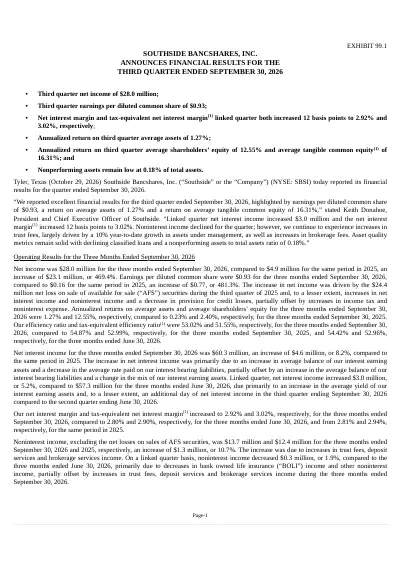
Thank you, Lindsey, and welcome to today's call. Our third quarter results are highlighted by 93 cents earnings per share, a 1.27% return on average asset, a 16.31% return on average tangible common equity, and a 3.02% tangible equivalent net interest margin.
Our tax-equivalent net interest margin benefited from improved loan and security yields and flat funding costs during the quarter. We expect the September Fed rate increase to be accretive to fourth quarter loan yields as approximately 55% of our loan book will reprice over the next 90 days.
Third quarter new loan production was strong, but largely offset by payoffs, resulting in a relatively flat loan balance during the quarter. Recognizing that commercial real estate originations may slow with recent rate increases and our expectation of continued payoffs, we are moderating our loan growth guidance to low- to mid-single digits for 2026.
Third quarter new loan production totaled approximately $400 million, of which $276 million funded during the quarter. Excluding regular amortization and line of credit activity, third quarter payoffs totaled $281 million.
This was down slightly from second quarter payoffs totaling $297 million. Third quarter payoffs are heavily weighted towards CRE and include four multifamily loans accounting for just over half of our payoffs.
On a positive note, these payoffs resulted in a $15 million decrease in classified assets for the quarter. Our loan pipeline totals $1.2 billion today, down from the second quarter levels of $1.4 billion.
We've issued term sheets on approximately $222 million of this pipeline with $99 million in the closing process. Commercial construction loans and commercial lines of credit represent approximately 56% of the pipeline, while full funding term loans represent approximately 44%, a change from second quarter pipeline when term loans made up approximately 52% of the total pipeline.
C&I loans, including owner-occupied real estate loans, increased approximately 5% during the quarter and now represent 18% of our total loan portfolio, up from 16% at year-end 2025. In addition, C&I opportunities represent approximately 24% of today's total pipeline.
Other notable third quarter items include a newly hired director of treasury management and the start of a second branch construction project. The new start is located south of Fort Worth in Burleson, Texas and expands our commitment to the greater Fort Worth market.
Additionally, the Celina-Prosper construction project continues to move forward with completion expected in the second quarter of 2027. When considering our net income, earnings per share, and other financial results, we had an excellent quarter.
Overall, the markets we serve remain healthy, and the Texas economy is anticipated to grow at a faster pace than the overall US growth rate. With that, I look forward to answering questions, and I'll turn the call over to Julie.
Julie Shamburger
Thank you, Keith. Good morning, everyone, and welcome to our third quarter earnings call.
For the third quarter, we are pleased to report net income of $28 million, a linked-quarter increase of $1.1 million, or 4.2%. Diluted earnings per share were 93 cents for the third quarter, up 3 cents per share linked quarter, a 3.3% increase.
Loans increased slightly compared to the second quarter to $4.96 billion as of September 30th, and the average rate of loans funded during the third quarter was approximately 6.1%, consistent with the second quarter and down from 6.3% in the first quarter. As of September 30th, our loans with oil and gas exposure were $54.6 million, or 1.1% of total loans, a decrease of $21.5 million compared to $76.1 million on June 30th, driven by payoffs associated with one relationship.
Nonperforming assets increased by $6 million, or 61.6% linked quarter, largely driven by a $5.2 million CRE loan that subsequently paid off in full on October 1st, 2026. Nonperforming assets remain low on a linked-quarter basis at 0.18% of total assets at quarter end.
Our allowance for credit losses increased to $50.4 million from $49.3 million on June 30th. Linked quarter, our allowance for loan losses as a percentage of total loans increased 2 basis points to 0.94% at September 30th.
The securities portfolio increased $49.3 million, or 1.8%, to $2.83 billion on September 30th when compared to $2.78 billion on June 30th. The increase was mainly driven by purchases of mortgage-backed securities and, to a lesser extent, corporate bonds during the third quarter.
As of September 30th, we had a net unrealized loss in the AFS securities portfolio of $93.3 million, an increase of $83.5 million compared to $9.8 million last quarter, which was driven by the increase in longer-term rates. On September 30th, the unrealized gain on the fair value hedges on municipal and mortgage-backed securities was approximately $7.6 million compared to $3.1 million linked quarter.
This unrealized gain partially offsets the unrealized losses in the AFS portfolio. Our AOCI on September 30th, 2026 had a net loss of $149.8 million compared to a net loss of $92.1 million on June 30th, 2026.
The net loss was comprised of net losses on our securities and swap derivatives of $133.9 million and $15.9 million related to our retirement plans. As of September 30th, the duration of the total securities portfolio was 7.8 years compared to 7.2 years at June 30th, and the duration of the AFS portfolio was 5.9 years compared to 4.3 years on June 30th.
At quarter end, our mix of loans and securities was 64% and 36% respectively, consistent with the second quarter. Deposits decreased by $155.6 million, or 2.5% on a linked-quarter basis.
This was primarily driven by a decrease in public fund deposits of $200.2 million and an overall decrease in commercial and retail deposits of $4.8 million, partially offset by an increase in brokered deposits of $49.4 million. The net decrease in commercial and retail deposits resulted from the seasonal $99.1 million commercial escrow account that funded during the second quarter and rolled off in July.
We remain well capitalized with strong capital ratios. Liquidity resources remain solid with $1.9 billion in liquidity lines available as of September 30th.
We did not repurchase any common stock during the third quarter. However, since quarter end, we purchased 36,474 shares at an average price of $30 per share.
Our tax-equivalent net interest margin was 3.02%, an increase of 12 basis points on a linked-quarter basis from 2.90% for the second quarter. Our tax-equivalent net interest spread for the same period was 2.36%, an increase of 10 basis points from 2.26%.
The increase in the net interest margin and the net interest spread is primarily due to the higher yield on securities and loans and flat funding costs in the third quarter. Suni will provide details on the higher yield in the securities portfolio during her remarks.
For the three months ending September 30th, we had an increase in net interest income of $3 million, or 5.2% compared to the linked quarter. Noninterest income decreased $271,000, or 1.9% for the linked quarter due to decreases in BOLI income and swap fees and equity fair value adjustments included in other noninterest income.
Our trust and brokerage services continued to perform well this quarter. Trust fees increased $259,000, or 10.8% linked quarter, and increased $1.5 million, or 27% for the nine months ending September 30th, 2026 when compared to the same period last year.
Wealth management and trust assets under management increased to $1.8 billion on September 30th compared to $1.5 billion on September 30th, 2025. Additionally, brokerage services income increased $137,000, or 9.8% linked quarter, and $795,000, or 22.6% year to date compared to the same period in 2025.
Noninterest expense was $39 million for the third quarter, an increase of $346,000, or 0.9% compared to the linked quarter. The increase was largely driven by an increase in salaries and health expense.
Our fully taxable equivalent efficiency ratio decreased to 51.55% as of September 30th from 52.96% last quarter due to the increase in net interest income, partially offset by the increase in noninterest expense. Our budget indicates average noninterest expense of approximately $40.5 million for the fourth quarter.
We recorded income tax expense of $6.3 million compared to $5.7 million in the prior quarter, an increase of $542,000, or 9.4%. Our effective tax rate was 18.3% for the third quarter compared to 17.6% last quarter, and our current estimate for the 2026 annual effective tax rate is 18%.
At this time, I will turn the call over to Suni. Thank you.
Suni Davis
Thank you, Julie. There were several factors that contributed to the linked-quarter increase in securities income, such as the average book balance increased approximately $11 million, amortization expense decreased $638,000, interest income on the fair value swap increased $163,000, cash flows reinvested during Q3 brought approximately 35 basis points higher yields than those purchased in Q2.
Also, various bank sub-debt bonds repriced from fixed to floating, and we received a one-time prepayment penalty on a CMBS of $65,000. The MBS purchases of $172.2 million in the third quarter have coupons ranging from 5% to 6%, a duration of 6.9 years, and yield 5.75%.
These were purchased at slight premiums. Corporate bond purchases of bank sub-debt were $19.5 million and were new issues of investment-grade credit yielding an average rate of 6.63%.
We expect to reinvest future cash flows from the securities portfolio into AFS MBS and potentially to a lesser extent into bank sub-debt while maintaining the balance of securities at approximately $2.8 billion. The principal cash flows we received during the quarter were $55.6 million, a decrease of $53.9 million linked quarter.
The spot rate on our CDs was 3.62% at quarter end, a decrease of 5 basis points linked quarter. The average rate was 3.62% during the third quarter, a 7 basis point decrease from Q2.
CDs totaling $517 million with an average rate of 3.63% will reprice in Q4. We expect to retain the majority of these deposits, but believe there will be a near-term need to increase the rates offered due to competition.
Additionally, $1 billion in CDs with an average rate of 3.64% will reprice in the next 12 months. We adjusted CD rates and high-yield savings rates after the Fed funds increase in September, maintaining an approximate average beta of 35 on those accounts.
Our public fund deposits decreased $200.2 million in the third quarter. Approximately $141 million was due to maturing CDs requiring renewal rates we were unwilling to pay.
The remaining decrease was due primarily to construction draws from bond funds. We have certain non-maturity deposit accounts with exception pricing.
There were no interest rate adjustments to these accounts in Q3 other than on an individual basis. We have seen a higher cost on recently acquired deposit accounts versus existing accounts.
In the third quarter, new deposit accounts, including CDs, but excluding brokered and public funds, had an average rate of 2.64% versus existing accounts averaging 1.57%. Reciprocal deposits were $338.5 million at quarter end, a decrease of $21.6 million linked quarter.
Many of these accounts are included in the exception pricing. Approximately 83% are commercial and 17% are consumer.
Linked quarter, our wholesale funding increased $334.3 million to $1.7 billion. This includes an increase in brokered deposits of $49.4 million.
The increase was primarily due to a decrease in public fund deposits and an increase in the book value of securities. Our cash flow hedge notional remains at $615 million with no maturities or additions in Q3.
The next maturity is a $25 million notional maturing in November, currently at a rate of 4.75%. After this maturity and some amortization related to past unwinds is fully expensed in October, the rate on our current cash flow hedges will drop approximately 25 basis points, assuming current spreads.
However, if we were to replace the Q1 2027 maturities at current rates, that $160 million would reprice up approximately 150 basis points. We have a notional of $291.1 million in fair value swaps on municipal and MBS securities.
This is a reduction of $67 million linked quarter due to an MBS maturity on September 1st. Approximately 37% of our loans have fixed rates and 63% have a floating rate, with approximately 82% of our floating rate loans having floors.
We have approximately $318 million in fixed rate loans that mature or reprice in the next 12 months. $131.1 million of those are in Q4.
Of the loans maturing or repricing in the next 12 months, $137.5 million have an average rate of 3.7%. We are currently modeling Fed funds to be flat for the remainder of 2026 as forecast by Moody's.
Should rates increase in the short term, we could expect a positive impact on net interest income since we are asset sensitive. We are modeling a beta of 39 on non-maturity deposits.
Thank you for joining us today. This concludes our prepared comments, and we will now open the line for your questions.
Operator
We will now begin the question-and-answer session. If you would like to ask a question, please press *1 to raise your hand.
To withdraw your question, press *1 again. We ask that you pick up your handset when asking a question to allow for optimum sound quality.
If you are muted locally, please remember to unmute your device. Please stand by while we compile the Q&A roster.
Your first question comes from the line of Brett Rabatin with StoneX Group. Your line is now open.
Please go ahead.
Brett Rabatin
Hey, good morning everybody. Thanks for the questions.
Wanted to first start off on the margin and the securities yield. It seemed like there was a lot of noise in the linked-quarter change in the yield.
I was trying to write down all the numbers you guys were mentioning about the various line items that impacted that. Does the securities portfolio yield hold at these levels, or could there be some atrophy?
Then, I guess I'm just curious, you're talking about being asset sensitive, but it does seem like you've done a great job managing the funding costs here, particularly in 3Q. It sounds like maybe the fourth quarter might be somewhat higher in terms of the funding costs.
I was just hoping to encapsulate all of the variables there that I know the margin's hard to predict, but was just trying to understand a little bit better what might happen from here.
Suni Davis
On the securities portfolio, of course we had the one-time CMBS prepayment of $65,000, and some of that fair value swap income, the $163,000, is related to ineffectiveness, and that was an expense to us in the first half of the year. It flipped, it was now income in the third quarter.
The fourth quarter, I don't see the same amount of change. As far as the yield on the purchases, I see that holding because our prepays have slowed down.
It was $638,000 decrease in our amortization expense linked quarter, I see that being consistent in the fourth quarter. Not down another 638, but being flat in Q4 to Q3 because we haven't seen the huge prepayments that we saw in the first quarter and into April of this year.
Keith Donahoe
On the loan side, we've spent a lot of time over the last two years making sure that the new real estate transactions were booking, for the most part, are floating rate transactions. Customers are always interested in interest rate protection, we are putting them into back-to-back swaps, and we've done a really good job of that in the last couple of years.
So, 55% of our book is floating and, well, actually floating is a little bit higher, but 55% of our book will be repricing, and most of that repricing has now happened since the Fed moved in September. We only had two weeks of that benefit in the third quarter, I'm pretty bullish on the fact that if rates continue to move up, we're going to see the benefit.
There'll be somewhat of a lag, but most of that loan portfolio is priced at a floating transaction. It's 30-day SOFR plus a spread, so.
Suni Davis
On the funding side, we will see some increase in our CDs that are coming up for repricing, because they're going to be pricing probably into the 3.90s range from an average they're averaging right now in the low 3.60s. On wholesale, at quarter end, our non-swapped wholesale was 4.03%.
I see that increasing. I'm going to try to keep it around 4.10%, but it could creep up to 4.15%.
I think these are smaller dollar amounts, and the betas on the CDs for sure are smaller than the betas on the loans. The loan amounts are higher and the betas are 100%.
Brett Rabatin
Okay. That's good color.
Then, I saw that you had the pass-through payoff and classifieds down to 245 from 260. Was just hoping to get any additional color.
I know there's several multifamily projects in Austin that you guys have been working on. Just was hoping for maybe any update on those and how you guys kind of see asset quality from here.
You obviously had no charge-offs this quarter, credit continues to be fairly benign, but was just hoping for some additional color on those properties.
Keith Donahoe
I guess I kind of want to reiterate, we are very conservative with our risk rating, and that comes from a lot of experience in the real estate market in particular, where we know the sooner you identify struggles, the easier it is to manage. We're pretty good and focused on making sure that we're identifying issues early.
As a result, you saw somewhat of a spike in our classified assets earlier in the year. We did not and still do not see any true losses coming out of those larger real estate transactions.
As indicated by the fact that we haven't seen the charge-offs, and we continue to see a reduction in our classified assets. Many of these assets, the four that paid off, the four multifamily assets that paid off in the third quarter, two of them were refinanced by life companies, one was, I think, refinanced by debt fund, and one was open market sale.
It's a sign of a healthy real estate portfolio, in spite of the fact that we're pretty critical on our risk rating. I anticipate more of the same.
There's nothing that is sticking out, for sure in the near term, that causes me any concern. There's always surprises, but we hope that we are engaged with our lending staff early and often to identify those.
Right now, there's nothing on the horizon that indicates any major issues.
Brett Rabatin
Okay. That's really helpful.
Thanks so much.
Operator
Your next question comes from the line of Woody Lay with KBW. Your line is now open.
Please go ahead.
Woody Lay
Hey guys. Wanted to start out on the margin again.
If I think back to last quarter, we had talked about the potential for additional NIM pressure unless we get a rate hike. We got the rate hike, but it came kind of at the end of the quarter.
It feels like the margin outperformed expectations. I was just curious from y'all's perspective, what were the biggest surprises in your view that allowed for this positive snapback?
Keith Donahoe
I think one of them is we were pleasantly surprised that we won a couple of loan transactions that had slightly higher spreads, which helped. In addition to that, I think Suni and her team has done a great job on managing the funding cost.
Suni, you want to add anything?
Suni Davis
No, we just been very diligent about it, and we've moved our sources. As you can see, we went back into the brokered market some.
We've continued to do that in Q4, just because those rates have come down and we've seen they're advantageous over borrowing from FHLB. We've maxed out our collateral at the discount window and continue to borrow there, because that is the cheapest rate that we can get wholesale-wise.
Unfortunately, we had to let some public funds go, and so that was due to rate. We're just watching and just seeing it being opportunistic with funding.
Being cautious with our exception pricing as well. We get requests multiple times a day for exception pricing on deposit accounts, and we set some parameters around that.
I think we did well with that in Q3.
Keith Donahoe
That help, Woody?
Woody Lay
Got it. No, that's really helpful.
I guess, because y'all have been very active on the liability optimization to find the best rate, sometime it can be a little bit tough from my seat to get a sense of the core deposit trends given some of the movement. Was just curious if y'all had a spot rate, cost of deposits at the end of the month and just general expectations for deposit cost from here post-rate-hike.
I'm
Keith Donahoe
looking at Suni. I don't know if we have that specific number.
Suni Davis
On cost of deposits, Woody, they were 1.89 in the third quarter versus 1.94 in the June 30 quarter.
Keith Donahoe
At June 30.
Woody Lay
I just didn't know if y'all had a spot cost post-rate-hike and the direction that's trending.
Suni Davis
I have it for CDs. It was 3.62 for CDs, and then our existing deposit base was 1.57 including CDs, but not including brokered and public funds at quarter end.
Then the newly put-on deposits was the higher, what was it, 2 2.62-ish during the quarter.
Keith Donahoe
Deposit competition is real, and we're going to see upward pressure on our pricing. We do have some initiatives in place that they're not going to move the needle tomorrow, but over time they will, that one reason I highlighted the growth in our C&I business is because we truly believe that C&I business drags in more deposits, stickier deposits, and a lot of times cheaper priced deposits, because you get larger non-interest-bearing accounts.
We are very focused on that as an organization. As we grow into the metro markets, our growth pattern is going to lead with C&I.
We've got real estate covered, and we'll continue to grow that book, but the C&I is really about it's loan growth, but it's also deposit growth geared.
Woody Lay
I appreciate the color. I guess just last for me, it was good to hear you all positively surprised on some of the loan yields y'all are getting on a couple of credits.
Just curious how that pricing and spread has held up so far in October.
Keith Donahoe
Don't get me wrong. It's still competitive out there.
Where you may see some lift, and I don't have these numbers, but we've booked quite a few construction loans that over the last 18 months that are going to start funding up. The ones that were booked a year ago to 18 months ago had significantly higher spreads, and so we will benefit from that over the next 6 months as they start to fund up.
Maybe before the next call, I'll have some color on what we anticipate from a construction draw funding, because those spreads are higher. It is still hand-to-hand combat, both on loan spreads as well as deposit pricing.
Woody Lay
Yep. All right, well great.
Thanks for taking my questions.
Keith Donahoe
Thank you.
Operator
Your next question comes from the line of Michael Rose with Raymond James. Your line is now open.
Please go ahead.
Michael Rose
Hey, good morning guys. Thanks for taking my questions.
Just wanted to go back to some of the comments you made, Keith, on loan production and pipelines. I think you said the pipeline was down about $200 million from last quarter.
Obviously, you've had some payoffs and rates probably going to move higher at least one more time. We'll see.
How should we think about the payoffs? I know obviously just given what you've had over the past couple quarters, the loan growth for the full year is a little bit subdued versus your prior expectations.
As we kind of contemplate kind of next year with likely some continued CRE payoffs and ongoing growth in other parts of the business, is kind of the low- to mid-single digits the way we should at least initially think about growth for next year? Thanks.
Keith Donahoe
I wouldn't expect a drastic change in 2027. We are putting in place or we've got a couple of initiatives to help even out the loan growth, if you will.
Historically, we've not spent a lot of time on the retail side of the business. We have an effort in place right now to grow our consumer lending business.
Some of that's going to come through a home equity line of credit product that actually is out and available to customers today, just started in the last 30 days. We're hopeful that helps move some needles.
We're also focused on just general consumer lending. If you go back and look at our numbers over the last 10 years, that portfolio has just declined every year.
We're going to try to turn that around. I'm not telling you we're going to book $100 million worth of that next year, but it is something we're focused on.
In addition, we are actively engaged with potential team lift-outs in different markets. As everybody knows, there's been a lot of disruption in the metro markets in particular, although we've also seen it here in the East Texas market.
Many of those folks are not in a position to make that move yet, but I do think early '27 and throughout '27 those opportunities are going to come our way, and we are actively looking. Those won't have an immediate impact on loan growth, but they will over the next 24 months to 36 months.
Michael Rose
That's helpful color, Keith. I appreciate all the commentary.
Maybe just as a follow-up, it was good to see you guys repurchase some stock after kind of quarter end. Capital levels obviously still very strong.
I know the TCE impacted by the AOCI impacts that you and others are facing. How should we think about buybacks from here?
I know you previously talked about M&A. Just any updated thoughts there.
Thanks.
Keith Donahoe
I guess one way to say it is unfortunately, when you see us buying stock, it's because our stock is trading below where we think it should be. We will continue to be opportunistic with those purchases.
An acquisition is still something that's likely in our future. I continue to meet folks and have discussions, but there's obviously nothing active today.
We do think in 2027, there may be some opportunities that come our way.
Michael Rose
All right. Thanks for taking my questions.
Operator
Your next question comes from the line of Matt Olney with Stephens. Your line is now open.
Please go ahead.
Matt Olney
Hey, thanks for taking the questions. Want to ask about your loan-to-deposit ratio is now, I think, a little over 80%, the highest we've seen in a while.
Curious kind of your expectations here. Can this continue to move higher?
Just any thoughts there. Thanks.
Keith Donahoe
I can't tell you it's not going to go a little bit higher, but it all depends on our ability to go gather deposits. Brokered deposits might have a positive effect on that ratio as we move back into that market.
Again, we're pretty opportunistic, and Suni's team really literally daily manages that funding side. That was probably the biggest hit.
As you could tell, we weren't outstripping loan growth from our deposits. We just moved out of brokered deposits earlier this year that spiked that ratio.
Matt Olney
Got it. Keith, on the brokered side, is there any strategic target or percent of deposits that you're targeting for brokered versus non-brokered?
Suni Davis
We have internal limits, but no, there's not a target. It's just as long as we need wholesale, we're just looking for the best rate.
Matt Olney
Okay. Appreciate that.
Then Keith, you mentioned the strong C&I growth, and it sounds like some good pipelines there. Any more color?
I think you made some nice hires over the last few years. I would assume some of this pipeline growth is from those new hires.
Any more color on the C&I performance?
Keith Donahoe
Some of that is coming from the Houston team, we've now been together a couple of years. They really are starting to get their footing.
A lot of that growth also came right out of our East Texas markets. As I've pointed out a number of times, we've long done C&I throughout East and Southeast Texas, and we do it really well.
We've had some hires here in the East Texas market that is really helped drive some of that. We're anticipating a handful of other hires in the East Texas and Southeast Texas markets that can help do that as well.
Matt Olney
Okay. Thanks for the color.
I'll step back.
Operator
Your next question comes from the line of Stephen Scouten with Piper Sandler. Your line is now open.
Please go ahead.
Stephen Scouten
Hey, appreciate the time here. Thank you.
Maybe going back to the NIM outperformance here in the quarter, it was great to see cost of deposits down 5 bips, seemed to be the primary driver. Is the kind of anticipated pressure on funding costs, is that primarily dependent on loan and overall balance sheet growth?
Is it just that, you were able to, yeah, shrink deposits this quarter because of the lack of loan growth, that kept that pressure from manifesting? Is that kind of the right way to think about it?
Keith Donahoe
Do you want to answer?
Suni Davis
I don't know that that is the
Keith Donahoe
run-down. We we had a seasonal deposit deposit relationship that spiked in the second quarter, paid off in the third quarter—not paid off, it moved out in the third quarter.
Some of that contributed to our our deposit reduction. I think, as one thing that, because of the effort we've done with moving to a more floating rate book, so far, our our loans have repriced at a higher rate than what our deposit growth or our deposit cost increase has been.
We anticipate that to continue. I know I would love to say that, we can keep it at a 15 basis point delta, but as long as we're able to reprice loans faster, which this is different, something that that everybody ought to be aware of, the last time rates rose, we were not in a position to reprice our book loan book as fast as we're able to reprice our loan book today.
In addition, Suni pointed out, we've got about $131 million in loans that come up for maturity or repricing in the fourth quarter. Those those rates right now in that book is about 4.74%, I think you said, 4.75%.
We anticipate moving those to, more market rates that will help also improve the loan yields.
Stephen Scouten
Got it. Have you guys quantified at all kind of the impact of each potential 25 basis point hike on the NIM?
If we get these two more hikes that the forward curve suggests, is that a couple basis points per hike, or do you have a number that is a proxy there?
Keith Donahoe
We have not run that number specifically. We're making a note.
We'll see if we can get that out to you.
Stephen Scouten
Great. Then, just thinking about the securities book, it sounds like you guys are increasing the duration of the securities book a bit.
Can you talk to me about the strategies there or maybe what that signals where you think rates could be going over the, I guess, longer term maybe? Just any color there would be great.
Keith Donahoe
That had more to do with the rising rate environment stretching out the duration than intentional movement by us. In a perfect world, I'd love to see a 3 to 4-year duration on our entire securities book, but with almost half of it in HTM, we're not able to do that.
Hopefully that answers your question.
Stephen Scouten
That's good. Then just lastly, with the move to more C&I loans on your books and in the pipeline as well, should we expect to see the loan loss reserve as a percentage of loans increase kind of in tandem with that increase in C&I loans?
Do you hold more reserves against those loans than the CRE loans? No,
Keith Donahoe
I haven't dug in specifically on that. I don't anticipate it having a material effect.
One reason is because, as tight as we are on real estate credit, we're probably a little more tighter on C&I credit. I'll look at that number and maybe provide some guidance on that on future meetings, but right now, it's not something that I anticipate to be a material increase in reserves.
Julie Shamburger
About a 1.11 on the commercial, the pure commercial, not even real estate,
Keith Donahoe
just
Julie Shamburger
commercial.
Keith Donahoe
I don't know if you heard that.
Julie Shamburger
Probably not,
Keith Donahoe
I was Julie said that we have a 1.11 coverage on just pure commercial. It does not include commercial owner-occupied.
Julie Shamburger
No, it does not. Those are higher.
Stephen Scouten
Maybe a little bit higher then, but not materially, because you guys remain very tight on that credit box. That's great to hear.
Okay. Fantastic.
Thanks for all the color today. Appreciate it.
Keith Donahoe
Thanks, Steve.
Operator
There are no further questions at this time. I will now turn the call back to Keith Donahoe, President and CEO, for closing remarks.
Keith Donahoe
Thank you everyone for joining us today. We appreciate your interest in Southside Bancshares along with the opportunity to answer your questions.
We're optimistic about 2026 and moving forward into 2027 and look forward to joining you all on the earnings call in January. Thank you.
Operator
This concludes today's call. Thank you for attending.
You may now disconnect.