Tecogen Inc.
AAMEX:TGENQ4 FY2025 · Earnings Call TranscriptMarch 18, 2026
Operator
Greetings, and welcome to the Tecogen fiscal year 2025 conference call. At this time, all participants are in listen-only mode.
A question-and-answer session will follow the formal presentation, and you may be placed into the question queue at any time by pressing star one on your telephone keypad. As a reminder, this conference is being recorded, and if anyone should require operator assistance, please press star zero.
It's now my pleasure to turn the call over to Jack Whiting, General Counsel and Secretary. Please go ahead, Jack.
Jack Whiting
Morning. This is Jack Whiting, General Counsel and Secretary of Tecogen.
The call is being recorded and will be archived on our website at tecogen.com. The press release regarding our fourth-quarter and year-end 2025 earnings and the presentation provided this morning are available in the Investors section of our website.
I'd like to direct your attention to our safe harbor statement included in our earnings press release and presentation. Various remarks that we may make about the company's expectations, plans, and prospects constitute forward-looking statements for purposes of the safe harbor provisions under the Private Securities Litigation Reform Act of 1995.
Actual results may differ materially from those indicated by forward-looking statements as a result of various factors, including those discussed in the company's most recent annual and quarterly reports on Forms 10-K and 10-Q under the caption Risk Factors filed with the Securities and Exchange Commission and available in the Investors section of our website under the heading SEC Filings. While we may elect to update forward-looking statements, we specifically disclaim any obligation to do so, you should not rely on any forward-looking statements as representing our views as of any future date.
During this call, we will refer to certain financial measures not prepared in accordance with generally accepted accounting principles, or GAAP. A reconciliation of non-GAAP financial measures to the most directly comparable GAAP measures is provided in the press release regarding our Q4 and year-end 2025 earnings and on our website.
I'll now turn the call over to Abinand Rangesh, Tecogen CEO, who will provide an overview of fourth-quarter and year-end 2025 activity and results, and Roger Deschenes, Tecogen CFO, who will provide additional information regarding Q4 and year-end 2025 financial results. Abinand?
Abinand Rangesh
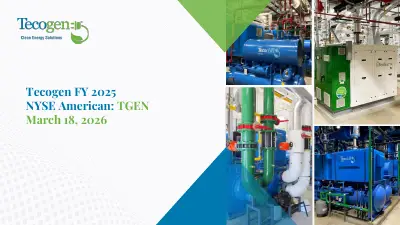
Thank you, Jack. Welcome to Tecogen's fiscal year 2025 call.
I know many of you would like an update on how the data center cooling strategy is progressing. Today, I'm going to start with an update on the Vertiv partnership.
There have been some key positive developments that I'll share, including their opportunities for our chillers. Then, I'm going to walk you through Tecogen's data center opportunity pipeline outside the Vertiv partnership.
After that, I will provide an update on the other avenues we are working on, including expanding our manufacturing throughputs, increasing service revenue and margin, and the non-data-center pipeline. We have seen significant forward momentum with the Vertiv relationship.
First, Vertiv has designed, or is in the process of designing, between 25 and 50 MW of our chillers into various projects. This is equivalent to 50 to 100 of our 150-ton dual power source air-cooled chillers.
Second, we have been negotiating our master partnership agreement that expands the marketing agreement that we signed last year. Third, we have discussed bringing Tecogen's hybrid drive technology to Vertiv chillers.
As the sales grow, this may allow Tecogen to scale manufacturing very quickly, because we would focus on the dual power source and mate this to the refrigeration system that is already built in volume in Vertiv's factories. Last, and most exciting of all, we have secured a demonstration project with Vertiv.
This is expected to ship sometime toward the end of Q2 for 1 MW of cooling, or two times our 150-ton dual power source chillers. Our chiller will go to the Vertiv controlled environment test chamber, where it will operate under simulated AI data center conditions and various outside ambient temperatures.
This technology demonstration project gives prospective customers data on how the chiller will operate under real-world data center conditions across a range of ambient temperatures. While we have been furthering the Vertiv partnership, we have also been expanding our own data center pipeline.
In this list, we have only included opportunities where the end customer has told us they plan to use Tecogen chillers and have made significant progress on signing data center tenants. This list is sorted based on our current project confidence.
Developers that have existing data center experience and financing are higher on the list. Based on past experience, customers typically want chiller equipment delivered six to nine months before the site needs to be operational.
For sites that are expected to be operational in early 2027, this would suggest equipment orders no later than Q2 or Q3 this year. Timing is always difficult to predict, because there are multiple moving pieces on the customer's side, but the timeline we have seen to date is completely consistent with our historic sales cycles.
Projects can also go through stop-start cycles before closing. For example, in the past five months alone, we have had two instances where potential customers have told us they were ready to place the purchase order, but then hit unforeseen delays on their end.
However, as you can see, we have multiple opportunities of various sizes, thereby increasing the odds in our favor. One project is an expansion of an existing data center.
They plan to use our dual power source chiller to handle new tenants. Another is in the final stages of tenant negotiations and expects to use our DTX chillers to maximize IT capacity.
The same developer also has a second project of a similar size and another of a larger scale. Next, there is an opportunity for a demonstration project with an established data center owner for up to 40 chillers.
This developer evaluated the cost of power from our chillers against the alternatives and found the value highly compelling. However, they were also looking for some independent validation of our chillers.
We believe that the Vertiv demonstration project will be instrumental in unlocking this opportunity. The remaining projects have filed for environmental permits and are in active discussions with tenants.
They represent 100 to 200 chillers collectively. We expect more clarity on construction timing as permits are granted and tenant negotiations progress.
In our previous calls, we had mentioned an opportunity where we have an LOI for six STX chillers. Although this opportunity is progressing, we have moved this further down the list because we believe the others outlined above are moving faster and have more near-term potential.
In addition to this list, we also have ongoing discussions with multiple hyperscalers and multiple other data center developers. The current timeline on these projects are completely in line with projects in other industries.
We also believe that closing the first few opportunities will unlock significant demand. Based on conversations with prospects, even if we have chillers in other critical cooling applications, many data center owners would still like to see our chillers in other data centers or cooling AI loads.
We believe this concern will be addressed with the Vertiv demonstration project and some of the near-term opportunities. Aside from data center projects, we are expecting chiller orders from other segments, such as cannabis, hospitals, and comfort cooling.
These represent at least another six DTX chillers. Expected delivery is the fall and winter of this year.
We're also seeing a gradual resurgence in cogeneration leads as utility rates rise across the United States. Given the significant amount of interest in our dual power source chiller, we wanted to make sure we could handle a step change in order volume.
We have now qualified a vendor for the sheet metal and refrigeration assembly. This vendor already builds hundreds of similar refrigeration and sheet metal assemblies for a large chiller company.
We have also qualified an electrical assembly vendor for the power electronics and are in the process of qualifying a second vendor. We are also presently building some inventory of both the dual power source chillers and DTX chillers.
Our engineering team has been iteratively improving our design for manufacturability and to reduce build time. Given the cash usage over the last six months, I would like to provide some context and then the plan for the next nine months.
Given the size of the pipeline, one of the concerns we had was being able to handle aggressive delivery schedules. As a result, we expended cash on several fronts simultaneously to get everything we needed to do done.
Some of these uses of cash included manufacturing capacity expansion, performing the testing and improvements needed for our dual power source chiller to operate under data center conditions. We also hired a marketing firm that specializes in data centers.
In addition to the above, in Q3, we invested significantly in the service group, especially in the Greater Manhattan area. We have found over the last two years, despite increasing our service contract rates greater than inflation, we found that margin on the cogeneration products was reduced in the Greater Manhattan and Toronto service centers.
The chiller product continues to maintain solid margins. The cost of labor and increased travel times between sites is one of the biggest contributors to this decline in margin.
To counteract this, we invested in new engines in this territory with the latest performance improvements. This allows us to increase service intervals by at least 50%.
We expect this to lower labor costs per hour of operation. In Q4, we saw an increase in both run hours and margin compared to Q3 in these territories.
We will continue to monitor and, if needed, institute aggressive price increases or cost reductions where needed. Our current cash position is $10 million.
By Q2, we plan to cut the cash burn down substantially. From 2023 to mid-2025, we managed with $2 million of cash, including a factory move.
Roger will discuss the results and the financial plan going forward.
Roger Deschenes
Thank you, Abinand, and good morning, everybody. I'll start with the fourth-quarter results.
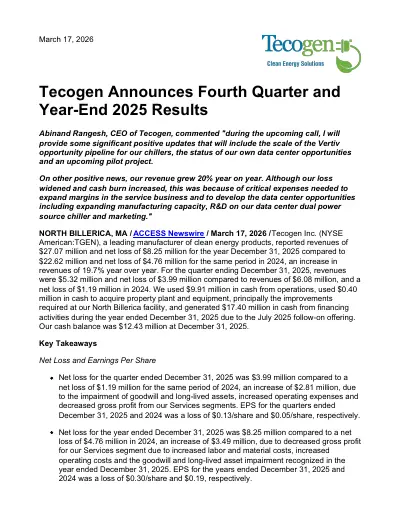
Our revenues for the quarter decreased by $800,000 in the fourth quarter to $5.3 million, which compares to $6.1 million in the fourth quarter of 2024. This is due to the decrease in product shipments and a reduction in energy production revenue.
Our gross profit also decreased by 28% in the fourth quarter compared to the comparable period in the prior period. This is due to the decrease in our products revenue and an increase in our service costs.
The gross margin decreased 8.2% to 36.8% in the fourth quarter from 45% in the comparable period in 2024. As Abinand touched upon earlier, our services margin was lower compared to the same period last year, but has increased compared to the third quarter of this year.
The quarter-over-quarter changes in revenues and gross margin will be discussed further in our segment performance slide. Our operating expenses increased 57% in the fourth quarter of 2025 to $6.1 million from $3.9 million in the fourth quarter of 2024.
This is due in part to a $900,000 increase in the asset impairment charge in our energy production segment, increased operating costs in our services segment, and increased costs in our production segment which we incurred for the manufacturing expansion that we're working towards, and we also saw increases in our R&D costs which were incurred to continue the development and refinement of our dual source chiller which is focused on our entry into the data center market. Our net loss increased in the fourth quarter to $4 million from $1.1 million in the similar period in 2024.
This is due to the reduction in sales and gross margin, the asset impairment charge, and an overall increase in our operating expenses. We'll discuss expenses in more detail in our full-year 2025 numbers.
Moving to adjusted EBITDA, the adjusted EBITDA loss for the fourth quarter was $2.4 million, which compares to about $700,000 in the same period last year. Again, this is due to lower sales and gross margin and the increased operating expenses that we experienced.
Moving to performance by segment, our products revenue decreased 68% to about $500,000 in the current period from $1.4 million in the fourth quarter 2024. This is due to a delay, as Abinand suggested earlier, of a couple projects which we expected to ship in the fourth quarter 2025, but we now expect to close these orders in the next few months.
As we have discussed in the past, our product revenue has significant variability quarter to quarter and it's borne out in this past quarter. Our products gross margin decreased to a negative 6.9% from 30.9% in the fourth quarter of 2024.
This is increased unabsorbed labor, and this is labor that we're using to work towards increasing our throughput, an increase in our inventory reserve, a slight increase in warranty costs, and all of these costs which have a disproportionate impact on margin due to the revenue decrease. Our services revenue increased 9% quarter over quarter to $4.5 million in the fourth quarter compared to $4.1 million in the comparable period in 2024.
This is due to higher billable activity and higher operating hours of the equipment from our existing service contracts. Our service margin decreased 7.4% to 43.4% in the fourth quarter 2025 from 50.8% in the fourth quarter 2024.
This is due to increased labor and material costs in the Greater New York City area. Our energy production revenue decreased 28% in the fourth quarter 2025 to just under $400,000 compared to $5 million, about $550,000 in the fourth quarter 2024.
This is due to contracts that expired early in 2024, and some of which expired late in 2023, and temporary site closures during the year. Our energy production gross margin decreased to 13.7% in the fourth quarter 2025 from 39% in the fourth quarter of 2024, and this is due to an increase in costs with our energy production business.
Moving to the full-year 2025 results, our revenue increased 19.7% or $4.5 million in 2025 to $27.1 million compared to $22.6 million in fiscal 2024. This is due to a significant increase in our products revenue and an increase in our services revenue.
Our gross profit decreased about a half a percent in 2025 compared to 2024, and the decrease in the gross margin was 7.3%, which decreased from 43.6% in 2024 to 36.3% in fiscal 2025. We'll review year-over-year changes in revenues and gross profit further in the segment performance slide.
Our operating expenses increased 25% in 2025 to $18.1 million from $14.4 million in 2024, due in part to the $900,000 increase in the asset impairment charge in our energy performance segment, increased operating costs in our services segment, an increase in costs in our products segment, again, that's geared to the manufacturing expansion, and increased R&D costs which we incurred to continue, again, the development and refinement of our dual source chiller, again, that was focused to utilize in the data center market. Our net loss increased in 2025 to $8.2 million from $4.7 million in 2024, and the loss is due to, again, lower services and energy production gross margin, the asset impairment charge, and an increase in operating costs.
We'd like to point out that we are working on a program to reduce our OpEx to levels that are consistent with levels from 2024, the 2024 spend, I should say, and anticipate to see reductions to commence in the second quarter of this year, and further expansion of those reductions in the third quarter and in the fourth quarter. Our adjusted EBITDA loss was $5.6 million in 2025, which compares to $3.6 million in the same period last year.
This is due to lower services and energy production gross margin and the increase in operating costs. Reviewing our performance by segment, our products revenue increased 105% to $9.1 million in the current period from $4.4 million in 2024.
This increase is due to an increased chiller and cogeneration revenue that was recognized in the first three quarters of 2025. As we mentioned earlier, this increase was partially reduced by, or offset by, the decrease in production revenue we experienced in the fourth quarter due to project delays.
The gross margin for products improved 1% in the 2025 to 33.2% from 32.2% in 2024. Our services revenue increased 3% year over year to $16.6 million in 2025 compared to $16.1 million in 2024.
This is due primarily to higher billable activity and a slight increase in operating hours of the equipment that's being serviced. Our service gross margin decreased 8.9% to 38.6% in 2025 from 47.5% in 2024.
This is due to increased labor and material costs incurred as we invested in new engines and new performance upgrades to the sites in New York City. The intention of these investments is expected to reduce labor hours needed per system going forward.
The decline in margin is presently only in the cogeneration equipment. Our chillers continue to generate expected and very strong margins.
Therefore, we plan to institute both price increases for cogeneration equipment in the Greater New York City area and make significant cost reductions in the territory to restore this region to higher profitability. Our energy production revenue decreased 37% in 2025 to $1.3 million from $2.1 million in 2024.
Again, this is due to contract expirations in the latter part of 2023 and early 2024 and temporary site closures for repairs. Our energy production gross margins decreased to 28.3% from 38.0% in 2024.
That concludes the results review, and I'll turn the call over to Abinand for his closing remarks.
Abinand Rangesh
Thank you, Roger. I think the single biggest improvement that we have seen in the last five months is really the securing of the first demonstration project.
I personally believe that this will be the catalyst for everything else that will come and will also unlock the much broader opportunity that we have been pursuing. In a world where AI tokens per unit of power is the new metric, we provide the simplest and most cost-effective way for a data center to obtain more power, which directly results in more compute and more revenue.
We have a robust pipeline of opportunities, the demonstration project, and I think all the pieces are coming together to unlock the larger projects and the multibillion-dollar data center cooling opportunity. Thanks for listening, and I'll open the floor for questions.
Operator
Thank you. We will now be conducting a question-and-answer session.
If you'd like to be placed into the question queue, please press star one on your telephone keypad. A confirmation tone will indicate your line is in the question queue.
One moment, please, while we poll for questions. Once again, that's star one to be placed into the question queue.
If you'd like to remove your question, please press star two. Our first question is coming from Chip Moore from Roth Capital.
Your line is now live.
Chip Moore
Hey, good morning. Thanks for taking the question.
Abinand Rangesh
Morning, Chip.
Chip Moore
Hey, Abinand. Maybe starting there where you finished on the Vertiv demonstration project.
I think you said expect this to ship later in Q2. Help us think about how quickly that should be up and running and real-world data when that should flow.
I assume this plays a role in the 25 to 50 MW that you mentioned that they're in the process of designing. Just when could we conceivably see some of those move to orders once that demonstration project is up and running?
Abinand Rangesh
I think the two pieces will move concurrently. This unit for chips in Q2 is actually going to go and get tested almost immediately in their thing, because what typically happens in a lot of these projects that we have is the end customer would like to see how is this chiller going to run in let's say 110° ambient at a certain chilled water output.
What this does, because with our conventional DTX chiller, our own test cell, we can run a lot of those conditions here, but we can't control for 110° ambient or 120° ambient. The Vertiv test chamber allows us to do this, but it also acts as a way for a potential customer to come and see it as well, right?
That's usually a very good way to close projects. The designing of the projects in the background, that's going to happen currently, and they're going to continue marketing, and they're getting opportunities.
I can't talk very specifically on timing on their projects because at this point, it's either confidential or we don't yet have enough clarity on it. What I think it's going to do, this demonstration project, the hope is to have it actually running no later actually than the end of Q2.
What we think it'll do is act as both providing the feedback for some of the bigger projects that we have and also for some of the potential customers where they may want to use our chillers in certain environments like let's say Texas. They want to know what output it'll put out at different ambient temperatures.
That's also what you will get out of this, and it's really I would say an independent validation as well of our chiller, right, and a massive vote of support from Vertiv that they're essentially putting this together.
Chip Moore
Understood. That's helpful.
Appreciate that. Maybe, for your own internal pipeline, that slide, your highest, I think you've stacked them in order, that one where you're in final stages of negotiation and you could see orders here, I think you said Q2, Q3 for a '27 type of project.
Just any more you can expand on where that stands, what they want to see, when that could move forward?
Abinand Rangesh
I don't want to predict timing because I think it's extremely hard to predict the timing. What I will say is, firstly, the DTX, we've already got the test data, and a lot of these smaller ones, they've seen our equipment in other places.
The smaller projects also find it easier to get tenants, the odds of it moving faster is much much higher. Also things like financing and getting approvals for environmental permits tend to be much easier for the smaller projects.
Because some of the greater than 100 MW projects, you've got more hurdles to go through on the back end to make sure the local site approvals, all of that happens without an issue, and then also having the tenants. What we're seeing more broadly in the data center industry is you're getting a lot of the neocloud as potential tenants, and there's quite a few of the smaller-scale neoclouds that are interested in these kind of smaller-scale projects, which makes it much more likely that these things will go through.
I don't want to predict timing. All I know is that in many of these cases, the customer expects to be operational by early next year.
To really be able to get equipment on order, get everything delivered in that time, and actually constructed on-site, they need to move quickly.
Chip Moore
Helpful, very helpful. Maybe a last one for me, just on the manufacturing side.
It sounds like you've made some good strides, and you've got some potential with Vertiv as well. Just what's the highest priority?
What are you focused on? What do you need to do here to get prepared?
Thanks.
Abinand Rangesh
I think we've gotten most of the key pieces together now, because a lot of that was getting the subcontractors qualified and really get first articles from them, and then get the first article checked internally to make sure that meets our quality standards and that we can get the different pieces from them and it arrives at our factory, we can just do the final assembly, test it, get it out the door. Getting the subcontractors qualified was really the key, and I think we've now done that.
Also these subcontractors have significant scale-up capability already. I believe those pieces are now together, especially for the dual power source chiller.
The DTX, I think our supply chain was reasonably robust to start with. I think we have the ability because a lot of the bigger components on the DTX are built by some very large companies already, we can get scale-up from them without too much of a problem.
It was the dual power source chiller really with the size of the machine, as well as making sure that we weren't having a lot of time on the floor in our factory here. To get some of the bigger components built outside and brought in, that was really the key, and I think we've now done that.
Chip Moore
Got it. Maybe the follow-on, with a lot of that heavy lifting done, it sounds like maybe you don't need to sacrifice non-data-center orders, if you start to see demand pick up in some of those other areas.
Abinand Rangesh
Correct. I think we are going to see quite a bit more in non-data-center projects as well.
On the sales efforts and the marketing efforts, we essentially split the sales team to have some people handling non-data-center and some handling the data center. Part of the lumpiness on the product side is just what we've seen overall in the industry is we used to get a consistent amount of small multi-family like one-unit, two-unit orders that were kind of steady flow.
With the anti-gas sentiment in some of the bigger cities like New York and Boston, that portion had declined. It's starting to come back.
What we have a very good pipeline of is multi-unit larger projects that are going into bigger buildings. The problem with those projects is that if one project gets even slightly delayed, you've basically moved out three to four units at a time.
There's a little bit of timing issues there, but I think the pipeline is very, very robust on that.
Chip Moore
All right. Appreciate it.
Thanks very much.
Abinand Rangesh
Thanks, Chip.
Operator
Thank you. Next question today is coming from Alexander Blanton from Clear Harbor Asset Management.
Your line is now live.
Alexander Blanton
Thank you. Good morning.
Abinand Rangesh
Morning, Alex.
Alexander Blanton
Yes. I'm interested in your outsourcing strategy because, clearly, to get significant orders from data centers, they're going to have to be sure that you can deliver the quantities that you're talking about.
Could you just go into a little more detail about how that's going to work, what things are going to be outsourced? I take it these components will come to your factory and just be assembled.
You have obviously changed your manufacturing process significantly in doing that. A little more detail?
Abinand Rangesh
Yeah. No, that's a great question.
Let me start with the end portion, which is we didn't actually change our manufacturing process necessarily. When we designed the dual power source chiller, we always designed it with the option of being able to either do all of it in-house or have large portions of it built in subassemblies that then came internally.
The other thing that we always did on that product was to use a lot of components that are built in larger volume to start with so that we could with volume also see an increase in margin. When you think about the dual power source chiller, right, I think of it in sort of certain blocks.
You have one big block, which is really the refrigeration assembly, it's similar to an electric chiller. It has your compressors, it has your fans, it has your sheet metal assembly.
Then you have the power assembly, which has the engine and the generator. Then we have the power conversion or the electronics, which is really the dual power source technology.
The combination of the engine and the inverter and power electronics technology is very similar to our inverter. The biggest challenge we have in our manufacturing space is just in terms of just physical footprint on floor space, and also we historically have built numerous inverter units, we can build those in volume very very easily as long as the electronics show up pre-assembled.
We can mate it with our engine system, our generator, essentially build that power electronics and engine package very quickly. The refrigeration assembly, you're dealing with a lot of sheet metal.
It's not necessarily something that is best done in our factory here, because if we can reduce time on the floor by having somebody that builds similar assemblies for other electric chiller companies, then we can essentially have that portion pre-built, pre-tested, it can come to us and get mated with the power electronics assembly. The other big advantage of really focusing on a power electronics and engine assembly is it gives you other options as well, including beyond just pure chillers.
It gives you the option of being able to power things like fans in a data center or other loads, and where you can arbitrage the two power sources. You not only get a volume boost, but you can also open up a broader market.
Going back to your question of putting these two together, it's essentially a lot of that sheet metal assembly, it's better done by people that that's all they specialize in, and they have the volume throughputs, and usually they're vertically integrated, starting from the sheet metal all the way to all of the different components, and they're already buying a lot of those subcomponents in volume. Getting that as a single assembly, bringing it into our factory, mating it with the power system, and then shipping it out is one way to do it.
Eventually, we could even ship that power assembly to the sheet metal manufacturer, they do the final assembly, everything is pre-tested at each location, and then it's shipped. There's different ways to significantly improve volume and also hit delivery times using that approach.
Alexander Blanton
Given the constraints, what's your effective capacity then if you have your subcontractor do the assembly? Seems to me that it expands quite a bit.
Abinand Rangesh
Yeah. I would still say today, I would use what I'd said in I think the last call or the call before, where I'd say about 100 units is where we're targeting.
I believe it can be increased further from there, but that seems like with a little bit of a ramp-up, that's fully achievable. Then from there, with some optimization, it's likely you can increase further from there.
Alexander Blanton
100 units over what time period?
Abinand Rangesh
I would say per year. I think it's possible to go higher than that, but I think this is something that we've looked at and looked at the details on what it takes to get there.
It is possible to scale up substantially from there. It's just this, I think, is a good starting point.
It'll allow us to get many of the opportunities that we have on that pipeline, and then from there, there are different ways to figure out how you scale from there.
Alexander Blanton
What's the dollar volume of 100 units?
Abinand Rangesh
I don't want to comment on exact dollar numbers since we don't put pricing out, but I would say it's 3x, 4x, at least 3 to 4x of what we've done in our highest year. I'd say at least $30 to $40 million of product, likely more.
Alexander Blanton
That would be just for the data centers.
Abinand Rangesh
Correct.
Alexander Blanton
It doesn't include the cogeneration and other products for other markets, right?
Abinand Rangesh
That is correct.
Alexander Blanton
Okay. Thank you.
Operator
Thank you. Next question today is coming from Barry Haimes from Sage Asset Management.
Your line is now live.
Hi, thanks so much for taking my question. My question relates to the master agreement negotiation or renegotiation you're doing with Vertiv.
Could you talk a little bit about what are your goals in doing that, and what are their goals, given that you already had an agreement? Thanks so much.
Abinand Rangesh
Yeah. If you look at the marketing agreement we have with Vertiv, right, the way it's structured, it says that this is kind of the placeholder while we go through the full master agreement.
If you look at the marketing agreement, it has various terms that are to do with supply and delivery, things like that that currently are not binding terms within that agreement. All it does is it takes that marketing agreement and expands it so it has all those different portions.
It was always designed from day one to go into that broader agreement so that we could actually supply as an approved supplier and have this marketing portion rolled in as part of this broader agreement.
Great. What's the timing on when you expect that to get finalized and signed?
Abinand Rangesh
At this point, I can't really comment on timing because it's ongoing.
Okay. Thanks.
Appreciate it.
Operator
Thank you. As a reminder, that's star one to be placed in the question queue.
Our next question is coming from Kris Tuttle from Blue Caterpillar. Your line is now live.
Kris Tuttle
Great. Thanks for taking a couple questions from me.
I know it's not the sexy part of the business, but I wanted to go back to what you were talking about in terms of some of the investments you've had to make on lowering your service cost. These are mechanical units which, I guess in most cases, have a non-linear graph of support and maintenance costs over time.
I wanted to understand more about how you're situated in terms of if you have older inventory out there, how much are you still sort of on the hook for in terms of what would normally be kind of a customer cost? Seems like you guys had to spend some of your own money on that in Q4.
Abinand Rangesh
That's a great question. It is So the way the service contracts work, on the cogeneration units, we charge per run hour.
For every unit that machine runs, we charge per an hour on those. The the service contract includes components, everything inside the cogeneration box.
We most contracts are either, three-year, five-year, but they auto in many cases, the customers renew it. The reason the contracts were structured that way was so that the customer has some essentially predictable expenses and would allow the business to have a recurring stream of cash flow.
As the costs in places like New York have gone up, like the labor costs have gone up substantially, and the time to get from sites has gone up, the labor efficiency has gone way down. We've also seen material cost increases, but we're in the other territories, the material cost increases have been absorbed by any increases in service contract rates.
We had two choices: we could either turn around and say, "You know what? These service contracts are no longer profitable.
We either get out of that service contract or figure out a way to make those service contracts profitable." The concern we had with essentially walking away from some of these contracts was that, over time, like just as you're starting to get your data center side of things ramped up, the risk of a reputational hit, right, if you walk away from a number of service contracts, is high.
We felt, when we looked at the numbers, that with putting in new engines, we could substantially increase the service intervals. In our test cases, we got almost a 2x increase in service intervals.
I commented about, 50% increase on average. If you can do that and you don't have to go to the machine as often, the numbers suggested that we should get back up to, our previous margins, which were somewhere around the 50% gross profit margin.
That's kind of why, yes, it was very expensive in the short term, right, and it took us it pulled our loss down. At some stage, it if the units, if we can increase that service interval, the numbers should play out.
If, for some reason, that they're not happening, then we'll go back and just raise our prices, or in some cases, we will, get rid of service contracts that are not profitable anymore. That's But the short term, we felt that this was a better way to go, especially because you've got ongoing cash flow that comes from this, it's much better to figure out a way to make them profitable than walk away from them.
Kris Tuttle
That makes a lot more sense now. Were those the territories where you feel like you had the problem to address?
Abinand Rangesh
It's really been the urban environments, like just actually just predominantly Greater New York and, to a certain extent, up in Toronto. Those are the two territories that really pulled it down.
The chiller services in those territories continue to make good money, and part of that is just because you the the chiller product is billed a little differently. It tends to be a flat-rate contract, and it also tends to have already very long like one of the reasons actually we did this was because the chiller service intervals are much longer to start with.
That's why we took some of those improvements from the chiller product, applied it to the power generations thing, and said if the chiller can make money, we should be able to make the same things with the same kind of structures and same improvements to the cogeneration and get the cogeneration units making the same margins.
Kris Tuttle
Okay. I had two other quick ones for me.
Just one of them, could you remind us in terms of your pipeline of business with data centers and all that, and we understand they've been delayed. They've been delayed for lots of other companies.
It's been very topical. What are the terms in terms of the revenue recognition and payment terms?
Are there any upfront payments involved, like deposits? Do you recognize revenue on delivery?
Is there a customer acceptance period, and then what are the typical payment terms where you'd be getting that cash?
Roger Deschenes
This is Roger. Typically, we require a down payment from customers.
Sometimes it's destination, but for the most part, we recognize revenue when the product ships. Obviously, there are some holdback on the revenue rec for startups and minor things like that, but for the most part, when we ship a unit, we will recognize revenue at that point.
Kris Tuttle
Okay. Payment terms: 30, 60, 90 on the balance?
Roger Deschenes
Payment terms is generally 30 days upon customer acceptance.
Kris Tuttle
Okay.
Roger Deschenes
Usually that could add another 30 days to it, but generally between 30 and 60 days, I'd say.
Kris Tuttle
Okay. Then last question, really helpful update on the pipeline.
It sounds like things that got delayed from Q4, they got delayed a bit, not just slipping into the March quarter. We're now almost done with the March quarter.
It sounds like expectations should be we're going to see more deliveries really starting more in Q2. Did I not hear that right, or I know it's a little bit awkward in terms of timing, but it seems like more of these things are going to be flowing starting in 2Q, 2 2Q 23?
Abinand Rangesh
There's two portions of it. Some of the projects there, that's non-data-center-related projects, right?
There was some cannabis, some non-cannabis, like hospitals and comfort cooling and things. Those are the ones that pushed out a little bit.
The data center pipeline, it has been, I think, within the range, your typical sales cycle is longer than what we've seen already on the data center stuff. I would say the two are likely to come together around the same time.
With data center projects, it's very much something could suddenly start moving. Close the project as soon as they get a tenant or a lot of pieces start to move very quickly after that.
With the non-data-center projects, usually the timing is contingent on if they're doing, let's say, air conditioning load, then they would usually do that off-season, they would plan to take equipment deliveries in the fall and winter so that they could do the construction of the chiller plant in the off-season. That typically moves that timing.
Then with cannabis, a lot of it is just tied to their financing timing. If they can get financing, the project moves.
Kris Tuttle
Okay. Therefore, you can have some reasonable volume in Q1.
Abinand Rangesh
Reasonable, but I think some of the bigger projects will close. I think we've got enough over there that timing is very hard to predict.
Kris Tuttle
Yeah. Understood.
All right, I've got some other technical questions, but those are best left for another time. Thanks a lot, fellas, for the answers.
Abinand Rangesh
Thanks, Kris.
Operator
Thank you. Our next question today is coming from Maj Soueidan from GeoInvesting.com.
Your line is now live. Hi,
Maj Soueidan
good morning, Abinand. Quick question.
I think I recall, I think from previous conversations with you, at least maybe during earnings calls, that you didn't really see hyperscalers as an opportunity. In the last few calls, you've kind of mentioned them, I'm trying to understand what's changed there.
Is that from the cooling side or power side, and maybe you could maybe touch on that a little bit for a few seconds.
Abinand Rangesh
That's a great question, Maj. Originally, we felt that the validation process and a lot of this thing might just be out of what we would be able to do.
As we've started to go after many of these projects, on the colocation side of things, we've found that we've either met hyperscalers at trade shows or direct outreach to hyperscalers has resulted in actually very positive engagement. I think with a lot of this, I can't really comment on specifics on any of them, but it does seem like there is significant interest from the hyperscale side of things.
We're kind of letting the hyperscale conversations continue, and we'll see whether that leads into projects or pilot projects or what that leads to. We don't yet know.
It's just they appear to be happening concurrently, we're going to pursue it. We have presented to a number of them, and there has been clear interest on the technology for the chiller side.
I think the power side, at this point, we're not leading with it, but there may be interest on some of the ancillary loads. That is something that the chiller seems to have significant interest.
Maj Soueidan
Great. I have two more additional questions, real short.
I'll start with the service contracts, that business, and the things you've done to decrease maintenance needs on-site, increase service intervals. Does it make sense to do that in other jurisdictions, other than where you're at now, to increase margins there, too?
Yes.
Abinand Rangesh
We are in other jurisdictions. We're doing those because one of the biggest costs on the service side of things is your oil change intervals and your engine component intervals.
It's better to do that when you're replacing the whole engine rather than do it on a engine with higher time. In other service territories, we're doing those changes, but we're doing them as we get rather than do it proactively on units, because at some point, right, there is an expense associated with it.
It's better to do it where you're going to have the biggest return on that expense. In other territories, we are doing it, but on a much more gradual basis.
Maj Soueidan
At some point, you could see the overall gross margin on that business go up as places like New York catch up to being where they used to be and other areas maybe even getting an improved gross margin profile. Am I understanding that correctly?
Abinand Rangesh
Correct. The target is across the whole service territory, we would like to have at least a 50% gross profit margin.
Maj Soueidan
Okay. Finally, I just have a question on the modular data center space.
I don't know you've kind of mentioned it in the past, fleeting comments about seeing that market kind of heating up a little bit. I was wondering if you could give us a little bit of color on what you're seeing there, and if you can, and do you see opportunity for Tecogen to play in that growth potential there?
Abinand Rangesh
We have seen quite a few leads in that space. As yet, nothing has gotten far enough that they made it into that opportunity list that I presented.
We believe, just looking at the broader picture, that there's going to be a lot more modular data centers being built, but also there's going to be a lot more smaller-scale data centers being built, because we're seeing some of the really large data center campuses run into other hurdles, such as local opposition from people that live in the area, or permit problems on the really large data centers. I think there's going to be a push for these modular, as well as the smaller-scale data centers being built in urban environments.
In that sense, our product is a perfect fit for that market. On
Maj Soueidan
the cooling side, right? Sorry.
Abinand Rangesh
Correct.
Maj Soueidan
Okay. That's all the questions I have.
Thanks.
Abinand Rangesh
Thanks, Maj.
Operator
Thank you. We reached the end of our question-and-answer session.
I'd like to turn the floor back over for any further closing comments.
Abinand Rangesh
Thank you very much for listening. If anybody wants a further conversation on any of this, management is available to have more in-depth discussions.
Thank you.
Operator
Thank you. That does conclude today's teleconference webcast.
You may disconnect your line at this time, and have a wonderful day. We thank you for your participation today.