WSP Global Inc
Q3 FY2026 · Earnings Call TranscriptNovember 5, 2026
Operator
Good day, and thank you for standing by. Welcome to the WSP Global Inc.
third quarter 2026 results conference call. At this time, all participants are in a listen-only mode.
After the speakers' presentation, there will be a question-and-answer session. To ask a question during the session, please press star one one on your telephone.
You will then hear an automated message advising your hand is raised. To withdraw your question, please press star one one again.
Please note that today's conference is being recorded. I would now like to turn the conference over to your first speaker, Quentin Weber, Head of Investor Relations.
Please go ahead.
Quentin Weber
Thank you and good day, everyone. We will discuss our Q3 2026 results and performance today, followed by a Q&A session.
Alexandre L'Heureux, our President and CEO, and Alain Michaud, our CFO, are joining us this morning. Note that this call is also accessible via webcast on our website.
During the call, we may make forward-looking statements. Actual results could differ from those expressed or implied.
We undertake no obligation to update or revise any of these statements. Relevant factors that could cause actual results to differ materially from those in the forward-looking statements are listed in the MD&A for the quarter ended September 25th, 2026, and the financial year ended December 31st, 2025, which can be found on SEDAR+ and on our website.
In addition, during the call, we may refer to specific non-IFRS financial measures. These measures are defined in our MD&A for the quarter ended September 25th, 2026.
Our MD&A includes reconciliations of non-IFRS financial measures to the most directly comparable IFRS measures. Management believes that these non-IFRS measures and other financial measures provide useful information to investors regarding the corporation's financial conditions and results of operation as they provide additional key metrics of its performance.
These non-IFRS measures are not recognized under IFRS, do not have any standardized meaning prescribed under IFRS, and may differ from similarly named measures reported by other issuers, and accordingly may not be comparable. These measures should not be considered as a substitute for the related financial information prepared in accordance with IFRS.
With that, I will now turn the call over to Alexandre.
Alexandre L'Heureux
Thank you, Quentin, and thank you all for joining us this morning. Let me start by saying that we are pleased with our third quarter results, which continue to demonstrate the strength of our diversified platform.
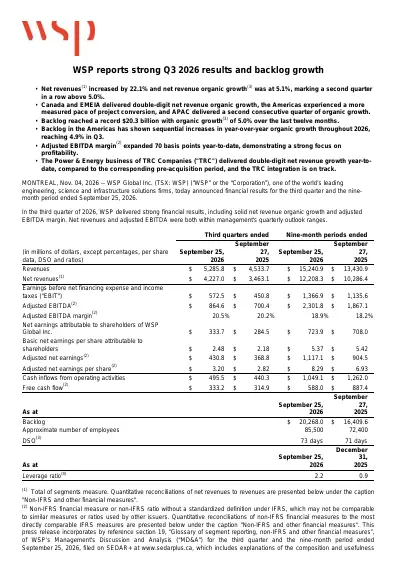
We delivered a strong third quarter with growth across all reportable segments, continued margin expansion, record backlog, and solid cash generation. Our quarterly results came in line with our quarterly outlook ranges and our key financial measures: net revenues, adjusted EBITDA and margin, adjusted net earnings, backlog, and free cash flow all improved year-over-year.
The fundamentals that fuel our business are sound, and our positioning across our end markets and regions is strong. Let me highlight four points for the quarter.
First, net revenue increased 22% year-over-year, including 5.1% organic growth. This was led by double-digit organic growth in the UK and Canada, and a more measured pace of project conversion in the Americas, and a second consecutive quarter of organic growth in APAC.
This was our strongest quarter of organic growth since Q4 2024 and our second consecutive quarter above 5%. Second, backlog reached another record level of $20.3 billion at quarter-end, up 23.5% over the last 12 months and representing 11.6 months of revenue.
For a second quarter in a row, organic backlog grew at or above 5% over the same period last year, led by the US, the UK, and Australia. In the Americas, year-over-year organic backlog growth improved sequentially from -1.4% in Q1 to 2.1% in Q2 and 4.9% in Q3.
Third, adjusted EBITDA grew 23.4% and adjusted EBITDA margin expanded 30 basis points to 20.5%, mainly driven by strong margins in the US and Canada. Year-to-date, adjusted EBITDA margin stands at 18.9%, up 70 basis points, reflecting our continued and disciplined focus on productivity and margin improvement.
Fourth, our Power & Energy platform continues to scale. TRC's Power & Energy market sector delivered double-digit net revenue growth in the first nine months of 2026, and the integration is progressing as planned.
More than 100 joint pursuits are already demonstrating the strength of our combined offering. Before turning to our regions, let me step back and explain what these results tell us about WSP positioning.
We are in the early stages of a generational investment cycle: grid expansion, energy capacity, defense, nuclear, water, critical minerals, and digital infrastructure are reshaping our clients' capital plans. These markets increasingly require scale, technical depth, and an integrated offering from planning through delivery.
WSP is exceptionally well positioned for this shift. Our results this quarter reinforce three points: execution remains strong, our diversified portfolio is performing as designed, and our addressable opportunity continue to expand and the power of diversification both geographically and by end markets is creating a resilient environment for WSP.
With that context, let me turn to the regions and focus on the development that matter most. Starting with Canada, we delivered an excellent quarter with organic growth of 10.2%.
T&I, or Transport & Infrastructure, performed strongly, and momentum continued to build across energy, mining, defense, and data centers. We remain involved in 68 of the country's 100 largest public sector infrastructure projects, more than any company in the industry.
The acquisition of GCM Corp. will further strengthen our energy and industrial capabilities.
Looking ahead, demand remains healthy across transportation, defense, data centers, water, aviation, energy, and municipal infrastructure, with additional opportunity from the federal push to accelerate nation-building projects. Canada's quarterly growth also benefited from the timing of certain project milestones.
We do not extrapolate any single milestone into future quarters. What gives us confidence is the breadth of demand across transportation, power, mining, defense, data centers, and municipal infrastructure, together with a strong pipeline of nation-building programs.
Turning to the Americas, our view of the underlying demand in the US has not changed, but our view of the pace of conversion has. Since our second quarter results, we have longer timeframes between project award, funding authorization, and the start of work in parts of our public sector transportation infrastructure and Earth & Environment market sectors.
Federal funding reviews and various agencies have contributed to these delays. Importantly, demand remains strong.
Year-over-year organic backlog growth improved sequentially through 2026 to reach approximately 5% in Q3. Backlog cover over 12 months of revenue, while our Transport & Infrastructure backlog represent 13 months of revenue and a 1.2 book-to-bill ratio, demonstrating continued award activity.
As we head into 2027, we are closely monitoring funding authorizations and client mobilizations, as well as developments following this week's midterm elections. The US is not one market moving in one direction.
Core highway funding remains comparatively well supported, and streamlined federal permitting should over time move projects more quickly into engineering, design, program management, and construction support. At the same time, the structural drivers in Power & Energy continue to strengthen, fueled by electrification, energy capacity, and the need to modernize aging grids.
Our recent selection by American Electric Power as a delivery partner for its Western Regulated transmission portfolio is a clear example of how major utilities are seeking engineering and program management capacity to deliver significantly expanded capital plans. This is an important strategic win for our US business and demonstrates the type of long-duration client relationship we believe our expanded Power & Energy platform can increasingly capture.
On data center, we are closely monitoring the pace and location of capacity additions, but we do not view our Power & Energy opportunity as dependent on a single end market. Utility capital plans are being driven by load growth from multiple sources: grid reliability, electrification, aging infrastructure, and the need for new generation and transmission.
POWER Engineers and TRC are growing at a double-digit pace year-to-date, integration remains on track, and the more than 100 joint pursuits give us increasing confidence in the revenue and synergy opportunity in 2027. To sum it up, our view of the US opportunity has not changed; our view of the timing has.
With the backlog of $11 billion, up 5% organically year-over-year, the work is there. What we are managing is the pace at which it converts, and the pace of improvement will depend on observable client actions: funding authorization, task order releases, project mobilization, and utilization.
Based on what we see today, we expect the recovery to be gradual rather than linear. The sequential improvement in backlog support our confidence in the opportunity, but we will remain disciplined on the timing we built into 2027.
In Latin America, our mining business is performing well, supported in part by strong demand for copper. Turning to EMEA, organic growth reached 10.5% and backlog grew by almost 12% organically over the last 12 months.
The UK delivered its fifth consecutive quarter of double-digit organic growth, supported by T&I, Power & Energy, and data centers. We are also expanding in defense and nuclear, while the AMP8 investment is expected to support increased water activity.
The acquisition of Hawley and Kirkwood further strengthens our building services capabilities. In Central Europe, conditions remain healthy, with selective strength in data centers, industry, energy, and defense.
Turning to the Middle East, we continue to perform in line with expectations, with Transportation Infrastructure and Property & Buildings both delivering double-digit organic growth in the quarter. We secured work with key clients, notably the modernization of King Fahd International Airport in Dammam.
The evolving geopolitical situation has, however, prompted governments to review spending priorities and adopt a more considered approach to the timing of new project awards. We are therefore taking a prudent near-term view of the region, focusing on converting priority pursuit, expanding into new sectors, and maintaining our strategic and commercial discipline.
Finally, APAC delivered organic growth for a second consecutive quarter. Australia has healthy momentum, supported by Property & Buildings and major transport programs, and the acquisition of E2M expands our ecology and approvals capabilities.
In New Zealand, lower public spending continues to weigh on activity, and we are taking actions to deliver sound results in the current environment. APAC margins was lower year-over-year, principally reflecting the regional mix and foreign exchange hedging FX, together with continued softness in New Zealand.
We are addressing these elements within our control, including the cost base, utilization, and project execution, while protecting the capabilities needed to benefit when activity improves in New Zealand. With that, I'll turn it over to Alain, who will walk you through our financial results.
Alain Michaud
Thank you, Alex, and hello, everyone. I'm pleased to report on our financial results for the quarter this morning.
Let's start with growth. In the third quarter, revenues increased 16.6% year-over-year to $5.3 billion, while net revenue increased 22% to $4.23 billion within our quarterly outlook range.
Net revenue organic growth reached 5.1% with all reportable segments contributing. Acquisition growth was solid at 15%, mainly attributable to TRC and Ricardo.
Canada and the UK led this performance, both delivering double-digit organic growth. APAC delivered organic growth for the second quarter in a row, and TRC's Power & Energy market sector achieved double-digit net revenue growth in the first nine months of 2026.
Backlog reached a new record level of $20.3 billion as of the end of September, up almost 24% over the last 12 months and representing 11.6 months of revenue. Organic growth was was at or above 5% over the same period, marking the second consecutive quarter of backlog organic growth at or above 5%, while the Americas has shown sequential increases in year-over-year organic growth throughout 2026.
Moving on to profitability, adjusted EBITDA in the quarter grew to $865 million compared to $700 million in the quarter in the third quarter of 2025, an increase of 23%, in line with management's quarterly outlook range. Adjusted EBITDA margin for the quarter increased 30 basis points to 20.5% compared to 20.2% in the third quarter of '25.
The improvement was mainly driven by strong margins in the US and Canada. For the first nine months, adjusted EBITDA grew 23.3% to $2.3 billion, and margin expanded by 70 basis points.
The year-to-date margin improvement reflects a combination of stronger regional operating performance, productivity, and cost discipline, as well as favorable foreign exchange. We are very pleased with the margin outcome.
Adjusted net earnings for the quarter reached $431 million, or $3.22 per share, up by $62 million, or 38 cents per share, compared to the third quarter of 2025. The increase was mainly attributable to higher adjusted EBITDA, partially offset by higher interest on long-term debt following the issuance of senior unsecured notes in the first quarter.
Net earnings attributable to shareholders were $334 million, or $2.48 per share, compared to $285 million, or $2.18 per share last year. As for cash position, cash inflows from operating activities was were $496 million in the quarter, up from $440 million, and free cash flow was $333 million compared to $315 million in the third quarter of '25.
Free cash flow for the nine-month period ended at the end of September stood at $588 million, and the trailing 12-month free cash flow amounted to $1.41 billion, representing 1.4 times net earnings attributable to shareholders. DSO as at as of the end of September stood at 73 days compared to 71 days at the same time last year.
Our leverage ratio stood at 2.2 times at quarter-end, slightly above our target range following the TRC acquisition. We remain on track to return to our target range by year-end, supported by earnings growth and cash generation.
Our capital allocation remains priorities remain unchanged, which is to fund organic growth, integrate our recent acquisition, return leverage to our target range, and preserve flexibility for disciplined value-creating opportunities. Turning to our 2026 outlook, the financial outlook issued on February 25th, 2026, and revised on May 6th and August 5th, 2026, is reiterated, except for net revenue and adjusted EBITDA, which we are narrowing to between $16.3 billion and $16.65 billion, and between $3.11 billion and $3.15 billion respectively.
As mentioned last quarter, given the progress achieved to date, we are now comfortable that we will reach our 2027 adjusted EBITDA margin target of 19% in 2026. Reaching our target early gives us flexibility in 2027 to invest selectively in talent and capabilities that support sustainable growth while maintaining strong operating discipline.
For Q4 2026, we expect net revenue to range from $4.1 billion to one to $4.45 billion, and adjusted EBITDA to range from $810 to $850 million. Our outlook now assumes low single-digit organic growth in net revenue for the Americas reportable segment and upgraded mid to high single-digit organic growth for EMEA.
In the US, project conversion is progressing as at a more measured pace than anticipated. Importantly, backlog and award activity remain healthy, reinforcing our view that this is primarily a timing issue.
Contribution for emergency response services in the Americas is expected to be below the historical average in the fourth quarter, given the muted hurricane season in the US. In APAC, we expect reduced public investment in New Zealand to continue to temper activity level.
We will not be providing 2027 guidance today. At this stage, the key building blocks are clear: healthy backlog and structural demand in Power & Energy and other priority sectors, continued strength in Canada and EMEA, and a gradual rather than immediate improvement in the US project conversion.
We will provide our formal outlook with our year-end results based on the visibility available at that time. I would like to remind you that this outlook is intended to help analysts and shareholders refine their perspective on our performance, and using this information for other purposes may be inappropriate.
Actual results may differ, and such differences may be material. Our outlook assumes foreign exchange rates, inflation, interest rates, and effective income tax rate will remain consistent throughout Q4 2026.
Also, our selected financial outlook does not include any dispositions, mergers, business combinations, or other transactions that may be announced or completed after today. With three quarters now behind us, our results, organic growth across all segments, continued margin expansion, a record backlog, and a solid cash generation puts us on a strong footing to close out 2026.
With that, back to you, Alex.
Alexandre L'Heureux
Thank you, Alain, and let me close by bringing the quarter back to the broader investment thesis. The generational investment cycle I described earlier continues to broaden across our markets.
Clients are committing capital to larger, more complex, and increasingly interconnected programs. Grid expansion, energy capacity, defense, nuclear, water, critical minerals, and digital infrastructure are changing both the scale of our clients' capital plans and what they need from their advisors.
We continue to strengthen this platform, more recently with the GCM Corp. acquisition in Canada, Hawley and Kirkwood in the UK, and E2M in Australia.
Our priorities remain straightforward: convert our record backlog into profitable growth, generate strong cash flow, and maintain financial discipline. At the same time, the opportunity in front of us is expanding.
The world's infrastructure needs are becoming larger, more complex, and more interconnected, precisely the environment in which WSP scale, technical depth, and global platform create the greatest value. With that, we will now open the line for questions.
Operator
Thank you. As a reminder to ask a question, please press star one one on your telephone and wait for your name to be announced.
To withdraw your question, please press star one one again. Once again, please press star one one on your telephone and wait for your name to be announced.
To withdraw your question, please press star one one again. We are now going to proceed with our first question.
The questions come from the line of Sabahat Khan from RBC Capital Markets. Please ask your question.
Sabahat Khan
Thanks and good morning, everyone. Maybe just starting with kind of the overall demand outlook commentary, Alex, that I think you shared around the US.
I think you referenced some delays in project conversion, backlog growth has been good. Can you just maybe detail kind of the conversations you're having with some of these clients?
Is it they added a project to the backlog, tariffs got put in place, we've been hearing some commentary about public funding in the US not being good. What are kind of the things that they're looking for?
I think you mentioned the recovery will be gradual, but just can you share some of the milestones that or items that we should be keeping an eye on and that you're discussing with your customers primarily sort of on the US market? Thanks.
Alexandre L'Heureux
Yeah. Let me start by saying what I said early on.
Our view of the US market has not changed, it's the timing of it that is slightly moving to the right. At the moment, what we're seeing is proposal activity level very strong, backlog growth, you saw the sequential increase in our US business has gone from -1% to 2.5% to 5% now.
The backlog is growing, and there's a lot of activity in the pipeline for WSP. The funding and accessing the funding of it has been slightly more challenging for clients.
Getting the notice to proceed from our clients has been what has caused the delay, especially, and not everywhere, but especially in public work, in Transportation Infrastructure, and in the portion of our Earth & Environment business related to transportation. The funding from the federal government to the states and the local has been delayed in some instances.
Obviously, hopefully the December 11th timeline that will hopefully be extended by the existing Congress to the new Congress on January 3rd will unlock some of that. That's what we have seen in the second half of this year.
As I said, very, very strong market, backlog growing, but accessing the funding has been causing or there's been some delays in some part of our US business.
Sabahat Khan
Great. Then just a second question, I guess, on the margin side.
Not trying to front run the '27 guidance, but Alain, I think you mentioned sort of to think about the overall algo being largely intact. Is there any sort of at least just, don't need to get numerical, but any building blocks on the '27 margin outlook?
I think TRC contributed for a good chunk of the year, but any other sort of big-picture items on margin drivers that we should think into 2027 as sort of the demand environment evolves? Thanks.
Alain Michaud
Currently working on it, Sabahat. Budget season is going full stream, so as you said, I will refrain from giving you color on '27.
What I could tell you, though, is we're now very comfortable with our margin trajectory for '26. We will reach a full year in advance our '27 target.
That's more than 100 basis points in two years that we will have delivered with what you could call maybe a different operational leverage than when we would have thought with lower growth, but despite all of that, we delivered strong margin and we were very proud of that. That's part of our DNA, as so we'll take that into consideration as we look into '27.
Sabahat Khan
Great. Thank you.
Operator
We are now going to proceed with our next question. The questions come from the line of Steven Fisher from UBS.
Please ask your question.
Steven Fisher
Thanks. Good morning and congrats on the solid results.
I want to talk about Canada a little bit. The Canadian backlog growth year-over-year had a pretty big swing from Q2 to Q3.
I guess I'm just curious what do you think the underlying trend there is. I know backlog can be a little lumpy, just curious given that swing.
Maybe related to this, the follow-on from the Canadian Investment Summit last month, curious sort of what sort of opportunities you think could be presented there and what timeframe.
Alexandre L'Heureux
Yeah. I I think you you mentioned it.
Backlog can be lumpy, lumpy, and and the size of the projects, and I think I've said that in my in my in my address this morning, we are dealing now with with so many large programs in our portfolio at at WSP that one award can can can can can significantly shift the backlog growth from one quarter to the other. I would I would refrain our our investors and and analysts to to make determinations on a on on one quarter.
I think, the fact that the backlog is I think -1% or flat this quarter is not giving us any concern whatsoever for Canadian business. We've had a great year.
We see a great pipeline of of opportunity. Commenting on the Investment Summit, I had the the opportunity to participate in the Investment Summit and and engage with with many of the sovereign funds present at that at at the summit.
Yes, I think this is going to provide it's it's it's loads of of opportunity in in the next few years. We saw a number of of announcements by the federal government in in in recent weeks.
Since the Investment Summit, I think this will hopefully and definitely encourage great productivity investment in the country. In order to be more productive as a country, you've got to have state-of-the-art infrastructure.
I think this government is is is very well aware of that. I think we're going to see tremendous investment in in ports and marines.
We're going to see investment in in airport and and roads. In defense, and obviously in the energy sector when we talk about that data sovereignty as being a a high priority for this country.
I I think we should be expecting a lot of of of investment in the energy sector. All that to say, am I am I concerned about our our backlog growth in this quarter?
Absolute absolutely not. We're feeling extremely good about our Canadian country our Canadian business, sorry.
Country, by the way.
Steven Fisher
Sure. Thank you.
Just as a follow-up, going back to the US here, just on the slower pace of conversion here, curious what you think really triggered it. I know you talked about it in the context of the highway bill.
Was it basically kind of getting to the endpoint of the IIJA and seeing that deferral to December, because it sounds like you think perhaps another extension in December will help? I'm curious, do you think is this a broad industry-wide issue for all players in this?
Is there anything in particular about your particular area of exposure here? What do you think the catalyst is to get it to reaccelerate?
Is it another extension or do we really need sort of a full new bill to get this moving again?
Alexandre L'Heureux
Look, since the administration was elected in late '24, as you've seen and witnessed, there's been a lot of changes in priorities by this administration, certainly in infrastructure spend, very focused on traditional energy sector, which has benefited WSP in some fashion, obviously tremendous investment in AI. Also put in place the Government Accountability Office, which was designed to review many projects that were outstanding during the IIJA funding process.
I think was 2,500 projects that had to be reviewed by the Government Accountability Office. You combine this with the permitting reform that has been taking place in the last 12 to 18 months, and it is creating some delays, whether you like it or not.
When you're changing priorities like this, and you're reviewing projects like that, it is going to create some delays. The good news is that of all I think those 2,500 projects that have been reviewed and finally approved, very few got either delayed for a very long period of time or canceled.
I think for me is when I'm looking that very high level, I think my feeling and my view of our US business and the market, the infrastructure market in the US has not changed. I think it's a buoyant market.
Demand is there. The needs, more importantly, the needs are there.
We have seen backlog growth in the US market, but as I said, I believe the return or the pace at which we are going to be accessing the funding because of everything I just explained will be gradual rather than linear. We are obviously monitoring this, but as I said, no cancellation, but it's the timing of it that is the issue at the moment.
That's the view for US market at the moment.
Steven Fisher
Thank you for the color.
Alexandre L'Heureux
Thank you.
Operator
We are now going to proceed with our next question. The questions come from the line of Krista Friesen from CIBC.
Please ask your question.
Krista Friesen
Hi. Thank you for taking my question.
Not to beat a dead horse here, but just on the US market, how are you thinking about the extension that's expected on December 11th? Do you really think that will change much in your customers' minds or is that too temporary?
Do you think we really need to wait until the Build America 250 Act is kind of passed into law?
Alexandre L'Heureux
Look, I don't have a crystal ball and I'm not a political expert, I can only tell you what I think it's going to happen. I think the December 11th will get extended for the new Congress to review what they intend to do in the negotiation they intend to have with the President.
As I said, to me, this is noise. When you look at the high level, and you look at the business as a whole, and you look at the US market as a whole, it is the biggest market in the world, where the needs are the greatest.
Yes, we may have a bit of noise in the system, but the backlog is growing. Like to remind everyone that we delivered 22.5% margin in our US business.
It's one of the most profitable market in the world. I just think it's just a moment in time, and we'll get back on the growth mode when all that noise is behind us.
Krista Friesen
Thank you. I appreciate that.
Maybe just pivoting to M&A, can you just give us an update on what the pipeline looks like for you and maybe just how valuations are trending there? Thank you.
Alexandre L'Heureux
Thank you. Look, we've completed three acquisitions in the quarter, obviously mind you smaller in size.
We continue to have formal and informal discussions. M&A is part of our fabric, it's part of our DNA.
We believe that our platform continue to be subscale in some area of our business. At the right time with the right opportunities, we would like to continue to grow our platform by acquisition.
On valuation at the moment, I'd say that it's quite constant. We haven't seen a major shift on valuation at this point in time.
We've done some of our best deals in period like today. In the past.
We remain on the watch, and we'll see what the future will bring.
Krista Friesen
Thank you. Appreciate the color.
Alexandre L'Heureux
Thank you. Thanks, Krista.
Operator
We are now going to proceed with our next question. The questions come from the line of Frederic Bastien from Raymond James.
Please ask your question.
Frederic Bastien
Hey, good morning, guys. Just building on prior questions, your proposed acquisition of GCM Corp.
clearly suggests growing confidence in Canada's investment outlook. Now, given that WSP's global footprint, are you seeing a meaningful shift in Canada's relative attractiveness when it comes to allocating capital across your platform?
Alexandre L'Heureux
Not really, Frederic. If if you look back over the last 10 years or the last decade, we probably tripled the size of our of our Canadian business by headcount, by revenue, by EBITDA.
Our our home country has always been extremely attractive to WSP. It's just that we've grown rest of world so rapidly in the last decade that as a percentage of our total business, Canada represent I believe 18% of our net revenue.
It's hard to move the needle given the growth that we have experienced outside of the country. There's no doubt that Canada is one of the most attractive market for WSP.
Will continue to be. We are we are obviously very focused on on on the market, and if and if and when we we find more opportunities in the in the Canadian in the Canadian market, we'll certainly going to be at the forefront of it, and we will want to grow our business.
No doubt about that.
Frederic Bastien
Okay. Is it fair to say, too, that, having seen a lot of the global players not really focus on energy for so many years, there's probably a lot of players that are subscale in that sector
Alexandre L'Heureux
to be a sector? GCM is an example of that.
So 600 people, this is not de minimis. We're clearly growing our Power & Energy sector in Canada with this acquisition in process engineering, and we are accessing a list of blue-chip clients that we didn't have access to in the oil and gas sector and in the mining sector and other power-related sectors.
We're quite excited about this acquisition, actually.
Frederic Bastien
Sorry. Does your expectations end the year with a leverage below two times factor in that proposed acquisition?
Alexandre L'Heureux
Yes.
Frederic Bastien
Okay. Sweet.
Thank you.
Operator
We are now going to proceed with our next question. The questions come from the line of Devin Dodge from BMO Capital Markets.
Please ask your question.
Devin Dodge
Thanks. Good morning.
Alex, Alex, I wanted to start the question for you. I think you mentioned that more clients are doing procurement under framework agreements.
I don't believe this gets added to backlog. Just wondering if you can frame how much work you have secured under those type of agreements and how this compares to six or 12 months ago.
Alexandre L'Heureux
I don't have the data in front of me, maybe, Alain, you do, but in terms of soft backlog and framework, especially in the power sector, we have a big portion of our work that is not part of our hard backlog. Give you an example, the American Electric assignment that I just talked about and we press released this week is through a framework agreement.
Very little has been added in our backlog, but we going to have an enormous amount of work over the course of the next five years. We are not disclosing it because we're taking a prudent approach in the way we report backlog to our investors, but you are right in saying that a big portion, especially now that we've acquired POWER Engineers and TRC, a big portion of their work is being procured through framework agreement, just a bit different than transportation.
Devin Dodge
Understood. Okay.
Thanks for that. Then just one quick follow-up.
Has there been any progress or plans to apply for an NCIB?
Alain Michaud
As I said in my remark, Devin, the priority right now is to bring our leverage back into our zone, and this is what we intend to do for rest of years. As usual, as we start '27, we always review with our board our capital allocation priorities, and this will be part of the
Alexandre L'Heureux
discussion
Alain Michaud
at that time.
Devin Dodge
Okay. Makes sense.
Thank you. I'll turn it over.
Operator
We are now going to proceed with our next question. The questions come from the line of Maxim Sytchev from NBC Capital Markets.
Please ask your question.
Maxim Sytchev
Hi. Good morning, gentlemen.
I just had one one quick one. Obviously, power has been a very strong contributor year-to-date in terms of M&A growth.
When we look at some of the ballot measures in the US, I'm just wondering if you think that could potentially slow down the pace of activity, or do you think that's more sort of optics versus kind of the potential reality? Just curious your thoughts there.
Thanks.
Alexandre L'Heureux
My thoughts are simple. If I look back, as we reported when we acquired TRC and I acquired POWER Engineers, for the last 10 years, the CAGR rate of those two firms and their Power & Energy sector has been north of 10%.
Our thesis around our Power & Energy sector is not related to data centers. I would tell you frankly that a small part of our work in transmission, modernization work, and substation design is related to data centers, Max.
We're feeling extremely good about our position in the market with those two acquisitions. I'm feeling confident that '27, '28, '29 will be great years for that sector as it relates to our work.
I think when we announced the Power & Energy a deal and TRC deal, I mentioned that most of the transmission line in the US have reached their peak in term of useful life. They're around 30 years, 40 years.
All of that will have to be replaced irrespective of data centers. I'm feeling very, very good about our position at this point.
Maxim Sytchev
Okay. That makes sense.
Thank you so much for the color. Thanks.
Alexandre L'Heureux
Thank you.
Alain Michaud
Thanks, Maxim.
Operator
We are now going to take our next question. The questions come from the line of Michael Tupholme from TD Cowen.
Please ask your question.
Michael Tupholme
Thank you. Good morning.
Alexandre L'Heureux
Hello, Michael.
Michael Tupholme
Morning. First question is just around the US market and the conversion delays you mentioned there.
Just curious about if you can talk about how you're managing staffing levels in that market in the interim. It's obviously clear that you view the US demand outlook as positive and you've continued to see good margin improvement in the Americas segment, both year-to-date and in the third quarter, but I'm just curious again about how you manage headcount and ensure high productivity during this period here.
Alexandre L'Heureux
Michael, the beauty of our model is our cost structure is variable. Less than 10%, I'd say 7, 8% of our costs are fixed.
We are able to be very nimble and agile. I'll give you an example, our T&I workforce is the same size I was on January 1st because we've been very nimble in the way we've been managing our T&I sectors because of the reasons I explained today.
That's why we're feeling good about the US market and we're looking at our backlog growth and we're like, okay, the work is there, the proposal activity is there, our win rate is actually increasing, which means we're, in our personal belief, we are stealing market share. The notice to proceed on some large projects has been taking a bit longer than anticipated.
That's why I said that we believe the recovery will be gradual rather than linear. Let's see what this new Congress is going to do on Jan 3rd.
Again, if I strip out the noise and I take a long-term view or medium-term view of the market, this is an incredible market. We are very, very well positioned in all of our segments.
For me, looking back at our results for the quarter, great margin, good backlog growth. I would add that for two consecutive quarters, we've had 5% organic growth.
This is a testament of the diversification of the WSP platform. We have our largest market that is experiencing some delays, and yet we are in a position to deliver mid single-digit growth because our other markets are performing.
It's a testament of our diversified platform.
Michael Tupholme
That's perfect. Thank you.
Then the second question is just turning to the EMEA segment. Strong organic growth and backlog growth has continued there.
Seems like the UK continues to be the key driver. Hoping you can talk a bit more about the greatest areas of strength for WSP in the UK and also the sustainability of that strength as you look out into next year and we think about the EMEA segment and the organic growth potential.
Alexandre L'Heureux
I think we had two or three consecutive years of almost double-digit organic growth in the UK, I'm not going to sit here telling you that for the next few years we're going to continue to always grow at that pace. It's been an incredible market, and I can tell you with certainty that we have been growing much faster than our peer group in this market because we have one of the, if not the best brand, and we have a great workforce and in the T&I sector and the high-rise and Property & Buildings sector.
In power, we're making great, great headways in the nuclear side in the UK. Is in the water.
In water, we were not a player six, seven years ago, and I would tell you that we're growing at a very fast pace with the AMP8 cycle, and our position in the marketplace. It's been a great story for us at this point.
Michael Tupholme
That's helpful. Thanks very much.
Operator
We are now going to proceed with our next question. It comes from the line of Ian Gillies from Stifel.
Please ask your question.
Ian Gillies
Morning, everyone.
Alain Michaud
Morning, Ian.
Alexandre L'Heureux
Morning.
Ian Gillies
On the topic of EBITDA margins, the revenue mix has probably been a little different than we all would have thought this year. Would it be fair to say that EBITDA margins are trending even a bit better than we all would have thought, just given the US is it come in a little lighter from a revenue perspective and it's the best margin business you have?
Alexandre L'Heureux
Look, well, our Canadian business is our best margin business that we have, followed by the US, which is trailing not far behind. North America is our best margin, I'd say the best regional margin profile.
Yes, the answer is absolutely yes. We've performed better than anticipated because we are going to be finishing the second year of a three-year plan and we already met our target.
I feel that this is giving us flexibility to continue to invest in technology in the business, really to strengthen the platform, to hire the best talent out there, rainmakers, to continue to grow a business. It's a great place to be when at the end of your second year, you already met your objective for your three-year plan.
Obviously, we're clearly feeling good about what we were able to achieve.
Ian Gillies
If we look ahead, WSP's always been very good at identifying end markets before they necessarily become hot end markets, for lack of a better way to frame it. When you think about the next few years and you look at end markets you might not be in right now or want a bigger presence, is there an area that you really want to be, whether it be defense or something else where there might be a larger spending pie coming?
Alexandre L'Heureux
If you recall, Ian, the plan that we had unveiled at the beginning of '25, in February '25, we had identified seven select high-growth area for WSP. I can tell you that those seven high-growth area are very pertinent to this day, they haven't changed.
Program project management is an area that we would like to grow, water is an area that we will continue to grow, defense we are making great headways in Australia, in UK, in Central Europe, in Canada. We're going to put a lot of emphasis into that over the course of the next few years.
Power & Energy, I think it's unfinished business. We probably have the largest platform in the US right now, by stretch in my personal opinion, but it's unfinished business in rest of world.
Last year, we made an acquisition in Spain, but there's so many other markets that we would like to increase our presence. I could go on and on and on like this, but there are six or seven sectors that I believe in the next few years we will grow, and we will want to grow, and that will have to take place through our organic growth, but also inorganic growth.
That's why I still believe in our investment thesis, and I haven't changed my mind irrespective of what we have seen on valuation in the industry. That I have a long-term view on things, and I think that's what made us successful in the past, and I think that's what will make us successful in the future.
I do think that there's a lot of runway for this platform, and I'm very excited about the future.
Ian Gillies
Thanks very much. That's very helpful detail.
I'll turn it back over.
Alain Michaud
Thanks, Ian.
Operator
We are now going to proceed with the next question from the line of Chris Murray from ATB Cormark Capital Markets. Please ask your question.
Chris Murray
Thanks, folks. Just a couple quick ones.
One, I don't think we talked about the leadership change in the US. Can you talk a little bit about that transition and how you were thinking about positioning with the leadership team for the next little while, as it seems like maybe government-related work is going to be more important?
Just thinking about kind of the different folks who take about that business over the coming years.
Alexandre L'Heureux
Look, Joe Sczurko, this was a planned retirement. When we acquired the Wood E&I business in 2022, there was an agreement between Joe and I that Joe would give us four, five years, and Joe done incredible work for our organization and has been an active contributor to the building of our US business in recent years.
I want to thank him for his service. Joe has elected to retire.
This was in the mix. We intend to find a replacement very soon.
I'm not in a position to talk about it now, but we intend to make an announcement in the not-so-distant future. For us, it's business as usual.
We have our Chief Operating Officer that is acting as interim CEO right now. We have a very, very strong leadership team in our US business.
For us, it's business as usual, and we'll make an announcement when ready.
Chris Murray
All right, fair enough. Then just one kind of housekeeping question, Alain, for you.
Just on working capital transition and I guess getting back to that sub-two number. I guess a couple things.
One, is there anything that we should be thinking about that's unusual in the quarter in terms of working capital pick-ups other than kind of normal seasonality, which really boost that number? Along those lines, just a quick question just from some of the larger acquisitions, as you had time to season them now.
Is there anything in there, DSO numbers that you feel like there's more opportunity to get them down? Any color on that would be appreciated.
Alain Michaud
All right. Nothing special in Q4 in working capital adjustment.
It's our best quarter all the time in terms of free cash flow generation, we expect this year to be the same. As for acquisition, DSO trailing, we don't disclose that, but largely I would say there's still opportunity where there's always opportunity.
I guess, Chris, that'd be my message, to keep on refining and optimizing our working capital management.
Chris Murray
Okay. All right, great.
I'll leave it there. Thanks, folks.
Alexandre L'Heureux
Thanks.
Operator
There are no further questions showing, I'll now hand back to the speakers for any final remarks. Thank you.
Alexandre L'Heureux
Thank you very much for attending the call. Thank you for your very good questions, and we look forward to updating you in Q4.
On that note, I would like to wish you a great day.
Operator
This concludes today's conference call. Thank you all for participating.
You may now disconnect your lines. Thank you.