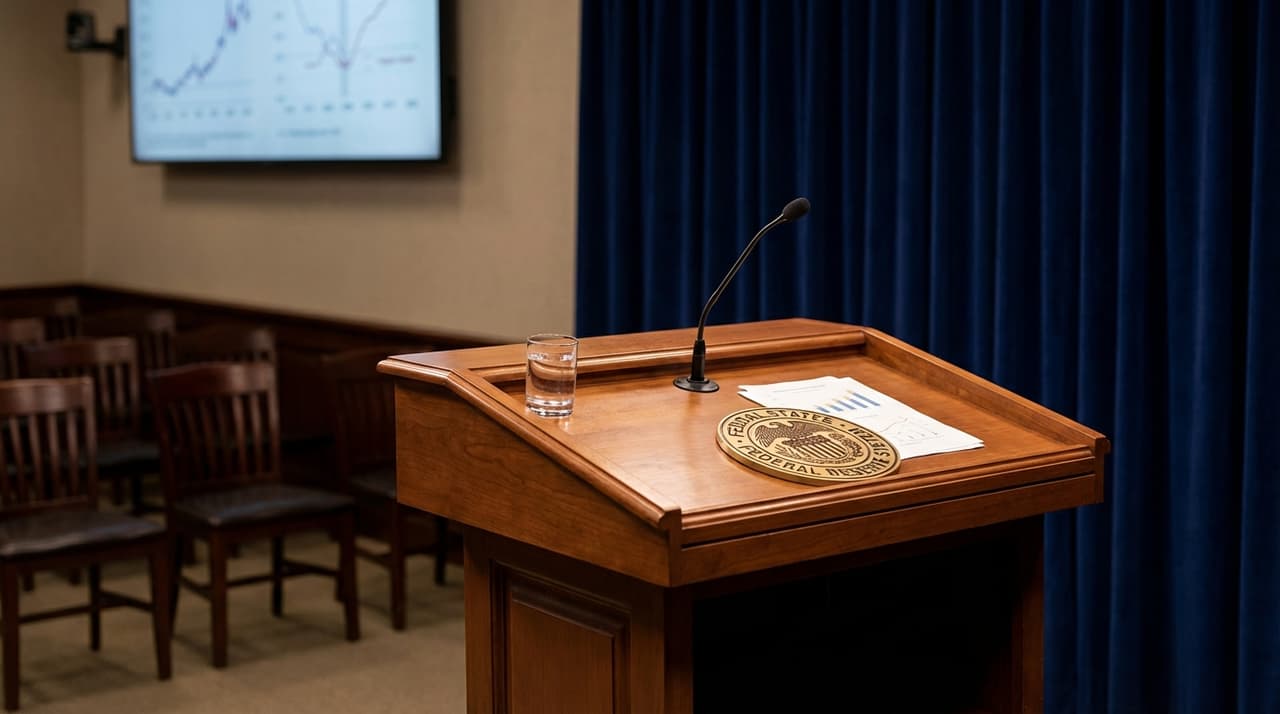
- The Federal Reserve held the federal funds rate steady at 3.50%-3.75% in its January 2026 meeting, with markets over 97% certain of no change, following three quarter-point cuts in late 2025.
- Fed Chair Jerome Powell concluded his press conference emphasizing the economy's "firm footing" and the Fed's dual mandate, while facing a Department of Justice investigation into his testimony and political pressures from the Trump administration.
- Consumer confidence plunged in January, raising deflation risks despite potential 6% GDP growth driven by AI productivity and exports, with analysts eyeing possible rate cuts by June.
A Steady Hand Amid Turbulence
Federal Reserve Chair Jerome Powell wrapped up his press conference on January 28, 2026, after the central bank's first meeting of the year, leaving interest rates unchanged in a move widely anticipated by financial markets. The decision to maintain the federal funds rate at 3.50%-3.75% comes on the heels of three quarter-point reductions in late 2025, as the Fed navigates a landscape of steady inflation and an economy showing resilience. In his opening remarks, Powell noted that the U.S. is "coming into 2026 on firm footing," underscoring the Fed's commitment to its dual mandate of stable prices and maximum employment.
Efforts to steer monetary policy have hit a snag, however, with Powell confronting a Department of Justice probe into his testimony regarding Fed building renovations and mounting political pressures from the Trump administration, which has been vocal in advocating for lower rates. According to people familiar with the matter, the investigation adds a layer of complexity to Powell's final months as Chair, with his term set to expire on May 15, 2026. President Trump is expected to announce a replacement soon, injecting uncertainty into the Fed's leadership at a critical juncture.
Without a clear path forward, the Fed risks eroding public trust, as political interference could undermine its cherished independence. Powell recently pushed back publicly against these pressures, a stance that echoes historical precedents of Fed resistance to executive overreach. Meanwhile, a Supreme Court case looms over Trump's potential firing of Fed Governor Lisa Cook, further complicating the institutional landscape.
Economic Crosscurrents and Market Implications
The steady rate decision supports the ongoing effects of last year's cuts, but underlying economic signals are mixed. On one hand, AI-driven productivity and robust energy and pharma exports could fuel potential GDP growth of up to 6% without sparking inflation spikes. On the other, consumer confidence took a sharp dive in January, according to the Conference Board, raising alarms about deflation risks if left unaddressed. This divergence puts the Fed in a delicate balancing act, with PCE inflation still hovering around 80 basis points above the 2% target.
Wall Street is bracing for volatility, with earnings reports and Fed caution likely to drive market movements in the coming weeks. Analysts, including those from Bank of America, predict that Powell will maintain a data-dependent approach, deflecting political distractions to focus on economic indicators. "We expect the Fed to proceed meeting-by-meeting," one analyst noted, highlighting the uncertainty surrounding future policy shifts. Markets are already pricing in the possibility of rate cuts by June, should deflationary pressures intensify.
Looking ahead, Powell has just two more meetings before his term ends, with the FOMC set to rotate voting members in 2027, including Dallas Fed's Lorie Logan. The new Chair will inherit the challenge of combating potential deflation through lower rates, all while upholding the Fed's data-driven ethos. In the short term, a pause in policy shifts seems likely, despite the economy's hot streak, as the central bank weighs these competing forces.
Correction: An earlier version of this article misstated the timing of Powell's term end; it is May 15, 2026, not January 2028.