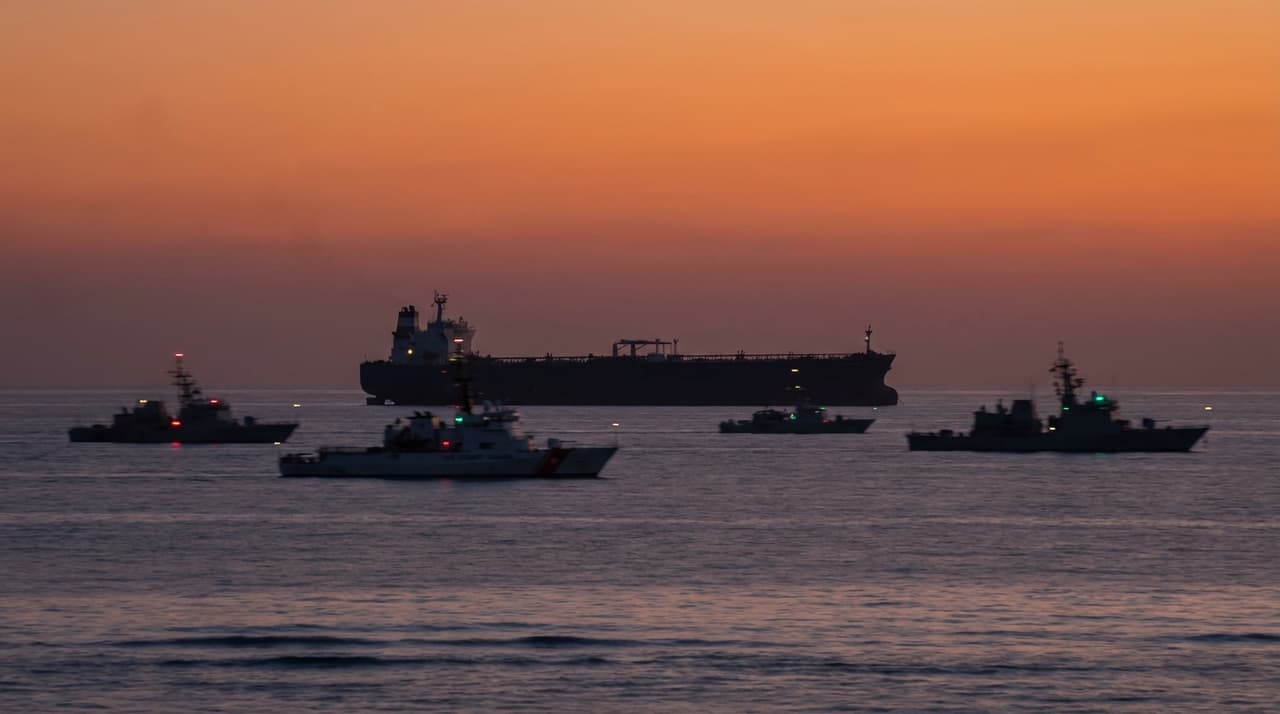
- The U.S. Coast Guard, FBI, and Homeland Security, with military support, seized an oil tanker off Venezuela that Washington says had long violated U.S. sanctions related to Venezuela and Iran.
- President Trump publicly confirmed the operation and suggested the U.S. would keep the oil, framing it as part of his administration's maximum-pressure campaign and a means of effectuating U.S. sanctions.
- Venezuela's government condemned the move as "theft" and "international piracy," calling it an illegal escalation and de facto blockade amid a major U.S. naval buildup in the Caribbean.
In a bold move that underscores the Trump administration's hardline stance, U.S. authorities have seized a sanctioned oil tanker off the coast of Venezuela, according to people familiar with the matter. The operation, conducted by the U.S. Coast Guard, FBI, and Homeland Security with military backing, targeted a vessel that Washington alleges has repeatedly flouted sanctions tied to Venezuela and Iran. President Trump quickly took to social media to confirm the action, suggesting the U.S. would retain the oil and framing it as a critical step in enforcing and validating his administration's sanctions policies against the Maduro government.
Venezuela's response was swift and fierce, with officials denouncing the seizure as "theft" and "international piracy." They argue it represents an illegal escalation and amounts to a de facto blockade, particularly as the U.S. has amassed its largest naval presence in the Caribbean in decades. Analysts interpret this buildup as a warning shot not just at Maduro but also at external backers like Iran, China, and other actors operating in the region. The seizure is intended to tighten Venezuela's access to oil revenues, a primary lifeline for the Maduro regime, reinforcing U.S. efforts to choke off sanctioned crude exports that have contributed to the country's severe economic contraction and hyperinflation.
Efforts to restructure Venezuela's economy have hit a snag with this latest enforcement action. Without a deal to ease sanctions, the country could be forced into deeper isolation, worsening humanitarian conditions for ordinary citizens. The move aligns with a broader Trump-era strategy emphasizing the Monroe Doctrine, signaling that non-Western Hemisphere actors may face severe targeting. U.S. officials, speaking on condition of anonymity, frame the seizure as a law-enforcement measure against a sanctioned vessel rather than a formal naval blockade, likely to avoid crossing the threshold into an act of war under international law.
In the oil markets, individual tanker seizures typically have limited direct impact on prices, but repeated operations like this one increase perceived geopolitical risk premia. For instance, Chevron (CVX) has continued limited operations in Venezuela under special licenses, paying in oil rather than cash due to sanctions, illustrating the selective nature of U.S. economic engagement. The seizure sends a clear signal to Iran and other states helping Venezuela move oil under sanctions, raising the cost and risk of practices like ship-to-ship transfers and flag-hopping.
Looking ahead, expect more aggressive tracking and potential seizures of sanctioned tankers linked to Venezuela and possibly Iran, especially in or near the Caribbean. Caracas may respond with legal challenges and closer ties with Russia and China, seeking alternative protection. Shipping companies and insurers are likely to further de-risk from Venezuela-linked cargoes, increasing its isolation. In the long term, sustained enforcement could further degrade Venezuela's oil sector, but experts are divided on whether it will lead to political change or simply harden Maduro's hold on power. The operation has drawn scrutiny over the legality of U.S. maritime actions, echoing past episodes with Iran and North Korea where ship seizures became key tools in sanctions policy.
Correction: An earlier version of this article misstated the timing of the naval buildup; it is ongoing and described as the largest in decades, not a recent surge.