adidas AG
Q3 FY2026 · Earnings Call TranscriptOctober 29, 2026
Operator
Ladies and gentlemen, welcome to the Adidas AG Q3 2026 conference call and live webcast. I am Moira, the Chorus Call operator.
I would like to remind you that all participants will be in listen-only mode and the conference has been recorded. The presentation will be followed by a Q&A session.
You can register for questions at any time by pressing * and 1 on your telephone. For operator assistance, please press * and 0.
The conference must not be recorded for publication or broadcast. At this time, it's my pleasure to hand over to Sebastian Steffen, Head of Investor Relations.
Please go ahead.
Sebastian Steffen
Thanks very much, Moira. Hello, everyone.
Good evening, good afternoon, good morning to everyone joining us today wherever you are in the world. Welcome to our Q3 results conference call.
Our presenters today are our CEO, Bjørn Gulden, and, for the last time, our CFO, Harm Ohlmeyer. Also with us in the room is Birgit Kretzschmar, who joined our Executive Board in September, and as will take over from Harm at the beginning of next year.
Welcome back, Birgit. As always, we will kick it off in a second with Bjørn and Harm taking you through the highlights of the quarter, our financials, and the outlook.
Then, of course, we will open the floor to your questions. The drill: during the Q&A session, please limit your initial questions to two.
This will help us to give as many participants as possible the opportunity to engage and ask their questions. Thank you very much for that.
Now, before I will hand over to Bjørn in just a second, we want to start, as we always do, with a video. Here we go.
Lock in! Lock in!
For over 75 years, we have defined sport. We want to change the game, right?
The world will be shaken. We've defined culture.
What the hell makes you different? We are Adidas.
That's it? Right now, I'm building something.
Fueled by innovation. First ever sub-100 g shoe.
We've literally witnessed history being made. Personally couldn't be better.
Always changing the game. A brand new shoe that has been years in the making.
You can't beat that. Got to be crazy, yeah?
From the court... That's a monster!
A three-pointer! ...to the pitch...
Absolute [unclear]. He's a superhero in this game.
It's a big thrill, right? ...to the street...
I only wear Adidas, y'all. This is the best shoe on the market.
Ooh! I think these are sexy.
...to the runway... What are those?
It is the Willy Chavarría, guys. ...and beyond.
That's it! We are a global brand...
Adidas is everywhere. Bring the whole world together.
Look at what just dropped today: Originals collection. Adidas, period.
...with a local mindset... Dropping in India.
I'm going to go get some right now. ...meeting consumers where they are...
That's what it's all about. ...and seeing our influence everywhere.
I've never seen anything like that. The doors are open.
Adidas is here for anyone who's willing to put it all on the line, no matter who they're up against. Our time is now...
It's not a winning streak. It's a [vintage?]
. ...to be the number one sports brand in the world, and we're just getting started.
Bjørn Gulden
Hello also from my side. Hope we find you in good shape and in a good mood.
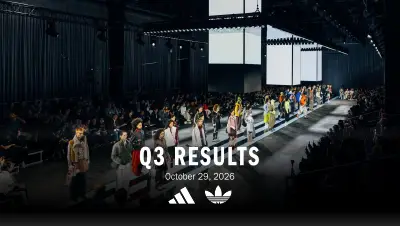
We are actually in a good mood. You have seen the results, and I think the picture on your screen also shows a little bit why we are in a good mood.
That's from the Fashion Week in China. I don't need to tell you that the brand is currently on fire in China.
We were there with our Management Board and the Supervisory Board, and I think we all returned very, what should I say, optimistic about the future in a market that most people say it's very difficult. It's also great to see that our momentum continued in Q3 also after the World Cup, which many people were afraid of, and also cool to see that we were able to save the 60 million in marketing.
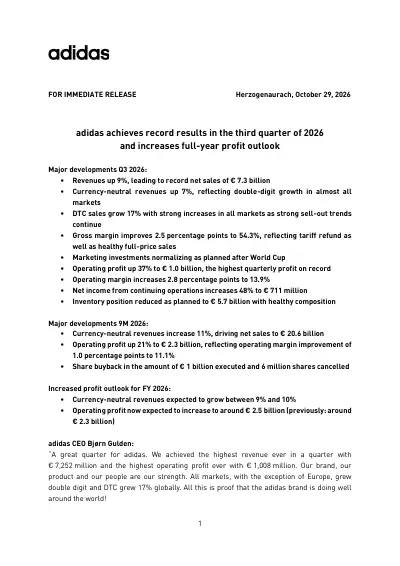
What we told you in Q2 actually happened in Q3. When we then add that all up, we do have a record revenue and a record profit in the quarter, which again, I think tells you that the brand and the people and the product we have is working, and even the strategy that we have talked about is currently the right one in a very difficult marketplace.
If you go quickly into the numbers, the top line at 7.2, which is 7% in currency neutral or in local currencies, and this time, the reported is for the first time higher than the currency neutral by 9%, which, of course, is also positive when you look at it on the top line. Gross margin at 54.3%.
Yes, helped by 200 million tariffs that Mr. Trump gave back to us.
Remember, when you do this, that these 200 million are tariffs that we have paid over the last quarters, this is just getting back what we have paid too much. Of course, in the quarter, that then improves the gross margin substantially.
The operating profit then, when you put everything together, at 1 billion and 8, and that is, of course, a very, very high, what should I say, EBIT. Again, if you subtract the 200, you still see that the EBIT was very high in the quarter.
Year to date, 20.6 billion in sales, now the currency neutral higher than the reported with 11% versus 10%. Gross margin at 52.7%, and then an operating profit currently at 2,287, which is close to our full-year guidance of 2.3 billion.
Have to again repeat, also because it's Harm's last time, that Harm and me built a plan four years ago, basically saying we should leave in 2026 with a, what should I say, healthy and successful company. You remember we defined that to be 52% margin, 12% marketing, 30% operating expenses, and a 10% EBIT.
Happy to see that we have delivered almost all those numbers. We also said that at that time, we needed to reset the brand and then invest in the brand to create brand heat.
We said we need to invest more in sports and then over time launch innovation, because we live of sports and we live of innovation. In the meantime, until we are ready to do that, we needed to commercialize lifestyle footwear, and at that time, through the terrace trend.
At a point, when the market was ready and I would say the discounting and the commodities in our lifestyle business was gone, we could grow lifestyle apparel again. It happened to be that that, of course, is helping us now a lot, while the lifestyle footwear business is more difficult.
We're getting back to that later. When you take those five elements, we then in addition said that we will build a future business model which is based on more local empowerment, not necessarily because we would like to do it, but that's the way the consumer and legal, I would say, issues are working.
We need to make sure that we have business models that target the consumer in China, that targets consumer in Europe, that targets consumer also in the US. Then there are some, I would say, hybrid models in certain other markets.
A business model that is much, much, much more having the consumer in focus than what we used to do. We also said that we will focus on taking market share and not cost-cutting programs.
That's what we have done so far. The most difficult thing in business right now, to simplify the way we work, we come quite a way, but we still have a lot of work to do, which I think most of the companies that you look upon also would say.
With all that, we, of course, had the target to bring Adidas back again where Adi once had us, and that's to be number one. We are not globally number one, but we are taking share in all markets, and we are actually number one in quite some markets already, and that journey will also continue.
When we then look at the top line, we have added double-digit every year and have basically brought 5.5 billion growth since 2023, which sometimes, when you talk about percentage growth, you need to think about the absolute number and not only at the percentage. Also, that since Q1 '24, all the quarters have been positive is also something to take with you, because it does tell a story that the markets have done a good job, I would say, all over the world.
The 7% you see here is the currency neutral. If you then look at reported, you had 9%, you just have that in your mind.
Profitability, same story, from almost breakeven now to, I call it a gross earnings number of 2.6. We have said that we in Q4 will take 100 million and do, what should I say, accruals and also book cost against future cost, and we will get back to that in a second.
That means that our current guidance will then be an EBIT of 2.5 billion, which we'll explain at the end of the presentation. Same thing here: remember that the earnings we have per quarter are always weakest in Q4.
That has to do with the industry is, that's where you do a lot of write-offs, that's where you do a lot of takebacks. I can assure you that this Q4 will be stronger than Q4 last year.
Also great to see that in the time period we talk about, we have had strong growth in all regions, which again tells you that, A, the brand is strong, that the product has been strong, and, of course, also that the business model of being local has helped in all the markets. Needless to say, we all know that North America is where we have the biggest distance to our competitor.
I would say we have fulfilled what we promised you four years ago, and as always, as you will say, we are again at a crossroad. At the crossroad, we here have four alternatives.
We could, as some of you say, fall again both in sales and EBIT, which we don't think is a good alternative. We can go into heavy cost-cutting, which then would help our EBIT short term, but not our top line.
We can do the opposite, to go wild on the top line, but not focus on the earnings. Of course, it shouldn't be a surprise for you that we will rather go for healthy growth, where we look at a healthy net sales growth, which is controlled, but establishes the company as a double-digit EBIT, and that is, of course, what we are now trying to do.
I don't need to tell you, because you have asked that many times, we have to do everything we can to avoid the normal Adidas cycle. Again, when you're trending on lifestyle footwear, it is then important when that turns that you're then trending on performance footwear, which we're doing.
It's also, what should I say, a goal that when footwear is having a tougher time, that we then accelerate apparel. To be honest with you, that's the beauty of being a global company that has strong businesses across performance and lifestyle, and also have the opportunity to play, I would say, different, what should I say, strategies when it comes to footwear and apparel.
That's what we're doing. No doubt, it all starts in sport, and that will never change.
Sports is in the core of everything we do, and we are so lucky that the culture that was born from it is then going into the lifestyle area all over the world. Don't forget that the lifestyle product we're selling today used to be performance product 10, 20, 30, and 40 years ago.
That's why growing 14% in performance in Q3 is for us very important. That the three biggest sports, football, running, and training, are actually growing the most is also good for us.
We grow now in all sports, even in sports like golf, we grow in specialist sports, and even in US sports. It's only basketball which are still hanging.
Don't forget that the way we report basketball is only performance, it's not the classics. That's still, which where we have work to do, but all over, extremely happy with that slide.
We are extremely proud that the football growth has continued after the World Cup. I think you agree that although you disliked our investment in marketing, we had a great World Cup, and I'm happy then to see that football, both footwear and apparel, also the culture wave, continued to grow in 2Q3.
Also very happy, of course, to see that our running business has continued to improve. That's both in road running and in trail.
I think you also see that we are very visible in the events. We have great athletes, we have great product, especially on the racing side.
We also now seeing the first steps of success in both in comfort running and in everyday running, which is very, very important for us. Then training, it's the same recipe: you sponsor athletes and events, we grow in footwear where we have innovations, and then you grow in apparel, which is the biggest part of the business.
Still a long way to go, but a healthy development. The visibility in sports is based on more investments, you see we're signing athletes, teams, and federations, and will continue to do that.
We're also signing more local teams and athletes in those sports and those regions that you might not be so aware of. That includes rugby, Aussie Rules football, many American sports, and also secondary federations, because we need to be a sports brand in all markets, and you do that by investing in those sports that are relevant in those markets.
They happen not to be always the same sports as here in Europe. Same with innovation.
I have always said that I think our innovation department is strong. I think we had a lot of concepts and ideas and also prototypes that will go to market.
That's why we keep on launching product both from an image point of view, from a storytelling, but of course also, especially in running and soccer and basketball now, product that also can go commercial. Some of you or many of you joined our Home of Innovation.
The idea wasn't after World Cup to start to talk about innovation and that you could see the pipeline, and I hope you like to see our innovators and also that you could talk to our regional responsibles, because they were all there, to see that they feel comfortable that they're getting the tools that they need to continue our journey. Then we all know that if our industry was only sports, it would be much smaller.
That's why the culture that is born from it is so important. That's also where we've had the growth in our lifestyle business for, I would say, the last 15, 16 quarters.
Now, lifestyle is growing at a lower base than performance, which also in a way is good. We know that both Originals and sportswear just have slight growth, but our apparel business is booming, and especially then our Originals apparel, which is growing almost at 50%.
Yes, at a low base, but very, very, very visible. The apparel that we are launching has to do that we have a great team and that they have the freedom now to go way outside what we used to do, which was basically cotton and polyester.
I think when you see the silhouettes that we're bringing both for him and for her, from materials including denim and knits and all other products, I think we're leading the sportswear apparel right now and are seeing the success, and actually, we're seeing the success globally. Then, yes, the white elephant in the room: the lifestyle footwear market is currently difficult.
Yes, you see a lot of discounts. Of course, it is difficult then to plan growth in the lifestyle footwear market currently.
That's why it's so important then to grow in the performance footwear market, and that's what we're doing. For those of you who have some years of experience, you know that we shouldn't panic.
This will normalize again. The inventories in the total market will calm down.
People will be more careful. Then, when the supply is not higher than demand, the discounts will also disappear.
Ironically, we will then all make more money, and that will happen because it's always happening. We still try to have the hottest shoes on the street.
That now means even more local development when it gets to storytelling and also when it gets to silhouettes. Some of the product like the Jennie collaboration that is coming out of Japan with a square toe is now flying.
Terrace is still very strong regardless what you're saying, but we need to then put more innovation into the storytelling and also into the materials. If it's collabs with Bad Bunny or with others, there is enough to talk about.
That Stan Smith, when we get into next year, is going to be a strong story, and triple white is coming back in the collegiate, what should I say, dressing. Very happy with the way we show up fashion-wise on the different fashion weeks.
Here you see both Shanghai, Seoul, and London. Yes, it is important for us to be on these kind of shows to showcase the brand.
The feedback that we're getting is also very, very good. Accessories, of course, now when the World Cup is over, the ball business will be reduced, but we still have growth because now we see that fashionable accessories is actually starting to sell.
We still, although the soccer ball business is going down, we then see other accessories then taking over. When you accumulate everything: footwear being flat, as I said, lifestyle being down, but performance being up; apparel growing at almost 20%; and accessories then at 5%.
That gives you then still a very healthy split where footwear is more than half of our business. Yes, you write about it, I don't need to tell you, there are of course some clouds in the marketplace.
Again, many of those clouds we cannot do anything with, but we have what it takes to still maneuver in this environment. You see that top-line-wise, here you see the different markets: North America being up 12% for the quarter, 40% for the year; Europe being down 4% for the quarter, up 2% year to date.
That's partly because Europe is in a difficult, what should I say, marketplace, but also because we had a very successful migration of our SAP system, part of our Q3 wholesale business was then moved into Q4, and that's why you will probably see high single-digit growth already in Europe in Q3. Ironically, I think you also will see footwear growth in Europe in Q4, which might be a surprise to you.
Greater China on fire compared to the market, with 13% and 15%. Same in South Korea and Japan.
LATAM, also coming out of World Cup, very strong and proud, which I've repeated many times, of what the teams are doing. We have market leadership in most of those markets.
Emerging markets, again, working in very, very difficult conditions, and of course, some of the markets being down because of the conflict in Middle East. Happy to report, for the first time in history, the region reported more than 1 billion in sales.
I don't need to repeat, these are the entrepreneurs of our company, and are working through many, many, what should I say, hindrances in a very successful way. That means 7% currency neutral, 9% reported, and year to date, 11% as a growth.
By channel, and this shows you the heat of the brand, our D2C business very strong: brick-and-mortar stores up 16%, like-for-like, I think in the area of 13%; e-com growing 18%; and then wholesale business only up 2%, which then is a combination of much inventory sitting generally in the trade, and of course, also we, in certain markets, being very careful with what we actually launching, because pushing units into a discounted environment doesn't make that much sense, and that's why you see this picture where sell-out is much stronger than sell-in. That gives you the 60/40 split still, where currently brick-and-mortar is still stronger than e-com when you look at the total global business.
One slide which I will not go into details, but here you see the total growth in the region, and in blue, you see the D2C. You see that with one exception, which is South Korea, Japan, the sell-out, meaning D2C numbers, are stronger than the sell-in numbers in wholesale.
Even in Europe, you see that the D2C numbers are actually at plus 7% compared to the numbers that we reported, which was minus 4%, which again strongly shows you that the demand in a difficult market for our brand and our product is very strong. It is strong because, I think, our stores look very good.
I've told you many times that we build and we merchandise stores based on the culture they are in, the stores doesn't look exactly the same all over the world. That, A, creates a much bigger consumer focus and, of course, is extremely motivating for our teams.
I don't know how you see it, but the time where you sell the same everywhere and think the consumer is alike is, in my opinion, over. That means that we have, as a company, everything that it takes from a collection, from a marketing power, and from the resources, but the way we look might and, in my opinion, will be different from market to market.
Could the consumer again go in a direction that she or he wants exactly the same, they will also get it, because that's how the model works. The business model, don't need to explain it again, but we want to be a global brand with local mindset.
That means, again, utilizing all advantages we can, including local sourcing, and of course, put the consumer in the focus of everything we do, being in performance or being in the lifestyle area. Local products, important, and again, it doesn't have to be local products, but if there is a need, we have the resources to do it, as you see here.
Local activations are probably even more important, because to convert the consumer, you need to activate. We clearly see that local activations can drive much, much, much more conversion than big, what should I say, global campaigns.
Here an example: you've probably seen that outdoor as a category is booming in China, both from a street point of view, but also then into the mountain, both summer and winter. Here you see that the Chinese have then created their own, I would say, concept called Shan Huan Li, which tells you that is the mountain and the river and a mindset.
Again, instead of us in Germany telling them how to do it, they have done their own concepts, and you will see a huge outdoor, what should I say, set-up in their stores that is also selling very well. That we might, over time, take some of these concepts also into other places in the world.
Again, it would be wrong to hinder them to do it when there is a clearly demand for it in the marketplace. Another thing, you probably saw Jennie, maybe the hottest celebrity in Korea, launched very successful in Korea and then actually taking global, and it's working everywhere, even the ballerina with a square toe, which I know some people don't like, but who cares as long as the consumer likes.
I think with that, the storytelling is kind of over. I hope you agree that we're doing something right.
Then I will actually hand over for the numbers and remind you that this is the last time Harm will do it. Next to me is Birgit, which will then do the year-end.
Harm, you are lucky that you can present good numbers as your final set. Here you are.
Harm Ohlmeyer
Thank you, Bjørn. First and foremost, welcome back, Birgit.
It has been a pleasure the last two months already to work with you. I hope, and I'm confident, that in a couple of months from now, you will say it has been an easy transition.
Before we go there, let's go through some numbers. As always, I'm starting with the net sales.
As Bjørn mentioned already, a very successful quarter after the World Cup with 7% currency-neutral growth and 9% reported. For all the people listening that have a spreadsheet to fill, I want to give you some more details as well when it comes to the European number of minus 4.
Bjørn mentioned it: we went successfully live with S/4HANA in Europe, and that probably shifted up to 50 million—there's no exact number, but let's call it up to 50 million—from Q3 into Q4, or 2 percentage points. You need to look at Q3 and Q4 in Europe as a second half, and then you get your spreadsheet filled correctly.
Similar things on the gross margin. When I double-click on this one, again, a very strong gross margin with the 54.3%, but I want to start on the left-hand side with the 51.8% from last year.
The green bar is really important, because we continue to be very disciplined on the pricing, on the discounting. Of course, the channel mix and the growth in D2C helped the gross margin as well.
Believe it or not, the teams have done a great job, given the tension in the Middle East, to keep the freight cost kind of flat compared to last year. Yes, it's a slight negative from the US tariffs, but overall, you see the green bar on the underlying drivers.
Then, yes, the euro-US dollar impact for us is still flat, but other currencies created a headwind, especially when it comes to Turkey, Argentina, Japan, to some degree, Korea as well. That was a negative impact.
We haven't mentioned it here what the underlying margin is, but you can also use probably something around 51.5% as the underlying gross margin in the third quarter. Then we got the benefits of the around 200 million tariffs refund to end up as a 54.3%.
When it comes to the currencies, rest assured, without giving you a guidance for '27, but the US dollar will turn into a tailwind going into '27. That's something that will happen next year.
When we talk about marketing, we always said we don't want to save ourselves to profitability on the marketing line, you see in Q3, we keep investing more in the marketing. As Bjørn mentioned, I want to go back to this again, as some of you questioned what we spent in Q2.
What we overspent in Q2, we actually underspent in Q3, and we will continue to do the right thing for the brand regardless of the quarter. That's what we have done in Q2, and that's what done in Q3 again.
That's why it's again a balanced picture overall. When you look at the nine months for the marketing, you're exactly at 12.2%, and I wouldn't be surprised if at year-end, it will be exactly 12%.
On the operating overheads, we keep investing into operating overheads, but that's also driven by the growth in D2C. It's 9% up, or 176 million.
This is because there's a lot of growth and variable cost in e-commerce and also in retail stores. If you're less pronounced in your B2B growth, then you see a lot of growth in your operating overheads as well.
The more important number is actually the ratio. When we talked about it back then with the 52% margin, 12% marketing, and below 30% operating overheads, you see it in Q3, and you see it for the first nine months as well, and that is really the key number that we want to continue to see.
All of that leads to an operating profit, or I would say a record operating profit of a billion and 8 million, 37% up. Of course, that is a record quarter, as we mentioned earlier.
I also would like to double-click on below the line of operating profit, net financial expenses. Probably three things there.
On the one hand, we got 10 million interest income. Given the refund of the tariffs took some time, and we get over time the interest of that money that had to be paid back.
We could have had more interest income if we wouldn't have done the share buyback, but we happily did a 1 billion share buyback. If we would have invested in the capital market, we could have gained some more interest.
Then operationally, we had a lower impact of the hyperinflation that we need to apply for in Argentina and Turkey, so that's why the interest expense is a little healthier in Q3 compared to last year. Income taxes are pretty stable with 25%.
All of that leading to a net income of 711 million, or an earnings per share of €4.06. What we really like on the quarter is when you come from 37% growth on the operating profit to 48% growth in net income, and even 58% growth on the earnings per share given the share buyback, and I know you will reflect that as well.
When it comes to the balance sheet, I know there was quite some debate on inventories when we built it up for the World Cup, I want to double-click on that as well. I am on record that we built some inventory to be available during the World Cup.
We fundamentally believe it helped us to deliver the growth in the second quarter around the World Cup, and you've seen now it came down to a very healthy level of 5.7 billion. It's 4% down compared to the last quarter, or 2% currency neutral up compared to last year.
The inventory is very current, or it's in transit, also the aging of the inventory is very healthy. Now, accounts receivable went up by 5% currency neutral.
That is also linked to the World Cup, a lot of sell-in. Where we also had to work with some accounts to make sure we treat them fairly.
That is something you will see probably slightly declining going into the fourth quarter. Accounts payable has normalized, and overall, operating working capital is only slightly up with 6%.
When we double-click on this one again as a ratio, which is probably giving you a bigger picture, we are finally going in the right direction slowly but steadily with 23.9% in Q3. With the receivables normalizing after the sell-in of the World Cup as well, I believe that is continuing to go into the right direction.
All of this led to much more cash in the balance sheet, we are at almost 1.7 billion, or 600 million up, or 60% up, cash on the balance sheet, despite the share buyback of a billion that we did, which leads to the next page, because we couldn't have done that without having a healthy balance sheet. Just as a reminder, we did 1 billion in share buyback, or 3% of the share capital.
We actually bought back 6.3 million shares, and we actually canceled 6 million shares, and all of that is completed. To be in the total again, 1 billion share buyback and 500 million dividend, we really returned to you as our shareholders 1.5 billion in capital.
Then you see here the cash and the net borrowing development. Also here, you see 500 million more cash compared to the second quarter.
Of course, 200 million of that is coming from the refund of the tariffs, but still operationally very, very positive. That leads also to an adjusted net borrowing of 600 million down for the third quarter.
Also there, when it comes to the balance sheet and the ratios, very healthy. I want to finish up with the leverage ratios that also develops in the right direction.
This shows how healthy our balance sheet is. I don't have a chart on the rating agencies, but they, of course, confirm that we are still a strong investment grade, and we want to continue to be a strong investment grade.
With that, I hand over to Bjørn again.
Bjørn Gulden
Thanks, Harm. It's great to leave the CFO role with those numbers.
Birgit, you have to take over. The good thing is that we feel that we have what it takes, Birgit can continue with good numbers.
Again, I want to repeat that we selling performance, but we also selling comfort. I do think that comfort is one of the areas that you will hear more about both in footwear, but also in apparel.
In footwear, you will start to see categories like walking becoming a topic, because not all people run. There are quite some markets now that are requesting real concept and innovation also for walking.
Comfortable running shoes, comfortable product in the walking category, and in general, talk more about comfort also for people that are not young and very agile, including myself, you will start to see concepts. Then lifestyle and fashion, the lifestyle business for us is big, and the higher fashion is not big, but it's very important to actually create brand heat over time.
That's why we're very active also on the fashion scenes around the world. I also would like, because a lot of discussion about this too, not only do we think we have what it takes, but I personally believe also that the industry outlook is a lot more positive than many people are currently writing.
It's a fact that more people are doing sports again, both in established markets, but don't forget also that the two biggest populations in the world have just started doing sports across their populations, meaning India and China. That is, of course, something that we have to have in our mind when we talk about the industry.
I do also not believe that casualization is over. I don't see a lot of people with tie and suit.
That means that the casualization also, when you look across the globe, is going to remain strong, and which, of course, plays in our role. I personally believe that the sports brand, including ourselves, when we do our job, can also take market share away from fast fashion, which we're currently doing in apparel.
Then, as I said, comfort, start to look for it, because it's obvious that that's a segment that certain brands had done very well, but maybe some of the other brands, including ourselves, has been a little bit late to actually accepting that that's a category that we should invent for and also market. When you look at that and you say that our business model is to be closer to the consumer, make decisions also more local, and utilize local supply chains, we think that we are in a good position to be very competitive and take share also into the future.
That, although we know that we have not done everything perfect, and that we still have to continue to work hard to, what should I say, deliver the results that we think we should. I would like to go once back at the end at our guidance so we all are agree upon what we're doing.
That starts with the old guidance that we started the year with of delivering an EBIT of 2.3 billion. Then we have operationally added another 100 million in our profit, when you look at it, all things being equal, we would then be at 2.4 billion.
Then we have in the last quarter received 200 million of tariffs that we have paid and taken through our P&L in the last quarters that we're getting back. When we add those 200 million, we then end actually at a possible EBIT of 2.6 billion.
This happened during the last part of the quarter, and of course, when we sat down and looked at it, we said, why don't we take 100 million of those in Q4 and find things that we can reduce our cost base for '27 going forward? That is assets, it can be stores and other assets that we don't need anymore that we can write off.
It can be software and systems that are going to be replaced by AI that we can take off the balance sheet and not depreciate. It can, of course, also globally be headcounts and structures that we can streamline to simplify and be more efficient in the future.
When you take those 100 million then away that will reduce our Q4 earnings, you then end with a guidance for the total year of 2.5 billion. I hope that is clear, and if it isn't, I'm sure you will ask questions.
Then for our future profitability, there are three things in addition to having the right product, and the right marketing, and efficient distribution, and all the things that we always talk about, that we need to focus on. One is to further reduce the complexity and simplify the way we do business, which we are doing, but we haven't formalized it, and of course, we will continue to do that.
Then it is to review and improve our infrastructure, because it's also obvious that we haven't done all the adjustment that we need to do for the future. Maybe it will never end, that is a continuous improvement.
Then, of course, the implementation of AI and where we should, what should I say, implement that quicker into our processes. When we talk about AI, we have three boxes: one is where it can give us additional growth, one is where it can make us more efficient, and the third one is, of course, where we can save costs.
That's how we work on it, and believe me, AI is on our table every week when we review our business. That, just to summarize again quickly: we have gone through high single-digit growth and 2.3 billion in sales to an updated one in July, 9% to 10% growth on the top line and an EBIT of 2.3.
We keep the 9% to 10% for the full year on the top line, and then are now talking about an operating profit at the end of the year of 2.5, which then includes the 100 million that we will then take as an expense in Q4. For the rest of the time period, we confirm that we are still looking at high single-digit growth in '27 and an EBIT around 10%.
For '28, we continue with that growth, and remember that growth gives you 2 billion or more in top-line growth, and then with an EBIT which then should be above 10%. That's where we are.
With that, I hand back to you, Seb, for any questions, and you will explain the process. Thanks very
Sebastian Steffen
much, Bjørn. I'm actually going to hand over to Moira to explain the process and have others ask questions.
Operator
We will now begin the question and answer session. Anyone who wishes to ask a question may press * and 1 on their telephone.
You will hear a tone to confirm that you have entered the queue. If you wish to remove yourself from the question queue, you may press * and 2.
Questioners on the phone are requested to disable the loudspeaker mode and eventually turn off the volume from the webcast while asking a question. In the interest of time, please limit yourself to two questions.
Anyone who has a question may press * and 1 at this time. First question comes from the line of Piral Dadhania from RBC.
Please go ahead.
Piral Dadhania
Hi, thank you for taking my questions. Sorry, I was just unmuting.
My first question is on—firstly, congratulations on the good results, and thank you very much to Harm for all of your partnership and leadership over these last decade plus. All the best in the future.
My first question is on 2027 guidance, high single digit. It's nice to see that you have that level of visibility in the business.
There are clearly puts and takes in relation to the category mix. Could you help us understand whether you expect to see a more balanced contribution between footwear and apparel, or do you think that the pendulum could swing quite sharply in the other direction where footwear starts to take over in terms of being the primary driver?
Then my second question is just a clarification on on this year. For the full year, you—sorry, for Q4, you talk about Europe accelerating to high single digit, which is again encouraging.
To make the numbers work for 9% to 10% for the full year implies that one other region must decelerate quite materially. We're just curious whether that's North America or Greater China, and what you're seeing in both of those markets that might lead to that, aside from perhaps the comparative in China, which I think gets a fair bit tougher.
Then third and finally, asking you to look into a a crystal ball, please, Bjørn. When do you think that the marketplace may be clean from a lifestyle footwear perspective such that, like you said in your prepared remarks, it's possible for the whole industry to start earning a better return and being able to sell into the channel in a more clean and healthy way?
Thank you. Counted,
Bjørn Gulden
I think you have three questions, huh? You want one I can leave out because you're only allowed to ask two?
Piral Dadhania
Oh, yes. Sorry.
Bjørn Gulden
On the guidance for next year and the category mix, I think you have seen that what we are trying to do is to deliver you a growth that independent on what categories and divisions are going, we deliver it to you. We started with lifestyle footwear because we were on trend and we scaled that.
Then we used that momentum then to get the growth into performance footwear, which is still going on. Then when we were ready, we actually then grew apparel.
When you look at that, that's the reason why we have been constant in our growth compared to other brands. When I look into 2027, I think it will be different from market to market.
I do think that some markets will return to growth again in footwear, but not all. The answer to the first question is then also dependent on what the answer is to your third question, because the market can only grow in footwear lifestyle when the market is clean.
Again, it depends on what other brands and retailers are doing. I think you see that the two markets that are overinventoried is Europe and America, not the other regions.
I don't have the answer for you, because I don't know what the others are doing. I'm pretty convinced, knowing that there is a lot of smart people in the industry, that you will start to see that production and deliveries of lifestyle footwear in those two segments will over time reduce, and that will help us all.
I do also think that when you look at it, I don't see any growth issues in most of the regions. The question is when Europe and America as markets will go into normal growth.
I think for us, given that our market share is so low in the US, we should continue to grow in the US regardless what the market is doing. Of course, short term is more difficult in Europe.
Ironically, we see growth already in Q4, partly because we hold back some deliveries in our wholesale business in Q3, but also you can see that our D2C business in Q3 was up 7%, which tells you that there is a demand for our brand which is higher than the market growth, which of course is good. I don't think I can give you any more specifics about that.
The sales or the revenue guidance of 9% to 10% in Q4, it can of course be higher than 9% to 10%, so that might happen. Then there are markets that will grow less and there might be markets that are growing more.
I don't think we should start to break that down for you in the quarter, because then we are on thin ice to deliver it all. That's why we kept the revenue guidance with some upside, and then we increased our earning guidance, so.
Piral Dadhania
Thank you.
Operator
The next question comes from Aneesha Sherman from Bernstein Société Générale. Please go ahead.
Aneesha Sherman
Thank you so much, and best wishes to you, Harm. I have two questions: one is on Europe and one is on China.
In Europe, I want to follow up on this point of the inflection that you're guiding for the wholesale business, going from what looks like down high single digits in Q3 to somewhere in the single digits positive in Q4. Beyond the timing shift that you discussed earlier in the call, what is changing in the market that's driving stronger sell-in now?
Could there be a risk of inventory build-up if you're selling in more in Q4? Perhaps if demand doesn't recover, could there be a risk of inventory build-up as we go into 2027?
Then in China, your biggest competitor is significantly cutting back their wholesale business. What are the implications to your business?
Does it expand demand for Adidas from those wholesale partners, and maybe could there be a short-term headwind from higher promotions as well, if you could just talk us through the implications in China? Thank you.
Bjørn Gulden
To your first question, as you can see, there is a sell-out growth in our business in Europe in D2C at plus 7%, and you saw that the full, what should I say, sales was minus 2%. That tells you that the sell-in has been weaker than the sell-out, which is a good place to be.
There is a demand from certain retailers now which is much higher than what we have given them product so far, which is causing some of the growth. It's not like we will flush our wholesale deliveries.
I don't think you should be worried that our inventory will go up in the next two quarters because we will push wholesale. It is a slight higher demand right now for certain product from our wholesale partner, which might have to do that they're correcting their brand portfolio or that they're a certain categories.
As long as I don't have overview what our competitors are doing, I don't dare to kind of give you any conclusion on that. We also see interest of reallocating some of the buys when you get to the second half of '27, which looks like we could have more growth in Europe again, even in the lifestyle area, during '27.
It's too early to tell, but the conversation, at least with the retail partners, look like it could recover in the second half of '27. When it gets to China, what our major competitors is doing and not doing, I'm not 100% aware of.
I have seen and read, of course, about their online business. I haven't heard that they're cutting their wholesale business on brick-and-mortar, but you might have more information than me.
To be honest with you, it doesn't really matter right now, because we have a momentum on our brand. That the business in China is mono-branded, our wholesale partner is either having Adidas stores or other branded stores.
We're not taking space from each other in a store. We have quite some requests from our partners to open more stores, that is correct.
If that is connected to our competitor, I really don't know. It's obvious with the numbers that we're having in China that there is an interest for our brand, which is higher than it used to be, should be obvious.
It's then now for our team then to balance what are we going to do D2C and what cities and what, what should I say, lower-tier cities are we then opening up for our partners. That is an ongoing process.
We were in China two weeks ago and had several meetings both with partners, actually with all our partners, and of course with our management. Again, I can only say that we feel very, very positive about our team.
We also have a new office in Shanghai that we opened, which will make us even more attractive as an employer, and that our stores look very, very good, and they're also doing very well. We look optimistic into the market regardless what our competitors are doing, to be honest, because our team is focusing on pleasing the consumer, and they have a very, very strong setup right now that we look upon.
I think that's all I can comment on.
Aneesha Sherman
Thank you very much.
Operator
Next question comes from the line of Jürgen Kolb from Kepler Cheuvreux. Please go ahead.
Oh,
Jürgen Kolb
yes. Thank you very much indeed.
Two questions from my side. On the wholesale channel again.
Bjørn, where do you see the demand coming from if you break it down, for example, into, let's say, family footwear, the more specialties, the different wholesale partners that you cater? Secondly, on '27, I think you mentioned that you guys were able to offset or mitigate rising input prices, but how do you see the situation for '27?
Does that imply that you might have to increase average selling prices or can you mitigate that with more efficiency in the whole chain? Thank you very much.
Bjørn Gulden
I think it's pretty obvious right now that the demand is highest in the performance area, because performance is not having the same inventory issues as lifestyle. I would say that globally, there doesn't seem to be an inventory issues on performance, and that part of the business is in pretty good shape.
Because we are bringing good products and good visibility, the demand there is strong and continue to be strong. I think family channel has been mixed.
I think, depending on what regions you are in, some are doing well, in other markets, the mid-to-low market has not been so much in demand, so that's very, very mixed. Then, as you've seen from our numbers, in the lifestyle area, it's not footwear, but it's apparel that is flying.
Anybody that has a good apparel, what should I say, setup, and that's especially the pure players on online, is doing very well with us. It is a very diversified picture and nothing that you can globally say, except for that performance is doing very well.
When it gets to the pricing, it's pretty interesting that I don't think we had any price increase per se, but we're selling a higher average price, which again has to do with that our Originals apparel is, of course, on a higher price than sportswear, and secondly, that our performance footwear is now doing well, which is also on a higher average price. We do see that average price currently is going up, but not because we have raised prices.
Therefore is on the like-for-like product is also depending on where you are. If you go to China and you look at our local-for-local product, we don't see any price increases.
We have seen freight increases on the spot market, but when I look at our long-term contracts going forward, they're pretty stable. It's only in the areas where there is a huge hike in oil prices that we get into pressure both from a raw material cost and from a freight cost.
Right now, looking into '27 first half, we look okay when it gets to the calculated margin when you look upon the input and freight. As if there is any more, what should I say, problems on the freight side, then there are tools where the freight companies and even the raw material companies could give us price increases.
Right now, it looks stable, to be honest.
Jürgen Kolb
Excellent. Thank you very much.
Operator
Next question comes from the line of Geoff Lowery from Redburn Atlantic. Please go ahead.
Geoff Lowery
Thank you. You've obviously given us some extra detail about the gap between wholesale and D2C performance by region.
Could you talk a little bit more about the product gap in terms of what's working and what's not in the individual channels and whether that tells us something important or otherwise? Second, I was quite struck by you've added nearly 90 stores year on year to your global fleet.
Is that the sort of run rate we should expect going forward? Thank you.
Bjørn Gulden
I think it's obvious that there are two things that are obvious between D2C and wholesale. We present our brand, of course, better in a D2C environment, both digital and in the brick-and-mortar, because it's an Adidas environment, any category we kind of represent better, and of course, that you clearly see in the numbers.
The other thing is that apparel is, of course, being presented much better in our own stores than it is in any other brick-and-mortar, and that's why we see a time lag between the success that we having in D2C apparel and what our partners having, because they have been slower, which is natural when they have limited space, to allocate their, what should I say, space to us on apparel. The only exception is the pure players, which, of course, have been much quicker to utilize the energy that we have in our lifestyle apparel business.
I think that's the major differences, to be honest. When it gets to the 90 more stores, I don't think that is a huge difference when you have 2,000 or more stores, and it isn't, what should I say, a huge growth vehicle for us.
What we are doing is that we're renovating and upgrading our stores and are trying every time we have the chance to get more space. You will see probably even more growth in square meters than you will see in number of stores.
I wouldn't be surprised if 100 stores is a run rate that we would do going forward. It might even be more, to be honest, if we decide in certain markets to accelerate it.
As you can imagine, especially in China, where you talk about so many doors, that could be a market that we could accelerate it later. Right now, for '27, I wouldn't see any big differences that I'm aware of, and should there be, we would talk about it when we get to you at the beginning of '27.
I don't see anything right now.
Geoff Lowery
Great. Thank you very much.
Operator
Next question comes from the line of Wendy Liu from J.P. Morgan.
Please go ahead.
Wendy Liu
Hi, thank you for taking my questions. I have two: one for North America and one for China.
North America, you had a very strong growth this quarter. You also said that next year, you still expect the market to grow, despite, I think, some of your peers are saying the market is being pretty tough.
What is working out for you there? Also, does that mean that there's going to be more operating leverage coming through to this market in terms of profitability?
Second question on Greater China, again, a very strong growth. I think some of your local peers are now seeing negative retail sell-through, and your 21% D2C is clearly very strong.
I see that also coming through to the margins. Can you give us your updated thoughts about the sustainable regional margin coming from Greater China, maybe for '27 and '28 as well?
Thank you.
Bjørn Gulden
North America, you know that we changed management over the last three years and that we focused on a more, what should I say, American setup, meaning more investment in high school and college sports, more investment in American football, more investment in baseball, softball, and all American sports. Of course, we're doing that to be more of a sports brand also in the US.
I think the team has done a great job doing that. Now we know that the payout of that takes some time, but it's the only avenue to be, again, a good brand for any generation in the US.
Of course, that's linked again than working with retailer like DICK'S. DICK'S is a destination of sport, and our goal is then to please Ed and his staff so he can put more categories with Adidas branding in his stores, and we connect also to the younger generation who hasn't grown up with us as a sports brand.
We see partly success in that and are happy with the development. We also know that our distance to our major competitor in the US is especially big, we also know that we need to continue to invest and improve.
That will continue. Regardless what the growth is in the marketplace, we will have to grow to then be globally successful.
We also need to grow in the US both from a top line, and then also over time get the leverage that we need to do to be more profitable. That is a very, very good conclusion.
Now, I have to tell that I think that the lack of growth and the lack of profitable growth in the US for many, many years has nothing to do with that we were doing a bad job in the US. It had more to do with our business model, which was more centralized and maybe took the American consumer too little in focus, and that's what we changed.
When it gets to China, I think it's the opposite: we have accepted that the Chinese market is very different. We have also taken the advantage that you can produce local in China.
We have hired back again the best people that are in the industry, our first-line management and our creative resources and product resources and everything we do in front of the consumer in China, for me is, I think our team is the best. Therefore, we're also successful.
I do think that the energy that the team has in front of the consumer in a mono-branded environment and also with a heavy digital environment, utilizing local production, local design with activations with both global celebrities and athletes together with local, what should I say, celebrities, is working, and that's why we look very positively to the market. The margin in China is, of course, also higher because you are producing locally, you should and can keep your inventory lower because you are producing in the marketplace, and your development times are shorter because you can develop straight in the factories in the marketplace.
There are many advantages in the China setup, which you also see in the P&L of the local brands. We are trying to be a global brand with a local setup, and then have learned from them, but with the addition that we're a global brand.
I think we have the recipe in China to be successful. That, of course, as we overproportionally grow China, will also have an impact positively on our margin.
It's just, again, to thank our team in China and say, continue like you're doing, and we will support you, because it's definitely a very good setup that also shows up in our P&L.
Wendy Liu
Great. Thank you.
Operator
Next question comes from the line of Andreas Riemann from ODDO BHF. Please go ahead.
Andreas Riemann
Yes, good afternoon. Two topics: running and the tariffs.
Running up 19%, still a fast-growing category. What franchises are supposed to drive the growth in running in the year 2027?
I would think that Evo SL will be facing tough comps going forward, or am I wrong here? The second one on the tariffs, in Q3, the average tariff cost, to say, excluding the refund, were higher year-over-year.
Is that also the case in the coming quarters, or should that not change? If so, when would that be the case?
These would be my two topics.
Bjørn Gulden
You are right on running, we have been growing constantly the last quarters, and it's been driven by our Adizero range, which is the top of the range for people that wants to run fast, and the design direction of Adizero. That includes Evo SL.
Now you have to see that Evo SL is not one shoe anymore, it's a whole package of product within the franchise, so that's still growing. It's growing not only on the performance side, it's also taking quite some steps into the lifestyle arena, we created something there that is actually going into both markets, which is great.
Then in addition to that, we have launched Supernova, which is our comfort story, the best foam for comfort in the marketplace, which you will then start to see more and more of in different price points. We are counting on growth on that side, not only on the high, high end, but also on the mid-price.
Then I think for the first time, if I'm really honest with you, the new Supernova that will hit us in the summer, which is more of a, I would say, everyday running shoe or franchise or group of shoes, for the first time look very good and performs very good. I think we have three elements of growth vehicles in running, and that we have a very, very easy structure: three silos, different price points, different design direction, different foams, that seems to correspond very well now with retailers, even now starting to correspond very well with running specialty.
Again, don't need to tell you that I'm very proud of what our running team has done from signing the right athletes, from having camps where athletes are developing into an extremely high standard, winning races, the way we sponsor and show up at events, also the merchandise that we're doing in the big events like in Boston or in Berlin. Then finally, I do think that all three silos that we have from a design and development and from a value point of view is where Adidas should be.
I think it's the first time going into '27 that I have nothing to complain about when it gets to the running setup. Very thankful what Patrick and his team is doing, and very happy with the setup.
I think on the tariff, I'm looking at Harm, and I think you are ready to answer?
Harm Ohlmeyer
Thanks, Andreas, for the question. It's a little technical answer, but when you look at last year, we of course still had products on inventory, they were not subject to the tariffs that were implemented in April.
We still sold some products in Q3, they were not impacted by the tariffs, and especially, you see it, and first of all, it's a small impact when we compare now Q3 '26 to Q3 '25. That's most pronounced in factory outlets, because when you clear product in factory outlets, that was primarily non-tariff-impacted products last year, and now it's all including tariffs this year.
Again, it's a little technical answer, but that gives you the difference of Q3 this year to last year because of that. That will not be meaningful going forward, it's all like-for-like now.
Bjørn Gulden
Thanks for that, and all the best, Harm, but of course also all the best to Birgit.
Operator
Next question comes from the line of Warwick Okines from BNP Paribas. Please go ahead.
Warwick Okines
Thanks very much. I've got two as well, please.
If we could just come back to US and European wholesale, you've obviously said both the markets are overinventoried, and yet I think US wholesale performed a fair bit better than European wholesale. Could you just explain the difference?
Is that just because the US market is a bit less bad, or are there other factors at play there? Then secondly, on your comments around Originals, category is up 3%, and you said apparel was up nearly 50.
Obviously, that implies sharply negative footwear sales for all the reasons that you've talked about. Perhaps you could talk about the puts and takes across the franchises within Originals, because I think you called out in the presentation that parts of terrace were still strong.
Thank you.
Bjørn Gulden
I do think there is one major difference between US and Europe for us, and that is our market share. We number one in many European markets and have a big share in our wholesale partners, and of course, when they're struggling, then it's difficult to get growth.
As you can see in D2C, it's still going at 7%, there's still demand from the consumers, and we still taking share. In US, it's different because the share that we have compared to the major competitor is much, much smaller, and therefore, because we're more successful than we've been before, meaning that most retailers would then still like to buy more from us than they've done before.
As you can see, the D2C is working well, I think the answer to that is market share. When it gets to the development of Originals, then we've had a huge run on original footwear, as which we then used to build performance growth and also move from footwear also into apparel.
The franchises are still on a sell-through and a stock turn point of view strong, but it's also obvious that we have now been careful not pushing more of it into a marketplace where many of it goes straight into discount, and that is the reason for it. Yes, original footwear is currently negative, no doubt, but is also much lower in stocks, we're managing the demand and the supply, I think, in a smart way.
Are carefully launching new, what should I say, franchises, and are seeing that some of the franchises are doing well, although different from market to market depending on the discounting in general in the marketplace. Again, I think you know this better than me, some of the biggest franchises in our industry are now on discount because they are on discount.
Again, as soon as that supply dries up, you will start to see good numbers again. We have been there in my career, I think, five, six times, and here we are again.
I cannot tell you when that will end because it's depending on all the other brands. I would assume that when you talk to them, they have similar discussions, and therefore, I would personally believe that at the back end of the '27, we will be in a different situation.
I don't have the numbers to back that up, but I feel it if I'm really honest with you, and that we can see maybe some strengthening in lifestyle footwear again globally already in Q3, Q4 next year. That's maybe a hope and a speculation, I can't prove it.
Warwick Okines
Brilliant. Thank you very much.
Bjørn Gulden
Moira, we have time for two more questions.
Operator
Thanks. The next question comes from the line of Anna Andreeva from Piper Sandler.
Please go ahead.
Anna Andreeva
Great. Thank you so much for taking our question, and congrats, nice results.
We have two. Great to hear about the high single-digit growth expected for '27.
Any initial view on the shape of the year given the World Cup? Should we think the growth is closer, maybe low to mid-single-digit run rate in the first half?
Then secondly, you talked about the 100 million you're investing in the fourth quarter, partially from the tariff refund that you received. Can you provide more color on that?
Is that incremental investment to what you planned for next year, or are you reallocating that spend to this year? Thank you so much.
Bjørn Gulden
If I understand the question correct, the 100 million we didn't book in Q3, but we will try to book it in Q4 to reduce the cost base in '27 going forward. As I tried to say, there are three buckets that we're looking at: one is assets that we can write off, we don't need to depreciate it in '27 going forward, that could be stores, it could be other assets; it can be IT, tech systems that are going to be replaced or are currently being replaced by AI so we can write them off and not have to depreciate them or allocate cost in '27 going forward; and then globally and in all functions, we have told people that if there are structures that includes headcounts where they would need resources, then we can use the 100 million buckets for that.
Accounting-wise that if we know or if we knew what we had to or what we wanted to do, we would have booked it already in Q3. Since we didn't know, we're just flagging it for you that we build space in Q4 so we can take these hits and still land at 2.5 billion.
That's been the thought process behind it. The shape of next year, of course, depends on the consumer when it gets to D2C.
It's obvious that there might be some of the markets that were heavily positively impacted by World Cup, like LATAM, if you look at Mexico, Argentina, and Brazil, that they will have a slower growth in Q2 than they had this year. Right now, we planning basically for a pretty flat first and second half when it gets to the growth rate.
You might see some adjustment, but the adjustment is then mainly based on how D2C develops. Right now, we're not planning for any big differences between the quarters, but there might be, as you're saying yourself, that there might be some differences depending on the different markets demand.
In our planning right now, the way we buy, we actually plan for having the same growth in each of the quarters when it gets to the percentage growth, with the opening of maybe some flexibility.
Anna Andreeva
Understood. Very helpful.
Thank you so much.
Bjørn Gulden
You're welcome.
Operator
The last question comes from the line of Monique Pollard from Citi. Please go ahead.
Monique Pollard
Hello, afternoon. Thank you for taking my questions.
Two from me, if I can. The first is just on the European sportswear market.
Obviously, your guidance is for a material acceleration, improvement in the growth rate as we go into 4Q. Other than the timing shift because of the S/4HANA, which I understand, is all of that sequential improvement coming from share-of-shelf opportunities from the retailers, or is any of that going to be driven by improved market momentum you're assuming in the fourth quarter versus the third quarter?
Then the second question is one for you, Harm, on the gross margin. You said that going forward, we should be in a like-for-like state when it comes to the tariffs.
Actually, as we go into first quarter 2027, shouldn't there actually be a slight tailwind from the tariff rates having come down from what they were?
Bjørn Gulden
It depends. Would you start, Harm?
Or should I start?
Harm Ohlmeyer
No, I can start right away when it comes to the tariffs. No, you're actually right when I said that a general direction that it's similar in '27 as it in '26, but it all depends what might happen in November, because as we experienced last year, it went up and down, and it depends on where you're sourcing, it even depends what markets get exceptions.
I think a lot of that is in play, but we believe going into '27 when I say it's pretty equal like-for-like, I think we have the ability to manage it to some degree as well. Unless there's a big hike in November with new decisions, then it might be different, but so far, I would say it's pretty steady-state.
Bjørn Gulden
I think when I look upon what they have proposed, it's actually to have the same tariffs as they initially had that we now got refunded. That's how it looks from the proposal, but we will see.
When it gets to the improvement in Europe in Q4, I do think that it doesn't show any improvement in the marketplace that we can see. It's partly orders that we moved from Q3 to Q4 because of SAP.
Then it has to do with when you see that our D2C growth is 7% and our total business was down 2%, I think there are retailers that are giving us a little bit more space because they see that that is what they should do. Now we need to be careful: we talk about one quarter, which is the smallest quarter in the year, and we talking about a marketplace that currently is probably not growing.
Don't read too much into it, because I think that could be dangerous. We feel at least that the retailers are looking at maybe some recovery in the marketplace in Q3, Q4.
At least that's the feeling that I have when I talk to them, also on the lifestyle side. That again depends on what the level of inventory then developed in Q1 and Q2.
We actually also see in Europe that the performance business is okay, it's the lifestyle footwear side that is having a tough time. Hopefully, we can replace that then with apparel, which looks to be good, and that more brick-and-mortar retailers are allocating then more of their space to apparel, because I really believe that sports, and especially us, but other brands, can take something away again from fast fashion, which was opposite for a while.
Then with newness coming in and hopefully discounting going down, then maybe us and also other brands then can see better margin and better pricing on the newness. That would be to hope for, but again, I think we will have to see how the situation is in Q1, Q2 before we do that conclusion.
There is some slight positiveness in Europe in the conversation with the retailers. As you can see, if they were all growing 7% at our D2C, we would all be in good shape, right?
Let's see.
Monique Pollard
Thank you.
Operator
Ladies and gentlemen, that was the last question. I would now like to turn the conference back over to Harm Ohlmeyer.
Harm Ohlmeyer
Thank you very much, and I just want to take this opportunity after more than 29 years with the brand and 10 years as the CFO to reflect a little bit, and don't be worried, it will not be a long speech. I also believe that I always tried, at least I tried, to always put the company first and don't take myself so important.
Secondly, I'm very, very happy that I was part of the last four years when Bjørn and I started to turn around this company, and that was definitely a tremendous pleasure to be alongside him and the board colleagues. I'm very, very proud to hand over solid financials in '26 as we promised four years ago.
Of course, most importantly, I'm very happy to have a great succession in place and also have handed over great teams, whether it's in finance or in IT or in supply chain, that will make sure that there will be a sustainable story on the top and on the bottom line for the Adidas brand. When it comes to myself, I want to try to stay healthy.
Believe it or not, I will do even more sport going forward, and I might even travel a little bit more. I also look for some opportunities to stay intellectually challenged with some side jobs here and there.
I also want to take the opportunity to say thank you to the trust of my board colleagues, and even there, very important to have felt the support of more than 60,000 employees around the world, especially for the last 10 years. To all of you, I really appreciated our conversations, the questions, and most importantly, your respect and your support for me personally, but also for the brand over the last 10 years and before, and I hope that will continue.
Wish everyone good luck out there. Stay healthy.
Of course, for my colleagues, a continued journey. All the best for all of you.
Bjørn Gulden
Harm, I think I should also say some words, because first of all, thank you for the four years that we've been together. I think I told everybody that without you, I wouldn't even have taken the job, because you were the guy I trusted.
I think all of us, including you on the call, knows that Harm is a person that you can trust, and has been a huge support for what we have done. Also now in finding Birgit and transiting your department into her hands, I don't think any CEO could have a better, what should I say, situation.
I hope, Harm, that we will see you often. I hope that none on the call will use you as an expert.
I'm sure you will get many offers, and I'm 100% sure that you will be close to our brand for a longer time. After 29 years, I don't think you can change your brand.
Secondly, having you as an advisor and as a person to go to, I think it's valuable for all of us. Again, thank you.
To Birgit, we have to continue the good numbers and look forward to that. With that, I hand it back again to you, Seb.
Sebastian Steffen
Thanks very much, Bjørn. Thanks very much, Harm.
Also, thanks very much, Birgit, for joining today. I hope you enjoyed being in the observer seat for the time being.
It's going to be, obviously, different next time. Thanks very much to all of you as well for participating in our call today.
You've heard that Harm has some plans to travel in the future, but before he can turn to private travel, there's still some business travel over the next couple of weeks, we look forward to seeing some of you during a roadshow together with Harm and Birgit over the next couple of weeks. Then we can also celebrate the 10 years that Harm has been in this role and meeting with all of you.
If in the meantime, you have any questions, then as always, please feel free to reach out to Adrian, Chiara, or myself. We'll be happy to talk to you and answer any questions that may have been left.
With that, we wish you a great remainder of the day. Bye-bye.
Talk to you soon.