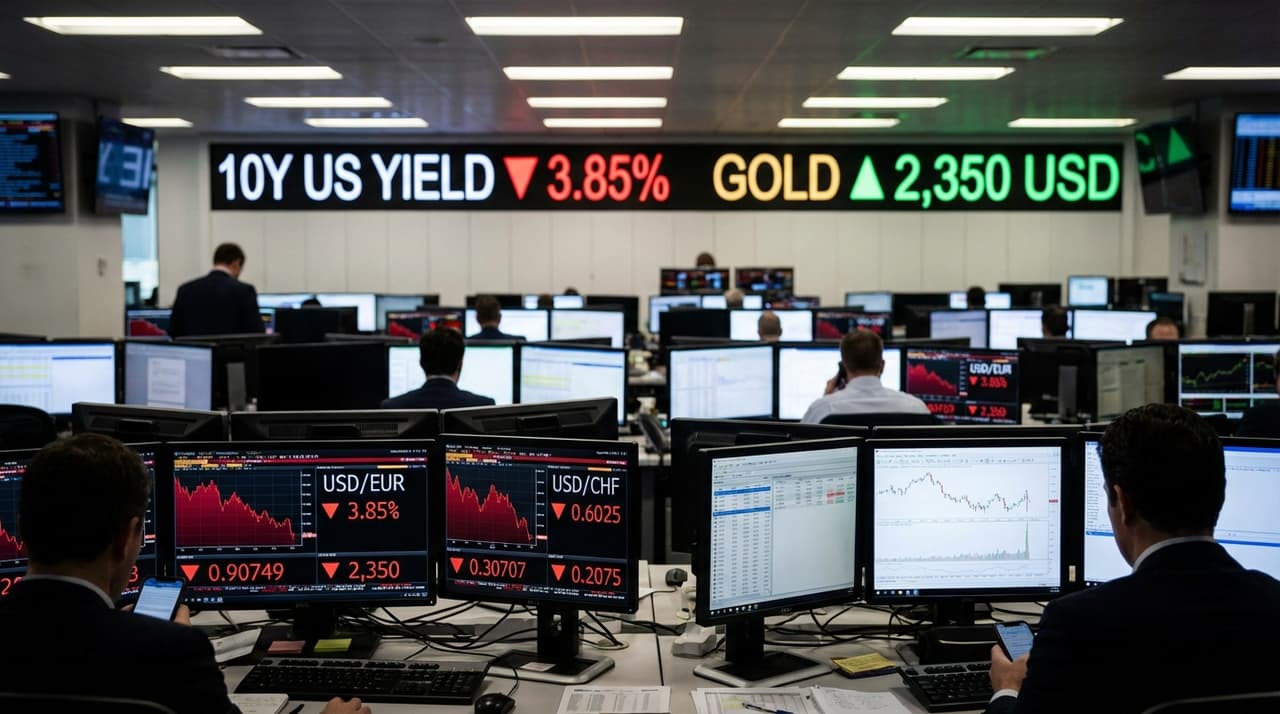
- Markets sold U.S. assets as President Trump's push to annex Greenland rattled investors, driving down the dollar, Treasuries, and stock futures.
- The dollar fell 1% against the euro and Swiss franc, the 30-year Treasury yield neared 5%, and gold and silver hit intraday highs.
- Analysts say investors are reducing exposure to a volatile U.S., though hopes for compromise remain.
President Trump has intensified his campaign to annex Greenland, causing significant market volatility as investors reassess exposure to U.S. assets. The escalation includes Trump's declaration that there is "no going back" on acquiring the Arctic territory, coupled with threats of substantial tariffs on European allies.
Trump has doubled down on annexation rhetoric through multiple channels, according to people familiar with the matter. He announced an upcoming meeting in Davos, Switzerland to discuss Greenland with "the various parties" involved, claiming the island is "imperative for national and world security." In a move that caught markets off guard, he threatened a 10% tariff on Denmark, Norway, Sweden, France, Germany, the Netherlands, Finland, and the United Kingdom starting February 1, escalating to 25% on June 1.
Market reaction was swift and severe. The dollar fell 1% against the euro and Swiss franc in early trading, while the 30-year Treasury yield approached 5%. Gold and silver hit intraday highs as investors sought safe-haven assets. "We're seeing a classic flight from uncertainty," said one trader who requested anonymity due to firm policy. "When the world's largest economy starts talking about annexing territory and slapping tariffs on allies, you have to reassess your exposure."
Trump's rationale centers on Greenland's strategic location and natural resources, which he argues are critical to U.S. national security, particularly for monitoring Chinese and Russian military activity in the Arctic region. He contends that Denmark cannot be relied upon to adequately protect the island from these geopolitical threats. The White House has refused to rule out military action as an option, according to sources briefed on internal discussions.
European leaders are struggling to coordinate a unified response. European Commission President Ursula von der Leyen outlined four key principles for the EU's approach to Greenland and the Arctic region and promised "massive" investment in Greenland. The EU has prepared retaliatory measures worth €93 billion and has the Anti-Coercion Instrument available for broader economic countermeasures. Denmark announced increased military presence in Greenland, with NATO allies France, Germany, Norway, and Sweden also committing troops for military exercises.
Greenland has consistently rejected any acquisition. Greenlandic Prime Minister Múte B. Egede affirmed the island's sovereignty and stated "We don't want to be Danish, we don't want to be American, we want to be Greenlandic." Earlier statements from Greenland's leadership indicated that if forced to choose between the U.S. and Denmark, they would choose Denmark.
NATO allies have warned that the use of military force to seize Greenland could threaten the decades-old transatlantic alliance. French President Macron called for Europe to defend "effective multilateralism" and "fix its own issues." Trump responded by threatening an additional 200% tariff on French wine and Champagne following Macron's refusal to join his Gaza peace initiative.
Efforts to reach the White House for comment were unsuccessful. A spokesperson for the Greenland government said they are "monitoring the situation closely" but declined to elaborate further.
Correction: An earlier version of this article misstated the timing of tariff escalations. The 25% tariff is scheduled for June 1, not May 1.