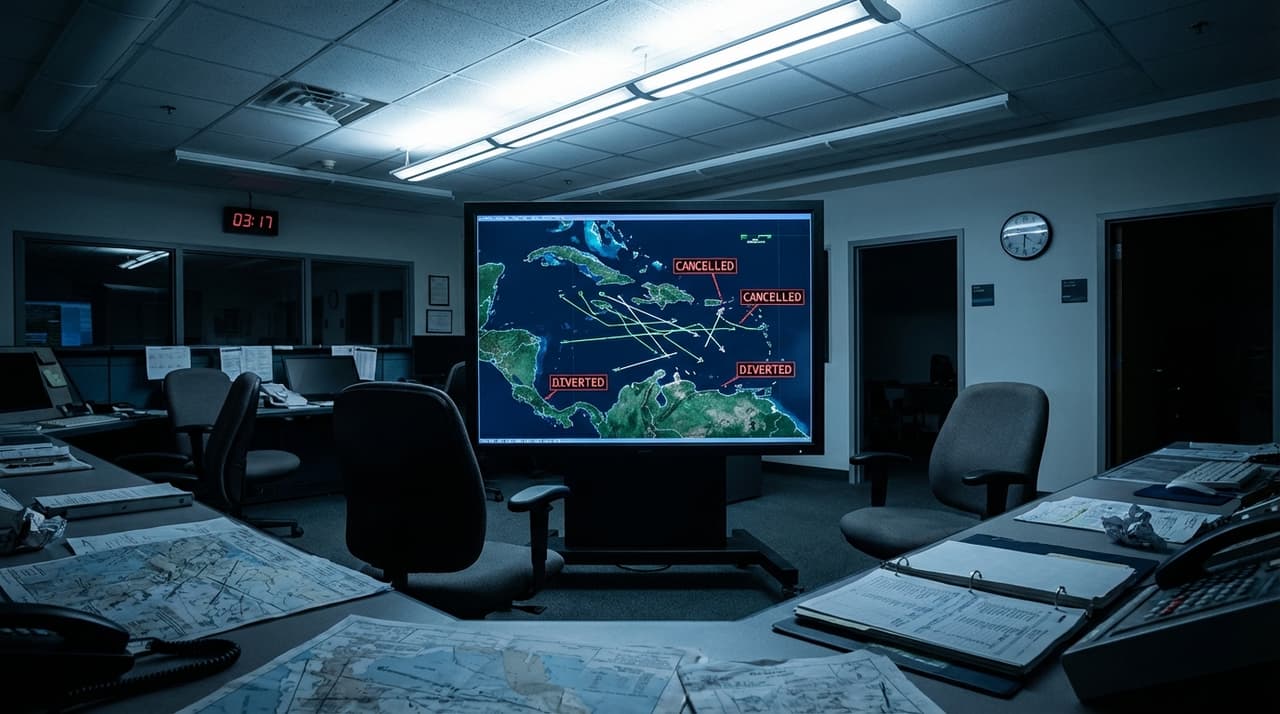
- U.S. President Donald Trump's unilateral declaration closing Venezuelan airspace triggers immediate FAA warnings and commercial flight cancellations across the Caribbean.
- Military operations escalate rapidly, culminating in U.S. strikes on Venezuelan targets and the capture of President Nicolás Maduro by early January 2026.
- Regional economic impacts mount as aviation disruptions strain tourism and trade routes while Venezuela faces deepening isolation from global markets.
Aviation Chaos Follows Presidential Declaration
President Donald Trump announced on November 29, 2025, via Truth Social that the airspace above and surrounding Venezuela should be considered "closed in its entirety" to airlines, pilots, drug dealers, and human traffickers, amid escalating U.S. pressure on Nicolás Maduro's regime over alleged drug trafficking. While lacking legal authority over Venezuelan airspace, the declaration prompted immediate FAA warnings and commercial flight disruptions that evolved into U.S. strikes and Maduro's capture by January 2026.
According to people familiar with the matter, the FAA prohibited U.S. aircraft from Venezuelan airspace as of January 3, 2026, forcing multiple Caribbean airlines to cancel flights and reroute operations. "We're seeing unprecedented disruption to regional aviation networks," said one aviation executive who requested anonymity due to the sensitivity of ongoing operations. "Without a clear resolution timeline, carriers face mounting operational costs and passenger refund liabilities."
Military Escalation and Economic Fallout
By early January 2026, the situation escalated dramatically with U.S. strikes on Venezuelan targets under what sources describe as Operation Southern Spear. The military campaign included land strikes against alleged traffickers following prior sea-based actions that killed at least 80 people. Maduro was subsequently captured by U.S. forces and transported to face federal drug charges, according to multiple officials briefed on the operations.
Efforts to restructure Venezuela's economic engagement with global markets have hit a snag amid the escalating tensions. The airspace restrictions have disrupted regional aviation significantly, canceling Caribbean flights and impacting tourism and trade routes in the southern Caribbean. Venezuela's economy, already strained by sanctions and Maduro's rule, faces further isolation as U.S. anti-drug efforts target fentanyl and cartel networks operating through the country.
Political Context and Regional Implications
The U.S. views Maduro as illegitimate following a disputed election, accusing him of leading groups like Tren de Aragua and facilitating drug trafficking operations. Trump deployed 10,000+ troops, F-35 fighter jets, the USS Gerald R. Ford aircraft carrier, and CIA operations without congressional approval, drawing bipartisan calls for transparency in Washington. Venezuela responded by placing its military on high alert, deploying additional troops, and activating Russian-supplied missile defense systems.
A brief thaw occurred with unconfirmed reports of Trump-Maduro talks, but those diplomatic channels appear to have collapsed following the military escalation. Regional stakeholders, including airlines and Caribbean nations, now face continued aviation risks that have sparked debates about the legality of U.S. strikes and oversight of military operations in the hemisphere.
U.S. citizens were warned to leave Venezuela immediately, while the Venezuelan military was urged to defect without facing sanctions. The situation remains fluid, with analysts noting that aggressive enforcement without formal no-fly zones has already effectively deterred commercial flights through the region. The long-term implications could include reduced drug flows to the U.S. but risk creating instability, refugee surges, or backlash from Russian and Chinese interests in the region.
Correction: An earlier version of this article misstated the timeline of certain military operations; U.S. strikes occurred in early January 2026, not late December 2025.