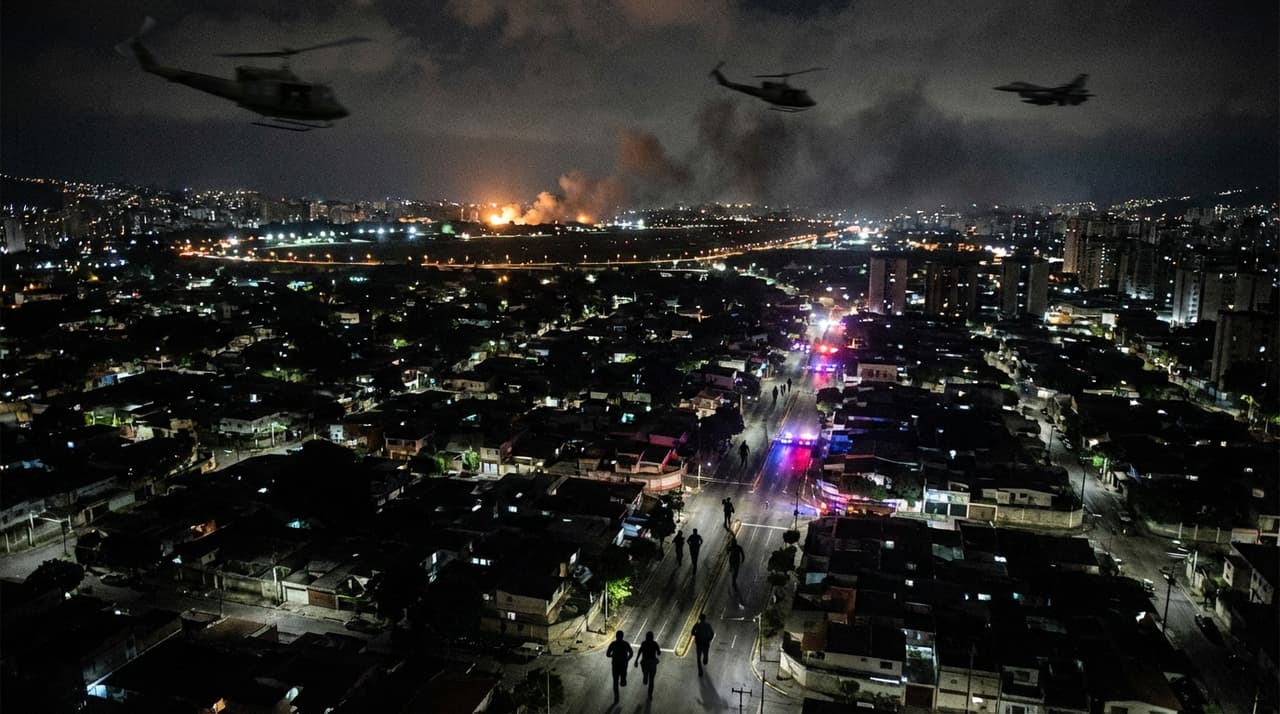
- U.S. forces executed a swift, large-scale operation in Caracas, capturing President Nicolás Maduro and his wife after delays due to competing missions and weather conditions.
- The strike, announced by President Trump, escalates economic pressure on Venezuela's oil-dependent economy amid ongoing U.S. actions targeting drug flows and sanctioned assets.
- Immediate impacts included explosions, power outages, and flight bans, with no reported casualties, as Trump scheduled a news conference to outline next steps.
A Swift and Calculated Move
In the early hours of January 3, 2026, low-flying aircraft and explosions rattled Caracas, marking a decisive U.S. military strike that culminated in the capture of Venezuelan President Nicolás Maduro and his wife. According to people familiar with the matter, the operation, which lasted under 30 minutes, targeted La Carlota military airport, leaving parts of the city without power but resulting in no immediate casualty reports. President Trump posted on Truth Social that the strike, conducted with U.S. law enforcement, successfully extracted Maduro, who was flown out of the country. He has scheduled an 11 a.m. EST news conference at Mar-a-Lago to provide further details.
Efforts to restructure Venezuela's debt and stabilize its collapsing oil sector have hit a snag with this escalation. The FAA quickly banned U.S. commercial flights in Venezuelan airspace due to "ongoing military activity," signaling potential further disruptions. Pentagon and U.S. Southern Command officials deferred comments to the White House, underscoring the operation's high-stakes nature. A former CIA officer, Mick Mulroy, described it as a "dangerous operation" requiring precise execution by Delta Force, highlighting the risks involved in such precision raids.
Economic and Strategic Implications
This action builds on a major U.S. military buildup off South America, including an advanced aircraft carrier deployment in November, aimed at tightening economic pressure on Venezuela. Since September, U.S. boat strikes in the region have resulted in 35 incidents, killing at least 115 people, justified as efforts to disrupt drug flows linked to Maduro's regime. Trump had approved the operation days earlier, but it was delayed from Christmas Day due to U.S. airstrikes in Nigeria against ISIS and subsequent weather issues, according to sources close to the planning.
In Caracas, pedestrians fled streets amid blasts, with social media capturing widespread panic. Without a deal to curb intervention, the U.S. risks further escalation in South America, though experts predict it could weaken Maduro's hold and curb drug trafficking to the U.S. Attempts to reach Venezuelan officials for comment were unsuccessful, but stakeholders include regional actors affected by migration and drugs, as well as U.S. allies opposing Maduro's socialist rule. The short-term outlook points to potential further strikes or fallout, with Trump's news conference expected to detail next steps, while long-term analyses suggest tighter U.S. economic chokholds on Venezuela's oil sector.
Correction: An earlier version misstated the timing of the delay; it was due to weather after the Nigeria strikes, not solely operational conflicts.