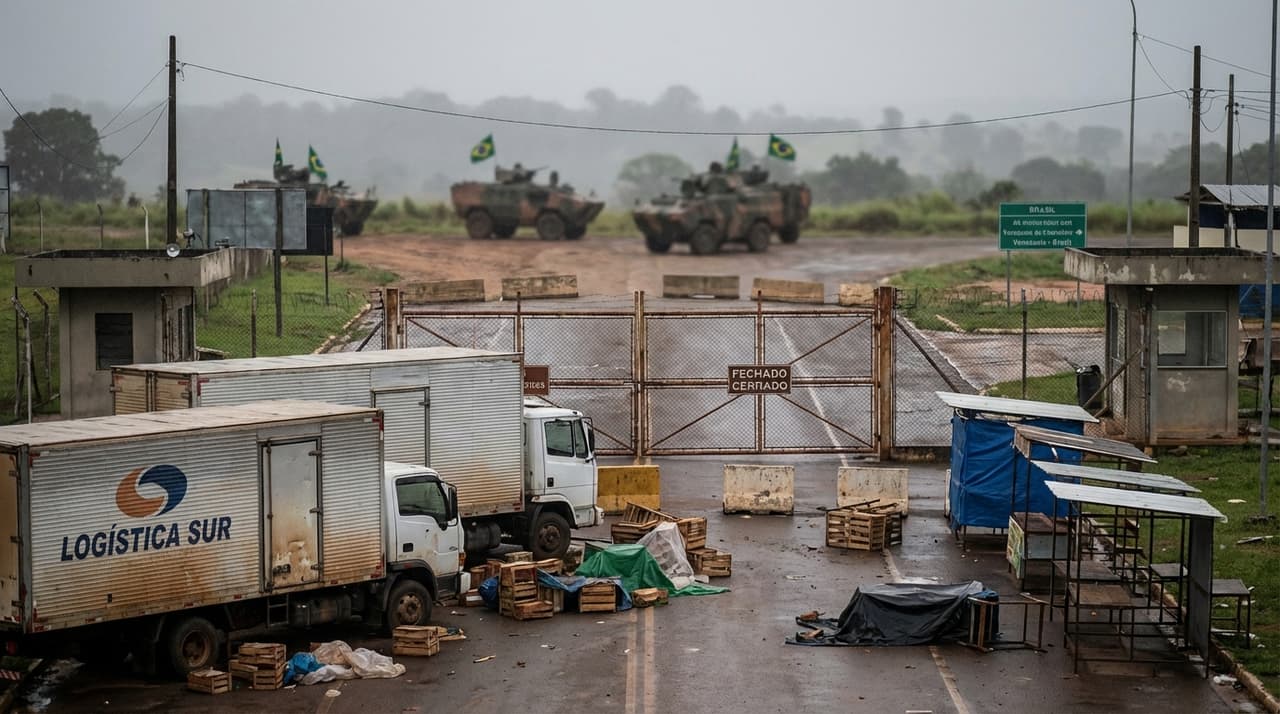
- Venezuela's border closure with Brazil disrupts trade and travel, with immediate economic losses estimated at $3.5 million.
- US military strikes targeting Caracas sites on January 3, 2026, have heightened security concerns, leading to troop deployments by Brazil and Colombia.
- The crisis risks escalating into a broader humanitarian and political instability in Latin America, impacting airlines and energy markets.
Border Closure and Economic Fallout
Venezuela has closed its border with Brazil, according to the head of Brazil's federal police, amid escalating tensions following large-scale US military strikes early on January 3, 2026. The strikes targeted sites like La Carlota airfield and Fuerte Tiuna base in Caracas, with reports of explosions hitting civilian areas. President Trump claimed that Nicolás Maduro and his wife were captured and flown out, though Venezuela's government denounced this as "imperialist aggression" and demanded proof of Maduro's life, according to people familiar with the matter.
This closure, which follows a brief earlier shutdown ahead of Maduro's January 3, 2026, inauguration, has stranded thousands of tourists at borders with Colombia and Brazil, causing significant travel disruptions. Trade losses are already mounting, with initial estimates putting the figure at around $3.5 million, as cross-border commerce grinds to a halt. Brazilian forces have extended deployments near Roraima until April 10 for security, anticipating potential migrant inflows that could worsen the humanitarian crisis.
Regional Military and Political Responses
In response to the strikes, Colombian President Gustavo Petro deployed troops to the border, calling it an assault on Latin American sovereignty while proposing dialogue. Brazil has similarly bolstered its military presence, with sources indicating that these moves are precautionary amid fears of terrorism and further instability. Venezuela has activated its full defense capabilities and urged street protests, with Vice President Delcy Rodríguez publicly challenging the US claims about Maduro's capture.
The political context ties back to disputed elections in July 2024, where the opposition claimed victory, but Maduro's inauguration prompted initial border closures amid "conspiracy" fears. Brazil and Colombia have withheld recognition of Maduro's win but have avoided naming an opposition leader as president-elect, adding to the diplomatic complexity. Efforts to de-escalate have hit a snag, with regional leaders expressing concerns over a potential state of emergency in Venezuela if diplomacy fails.
Impact on Aviation and Energy Markets
The crisis is rippling through financial sectors, particularly aviation and energy. Following a prior Venezuelan airspace shutdown on November 29, 2025, Brazilian airlines like Gol (GOL), LATAM (LILAK), and Azul (AZUL) have been forced to reroute flights, adding approximately 40 minutes and extra fuel costs. Analysts predict this could lead to 3-5% hikes in fuel budgets through the first quarter of 2026, with fare increases on Brazil-US and Caribbean routes expected as early as next week. Without a deal to reopen airspace, carriers face prolonged operational challenges.
In energy markets, broader US actions include a blockade targeting sanctioned oil tankers, which could impact global supply chains. Industry experts note that these moves build on Trump's aggressive Venezuela policy post-2024 US election, with risks of re-priced insurance premiums and further disruptions. Locals in Caracas report fear from strikes on residential areas, highlighting the human cost amid the financial turmoil.
Outlook and Implications
Short-term, the situation remains fluid, with potential for re-priced airfares and border crises if diplomatic efforts stall. Long-term, there is a risk of wider Latin American instability, refugee waves, or escalated conflict if Maduro's capture remains unconfirmed. Experts caution that precedents, such as past US restrictions, have led to prolonged economic costs, and current chaos could deter foreign investment in the region. As of now, attempts to reach Venezuelan officials for further comment have been unsuccessful, and updates on border status are pending.
Correction: An earlier version of this article misstated the date of the US strikes; they occurred on January 3, 2026, not January 2. The border was reopened on January 13, 2025, but has since been closed again due to recent developments.