Exzeo Group, Inc.
NNYSE:XZOQ1 FY2026 · Earnings Call TranscriptMay 6, 2026
Operator
Good afternoon, and welcome to Exio Group's first quarter 2026 earnings call. My name is Angela, and I will be your conference operator.
At this time, all participants will be in a listen-only mode. Before we begin today's call, I would like to remind everyone that this conference is also being broadcast live via webcast and is available for webcast replay approximately 4 hours after the call through May 6, 2027, on the Investor Relations section of Exio Group's website at www.exio.com.
I would now like to turn the call over to Bill Broomall, Vice President of Investor Relations. Bill, please go ahead.
Bill Broomall
Thank you, and good afternoon. Welcome to Exio Group's first quarter 2026 earnings call.
To access today's webcast, please visit the Investor Information section of our corporate website at www.exio.com. Before we begin, I would like to take the opportunity to remind our listeners that today's presentation and responses to questions may contain forward-looking statements within the meaning of the Private Securities Litigation Reform Act of 1995.
Words such as anticipate, estimate, expect, intend, plan, and project, and other similar words and expressions are intended to signify forward-looking statements. Forward-looking statements are not guarantees of future results and conditions, but rather are subject to various risks and uncertainties.
Some of these risks and uncertainties are identified in the company's filings with the Securities and Exchange Commission. Should any risk or uncertainties develop into actual events, these developments could have material adverse effects on the company's business, financial condition, and results of operation.
Exio Group disclaims all the obligations to update any forward-looking statements. Now with that, I'd like to turn the call over to Suela Bulku, Exio's Chief Financial Officer.
Suela Bulku
Thank you, Bill. Good evening, everyone, and thank you for joining us for Exio's first quarter earnings call.
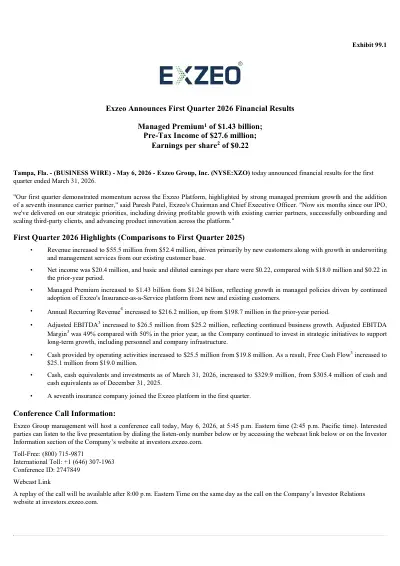
Exio continues to deliver on its core objectives. Managed premium on the platform experienced another quarter of growth to $1.43 billion and exceeded our expectations.
We delivered continuous bottom-line growth, including strong cash flows and a 49% adjusted EBITDA margin in the quarter. Pre-tax income in the quarter was over $27 million, an increase from $24 million in the prior-year quarter and above our previous guidance range.
Diluted earnings were 22 cents per share. For the first quarter, revenue increased to $56 million from $52 million in the prior-year quarter, driven by the increase of managed premium on the platform.
The growth in managed premium reflects continued diversification across the business, with managed premium from non-HCI clients reaching approximately $105 million, a positive step forward. Our adjusted EBITDA margin was over 49% in the quarter, and we believe our margins are repeatable in the future.
This quarter reflected continued investment in growth initiatives and personnel, and as our model continues to expand, we expect to make additional investments going forward. Kevin will go into more detail in his remarks.
A few additional highlights for the quarter: our annual recurring revenue was $216 million in the first quarter, an increase from about $199 million in the prior-year quarter. Free cash flow generation remains strong.
For the first quarter, we generated free cash flow of about $25 million. With net income of about $20 million, that represents a free cash flow conversion rate of 123%.
Turning to the balance sheet, we ended the year with $330 million of invested assets, which includes cash, cash equivalents, and fixed income securities, and we remain debt-free. Shareholders' equity increased to $275 million, an increase from $254 million at the end of the year.
Our shareholder equity is now eight times higher than it was a year ago. Excluding the IPO impact, it has more than tripled over the same period, reflecting strong underlying growth in the business.
Before turning the call over to Kevin, I want to quickly touch on our guidance expectations. For the second quarter, we expect pre-tax income to be between $27 and $30 million.
For the full year 2026, we are leaving our guidance unchanged at between $115 million and $125 million. With respect to managed premium, we expect managed premium to remain stable in the second quarter at approximately $1.4 billion, consistent with the anticipated timing of growth across our existing client base.
We continue to expect managed premium of $1.55 billion at year-end 2026. In closing, we are very pleased with our strong start to 2026, as Exio delivered another quarter marked by continued execution across premium expansion, revenue growth, solid profitability, and solid balance sheet.
With that, I will hand it over to Kevin, President of Exio.
Kevin Mitchell
Thank you, Suela. Exio has made meaningful progress towards its strategy in early 2026.
To remind those new to the Exio story, the composition of managed premium continues to evolve as Exio expands beyond its historical client base. At the end of the third quarter of 2025, all $1.2 billion of managed premium on the Exio platform was generated from HCI-sponsored carriers.
That has grown to approximately $1.3 billion as of the first quarter 2026. Additionally, over the past 6 months, we've added three new carriers to the platform, and these carriers added $105 million of managed premium as of the first quarter.
These new carriers account for over 7% of managed premium, marking an important milestone in diversifying revenue sources and validating the platform's ability to attract and support external partners. Because of the validation we are seeing in the market, we are investing in our business and infrastructure to ensure we have everything in place to pursue our future growth ambitions.
This includes investing in talent and platform capabilities. Through April of this year, the company added about 20 new full-time employees.
These new team members will focus on supporting, scaling of operations, onboarding new clients, and expanding product capabilities. This buildout reflects both the increasing demand for the Exio platform and management's confidence in the company's growth trajectory.
In closing, we continue to build momentum. The existing carriers on our platform are growing, the new carriers added to the platform are having success scaling and now contribute to the total managed premium on our platform, and we are investing in infrastructure to put us in a position to take advantage of the next phase of growth.
Now I'll turn the call over to Paresh, Exio's Chief Executive Officer.
Paresh Patel
Thanks, Kevin. As Suela highlighted in her remarks, we're successfully scaling our platform with tremendous efficiency.
Out of every dollar we are adding to the platform, 50 cents is dropping to pre-tax income. Because of these attractive economics, Kevin is working to add more managed premium to the platform.
I think we have a fabulous team to execute that strategy. In addition to that, we have an additional strategy that is now developing.
It requires a deep understanding of the broader industry and market trends. Let me elaborate.
First, we know that the insurance industry, our potential clients, generally are behind in adapting the latest technology. Most of them have IT teams who can implement and maintain software tools and systems, but what they cannot do is develop new tools.
Second, the Exio platform was developed entirely in-house from the ground up. We have developers and insurance experts under the same roof, and it shows that we know how to develop, deploy, maintain systems at scale.
This is a key differentiator. Third item is insurers are facing shortage of skilled talent, and that talent gap continues to widen across the industry.
Finally, there is AI. The industry recognizes that AI has the potential to significantly improve operational efficiency.
While there's been considerable discussion about how carriers can leverage AI, most companies are just adding AI to their tool set as an additional expense. Exio is doing something different.
Exio is using AI to build solutions. Let me give you a concrete example.
Starting April 1, insurance regulators in Florida implemented new wind mitigation requirements. These updated regulations, which include additional documentation requirements, creates a meaningful operational burden for all carriers.
Insurers must also find the talent and expertise needed to manage these new requirements. These challenges not only place additional strains on operations, but also introduces incremental costs.
While many in the industry view these changes as a challenge, Exio saw them as an opportunity. The Exio team was able to combine its deep expertise in building solutions with internally developed AI tools to design and deploy a solution in less than a month.
It is called WindForm Pro. By eliminating manual workflows, WindForm Pro streamlines the process and significantly reduces the operational and frictional burden on carriers.
In fact, multiple carriers outside the Exio platform are already testing WindForm Pro, and one carrier has already signed up to use it. What this demonstrates is that by combining AI capabilities with our in-house talent, we can quickly identify challenges and design and deploy solutions in a highly cost-effective manner.
We believe we are only beginning to tap into the broader opportunities that this approach can create. In summary, we already have a profitable platform that is a strong generator of cash flow and continues to scale.
At the same time, we are identifying and solving new industry challenges that can lead to additional revenue streams in the future. With that, I'll turn it over for questions.
Operator
Thank you. We will now begin the question-and-answer session.
Your first question comes from the line of Matt Carletti with Citizens Capital Markets. Your line is now open.
Matt Carletti
Hey, thank you. Maybe I'd start with kind of a two-part question, but kind of first part being can you update us on kind of the newer clients you've announced the past few quarters, kind of how that onboarding and integration and getting up to speed is going?
Then kind of alongside that, kind of how the pipeline's looking, conversations and so forth for customers eight, nine, and beyond?
Kevin Mitchell
Sure, Matt. This is Kevin.
From a new client standpoint or ones that we've recently onboarded, it's going as planned. As I think Suela and I both mentioned, from a standing start in December to around $105 million of premium on the platform, I think that's a strong uptake when you consider that those two clients, one was signed in September of last year and the other one was October.
All was on solid footing there. As far as new clients and pipeline continues to build, as we mentioned last quarter, we have team members that are focused at and each day, each week building on that pipeline, and we feel confident that we'll continue to execute and bring on new clients in standard fashion.
Matt Carletti
Great. Then if I could just maybe follow up with, Paresh, you talked a bit about this, WindForm Pro.
Could you just help us maybe give us a better understanding of, one, just kind of order of magnitude what that can mean to, if it does get some traction, kind of revenue or how it how it's how it's priced based on premiums, things like that. Then secondly, if you're really viewing this as kind of just a a a one-off product, or if if if more from an angle of kind of a maybe a hook or a an opportunity to bring, potential new customers into the broader, ecosystem that is Exio?
Paresh Patel
Matt. Answering the questions in different ways.
The product, because of the need that the industry had, it was built in very quick fashion, and obviously it solves a problem, a current problem that everybody's facing. As such, and the way we've deployed it, it's very, very, very cheap.
It's about 10% of what it would cost you to do manually. What it's doing is it's opening doors for new carriers to appreciate what Exio's capable of.
From that sense, it's a very good deal to further spread the Exio brand. In terms of revenue, I don't think this in and of itself, especially because of the prices we're charging, right, that it's going to be meaningful in terms of revenue.
I don't think Suhela is adjusting her financial models because of it. That's that part.
Really the big thing is how this was developed, the speed at which it was developed, how it's being deployed, right? This is basically monetizing AI capabilities in a manner that is both reduces our expenses to develop by orders of magnitude and enhances value to potential clients, right?
It's a real thing that we weren't even thinking of when we had the last earnings call two months ago. Right?
To be fair, our developers have been monitoring developments in the AI space, shoot, for almost three years at this point, pretty much since the week ChatGPT came out. It's waiting for it to be when the moment is right, when it's ready for prime time.
In WindForm Pro, we are demonstrating how AI can be used and utilized and turned into a product and turned into revenue all in two months.
Matt Carletti
That's great color. Thank you very much.
Operator
Your next question comes from the line of Terry Tillman with Truist Securities. Your line is now open.
Terry Tillman
Hey. Good afternoon, Paresh, Kevin, Suela, and Bill.
My first question, I kind of wanted to build on the last set of good questions, really about AI. It seems like it's almost daily something dramatic is happening in some of these industries, and we're hearing CEOs saying spending billions of dollars on this stuff.
Beyond just kind of this potential new factory where you can light up new solutions really quick like WindForm, I'm curious if AI is just this call to arms for even traditional insurers or upstarts is actually starting to drive some incremental sales funnel activity just because we really have to transform the whole business across everything, underwriting, policy management, etc. Are you seeing any kind of incremental tailwinds from just, hey, this AI thing is a real deal and we need to get going yesterday?
Then I had a couple follow-ups.
Paresh Patel
Yeah. Terry, what I would tell you about that is yes, all of those possibilities of underwriting, quoting, claims management, etc., there's always been that conversation of AI could do things, right?
The issue has always been how do you do it? A lot of insurance carriers probably want a packaged solution as opposed to, here's Claude code, develop your own solution.
That was my point about this, right, is that in my prepared remarks, it's just because it's available doesn't mean everybody can actually assemble it and turn it into a solution that they can use over and over and over again. It turns out that the Exio technology team can, right?
They do it in a controlled manner. Back to that whole thing, being able to design, deploy, and maintain things at scale is quite a need that still is there.
We are starting to sort of see a unique niche that we can fill. In theory, anybody can fill that niche is what people will tell you.
In theory, anybody could have built a copy of Google Search. Heck, Microsoft even tried with all of their resources, but Bing doesn't quite cut it, right?
You get the idea. We are seeing that having the idea and being able to actually put it into production are two separate, different things, yeah?
Terry Tillman
Yep, got it. Maybe one and a half more questions.
I know, Kevin, you were talking about investing in I think 20 FTEs. I know you all hired a key kind of long-term veteran in the industry.
Is that team built out now or is it got enough substance and size and how they're doing? I know it's early days, but just any progress there?
Then a model question for Suela.
Kevin Mitchell
Terry, this is Kevin. We continue to build the team.
Hence the 20 folks since January 1st. We continue to build the team around them to drive growth and drive ever-increasing pipeline activity.
Paresh Patel
Terry, and if I could put a different context into all of this stuff. I'm sure you've been on lots of earnings calls, and the recurring theme has always been we are adding AI as in licensing stuff and making it a new tool and running up an expense.
Two, we are cutting headcount, right? That seems to be the recurring theme.
We're doing the opposite. We're using AI as a revenue generator and a lead generator in lots of ways, we actually already monetizing it.
Secondly, Kevin is adding people, and to be fair, it's not a fair comparison because we started from such a lean, efficient operation that the people Kevin's adding should have a material impact on our rate of accelerating our growth going forward, right? That's why I'm kind of excited that he's adding people, yeah?
Terry Tillman
For sure. I'll turn it over to somebody else after just this question, but I really wanted to get it in.
Managed premium and ARR were strong in the quarter. They were well ahead of at least our expectations.
I know it takes time for that to move to revenue from operations and revenue. Can you share anything about how that played out in 1Q versus what you thought or just any commentary around timing from that large add of premium in 1Q as we move into 2Q and beyond?
Thanks, again. Oh
Suela Bulku
yeah, thank you for the question, Terry. As I mentioned before, the timing when the managed premium gets added to our platform obviously matters.
What we saw in Q1 is that the new additional premium, especially from the new clients, joined the platform mid to late quarter. Also keep in mind that we recognize up front about 25% to 30% of the revenue, and the remainder is recognized over time.
That said, new premium is still not large enough share of our total managed premium that we currently have in our platform to materially distort quarterly revenue on its own. On a normalized basis, you can think of the ARR conversion into revenue to being fairly flat consistent over the quarters.
Just a reminder, though, that we do have some seasonality on the margin, based on the renewal cycle of the policy and the product mix, and then how we recognize revenue along with expenses. Historically, you'll see higher margin renewals tend to be in the middle of the year, which drives the Q2 peak that we have seen historically.
Terry Tillman
Thanks.
Suela Bulku
Thank you.
Operator
Your next question comes from the line of Dylan Becker with William Blair. Your line is now open.
Dylan Becker
Hey, everybody. Appreciate it.
Maybe, Paresh, double-clicking on kind of the prior points, or maybe for Kevin as well, too, but on the opportunity to kind of dedicate more resources, given kind of the opportunity at hand and the ability for AI to kind of superpower that in some context. I know the cadence of getting WindForm into market is notable, but maybe how you think about that balance, right, of compounding the existing kind of platform value proposition, how that can compel more customers to come online, but also kind of scaling that outside of Florida and into new territories and regions, kind of maybe a breadth and depth type of question, if that makes sense, from a platform functionality perspective?
Paresh Patel
Yeah. Great question, right?
I think that's why we sort of in our prepared remarks try to talk about plans and growth for the existing platform and adding managed premium in that fashion, while at the same time exploring these new capabilities and basically door-opening projects that we're doing, they won't have impact immediately, but they will create long-term opportunity and create a differentiation for Exio over other solutions in the marketplace. We kind of have short-term things we're trying to do, medium-term things we're trying to do, and long-term things we're trying to do.
Personally, from my perspective, it's the long-term things that we're doing that I think are the most exciting as to what it could mean down the road, right? Because WindForm Pro, if you think of it as just a universal way of filling out this OIR requirement, right?
It's a very specific thing. The same architecture and method that we developed that, we could use it to create a digital agent for reviewing claims, or a digital agent for compliance, which is a big thing with the insurance carriers, or a digital agent for generating a rate filing, those kinds of things.
We can see that at this point, and we know how to use AI to develop those tools and capabilities. That's the beauty of AI.
It doesn't mean that it will only do it on the Exio platform. One of the agents could also work on any other software platform that a carrier might have implemented.
Think about what that opens up as a door, right? Again, very early days, but we didn't want to talk, if you noticed, through all of this stuff, we've never really mentioned AI in any material way.
We didn't because wasn't that we weren't aware of it, we weren't doing anything. We wanted to do it when we actually had something.
WindForm Pro actually shows you when we have something, but it was the sample of what is more to come, yeah?
Dylan Becker
Very helpful. No, and excited to kind of keep an ear out for what's to come in the future there.
Thank you, Paresh. Maybe for Suela, too, on the premium growth dynamic.
Obviously, still very impressive. I know you kind of said, hey, we expect it to be flat next quarter, reiterate the full-year outlook.
Could you just kind of remind us some of those seasonal components, and maybe again, a broader update given the Florida exposure, too, how underwriting cycles or maybe impacted or how carriers kind of think through those as we enter into hurricane season if there's anything to kind of be aware of there from a seasonal perspective? Thank you.
Suela Bulku
This is a very good question. As I mentioned, yeah, we expect managed premium to remain stable, which is consistent with the growth pattern of our client base.
Our clients are primarily based in Florida, which usually the growth is more back-ended, you'll see the growth in the managed premium more in the fourth quarter.
Paresh Patel
You get it, right? In the sense of it's not set by us.
It's set by clients. We're just trying to explain what clients typically do and what their cadence normally is.
Dylan Becker
Very helpful. Thank you.
Again, if you would like to ask a question, please press star one on your telephone keypad to raise your hand and join the queue.
Operator
At this time, this concludes our question-and-answer session. I would now like to turn the call back over to Paresh Patel, who has a few closing remarks.
Paresh Patel
Thank you. I want to thank everyone who joined the call today, and I also want to thank the Exio team for their continued hard work.
Before we wrap up, I should just provide a quick update on the Rule 10b5-1 purchase plan that is underway for me to buy shares. As of today, I think I've bought about 72,000 shares since the plan went into effect a couple of months ago, and it still continues on, and I look forward to it being filled out, hopefully sometime in the current quarter.
With that, we'll end the call. Thank you.
Operator
At this time, this concludes today's call. Thank you all for joining.
You may now disconnect.