Exzeo Group, Inc.
NNYSE:XZOQ2 FY2026 · Earnings Call TranscriptAugust 6, 2026
Bill Broomall
Thank you, and good afternoon. Welcome to Exio Group's second quarter 2026 earnings call.
To access today's webcast, please visit the investor information section of our corporate website at www.exio.com. Before we begin, I would like to take the opportunity to remind our listeners that today's presentation and responses to questions may contain forward-looking statements within the meaning of the Private Securities Litigation Reform Act of 1995.
Words such as anticipate, estimate, expect, intend, plan, and project, and other similar words and expressions, are intended to signify forward-looking statements. Forward-looking statements are not guarantees of future results and conditions, but rather are subject to various risks and uncertainties.
Some of these risks and uncertainties are identified in the company's filings with the Securities and Exchange Commission. Should any risks and uncertainties develop into actual events, these developments could have a material adverse effect on the company's business, financial condition, and results of operations.
Exio Group disclaims all the obligations to update any forward-looking statements. Now with that, I would like to turn the call over to Suela Bulku, Exio's Chief Financial Officer.
Suela Bulku
Thank you, Bill. Good evening, everyone, and thank you for joining us for Exio's second quarter earnings call.
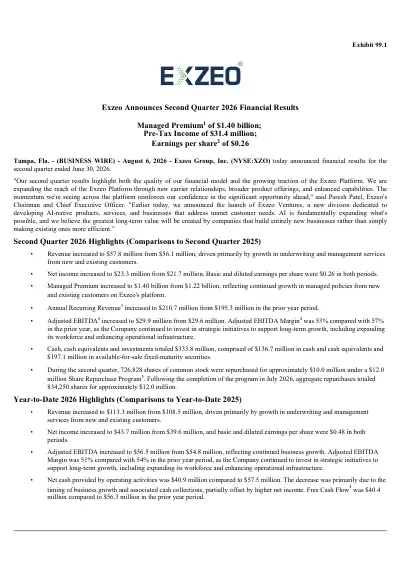
Exio continues down the path of strong execution and attractive financial results. Managed premium on the platform remains robust at $1.4 billion, and we delivered another quarter of attractive margins, including a 53% adjusted EBITDA margin in the quarter.
Pretax income for the quarter was over $31 million, an increase from over $28 million in the prior quarter. These results were above the guidance we provided.
Earnings per share for the quarter were 26 cents, and year-to-date earnings per share were 48 cents. For the second quarter, total revenue increased to $58 million, up from $56 million in the prior quarter, driven by the increase of managed premium on the platform.
Excluding outsourcing claim fees, adjusted revenue increased by $4 million year-over-year to more than $56 million. Managed premium in the quarter was $1.4 billion, an increase from $1.2 billion in the prior quarter.
Given the seasonality of growth for our clients, managed premiums were in line with expectations. Our adjusted EBITDA margin was over 53% in the quarter, and we believe annualized margins above 50% are achievable for the foreseeable future.
A few additional highlights for the quarter. Our annual recurring revenue was $211 million in the second quarter, an increase from $195 million in the prior quarter.
Our balance sheet remains exceptionally strong. We ended the quarter with over $333 million of invested assets, which includes cash, cash equivalents, and fixed income securities.
We remain debt-free and continue to maintain significant financial flexibility. Shareholders' equity increased to $288 million, an increase from $254 million at the end of the year.
Next, I want to quickly touch on our guidance expectations. For the third quarter, we expect pretax income to be between $28 and $31 million, and we expect managed premium to be approximately $1.4 billion.
Our guidance for the third quarter is consistent with the anticipated timing of growth across our existing client base. Our full-year guidance remains unchanged.
Before turning the call over to Kevin, I wanted to quickly touch on recent capital management actions. During the quarter, we repurchased over 726,000 shares of our common stock for approximately $10 million.
Subsequent to the quarter, we repurchased an additional 107,000 shares, which brings total repurchases to $12 million, completing the authorized share repurchase program. We continue to have tremendous confidence in the long-term outlook for our business.
Given our asset-light model, high margins, debt-free balance sheet, significant cash on hand, and the momentum we are seeing across the business, we believe allocating less than 1 quarter's worth of earnings to repurchase shares at attractive valuations was a compelling use of capital. With that, I will hand it over to Kevin, President of Exio.
Kevin Mitchell
Thank you, Suela. The Exio platform continues to gain momentum, and we are seeing encouraging customer wins.
Let me elaborate on some of these achievements. While we often talk about the insurance companies joining our platform, demand extends well beyond carriers.
We are seeing growing interest from independent agents who are proactively reaching out to join the Exio platform. The flywheel effect we've discussed in the past is real.
As more agents join the platform, it becomes increasingly attractive to insurance companies. As more carriers come on board, the value proposition for agents continues to strengthen.
That network effect is helping accelerate adoption across our ecosystem. Second, we've seen quote volume more than double since the beginning of the year.
Third, last month we signed our eighth carrier partner. Our new partnership with GEICO brings auto insurance to the platform, marking another meaningful step in expanding our capabilities.
Agents can now bundle home and auto. With the addition of auto, the Exio platform now offers homeowners, commercial residential, flood, and auto insurance.
Expanding our product set makes the platform more valuable to agents by enabling them to serve more of their clients' insurance needs through a single platform. In closing, since the beginning of the year, we've made meaningful progress across every dimension of the platform.
We've doubled the number of agents, we've more than doubled quote volume, and we've added additional products. We've grown to eight carriers on the platform.
Now I'll turn the call over to Paresh, Exio's Chief Executive Officer.
Paresh Patel
Thanks, Kevin. Suela provided numbers that clearly show how healthy and cash flow positive Exio already is.
Kevin highlighted the tremendous momentum in expanding the size and scope of the Exio platform. The continued addition of new carriers, new products, and new capabilities reinforces that our platform is gaining meaningful traction in the marketplace.
While these initiatives don't translate to results overnight, they continue to strengthen our long-term growth opportunity and expand the value we can deliver. Beyond all of this, earlier today, we announced the next new initiative: Exio Ventures.
The reason we're launching Exio Ventures is simple. AI represents a once-in-a-generation paradigm shift.
Most companies think about AI as a tool to make existing processes faster or more efficient. While that's certainly valuable, we think there is a much bigger opportunity.
A useful analogy might be to look back at the internet, the evolution of the internet. The first wave of the internet brought traditional businesses online, making familiar processes faster and more efficient.
The truly transformative companies were the companies that created entirely new business models that only become possible because of the internet. For example, companies like Uber fundamentally reimagined transportation.
We believe AI has the potential to follow a very similar path. Rather than simply asking how AI can make current businesses more efficient, we are asking a much bigger question: What entirely new products, services, and businesses can AI make possible?
That's the purpose of Exio Ventures. Now we've been working on these ideas behind the scenes for some time, and we've reached a point where we've seen enough progress and assembled the right team that we're ready to formalize the effort.
We're funding Exio Ventures as an internal platform, and its mission is to identify opportunities that only emerge when AI fundamentally changes what's possible. Let me give you one small example amongst the number of initiatives that we are working on.
After a major catastrophe event, insurance carriers experience an enormous surge in claims. The challenge isn't simply receiving those claims; it's having the personnel available to process them.
That staffing bottleneck often delays claim handling at exactly the time when policyholders need assistance the most. Simply put, scaling up the human element in a demand surge is challenging.
It is difficult to increase human compute at the touch of a dial. However, with AI, you can increase the compute by orders of magnitude immediately.
Imagine a carrier that normally processes 200 claims per week, suddenly needing to process 4,000 because of major catastrophe events. The claim volume has spiked 20-fold.
Now with the AI capabilities, processing capacity can increase just as quickly. The result will be faster claims handling, shorter wait times, and a significantly better experience for the policyholders during some of the most difficult times they'll ever face.
This is exactly the type of opportunity that excites us because it simply wasn't possible before AI. That's the vision behind Exio Ventures.
Across underwriting, claims distribution, claims, risk transfer, and many other areas, we believe AI creates the opportunity for entirely new categories of products and businesses. With that, I will turn over the call for questions.
Operator
We will now begin the question-and-answer session. If you would like to ask a question, please press star one now to raise your hand and join the queue.
To withdraw your question, press star one again. We ask that you do pick up your handset when asking a question to allow for optimum sound quality, and if you are muted locally, please remember to unmute your device.
Please stand by now while we compile the Q&A roster. Your first question comes from the line of Terry Tillman with Truist.
Your line is open. Please go ahead.
Terry Tillman
Good afternoon, Paresh, Kevin, Suela, and Bill. Three questions, but they'll be really quick, I promise.
First on GEICO, I think they're relatively large. I think they're the third-largest auto insurer in the US.
Is there any way to kind of ring-fence this or give us a sense on how sizable this could be and kind of timing and when this could start to hit the model? Then I had two follow-ups.
Paresh Patel
Yes, Terry. GEICO is big.
It's huge, right? There's also been a recent thing about people wanting to bundle home and auto and the benefits of all of that.
The issue becomes, do you bundle with the auto carrier bundling the home or the home carrier bundling the auto, or do you let the agent on the platform assemble the bundle? These are all choices that would result in the same outcome.
The partnership with GEICO lets people bundle and sell GEICO on the Exio platform. It's a big start.
We'll see how it grows into it, but, yes, it could be something big. Early days yet, but we are very excited to partner with GEICO.
Terry Tillman
Understood. I appreciate that.
Maybe the second question, and I'm assuming some others might want to also double-click on this, Exio Ventures sounds very interesting. Could you help us a little bit with another one of these, what would it do?
Would it be it drives more carriers or business relationships, or it drives more of a take rate with your existing carriers? Is it a managed premium dynamic?
At the same time, by making these investments, would you still be kind of achieving those really high 50% plus EBITDA margins?
Paresh Patel
I would characterize this way. What you sort of said about AI helping the Exio platform, that's all going to occur anyway.
That isn't what Exio Ventures is about. There will be AI on the Exio platform side as well, and that's what everybody else is also looking.
That's modernizing your current stack because of AI. What we're talking about in Exio Ventures is doing something that could not be possible without AI, right?
That's what we're talking about, think of again, in my earlier comments, the example of Uber. Uber is not possible without the internet and GPS and maps and everything else, right?
It isn't just taking a taxi company and putting it on a web presence. It's reimagining how things get done, how transportation is done.
We are starting to see there are things that you can now do with AI that just couldn't do without AI. One simple example of this that we kind of piloted a little bit was this win from Pearl we talked about last quarter.
It allowed carriers to process this new requirement that came in, and it would have required a lot of staffing and training and all that kinds of stuff. Using AI, we turned it into something that we could share with the whole industry very, very easily.
It's stuff like that that we're talking about, right? It's not retrofitting AI to existing businesses; it's trying to think of new businesses we can do that's only possible because of AI.
We've four or five in the hopper at the moment. We will obviously discuss them as they all come to more maturity as we go along.
We're in the process of seeding and setting all that up, but Exio Ventures is not just an incremental thing. It could be something very, very different that is even beyond insurance, if that helps.
Terry Tillman
Yeah. It does help.
I'm looking forward to hearing more. Just a final one and I'll jump off here.
Anything you can share though, Suela, in terms of 3Q and 4Q in terms of how to think about adjusted revenue, maybe versus where we ended at $56 million in 2Q? Then, can you remind us again what the managed premium target was for the end of the year and I think you said that's unchanged?
Suela Bulku
Yes. For full year year-end, our the guidance is $1.55 billion for managed premium.
In terms of, Q3 and Q4, the one thing I would say is just a reminder that, the ARR and then how it converts to revenue, this is the seasonality that we have in our business, and it depends on the renewal cycle and the and the product mix. For 2026, we have revenue that peaks slightly in Q2 and is more modest in Q3, more like more natural in Q3, and then the slight Q4, a slight Q4 step down.
Just that's very typical for our seasonality.
Terry Tillman
That's great. Very helpful.
Thanks.
Operator
Again, if you have dialed in and would like to ask a question, please press star one on your telephone keypad to join the queue now. Please stand by while we compile the Q&A roster.
At this time, there are no further questions. I would now like to turn the call back over to Paresh Patel, who has a few closing remarks.
Actually, we've just had someone raise their hand. The next question comes from Dylan Becker with William Blair.
Your line is open. Please go ahead.
Dylan Becker
Hey, guys. Hey, guys, sorry about that.
Got thwarted by the star one, unfortunately. We made it.
Hey, quick question, Kevin, you kind of touched on the carrier flywheel dynamic, and obviously GEICO seems to be a big unlock in that context as well. Wondering if you could kind of expand on that notion as you broaden kind of the scope across carriers, premium, as well as potential kind of lines, how that kind of drives the follower notion of more agents and obviously underwriting more premium through the Exio platform, as it seems kind of fortuitous in and of itself and starting to kind of gain some real traction and momentum here.
Kevin Mitchell
Thanks, Dylan. It's Kevin.
We're seeing some interesting trends definitely this year. What we're finding is agents are looking at being proactive with their clients.
A lot of that is utilizing technology. One of the things that's really having them gravitate to the Exio platform is just the ease of use.
When you look at that, and as the word gets out, when everyone's trying to drive more and more efficiency, it's almost like that I talked about in the comments of the flywheel effect. More and more agents come on board, and because everyone's looking for that edge, and as we bring more carriers onto the platform, then the Exio platform becomes a go-to or a hub, if you will, to solve multiple different client questions or placements of coverage.
It's a positive effect, and when we look at it, we look at it in a couple different metrics. One is the number of agents coming on board, but then the utilization of the platform, which is up as well.
It's exciting, and it's our job to bring more and more options onto the platform, and that's just going to encourage additional agent adoption and participation.
Dylan Becker
Got it. Very helpful.
Then as kind of maybe a follow-on to that as well, too, any color obviously we continue to add more of these external third-party carriers to the platform, but velocity maybe around kind of your pipeline conversations, maybe in particular as you enable and unlock more of that rapid time to value versus maybe a larger, more complex modernization effort, the need and urgency that you're pointing to, how that's maybe resonating in some of your pipeline conversations here as well? Thanks.
Kevin Mitchell
On a pipeline side, I think you just look at the last year. We've consistently added folks onto the platform, and we're going to continue to do that.
As we've seen, the more that come on and see the capabilities, obviously it becomes an easier conversation to go ahead and build that pipeline. Everything we're seeing is pointing in the right direction.
Dylan Becker
Very helpful. Thank you.
Operator
At this time, this concludes our question-and-answer session, and now I would like to turn the call back over to Paresh Patel for a few closing remarks. Please go ahead.
Paresh Patel
Thank you. In closing, Exio is well positioned for the future.
We have a debt-free balance sheet, significant financial flexibility, and a platform that continues to scale as we add new partners, products, and capabilities. With the launch of Exio Ventures, we're also investing in the opportunities that AI will create over the coming decade.
We believe this combination of financial discipline, platform scale, and continuous innovation provides a compelling foundation for long-term growth. I want to thank everyone who joined the call today, and I also want to thank the Exio team for all of their hard work.
Thank you.
Operator
This concludes today's call. You may now disconnect.