Exzeo Group, Inc.
NNYSE:XZOQ3 FY2026 · Earnings Call TranscriptNovember 4, 2026
Operator
Third quarter 2026 earnings call. My name is Tracy and I will be your conference operator.
At this time, all participants will be in a listen-only mode. Before we begin today's call, I would like to remind everyone that this conference call is also being broadcast live via webcast and is available for webcast replay approximately 4 hours after the call through November 4th, 2027 on the Investor Relations section of Axio Group's website at www.axio.com.
I would now like to turn the call over to Bill Broomall, Vice President of Investor Relations. Bill, please go ahead.
Bill Broomall
Thank you and good afternoon. Welcome to Axio Group's third quarter 2026 earnings call.
To access today's webcast, please visit the investor information section of our corporate website at www.axio.com. Before we begin, I would like to take the opportunity to remind our listeners that today's presentation and responses to questions may contain forward-looking statements within the meaning of the Private Securities Litigation Reform Act of 1995.
Words such as anticipate, estimate, expect, intend, plan, and project, and other similar words and expressions are intended to signify forward-looking statements. Forward-looking statements are not guarantees of future results and conditions, but rather are subject to various risk and uncertainties.
Some of these risks and uncertainties are identified in the company's filings with the Securities and Exchange Commission. Should any risk or uncertainties develop into actual events, these developments could have material adverse effects on the company's business, financial conditions, and results of operations.
Axio Group disclaims all the obligations to update any forward-looking statements. Now with that, I'd like to turn the call over to Kevin Mitchell, Axio's President.
Kevin Mitchell
Thank you, Bill. Good evening, everyone, and thank you for joining Axio's third quarter earnings call.
From the beginning, Axio has built tools and solutions for where the industry is going. Our founding belief was simple: technology should drive efficiency and, more importantly, better financial outcomes for our partners.
Everyone is talking about AI, and they should be. It will reshape many industries, and insurance is one of them.
Some things don't change: people still need to protect their homes and property, risks still has to be priced, and claims still have to be paid. AI won't make insurance go away.
What AI changes is how insurance gets done: how fast, at what cost, and with how many people involved. What AI can't do on its own is underwrite risk profitably at scale.
That's where we focus, and it's where we believe Axio already stands apart. Looking ahead, an insurer needs a few things to compete.
First, data: it has to be verifiable and available instantly, at scale and at low cost. You can't automate a decision you can't trust.
Second, automation: you have to be able to quote, underwrite, and bind without a person touching the file. Most of the industry is still working on the first and only talking about the second.
We have a curated data platform and an automated underwriter. They're integrated, they're proven, and they're in production today, and you can see that in the profitability of our existing partners.
We already automate underwriting, and we do it with confidence. Instead of waiting for carriers to bring us offerings built for this new environment, we're getting ahead of it by building AI-ready offerings.
They're designed around instant, verified data and automated decisions, and they're built to deliver strong underwriting results. They turn our speed and cost into a competitive advantage, not just in an efficiency gain.
As customers and distribution shift towards digital and an AI-driven channels, carriers will need to respond instantly and accurately. Axio is the platform that lets them do that, and the carriers already on the platform share that view of the future.
Whether or not the market fully recognizes it yet, the pieces are in place: we have the tools, our data and automated underwriting platform; we have the talent, the people who built it and run it every day; and we have the capital, the balance sheet to put it to work. As a result, carriers on our platform can approach the future differently than most.
Rather than being held back by uncertainty about AI, they benefit from the platform's operational efficiency, precise risk matching, and sustained profitable growth. I would like to turn the call over to Suela, Axio's Chief Financial Officer.
Suela Bulku
Thank you, Kevin. We delivered another quarter of solid financial performance, reflecting continued execution across our business and the strength of our technology-enabled operating model.
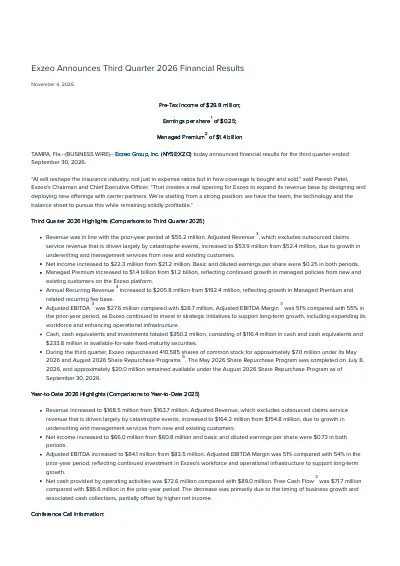
For the third quarter, we generated pre-tax income of about $30 million, earnings per share of 25 cents, and adjusted EBITDA margin exceeding 51%. These results were within the guidance we provided and reflect our continued focus on profitable growth, operating discipline, and financial performance.
Total revenue for the quarter was $55 million, consistent with the prior year quarter. Excluding outsourced claims service revenue, which is largely driven by catastrophe events, adjusted revenue increased to $54 million from $52 million in the prior year period.
Managed premium at the end of the quarter was about $1.4 billion, an increase from $1.2 billion a year ago. Our annual recurring revenue grew to $206 million in the third quarter, compared to $192 million in the prior year quarter.
Turning to our balance sheet, which remains a key strength of the company, we ended the quarter with over $350 million of invested assets, which includes cash, cash equivalents, and fixed income securities. As in prior periods, we remained debt-free and continued to maintain significant financial flexibility.
During the quarter, we continued to return capital to our shareholders. We completed our May 2026 share repurchase program and began repurchases under our August authorization.
Year to date, we have repurchased more than 1.1 million shares of common stock for approximately $17 million. These actions reflect both the strength of our financial position and our conviction in the long-term value of the company.
Turning to our guidance expectations, for the fourth quarter, we expect pre-tax income to be between $26 and $29 million, consistent with the seasonality of our business. We are expecting managed premium to be approximately $1.34 billion at the end of the fourth quarter.
As Kevin highlighted in his comments, we would expect managed premium to scale over time as we launch new offerings for our carrier partners. The big takeaway this quarter is that even after returning capital to shareholders through our share repurchase program and continuing to invest in Axio Ventures and the strategic initiatives Kevin outlined, shareholders' equity increased 17% from prior year-end to $298 million.
We believe this demonstrates the earnings power, cash generation, and underlying financial strength of our business. Now, I'll turn it over to Paresh, Axio's Chief Executive Officer.
Paresh Patel
Thanks, Suela. The takeaway from Kevin's comments is that there are opportunities emerging that can expand Axio's revenue funnel in the coming months and years.
Suhela's commentary laid out that we are solidly profitable, and we have the balance sheet with which to go after these opportunities. We are operating in a rapidly changing environment, and of course AI is the reason.
I don't think anyone can visualize how far AI will advance a year from now. Just look back: the evolution the past year has been stunning, and we expect it to continue.
More importantly, just like when the internet was first developed, AI will reshape the insurance industry. That impact will reach past expense ratios; it may eventually change how insurance is bought and sold.
As Kevin mentioned, insurance itself is not going away, but there is going to be a major reshuffling of insurance industry leaders. Let me explain what I mean.
The opportunity we see is in designing, structuring, and deploying insurance offerings that fit the changing purchasing habits of the policyholders. When we launch new offerings with our partners, we grow as they grow.
Revenue builds over time and is very durable. Give you a specific example of what I mean: in 2016, HCI launched TipTap to operate entirely on the Axio platform.
In the first few years, premiums only reached $15 million, but then the momentum picked up with great adoption, and the premiums reached over $100 million by 2020. Since then, TipTap has grown to over $500 million annually and is solidly profitable.
The takeaway is that when we get it right, our carrier partners see incremental premium and incremental profits. We have a profitable core business with strong margins and no debt.
This lets us invest in these new opportunities with confidence and still generate positive cash flow. Here are a few things we can say with confidence: first, we expect Axio to be in a stronger financial position at the end of next year than it is today; second, we are going where the market is heading, we already have the team and the technology to get there; and thirdly, while we pursue this opportunity, we are already solidly profitable, we're starting from a strong position, and we have a strong base of premium on the platform and a very clean balance sheet.
In summary, we're organizing Axio around the opportunity that will be here 1 to 3 years from now. Every day between now and then, we expect to be making more money than we are spending.
With that, I will turn it over for questions.
Operator
We will now begin the question and answer session. If you would like to ask a question, please press *1 to raise your hand and join the queue.
To withdraw your question, simply press *1 again. We ask that you pick up your handset when asking a question to allow for optimum sound quality, and if you're muted locally, please remember to unmute your device.
Please stand by now while we compile the Q&A roster. Your first question will come from Terry Tillman with Truist Securities.
Please proceed.
Terry Tillman
Good afternoon. Hi Paresh, Kevin, Suela, and Bill.
Two questions: the first one's a bit of a long-winded question, but I think it's important, just really kind of focusing on new growth drivers over time. Just maybe what can you share about what the pipeline looks like for new partners and carriers, again, knowing that the market's changing as we speak?
Then, GEICO, which sounded really interesting last quarter. Then the third part of this kind of new growth vectors is Axio Ventures and maybe timing of when we could start to see some fruits of the labor.
Then I have a follow-up.
Paresh Patel
Hey, multiple questions in one. It's perfectly fine, right?
The big thing about what we see going forward is that we are being asked by the C-suites we go visit, etc., to come to them with a solution: here's a product you could offer in a soft insurance space which would help grow incremental revenue, incremental premium, incremental profits, and can you come with those things and we could implement them. We've done a couple of those this year, and we've discovered that things go a lot better when we come with the complete solution, would you like to sell this on your paper.
It changes the equation a little bit because it's more of build it and then they will use it, as opposed to they already have something and we then incorporate it in. It is a slight change, but that is exactly what AI is enabling you to do, so that's why we are pivoting towards those kinds of items.
The second part of your question, one of the other things that we're also looking as we're doing this is to broaden the range of service offerings we can provide on the platform. We already talked about being able to add auto to the platform, and that is already progressing, and I think we've signed up additional auto carriers.
We also have some interest in adding additional flood carriers, and probably some liability carriers, because if you can do that, you're covering a large part of the waterfront from an average consumer's insurance needs. That's what we are looking to do.
As far as Axio Ventures goes, I am stunned by the rate of progress, how fast it's going, and in fact that is what also is informing us about the advances that are now going on in AI. We've got a number of initiatives that are underway, nothing we've announced publicly or anything else, but some of the things that people have been doing with AI is truly stunning.
We are now utilizing that to figure out how it can be monetized in a long-term basis, yep.
Terry Tillman
Yep, that's great, thanks. That was a test for sure, and you actually answered all three parts of that first question, that's great.
Just a second question is, I don't know if this is for Suela or for who it's for, but on managed premium, appreciate the updated guidance for 4Q. Curious what you can say about how you think about giving a guidance, is it close to the pin or does it include a lot of different potential variables or scenarios?
Is it primarily just Florida's a soft market, or are you just also not incorporating as much in terms of maybe some new things that could go your way? Thank you.
Paresh Patel
Terry, you broke up there a little bit, I may have missed a bit of the question, but let me see if I can answer the gist of your question. Yes, in terms of the things we're doing, we've always been reasonably conservative, we don't like incorporating what-ifs to a large extent.
The guidance we give is very much things that are kind of baked in. What we see is if you were to do a plus or minus delta, we have a lot more upside than any potential lowering on the downside, right?
The long-term projections look incredibly good because of what's about to occur. Don't discount the seriousness of my comment about there could be a major reshuffling of insurance leaders in the next few years, right?
That is what AI is going to do. In the right position the right way, it could really open up opportunities for new players and people who think to the future as opposed to cling to the past.
That's why I'm very excited about what we see in front of us. It's going to be slightly fuzzy for the next 1 to 1, 2, or 3 years while the world adapts.
Terry Tillman
All right, thank you very much.
Operator
As a reminder, if you would like to ask a question, please press *1 on your telephone keypad now to raise your hand and join the queue. Your next question comes from the line of Faith Brunner with William Blair.
Please proceed.
Faith Brunner
Hi team, thanks for taking my questions here. Maybe to pull on the thread of the first question that was asked, looking at the pipeline, is there any color you can give us on maybe how conversations are diverting between that cohort you talked about that are looking to be very future-forward using AI versus those that are kind of more hesitant or wanting to keep things as they are?
How has maybe the recent partnerships with GEICO and Tokio Marine really brought more people to the table?
Paresh Patel
Faith, let me try to explain this in a different way. One of the things that happened in the course of this past year was that Axio developed a new offering, and because it has jargony names, let's just call it Axio HO3, yeah?
This product and service offering, was entirely developed within the Axio framework. Then they went around looking for people to offer that.
The carrier that did, is CORE. What's happened with that product is I think it's put over 48 $40 million of premium on the books, premiums under management, in little over 6 months.
Suddenly everybody starts looking at this and says, there are other carriers, who I can't name, who are now saying, 'Hey, could we use that on your platform because we would like additional premium in that, etc.?' Therein lies the way forward, because what Axio is now looking at is how about developing three four three or four or five new products next year, and you then partner with somebody, and if you can add incremental premium with very easy turnkey method to lots of folks who are going to be under pressure because of it's a very soft insurance market in terms of rates and growth, it could be a wonderful opportunity.
What's going to happen is, and this is why we're not giving names or anything else, is that I think it'd be very short span between saying, 'Let's do this,' and it going into production. I say that because I think, if I recall correctly, the Axio HO3 product was first conceived within the bowels of Axio, I'd say late January, and it was already producing revenue for our carrier partner by early April.
You get the speed with which things go on. That's the kind of thing is that in the upcoming soft market that is definitely coming, and where everybody is trying to make what decision they should make in an ever-changing world because of AI, you don't need to make a decision, you just got to decide whether you want to take a shot at additional revenue or not, right?
I think there'll be enough people who'll be looking for some of these offerings as we develop them, be it in home, auto, flood, or whatever else, yeah? Obviously we definitely excel at home, beyond any doubt, but there are lots of other things that we could also do.
Faith Brunner
Right, no, that's super helpful. Then maybe just building off that, as you increasingly see that speed-to-value realization for the customers, does that help layer in visibility into ongoing premium ramp?
I know we're still early and you don't give a long-term outlook on this, but any way we should specifically be thinking about how managed premium on the platform will scale over the near term and long term?
Paresh Patel
I think it'll take a few months for this to settle out, but I think by this time next year, the growth and trajectories will become much more known and diverse, because they won't be lumpy based on who's on board and who isn't and how's that particular carrier's risk appetite. This way it'll be a much more diversified earning stream.
More importantly, there's another item that I want to make sure everybody in the call understands: note we're talking about doing this while we still make money every day, right? This is a differentiation of, you want to say, AI 1.0 versus AI 2.0.
AI 1.0 is let's spend hundreds of millions of dollars or a few billions of dollars and someday it'll be worth a lot of money. We're talking about doing this while strengthening the balance sheet each and every day while we're doing it.
That's a whole different business model.
Faith Brunner
Right, okay, no, this has been awesome. Thank you so much.
Paresh Patel
Welcome.
Operator
Again, as a reminder, if you would like to ask a question, please press *1 on your telephone keypad now to raise your hand and join the queue. Please stand by now for a moment while we wait for the queue to compile.
Your next question comes from the line of Matt Carletti with Citizens Bank. Your line is open.
Please go ahead.
Matt Carletti
Hey, thanks. Good evening.
Paresh Patel
Hey, Matt.
Matt Carletti
Paresh, hey, how are you doing? Paresh, you talked a bit about, I think, one of Axio's big differentiators, which is kind of the underwriting side of things and the ability to actually underwrite profitable business.
Can you talk a little bit about, I also think about the agent side of things and the technology that provides to an agent in terms of, as the market softens, obviously their revenues getting squeezed as premiums might go down, and how important is to them maybe to be able to be more efficient and bind a policy much faster than at maybe carriers that are not on the Axio platform? Maybe what you're seeing there, are you seeing when you work with agents that you get first look at a lot of things because they know it's going to be a minute and it's a yes or no and I can move on, or just kind of help us understand where that dynamic might stand.
Kevin Mitchell
Hey Matt, it's Kevin. Great question.
When we talk to the agents that we partner with, one of the big things they're seeing right now or requesting is efficiency. Obviously we've built the Axio technology and we have a curated database, some of the commentary I had during my formal remarks, but it's the combination of those things.
I think we're in a world right now where everyone's kind of demanding instant and simplified transactions. When we talk to the agents, the big thing for them is how few questions do they have to answer, and they're expecting whether the technology provider or the capacity provider to roll up their sleeves and have the majority of those kind of overall underwriting questions answered.
They're looking to us for the efficiency. Because we have the track record and the technology to drive a profitable result, there's a consistency and durability of that policyholder for the agent, they love it.
It improves and shortens their sales process, the customer experience is better, and then they have kind of long-term value of that client. I think that's a huge piece.
I think the other piece, and this is where the partnership comes in, is the capacity provider, the insurance company, are also looking for those things. They're looking for a technology provider that'll drive efficiency in their business, and they're looking for that profitable outcome.
As we see the market cycle we're in, which is softening, there is an abundance of capital on the capacity side. They want to grow, but they want to make sure they have that risk segmentation properly done so they can have a profitable outcome when they actually are on risk.
It's a combination, and I think Axio is right in the middle and provides that seamless transaction between the agent and then the carrier partner.
Matt Carletti
Perfect, super helpful. Thank you.
Hey,
Paresh Patel
yeah, hey Matt, if I can add to that a little bit, right?
Matt Carletti
Sure.
Paresh Patel
Very simply because I'm a numbers guy as you know. Far this year, Axio has delivered about seven almost 700,000 quotes on the platform, just this year, right?
To your point about agents, if you think about it, the agents that are on the platform 700,000 times came to Axio and said, 'Can you help me with this risk I'm trying to bind?' That number is growing as we go along, because it was a rounding error at the beginning of the year, on a weekly basis.
It's well north of 25,000 a 25,000 a week at this point, yeah?
Matt Carletti
That's helpful. Those are great numbers.
Yeah.
Paresh Patel
Basically, by the way, it also helps everybody across the whole value chain of those quotes, is because we've said it before, is that we have made the cost of doing a quote so efficient that it's like 80 cents to do a quote. Hence, when you do 700,000 quotes, you're not running up a bill that becomes a very expensive CAC, if you like,
Matt Carletti
yeah? It's a half a million bucks or something, yeah.
Great, thank you, that's super helpful. Appreciate it.
Paresh Patel
Thank you.
Operator
Your next question comes from the line of Terry Tillman with Truist Securities. Terry, please proceed.
Terry Tillman
This will be a shorter question, I promise, but it might be a two-parter. There's definitely all this hype and incredible activity around personal agents in the consumer world.
Kind of a viewpoint on that as it relates to the carriers you work with, looking at Axio Ventures, just any perspective on personal agents, and going forward with some of these products that you will be evolving and evolving rapidly. Would the monetization change from how you typically did things, or don't know, or it may not?
Thank you.
Paresh Patel
Terry, great question, because I've been reading the industry press on all this stuff as well, yeah? Everybody gets very excited and looks at it that way.
We take a more nuanced viewpoint, right? We are trying to connect our carriers with their policyholders, and the policyholders actually who are the ultimate customer, they buy insurance the way they want to.
We're not telling them that they have to do it this way or that way or whatever, whichever method they want to do: whether they want to buy through an agent, whether they want to buy it through a bot, as you put it, right? Or how about going with a hybrid: the agent's using a bot to bind the policy, that's going to come along, too, right?
Whatever it is, right, we are coming up with products and offerings so that the carriers can meet the buyers in the venue they want to buy, whether it's agentic personal shoppers, or whether it's agents, or agents' personal shoppers. We are always very agnostic.
The key thing is to meet the consumer where they want to buy the product. Things we are doing makes all of that very agnostic, because ultimately it's what our client carriers care about is putting premium on the books.
Operator
At this time, this-- Oh, sorry, go ahead.
Paresh Patel
No, sorry, go ahead.
Operator
At this time, this concludes the question and answer session, and I would now like to turn the call back over to Paresh Patel, who has a few closing remarks.
Paresh Patel
Thank you. In closing, I would like to note that tomorrow marks the 1-year anniversary of Axio's IPO.
In that time, we've made great progress in a world where AI is changing rapidly, and we are well positioned for what comes next. I want to thank everyone who joined the call today, and I want to thank the Axio team for all their continued hard work and progress that they've made.
Thank you.
Operator
This concludes today's call. You may now disconnect.