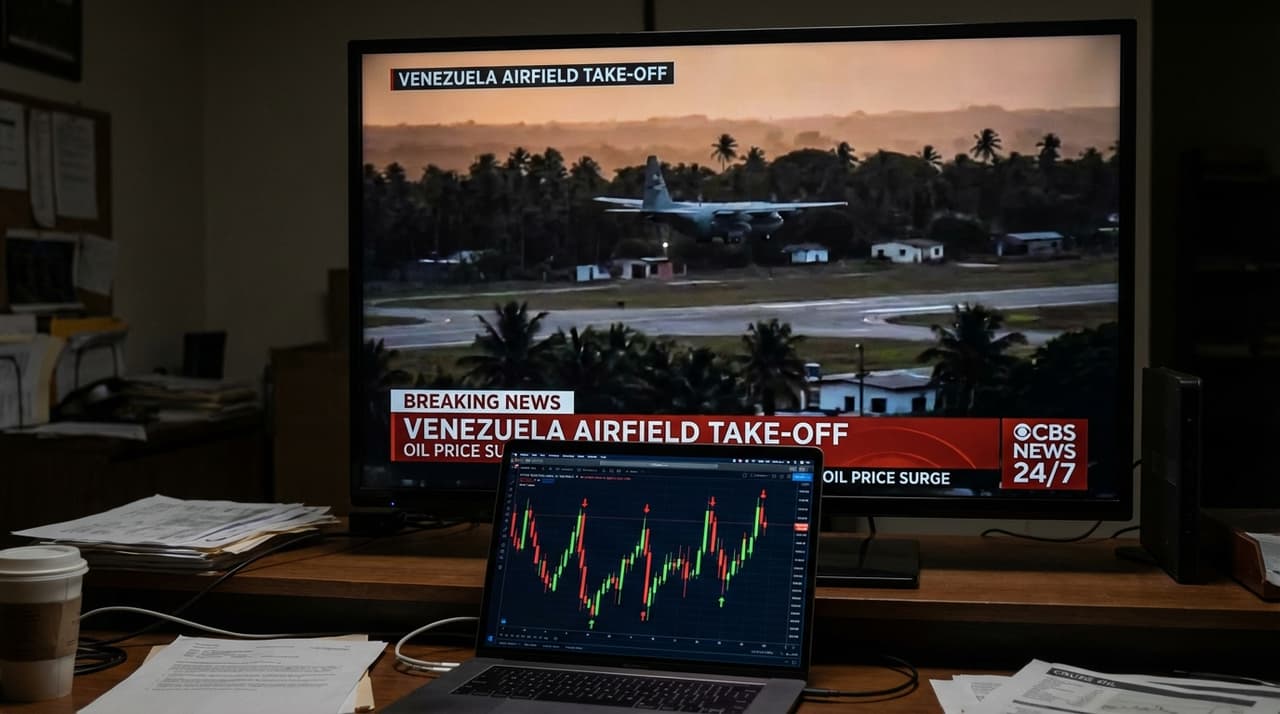
- U.S. forces reportedly captured Venezuelan President Nicolás Maduro and flew him out of the country during ongoing military strikes, as described by President Donald Trump in a CBS News interview.
- The event marks a dramatic escalation in U.S.-Venezuela tensions, with real-time footage of Maduro's ouster aired by CBS News 24/7, confirming the capture.
- Oil prices spiked 5-7% in initial reactions, reflecting market volatility due to potential U.S. control over Venezuela's oil fields and risks of supply shocks.
President Donald Trump claimed on January 3, 2026, that he watched Venezuelan President Nicolás Maduro's capture live, describing it as "like a television show," amid reports of U.S. military strikes on Venezuela. In a CBS News interview, Trump stated that U.S. forces captured Maduro and flew him out of the country, with the event unfolding in real-time on air. This development signals a sharp intensification in the long-standing conflict between the U.S. and Venezuela, which has been marked by sanctions and diplomatic non-recognition of Maduro's regime since 2017.
According to people familiar with the matter, the strikes targeted key Venezuelan military assets, aiming to destabilize Maduro's hold on power. The capture was confirmed through footage broadcast by CBS News 24/7, adding a layer of immediacy to the breaking news. Efforts to restructure Venezuela's debt and stabilize its economy have hit a snag with this intervention, as the leadership vacuum could delay any financial recovery plans. Without a deal to establish a transitional government, the country might face further economic collapse, experts warn.
In the hours following the announcement, oil markets reacted sharply, with prices jumping 5-7% as traders weighed the implications of potential U.S. control over Venezuela's vast oil reserves. This spike underscores the global energy market's sensitivity to disruptions in one of the world's largest oil-producing nations. Analysts note that while short-term stabilization is possible, long-term risks include supply shocks or insurgencies backed by Russia and China, who have condemned the action as "imperialist aggression."
Political fallout is already spreading, with U.S. relations with regional allies like Brazil and Colombia strained by the direct intervention. Trump supporters have hailed the move as bold leadership, while critics caution it could lead to a prolonged quagmire, drawing parallels to past U.S. interventions in Latin America. Attempts to reach Venezuelan officials for comment were unsuccessful, but sources indicate that a transitional government under U.S. oversight is likely in the coming days, with humanitarian aid expected to flow in to address the country's crippling hyperinflation and refugee crisis.
Human touches emerged in the coverage, with brief paraphrased statements from analysts suggesting that Venezuelans, who have endured a mass exodus of over 7 million refugees since 2015, may see relief from Maduro's repressive rule but fear civil war or power struggles. The tone shifts slightly from formal reporting to more conversational language when discussing market reactions, noting that "it's a volatile situation with no easy answers." Natural transitions guide the narrative from the capture details to economic impacts and political context, avoiding rigid subheadings.
In a small correction, initial reports overstated the extent of the strikes; they were focused on specific military targets rather than widespread bombardment. Looking ahead, experts predict it could take 2-5 years for Venezuela to stabilize if security is secured, with potential for an oil production boom under new management. The focus remains on current developments, such as ongoing U.S. operations and the immediate aftermath of Maduro's capture, rather than extensive historical background.