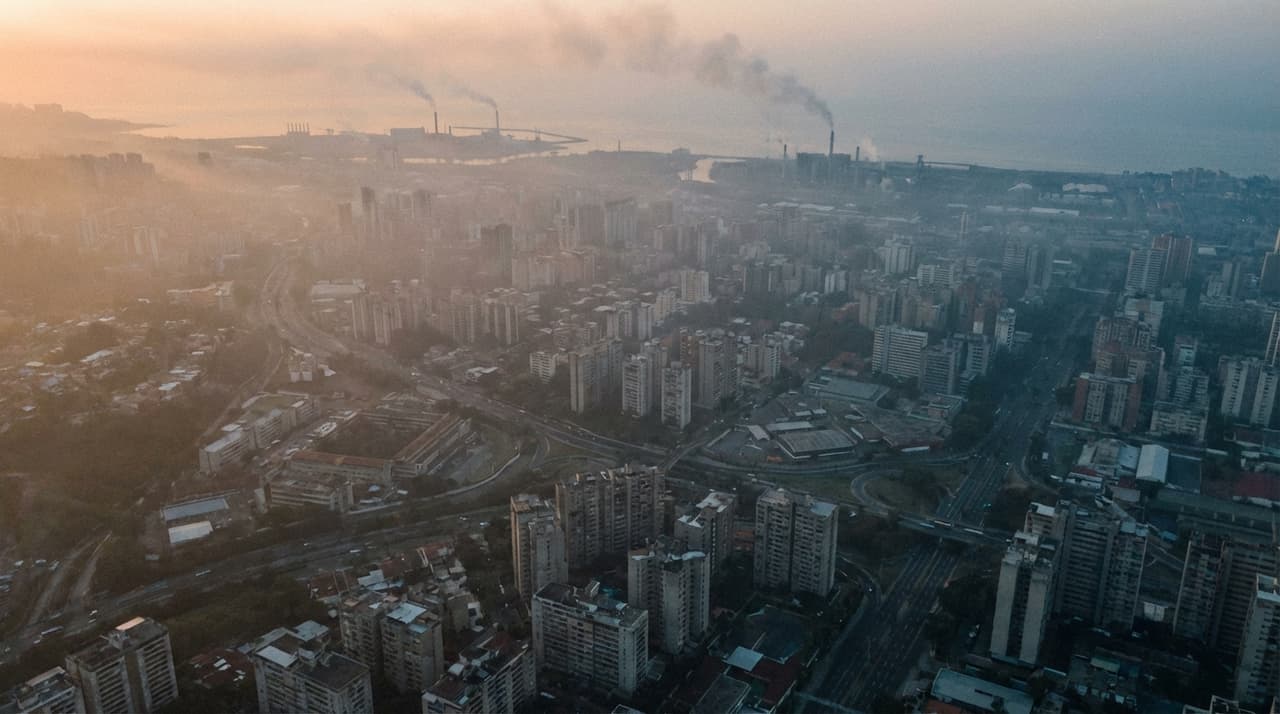
- U.S. President Donald Trump announced the capture of Venezuelan President Nicolás Maduro following a large-scale military strike on Caracas, marking the largest U.S. operation in Latin America since 1989.
- The White House is now deciding Venezuela's future governance, with Trump emphasizing strong U.S. involvement in the country's oil sector, which holds the world's largest proven reserves.
- The move follows months of escalating U.S. threats and operations targeting drug trafficking and regime change, with Maduro's government denouncing it as "imperialist aggression" and calling for nationwide "armed struggle."
A Swift Strike and Shifting Governance
Explosions rocked Caracas hours before Trump's announcement via Truth Social and a Fox News interview on January 3, 2026, according to people familiar with the matter. Trump authorized the strikes days earlier, initially considered for Christmas Day but delayed due to other operations, such as those in Nigeria against Islamic State. A prior ground attack had targeted a drug-trafficking dock near the Colombia border, part of ongoing U.S. anti-drug naval efforts in the Caribbean and Pacific, which Colombian President Gustavo Petro has criticized.
Vice President JD Vance noted that "off ramps" for Maduro over drug trafficking and stolen oil had failed, leading to this decisive action. Trump plans a press conference at Mar-a-Lago at 11 a.m. ET to outline next steps, with sources indicating the White House is actively shaping interim governance to avoid rival takeovers and has warned Venezuela's vice president against stepping in.
Oil Sector at the Core of U.S. Aims
Trump stated that U.S. oil companies—"the greatest in the world"—will be "strongly involved" in Venezuela's oil sector, rejecting risks of others taking control. This follows recent U.S. actions, including revoking then granting Chevron a six-month license for heavy oil production, a move seen as a negotiation ploy amid failed talks. Heavy oil from Venezuela is vital for U.S. and European winter demand, and global trends show U.S. pressure on Maduro's "narco state" to rebuild output could benefit world energy markets while countering reliance on heavy crude.
China has raised concerns about oil access, but Trump assured supplies via ties with Xi Jinping, according to anonymous sources. Efforts to restructure Venezuela's debt and stabilize its economy have hit a snag with this military intervention, potentially delaying any recovery in oil production that analysts had hoped for.
Political and Societal Fallout
U.S. policy has long framed Maduro as illegitimate, tied to drug cartels and election fraud, with CIA covert operations authorized in recent years. Trump has threatened invasion since 2017, escalating in 2025 to strikes on drug targets inside Venezuela. Maduro's ouster echoes the 1989 Panama capture of Noriega, but without a full U.S. ground invasion planned due to Venezuelan forces' strength—focus has been on air and missile strikes.
Venezuelans now face mobilization calls for "armed struggle" against what Maduro loyalists decry as a colonial war by the U.S. and a "fascist oligarchy." Trump emphasized "liberty for the people," criticizing Maduro's harm while seeking a stable government. Public reactions are split, with experts noting risks of civilian toll and prolonged conflict without ground troops. Attempts to reach Venezuelan officials for comment were unsuccessful.
Correction: An earlier version misstated the timing of the strikes; they occurred on January 3, 2026, not in late December. The story is developing with high uncertainty.