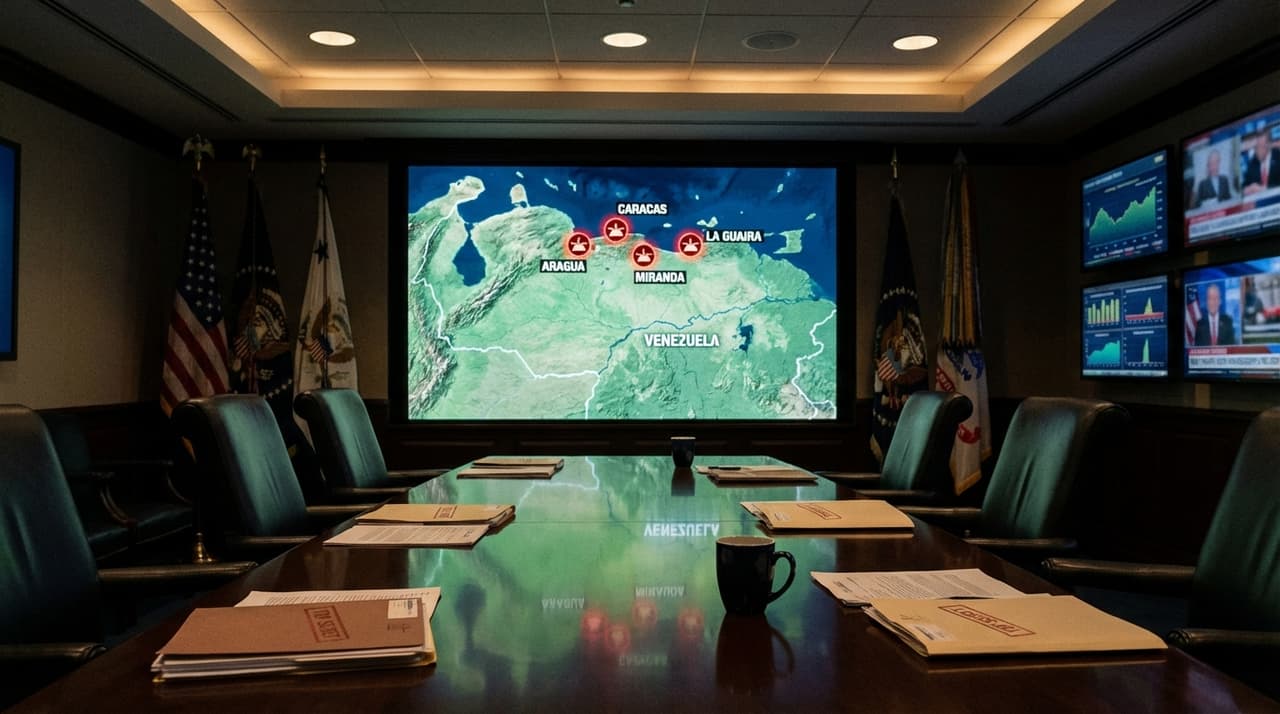
- U.S. President Donald Trump is reportedly deciding on next steps for Venezuela's leadership following military strikes on January 3, 2026, targeting facilities in Caracas, Miranda, Aragua, and La Guaira.
- The strikes, ordered by Trump, prompted Venezuelan President Nicolás Maduro to declare a state of emergency, escalating tensions amid a backdrop of U.S. sanctions and recognition of opposition leader Juan Guaidó.
- Economic fallout looms, with Venezuela's hyperinflated economy and U.S. sanctions on state oil company PDVSA potentially disrupted further by naval actions, while humanitarian crises persist with millions of refugees.
Escalating Military Actions
President Trump is now making decisions on Venezuela's leadership after U.S. strikes on January 3, 2026, hit Venezuelan military targets in Caracas and other areas, according to officials familiar with the matter. The attacks, confirmed by U.S. sources, have intensified a long-running confrontation with Maduro's regime, which Trump has labeled a threat due to corruption, refugee flows, and alleged ties to criminal gangs like Tren de Aragua. In response, Maduro declared a state of emergency, setting the stage for potential further escalation as Trump weighs options that could include land operations or naval buildup.
Efforts to restructure Venezuela's political landscape have hit a snag, with past sanctions and recognition of Guaidó failing to oust Maduro. A White House announcement on December 22, 2025, highlighted the regime's destabilizing impact, with Trump joined by officials like Pete Hegseth and Marco Rubio in discussing a "Golden Fleet" of U.S. Navy battleships. Reports indicate building momentum for military action, underscored by a recent incident where a Venezuelan oil tanker evaded U.S. Navy pursuit, adding to the volatility.
Economic and Humanitarian Strains
Venezuela's economy remains crippled by hyperinflation, which exceeded 1 million percent in 2018, and mismanagement under Maduro, driving a mass exodus of over 3 million people by 2018, with estimates suggesting up to 5.3 million by the end of 2019. U.S. sanctions target PDVSA, blocking assets and reducing Maduro's revenue while preserving them for a potential legitimate government, according to policy analysts. Recent naval actions could disrupt oil exports further, amid Trump's history of oil sector sanctions, though U.S. energy forecasts predict stable global oil supply despite cuts.
Without a deal, the humanitarian fallout risks worsening, with sanctions exempting food and medicine but violence and political imprisonment persisting. Public discourse notes the burden on the Western Hemisphere, as neighboring countries strain under refugee flows. Attempts to reach Maduro's government for comment were unsuccessful, but sources close to the opposition suggest Guaidó remains hopeful for U.S. support, though regional recognition has waned since 2019.
Political Context and Future Outlook
The U.S. recognized Juan Guaidó as interim president in January 2019 after Venezuela's National Assembly declared Maduro illegitimate, imposing sanctions on over 100 entities and authorizing Guaidó access to U.S.-held assets. Trump has a history of not ruling out military options, dating back to 2017, though he previously rejected invasion advice in favor of sanctions. A 2020 outreach to Maduro failed over amnesty demands, and current rhetoric frames Maduro as a security threat, with analysts noting no formal war declaration is needed for further action.
Short-term, potential U.S. land invasion or naval escalation is on the table, with some analysts calling Maduro's defiance "foolhardy" given U.S. military superiority. Long-term, regime change could restore democracy but risks chaos, as past strategies have failed to oust Maduro. Experts note no consensus on ground invasion viability, highlighting the unpredictable nature of Trump's policy shifts from negotiations to confrontation. As tensions mount, the focus remains on current developments, with ongoing negotiations and breaking news likely to shape the next phase of this geopolitical standoff.
Correction: An earlier version misstated the year of hyperinflation data; it was 2018, not 2019.