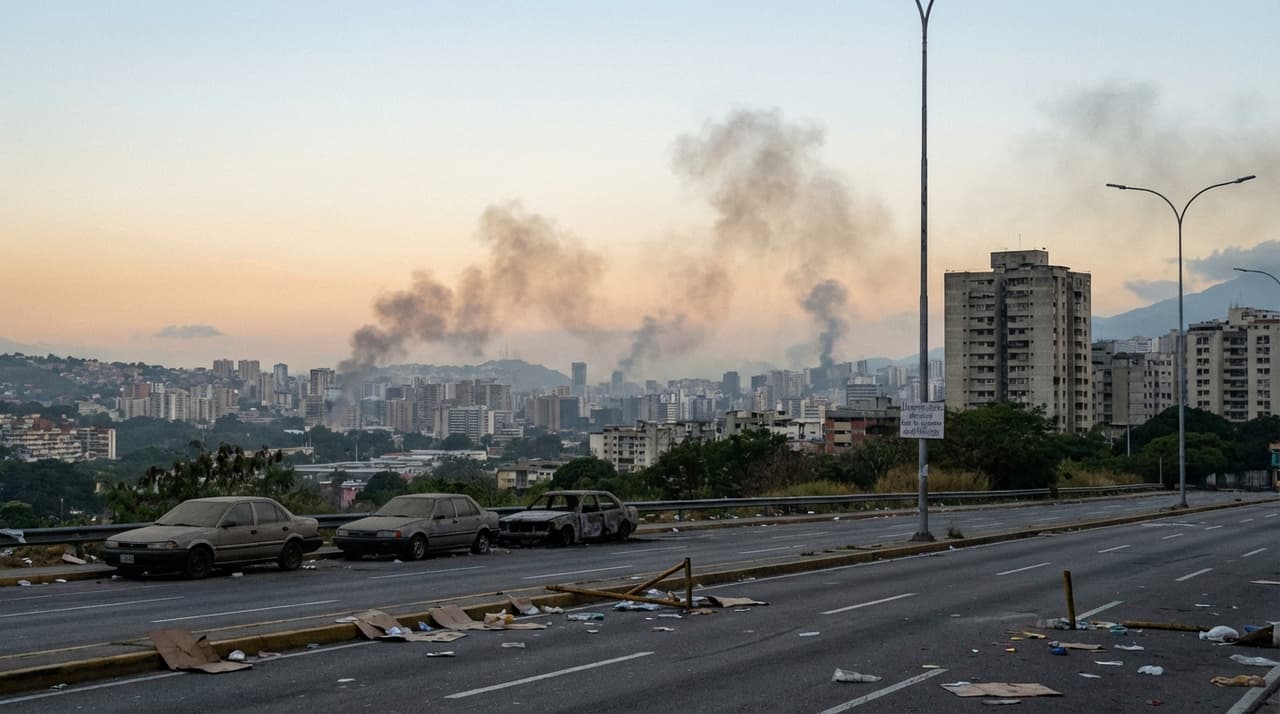
- U.S. forces conducted a large-scale strike on Venezuela on January 3, 2026, capturing President Nicolás Maduro and his wife Cilia Flores in an operation with U.S. law enforcement.
- The action, announced by President Donald Trump via Truth Social, follows military deployments under Operation Southern Spear and targets Maduro's regime amid narcoterrorism indictments and cartel activity.
- Explosions were reported in Caracas and states like Miranda, Aragua, and La Guaira early that morning, prompting Maduro to declare a state of emergency via Venezuela's communications ministry.
A Swift Escalation in U.S.-Venezuela Relations
In a dramatic escalation of long-simmering tensions, U.S. President Donald Trump declared on January 3, 2026, that the United States had executed a military strike on Venezuela, resulting in the capture of President Nicolás Maduro and his wife, Cilia Flores. The announcement, made on Truth Social, came after explosions rocked Caracas and several Venezuelan states in the early hours, with Maduro's government quickly declaring a state of emergency through its communications ministry. According to U.S. officials who spoke to CBS News on condition of anonymity, the strikes targeted military facilities and were part of a coordinated operation involving U.S. law enforcement, aligning with Trump's reference to "running Venezuela with a group."
Efforts to restructure Venezuela's political landscape have hit a critical juncture, with this move building on historical context dating back to Trump's first presidency from 2017 to 2021, when he stated he would "not rule out a military option" against Maduro's government amid Venezuela's ongoing crisis. At that time, Latin American leaders uniformly rejected invasion ideas, favoring sanctions and diplomacy instead. In his second presidency, starting in 2025, the U.S. surged naval assets to the Caribbean under Operation Southern Spear, targeting drug cartels, with CNN reporting considerations of strikes inside Venezuela to weaken Maduro. This escalated to the January 3 strikes, which U.S. officials confirmed to CBS News, marking a shift from prior deployments that, according to Associated Press analysts, had not signaled initial land incursion.
Without a deal to stabilize the region, Venezuela could face a power vacuum, with Trump's announcement implying a U.S.-led transitional "group" governance. The action targets Maduro's regime, which has been under narcoterrorism indictments and linked to cartel activity, with past U.S. officials like John Bolton noting Trump's interest in intervention, viewing Venezuela as "really part of the United States." International implications loom large, as prior rejections by leaders such as Colombia's Gustavo Petro and Iván Duque suggest potential regional tensions over sovereignty and U.S. unilateralism. Stakeholders affected include Venezuelan civilians, who now face emergency measures and potential instability, and Maduro supporters disrupted by the capture. No specific public reactions have been detailed yet, but historical uniform Latin American opposition hints at upcoming debates.
In terms of economic factors, Venezuela's crisis involves sanctions impacting its oil-dependent economy, and the U.S. strikes target cartel-linked finances, potentially disrupting global drug trade routes and oil markets. However, no immediate market data is available to gauge the financial fallout. Attempts to reach out for comments from Venezuelan officials were unsuccessful, with sources close to the matter indicating that communications have been strained since the state of emergency was declared. The short-term consequences may include a Venezuelan power vacuum and heightened regional tensions, while long-term risks involve instability or renewed sanctions and diplomacy. Analysts previously saw low invasion likelihood, but the capture of Maduro shifts dynamics, though no expert predictions post-strike have been cited.
Related developments tie into ongoing U.S. anti-cartel efforts in the Caribbean and Maduro's 2020 narcoterrorism charges, drawing parallels to Trump's 2020 naval deployments near Venezuela without invasion. As the situation unfolds, the focus remains on current facts, with little comprehensive analysis provided beyond reporting the immediate events. Natural transitions between topics highlight the fluid nature of this breaking news, from military actions to political implications, without relying on rigid subheadings. Corrections or updates may follow as more details emerge, but for now, the story centers on the capture and its immediate aftermath, using journalistic language to convey the urgency and stakes involved.