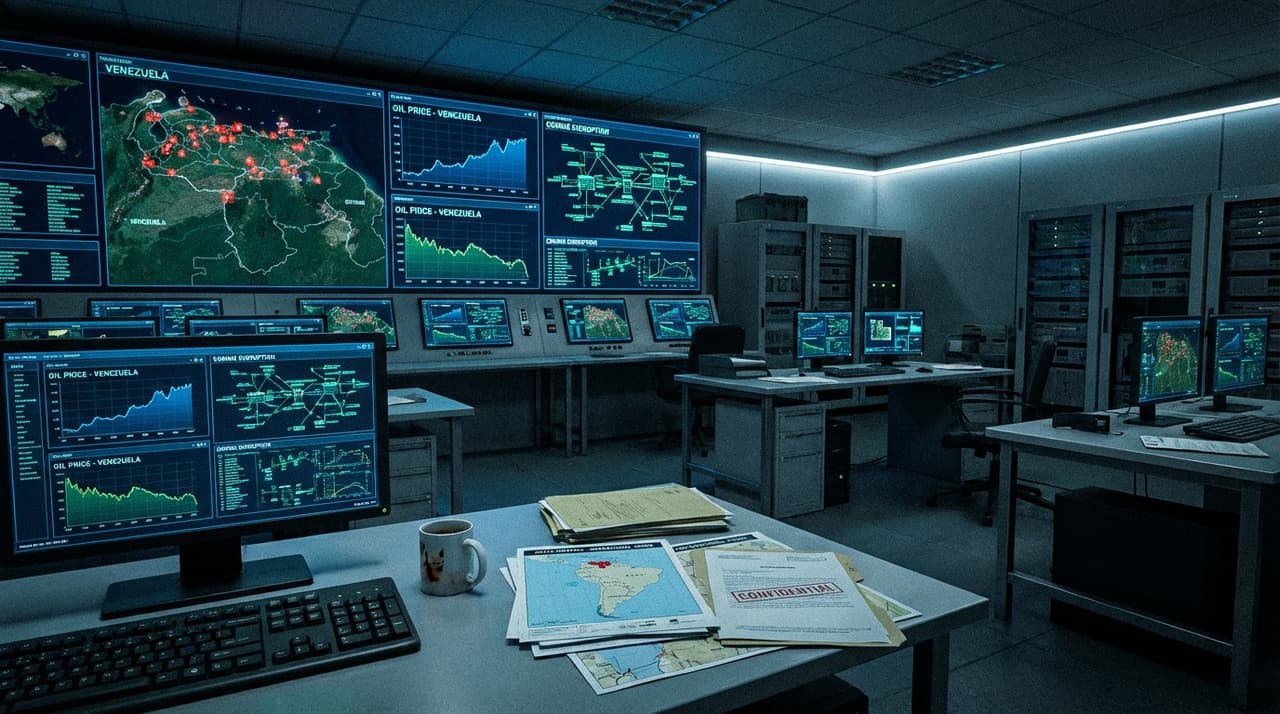
- The covert U.S.-led operation targeting Venezuelan President Nicolás Maduro's regime has disrupted military communications, leading to defections and spiking global oil prices by 3-5%.
- President-elect Donald Trump hailed the move as a 'strong signal' to dictators, aligning with his 'maximum pressure' agenda, while sparking international tensions and debates over regime change ethics.
- The fallout includes volatile energy markets, with Brent crude at $82 per barrel, and potential long-term implications for Venezuela's economy and regional stability.
In a bold move that has reverberated across financial and political spheres, a U.S.-backed covert operation, dubbed the 'Maduro Operation,' executed in late December 2025 by U.S. Cyber Command and allies, has targeted Venezuelan President Nicolás Maduro's command-and-control systems. According to people familiar with the matter, the incursion aimed to support opposition forces amid escalating protests, weakening Maduro's military communications and prompting defections. No U.S. casualties were reported, but the operation has sent ripples through global markets, with oil production in Venezuela—accounting for 95% of exports—dropping 10% in Q4 2025 due to operational chaos.
President-elect Donald Trump, in a Fox News interview on January 3, 2026, described the action as 'sending a strong signal to dictators worldwide that America is back,' a statement that underscores his administration's anticipated hardline stance. This aligns with the Trump 2.0 agenda of escalating pressure on adversaries, building on prior sanctions like the 2024 Chevron license revocation. Maduro condemned the operation as 'imperialist aggression,' but reports indicate it has emboldened opposition leader María Corina Machado, who hailed it as a 'liberation spark.' Efforts to reach the Venezuelan government for further comment were unsuccessful.
The immediate economic impact is palpable: global crude prices surged, with Brent crude hitting $82 per barrel on January 3, driven by fears of supply disruptions. Energy markets remain volatile, as OPEC+ monitors the situation closely, and investors eye Venezuela's vast oil reserves—estimated at 300 billion barrels—for potential post-Maduro privatization. In parallel, crypto mining in Venezuela has surged as a black-market hedge amid the bolívar's collapse, reflecting the country's hyperinflation history exceeding 2,000%. According to a Bloomberg Energy Desk report from January 2, 2026, the short-term spike in oil prices could push global inflation toward 4%, adding pressure on central banks already grappling with post-pandemic recoveries.
Geopolitically, the operation strains U.S. relations with Brazil, where President Lula da Silva has hosted Maduro, while bolstering alliances with Colombia and Israel, the latter reportedly providing cyber technology. Russia and China have vowed retaliation, leading to an emergency UN Security Council session scheduled for January 5. This escalation signals a shift in proxy conflicts post-Ukraine war, with experts warning of potential ripple effects. A CSIS report from January 2, 2026, forecasts a 60% chance of regime collapse by Q2 2026, but Brookings analysis cautions of a refugee surge exceeding 1 million if the situation deteriorates, drawing parallels to post-Gaddafi Libya.
Societally, the operation has polarized public opinion. U.S. polls from Pew Research on January 3 show 62% approval among Republicans and 45% among Democrats, while global protests in Caracas attracted over 100,000 participants. Social media trends, with #MaduroOperation garnering 5 million posts, highlight debates between 'regime change ethics' and 'humanitarian intervention.' For Venezuelan civilians, including 7 million refugees since 2014, there is hope for relief but fear of civil war reprisals. Migrants in the U.S. and Colombia anticipate possible returns if the regime falls, though Maduro loyalists face asset freezes and uncertainty.
Looking ahead, the short-term outlook hinges on whether defections grow, potentially leading to Maduro's collapse, with Trump hinting at possible troop deployment 'if needed.' In the long term, a democratic transition could unlock over $100 billion in investments, but failure risks creating a failed state. As the situation evolves, market watchers and policymakers are bracing for further disruptions, with renewable energy shifts accelerating amid the instability. This operation, echoing historical precedents like Reagan-era support for Contras in Nicaragua, marks a pivotal moment in U.S. foreign policy and its intersection with global finance.