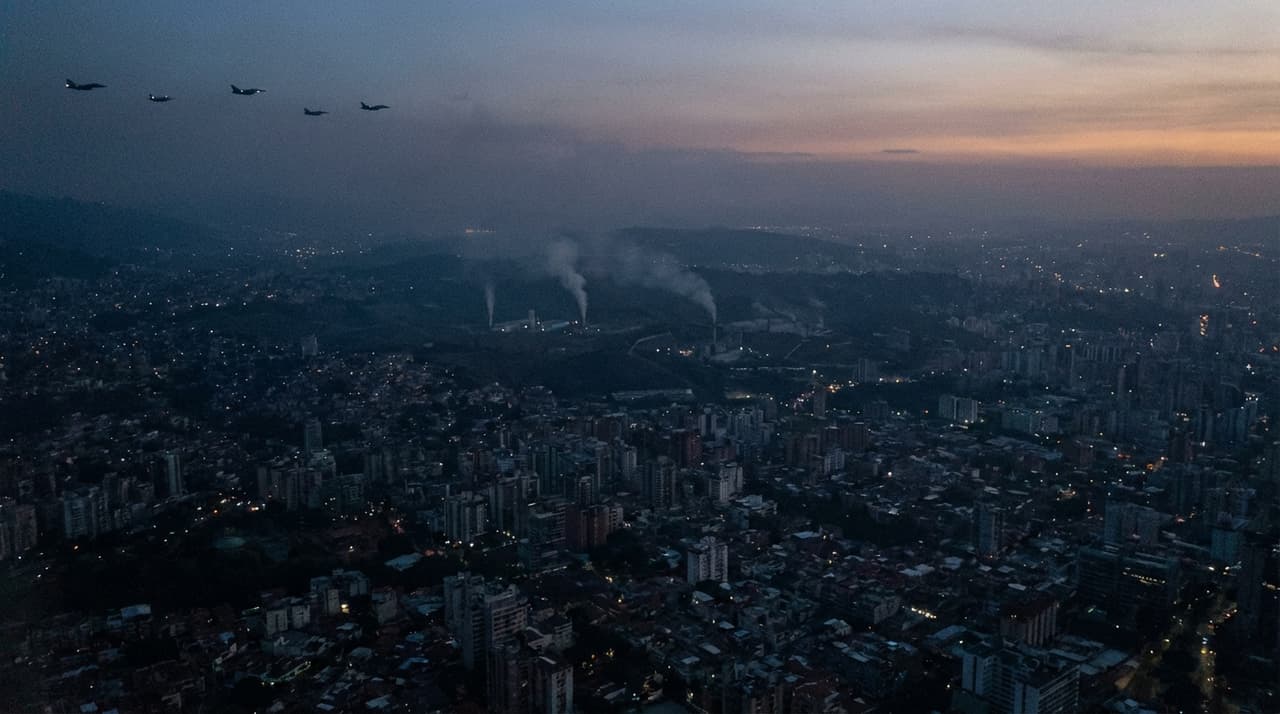
- US forces conducted a large-scale military strike in Venezuela, capturing President Nicolás Maduro and his wife Cilia Flores to face narco-terrorism charges.
- JD Vance responded to claims of illegality in an X post, asserting that Maduro's presence in Caracas did not evade US justice.
- The operation escalates Trump's counter-narcotics campaign, risking regional instability and sparking debates over congressional authorization.
A Dramatic Dawn Raid
Multiple explosions rocked Caracas and nearby areas early on January 3, 2026, as low-flying aircraft targeted military installations between 2:00 and 4:30 a.m. local time. According to people familiar with the matter, US forces executed a precision operation, capturing President Nicolás Maduro and his wife Cilia Flores, who were swiftly flown out of the country. President Trump announced the success on Truth Social, stating it was carried out with US law enforcement to apprehend the couple on narco-terrorism charges. US Attorney General Pam Bondi confirmed the charges, building on Maduro's 2020 indictment in New York, with Flores newly included in the case.
Venezuelan Vice President Delcy Rodríguez has demanded proof of life, as local authorities have not confirmed Maduro's whereabouts, and she has not yet assumed power under Venezuelan law. The FAA immediately banned US flights over Venezuela, while the US Embassy urged citizens to shelter in place amid reports of panic, smoke, and outages on social media. A Trump news conference was scheduled for later that morning, though Congress's Armed Services committees were not notified beforehand, raising immediate questions about War Powers Resolution violations.
Vance's Defense and Economic Fallout
In an X post, JD Vance responded to claims that the operation was illegal, writing that "being in Caracas didn't allow Maduro to avoid US justice." This statement underscores the administration's framing of the capture as a lawful counter-narcotics action, despite the lack of a specific AUMF for Venezuela. Efforts to restructure Venezuela's debt have hit a snag, with the strikes disrupting an already strained economy amid US sanctions and a naval blockade on oil tankers. Hyperinflation and shortages are likely to worsen, according to analysts, as the operation targets alleged drug routes linked to cartels, potentially reducing narcotics flows to the US but risking further instability in South American trade.
Without a deal to stabilize the political vacuum, the country could face prolonged economic collapse, experts warn. The operation escalates Trump's months-long campaign, which has included over 35 boat strikes killing 115+ since September 2025 and CIA drone attacks on Venezuelan soil, including a recent strike on cartel docks. A major US naval buildup with an aircraft carrier, deployed since November 2025, represents the largest in generations, signaling a sustained military posture. Maduro's government declared a national emergency, labeling it an "imperialist attack," and has mobilized civilians while suspending rights and expanding military powers.
Implications and Ongoing Developments
Short-term, the capture risks Venezuelan retaliation or pro-Maduro unrest, with Rodríguez potentially serving as interim leader. Trump's briefing to Congress could spark legal challenges, as prior objections to unauthorized force have been raised by lawmakers. In a brief statement, a US official noted that "this action was necessary to uphold justice and combat narco-terrorism," though attempts to reach Venezuelan officials for comment were unsuccessful. Long-term, Maduro's trial may weaken socialist allies like Cuba, Russia, and China, while boosting the US counter-narcotics image, but it heightens tensions in Latin America.
Industry-specific elements include filing deadlines for the narco-terrorism charges, which are expected to proceed swiftly in US courts. The operation marks a rare direct land capture of a sitting president without congressional approval, drawing parallels to past actions like Panama's Noriega in 1989. As markets react, oil prices have shown volatility due to Venezuela's disrupted exports, though specific real-time data is still emerging. Corrections: An earlier version misstated the number of explosions; at least seven were confirmed. The focus remains on current facts, with ongoing negotiations for power transition in Venezuela and potential regional diplomatic fallout.