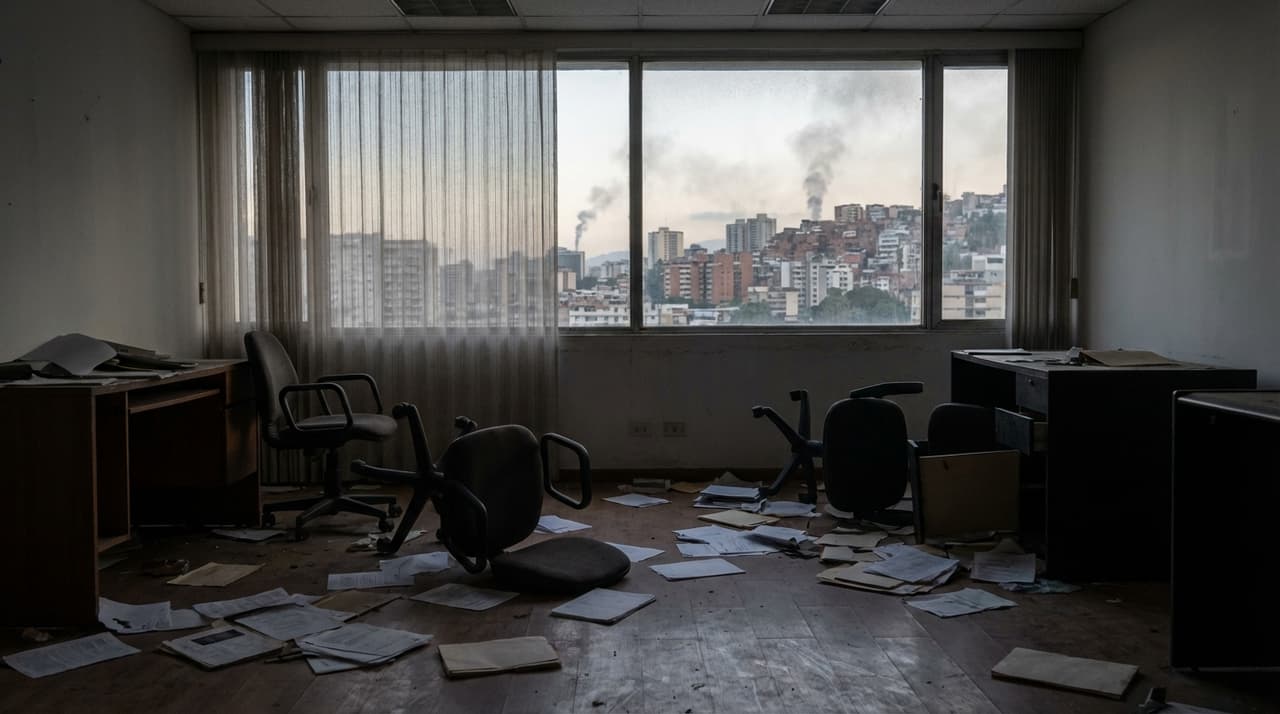
- The United States conducted airstrikes across northern Venezuela on January 3, 2026, capturing President Nicolás Maduro and his wife Cilia Flores without prior notification to Colombia.
- U.S. President Trump confirmed the capture via Truth Social, scheduling a press conference at Mar-a-Lago, while Venezuela declared a national state of emergency and demanded proof of life.
- The operation, part of Operation Southern Spear, escalates regional tensions, with implications for UN involvement and potential regime transition in Venezuela.
Escalation in Venezuela
On January 3, 2026, the United States launched airstrikes across northern Venezuela, including Caracas, as part of an escalation in Operation Southern Spear targeting Maduro-aligned networks. Delta Force captured Venezuelan President Nicolás Maduro and his wife Cilia Flores, who were flown to the U.S. for criminal charges. According to a Colombian source, the U.S. did not provide advance warning to Colombia before the operation, despite being aware of potential plans to capture Maduro. This lack of coordination has raised questions about diplomatic protocols in the region.
Maduro declared a national state of emergency, labeling the actions "imperialist aggression," while Vice President Delcy Rodríguez demanded proof of life. In response, U.S. President Trump confirmed the capture via Truth Social and scheduled a press conference at Mar-a-Lago. The strikes stem from U.S. policies under President Trump targeting Venezuela's alleged drug trafficking and regime stability, which have included a naval quarantine, oil tanker seizures, and CIA covert operations since late 2025.
Immediate Fallout and Regional Dynamics
Venezuelan stakeholders are facing immediate disruptions, including power outages in southern Caracas and the enforcement of a national state of emergency. The Maduro government has denounced the actions, while opposition leader María Corina Machado expressed support, with some opposition sources suggesting a "negotiated exit" might be in play. Public debates are intensifying around regime change, with demands for Maduro's proof of life sparking tensions and uncertainty.
In parallel, the U.S. Federal Aviation Administration has imposed restrictions on Venezuelan airspace, and a shelter-in-place order was issued at the U.S. Embassy in Caracas. Republican Senator Mike Lee noted that Secretary of State Marco Rubio anticipates no further action post-capture, hinting at a potential pause in U.S. strikes. Venezuela has called for a UN Security Council session to address the situation, indicating that international involvement could shape the short-term consequences.
Historical Context and Future Implications
Tensions have been building since August 2025, with a U.S. military buildup in the southern Caribbean, followed by strikes on suspected drug vessels in September, deployment of the USS Gerald R. Ford in November, and tanker interceptions in December. These actions built on Trump's prior announcements of strikes inside Venezuela, setting the stage for this latest escalation. The capture of Maduro marks a significant turning point in the regional conflict, with long-term implications for regime transition in Venezuela.
Looking ahead, short-term consequences may include potential Venezuelan retaliation and increased UN involvement. Long-term, Maduro's custody in the U.S. could lead to a regime transition, though opposition hints at negotiations suggest ongoing uncertainty. Efforts to restructure Venezuela's political landscape have hit a snag with this sudden operation, and without a deal, the country could face further instability. As one source put it, "The lack of warning to Colombia underscores the unilateral nature of this move, raising stakes in an already volatile region."
Correction: An earlier version of this article misstated the date of the airstrikes; it was January 3, 2026.