- US President Donald Trump announced the capture of Venezuelan President Nicolás Maduro and his wife in a military operation on January 3, 2026, with Maduro to face prior US narcotics charges.
- The operation involved explosions in Caracas and US law enforcement, prompting flight bans and immediate political fallout, following Trump's recent doubling of a bounty on Maduro to $50 million.
- This escalation marks a dramatic shift in US-Venezuela relations, with potential implications for regional security and anti-cartel efforts amid Venezuela's economic crisis.
A Swift Strike and Its Aftermath
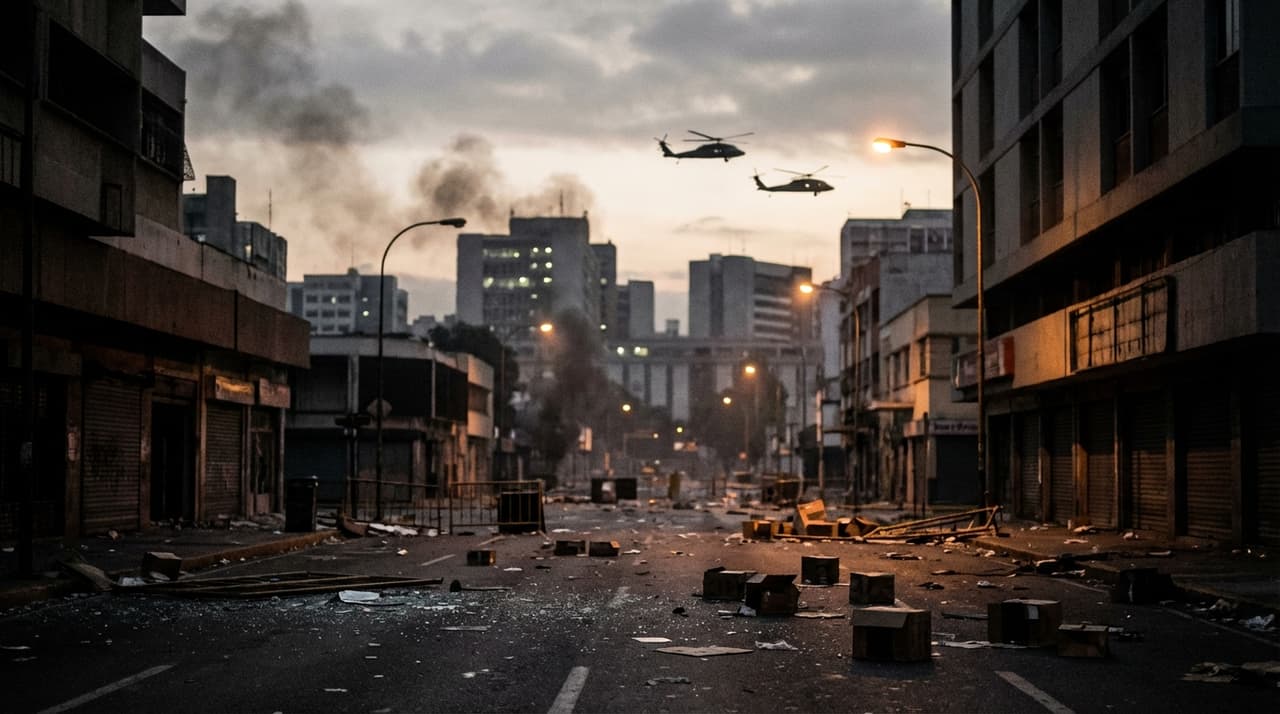
Early on January 3, 2026, residents in Caracas reported at least seven explosions during a brief, under-30-minute operation, described by US officials as a "large-scale strike" involving low-flying aircraft. The FAA quickly banned US flights in Venezuelan airspace due to military activity, signaling the operation's intensity. According to people familiar with the matter, US personnel led the capture, with Sen. Mike Lee confirming Maduro's arrest based on information from Secretary of State Marco Rubio. No immediate casualty or damage reports were available, but social media videos showed streets filling with chaos as news spread.
Trump took to social media to announce the capture, scheduling a news conference at Mar-a-Lago for 11 a.m. that day to provide details. Efforts to reach Venezuelan officials for comment were unsuccessful, but the move follows a recent escalation where Attorney General Pam Bondi doubled a bounty on Maduro from $25 million to $50 million, accusing him of narco-terrorism ties to groups like Tren de Aragua and the Sinaloa cartel. Without this deal, the US risked prolonged diplomatic stalemates, but the strike now forces Maduro into facing US justice for charges dating back to a 2020 indictment for cocaine importation and related crimes.
Political and Legal Ramifications
Maduro, who succeeded Hugo Chávez in 2013, has long been accused by the US of running a "narco-state" and rigging his 2024 election, which opposition groups claimed to win. The Trump administration had previously escalated pressure with sanctions, asset seizures totaling over $700 million including jets and vehicles, and cartel terrorist designations. Prior diplomacy, such as swapping jailed Americans for Venezuelan migrants and resuming Chevron (CVX) oil operations, now seems overshadowed by this aggressive action. Maduro had rejected these claims as regime-change attempts, but his capture could destabilize his regime, affecting millions in Venezuela grappling with hyperinflation and shortages.
Industry-specific elements come into play here: the US designations of Latin cartels as terrorists enabled such strikes, and Maduro's recent meeting with a Chinese delegation hours prior adds a layer of geopolitical tension. Experts note that this could weaken narco-networks and boost US-Latin America anti-cartel efforts, but it also heightens risks of retaliation or refugee surges. In a brief statement, a US official emphasized that "this is about justice for narcotics crimes," though critics fear escalation and regional instability akin to post-Castro Cuba transitions.
Looking Ahead
Short-term, the Mar-a-Lago briefing may reveal Maduro's US destination and specific charges, with potential for a power vacuum or successor clashes in Venezuela. Long-term, this could reshape anti-drug policies, but no firm predictions are available due to the recency of events. The operation's timing, amid Maduro's "Christmas Tun Tun" repression of opponents, underscores the high stakes. As one analyst put it, "This is a bold move that could curb fentanyl flows, but it's fraught with uncertainty." Updates will follow as more details emerge from the ongoing situation.